
Sound sensitivity, known clinically as phonophobia, affects if you have migraines, and it can turn ordinary noise like a dishwasher or a coworker’s voice into something unbearable.
The best earplugs for sound sensitivity during migraines reduce loud and harsh sounds without completely blocking normal conversation or environmental awareness.
Look for comfortable, reusable plugs made from soft silicone or flexible materials, with a moderate noise-reduction rating rather than maximum blocking, especially if you plan to wear them for several hours.
Key Takeaways
- Phonophobia, or migraine-related sound sensitivity, affects an estimated 70% to 81% of people during migraine attacks, according to a 2025 review in the journal Cephalalgia-adjacent otologic literature.
- Phonophobia is distinct from hyperacusis and misophonia, and treating them the same way can delay proper care.
- For vestibular migraine, choose a secure but non-pressuring fit, since excessive pressure or an uncomfortable seal may worsen discomfort or dizziness.
- Using earplugs to block all sound, all the time, can reinforce sound avoidance and worsen sensitivity through a documented sensitization pattern.
- Selective attenuation plugs, the kind musicians use, may serve sound-sensitive people better than plugs built for total silence.
- The best ear plugs for sound sensitivity during migraines work as one part of a broader management plan, not a standalone fix.
The Neurological Connection: Why Severe Migraines Trigger Debilitating Phonophobia
Migraine is a condition of sensory amplification, where the brain’s threshold for filtering out ordinary stimulation drops sharply during an attack.
Sound, light, and smell all get processed as more intense than they really are, which is why a phone ringing can feel like a physical blow mid-attack.
- Phonophobia is a core diagnostic feature of migraine, listed in the International Classification of Headache Disorders (ICHD-3) alongside photophobia as one of the defining accompanying symptoms clinicians look for when confirming a migraine diagnosis.
- Prevalence estimates cluster between 70% and 81% of migraine patients during attacks, with some population studies reporting rates as low as 52% and as high as 86%, depending on how the question was asked and which patient population was studied.
- Auditory cortex hyperexcitability is the likely mechanism. Imaging research shows migraine sufferers process moderate-volume sounds with abnormally high neural activation compared to people without migraine, even between attacks.
- White noise has been used experimentally to provoke migraine attacks in research settings, confirming that sound is not just an uncomfortable side effect but a genuine trigger for some patients.
- Interictal phonophobia is common too. Roughly a quarter of migraine patients report sound sensitivity even between attacks, not only during active headache episodes, which suggests the auditory system stays primed rather than resetting fully.
Sound sensitivity during migraine often travels with other symptoms affecting the ear, including pressure or aching around the ear canal on the side of the headache.
Phonophobia vs Hyperacusis vs Misophonia: Why This Distinction Matters
Phonophobia tied to migraine is episodic, flaring during the headache and often easing once the attack resolves.
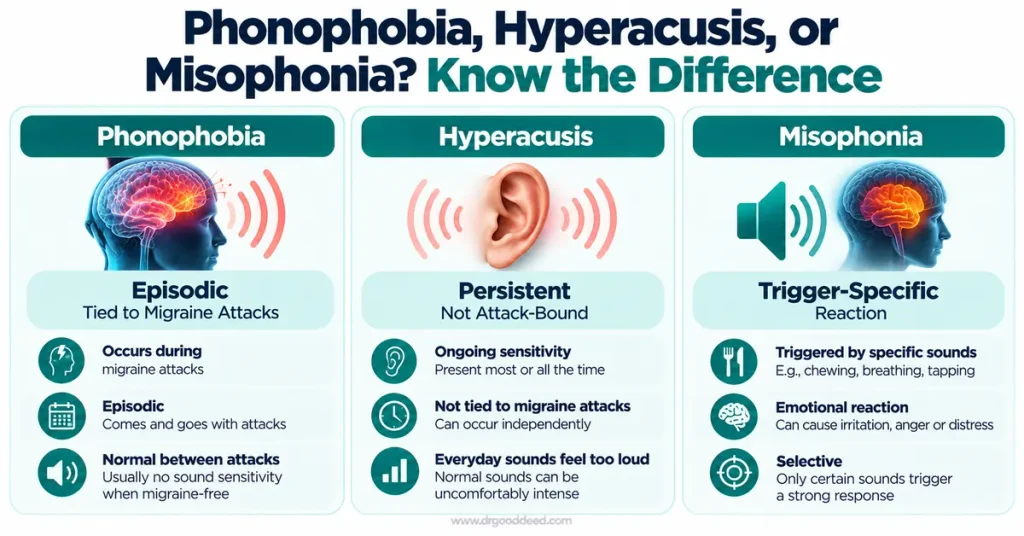
Hyperacusis, by contrast, tends to be a more constant, broader intolerance to sound that exists whether or not a migraine is present, and it affects an estimated 2% to 15% of the general population.
Misophonia is narrower still, involving a strong emotional or physiological reaction to specific trigger sounds rather than a general volume problem.
| Condition | Pattern | Typical Trigger | Best First Step |
| Phonophobia (migraine-related) | Episodic, tied to attacks | Any moderate-to-loud sound during an attack | Migraine management, situational plug use |
| Hyperacusis | Often persistent, not attack-bound | Everyday sounds at normal volume | Audiology evaluation, sound therapy |
| Misophonia | Trigger-specific reaction | Particular sounds like chewing or tapping | Cognitive behavioral therapy, trigger management |
A person can have migraine-related phonophobia without ever developing hyperacusis, and treating the two the same way, especially with constant earplug use, can mask a separate problem that needs its own evaluation.
The Hidden Danger of Overusing Earplugs: What is Auditory Gain?
Consistently blocking all sound trains the auditory system to expect silence, which can lower your tolerance for normal noise over time.
Research on avoidance behavior in migraine patients found that sound aversion thresholds were measurably reduced in people who habitually avoided noise, compared to those who did not, even when tested using objective auditory methods rather than self-report.
In plain terms, hiding from sound can make your ears more sensitive to it, not less.
- Avoidance reinforces the threat response. The brain learns that sound equals danger when it is constantly shut out, similar to how avoiding a feared situation strengthens anxiety rather than reducing it.
- Full-time silence removes normal habituation. Everyday background noise helps calibrate what “normal volume” feels like; removing that calibration for hours daily can widen the gap between comfortable and uncomfortable sound levels.
- This does not mean earplugs are harmful during an active migraine attack. The concern applies to using them as an all-day, every-day habit outside of attacks, not to protecting yourself during genuine flare-ups.
This is exactly why the best earplugs for sound sensitivity during migraines are chosen with intention, used during attacks and specific high-noise situations.
Product Comparison Metrics: High-Fidelity Filters vs. Total Noise-Blocking Foam Barriers
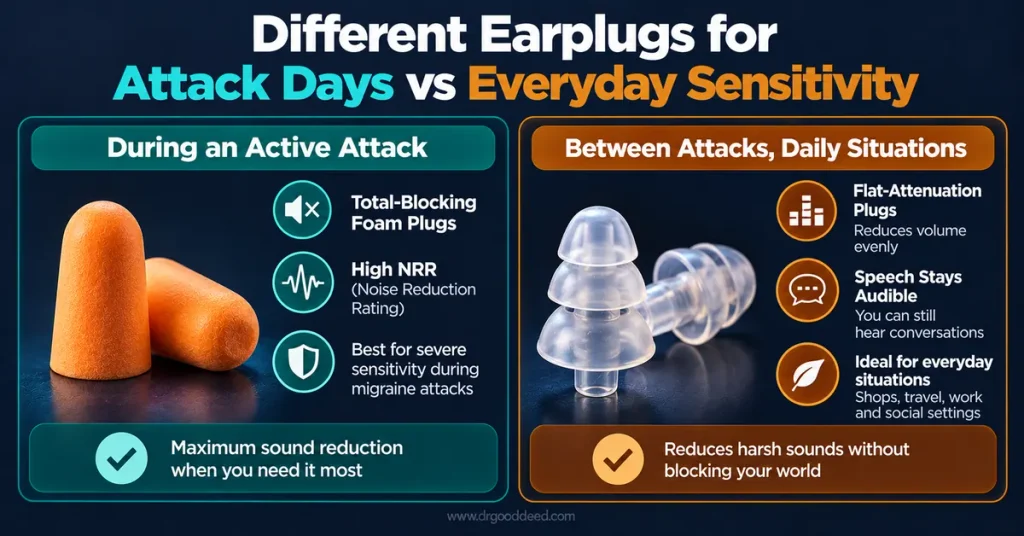
- Standard foam or silicone plugs block sound unevenly, cutting high frequencies more than low ones, which can leave a muffled, pressure-heavy sensation that some migraine patients find uncomfortable rather than soothing.
- Selective attenuation plugs, often marketed as musician’s earplugs, reduce volume evenly across all frequencies using a filtered flat-response design, so speech and ambient sound stay recognizable, just quieter.
- Flat attenuation may suit interictal sound sensitivity better because it lowers overall volume without creating the total sensory deprivation linked to the avoidance cycle described above.
- During an active, severe migraine attack, complete blocking is often the more practical short-term choice, since the goal at that moment is symptom relief rather than long-term sound tolerance.
- The right choice depends on frequency and context. Someone with occasional attacks might reach for high-NRR foam plugs only during flares, while someone with frequent interictal sensitivity may do better with flat-attenuation plugs for daily situations like commuting or open offices.
Buyer’s Guide: What Matters Most When Choosing Migraine Ear Plugs
Choosing ear plugs for migraine relief should reduce bothersome sounds without creating pressure, discomfort, or excessive awareness of your own breathing and heartbeat.
The Occlusion Test: Preventing the Internal “Thumping Heartbeat” Effect
The occlusion effect occurs when an ear plug seals the ear canal and makes internal sounds seem louder. You may suddenly notice your heartbeat, chewing, breathing, or even your own voice.
- For people with migraine-related sound sensitivity, this sensation can become distracting or uncomfortable.
- When testing earplugs, pay attention to whether your heartbeat becomes noticeably louder after insertion.
- Look for a fit that provides meaningful external noise reduction without creating an excessively tight seal.
- Soft silicone or adjustable designs may feel more comfortable than rigid plugs for some users.
Workstation Ergonomics: Low-Profile Designs for Pain-Free Side Sleeping
Ear plugs can become uncomfortable when they press against a pillow, headrest, headphones, or the side of your head.
A low-profile design can be particularly useful if you:
- Sleep on your side
- Rest your head against a chair
- Wear headphones over your earplugs
- Work at a desk for several hours
- Experience tenderness around the ears during a migraine
For sleeping, prioritize a soft material and minimal protrusion from the ear. For daytime use, consider how the plugs interact with glasses, headphones, and other equipment.
Understanding Noise Reduction Ratings (NRR) vs. Targeted Frequency Dampening
NRR, or Noise Reduction Rating, provides a standardized measure of hearing protection under specified testing conditions. However, it does not tell you exactly how an ear plug will perform against every sound.
Migraine triggers can include specific sounds such as conversations, traffic, alarms, keyboard noise, or high-pitched electronic sounds.
Targeted frequency dampening describes how strongly a product reduces different frequency ranges. When available, review the manufacturer’s frequency-response information rather than relying solely on the headline NRR.
Also remember that earplugs should not completely replace awareness of important sounds, particularly alarms, traffic, or emergency signals.
Material Safety: Reusable Medical-Grade Silicone vs. Disposable Open-Cell Foam
Material affects comfort, hygiene, durability, and fit.
- Reusable silicone: Soft silicone can provide a comfortable seal and can often be cleaned and reused according to the manufacturer’s instructions. It may suit people who use earplugs frequently.
- Disposable foam: Open-cell foam expands inside the ear canal and can provide substantial sound attenuation when correctly fitted. Because foam plugs contact the ear canal directly, proper insertion and regular replacement are important.
If you have sensitive skin, recurrent ear irritation, ear infections, ear pain, or a history of ear problems, consider discussing ear-plug use with a healthcare professional.
Multimodal Sound Defense: How to Quiet Your Environment Naturally Without Total Isolation
Ear plugs do not have to carry the entire burden of managing a migraine-triggering environment. Multimodal sound management combines moderate hearing protection with changes to the surrounding environment.
- Start by reducing the source of unwanted noise.
- Close doors, move away from loud equipment, silence unnecessary notifications, or choose a quieter workspace when possible.
- You can also use consistent background sound to soften sudden changes in environmental noise.
- A fan, quiet ambient sound, or another predictable background source may be less disruptive than intermittent sounds.
- For some people with migraine, controlled, predictable sound can be easier to tolerate than an environment filled with unpredictable noise.
- If light sensitivity accompanies your sound sensitivity, which is common since the two frequently overlap in migraine, our guide to indoor sunglasses for vestibular migraine photophobia covers the visual side of the same problem.
Pro Tip: If you find yourself reaching for earplugs on non-migraine days just to tolerate normal environments, that pattern change is worth mentioning to your neurologist. It can signal a shift from episodic phonophobia toward a more persistent hyperacusis-type presentation that benefits from a different treatment approach.
When Sensory Sensitivities Signal a Deeper Problem: When to See an Audiologist or Neurologist
Sound sensitivity that shows up only during migraine attacks and resolves afterward is typical and expected. Sound sensitivity that persists between attacks, worsens over months, or starts interfering with work and relationships needs evaluation beyond another pair of earplugs.
A headache specialist or audiologist can distinguish between escalating phonophobia, emerging hyperacusis, and unrelated hearing conditions, and can identify whether your migraine treatment plan itself needs adjustment.
FAQs
Can ear plugs make migraines worse?
No, not directly. Ear plugs do not trigger migraine attacks. However, using them constantly outside of attacks can heighten baseline sound sensitivity over weeks through auditory sensitization, making future noise exposure feel more intense.
Should you wear ear plugs between migraine attacks too?
No, not as a daily default. Reserve full-blocking plugs for active attacks and high-noise emergencies. Between attacks, flat-attenuation plugs used situationally protect comfort without reinforcing sound avoidance patterns.
Do noise-cancelling headphones work better than ear plugs?
It depends on the noise type. Headphones cancel steady, low-frequency sounds like engine hum well but perform poorly against sudden sharp noises, where high-NRR foam plugs still outperform active noise cancellation.
Can children with migraines use earplugs?
Yes, with supervision. Choose pediatric-sized silicone plugs, avoid foam plugs that pose choking risk in young children, and consult a pediatric neurologist before daily use, since children’s sensory systems calibrate differently than adults’.
How do you know if you have phonophobia or hyperacusis?
Track timing. Phonophobia tied to migraine appears only during or just before attacks and eases afterward. Hyperacusis persists constantly regardless of headache status and warrants an audiology referral.
Sources
- International Headache Society, ICHD-3 Diagnostic Criteria for Migraine link
- American Migraine Foundation, Understanding Migraine Symptoms link
- Journal of Headache and Pain, Sensory Hypersensitivity Burden in Migraine (2021) link
- PMC, Migraine and Auditory Dysfunction: Beyond Comorbidity link
- Sage Journals, Avoidance Behaviour Modulates Phonophobia in Migraine (2022) link
- PMC, Avoid or Seek Light: fMRI Study on Photophobia Treatment Strategies link
- Mayo Clinic, Migraine Overview and Symptoms link
- Cleveland Clinic, Phonophobia and Migraine link
- U.S. Environmental Protection Agency, Noise Reduction Rating Standards link
- NIH National Institute on Deafness and Other Communication Disorders, Hyperacusis Information link
Medical Disclaimer: This article is for general information only and is not medical advice. It does not replace a diagnosis, treatment plan, or guidance from a qualified healthcare professional. Always talk to your doctor about your own symptoms and before starting, stopping, or changing any treatment. If you think you may be having a medical emergency, call 911 or go to your nearest emergency room.