
Why does barometric pressure cause migraines? Changes in barometric pressure can trigger migraines because shifts in atmospheric pressure may affect the pressure balance in the sinuses, blood vessels, and pain-sensitive tissues around the brain. These changes may influence blood vessel dilation and nerve activity, particularly in people who are already sensitive to migraine triggers.
A drop in pressure, often before storms or during weather changes, is commonly reported as a trigger, although the exact biological mechanism is not fully understood.
Key Takeaways
- Facial pain that shows up with weather changes is frequently misdiagnosed as sinusitis when it is actually migraine, according to hospital-based studies.
- No study has established a confirmed causative relationship between barometric pressure and migraines; the link remains an association observed in some patient groups.
- Barometric pressure is the most studied weather trigger, but temperature swings and high wind events show comparable or stronger statistical associations in several studies.
- Humidity alone has not shown a significant link to migraine attacks in the largest meta-analysis available.
- Tracking your own headache diary against local weather data is more useful than any general rule, since sensitivity varies widely between individuals.
The Sinus Misdiagnosis: Why Weather Migraines Are Frequently Mistaken for Infections
A large share of people who blame weather for facial pressure and pain have never actually been diagnosed with migraine. They have been told that their sinuses are the problem.
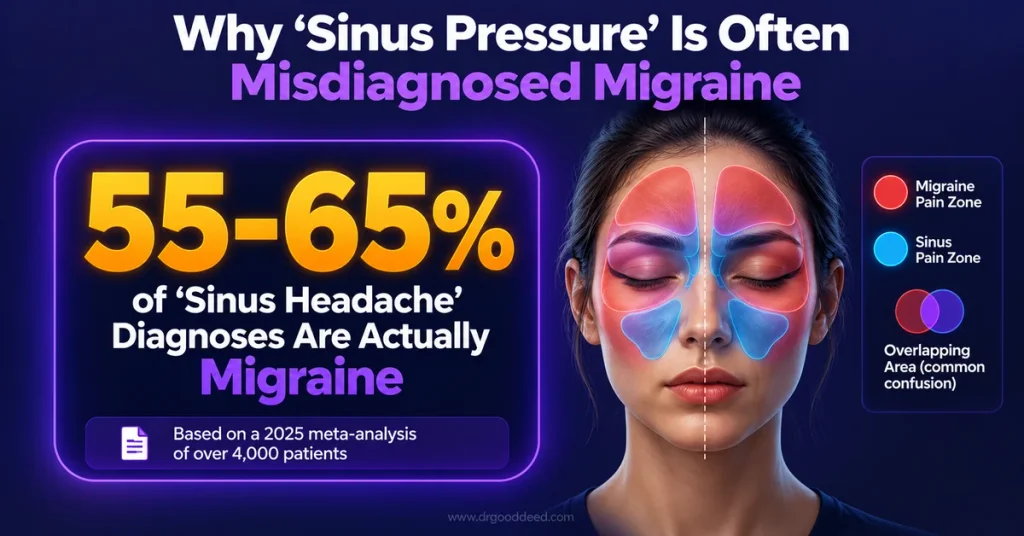
- A 2025 meta-analysis published in Headache Medicine pooled twelve studies covering 4,392 patients and found that among people initially diagnosed with sinus headache.
- The pooled prevalence of true migraine reached 55 percent, rising to 65 percent once tension-type headache was included.
- A separate cross-sectional study at Khartoum ENT Hospital, an otolaryngology center, found that migraine accounted for the majority of self-reported sinus headache cases evaluated there
- ENT clinics and consumer health sites remain the most common source of this mislabeling, largely because migraine pain often lands directly over the forehead and cheekbones, the same zones where the sinuses sit.
Expert Insight: Facial pressure that flares with weather changes is frequently mistaken for sinus disease because migraine pain frequently overlaps the same forehead and cheek regions the sinuses occupy, and migraine can also trigger nasal congestion and watery discharge that mimic true sinusitis. A clinician relying on symptom location alone, without checking for photophobia, nausea, or a throbbing quality, will miss the migraine diagnosis almost every time.
What the Research Actually Shows About Atmospheric Pressure and Brain Pain
A 2024 review in Current Pain and Headache Reports concluded that weather variables including barometric pressure and migraines together account for roughly 20 percent of attacks overall, while stating plainly that no causative relationship between weather and migraine has been established.
A 2025 systematic review focused specifically on pressure changes found that several studies reported significant associations between falling or rapidly fluctuating pressure and increased migraine frequency, but the connection to attack severity was far less consistent, and no clear link to attack duration emerged at all.
A separate meta-analysis of 31 studies calculated a modest but statistically significant odds ratio of 1.07 between ambient pressure and migraine attacks, smaller than the odds ratio found for temperature.
The Storm Synergy: Other Weather Factors That Lower Your Migraine Threshold
Barometric pressure dominates the conversation, but it is not the only, or even the strongest, weather variable tied to migraine onset in recent research.
Sudden Temperature Changes and Nervous System Shock
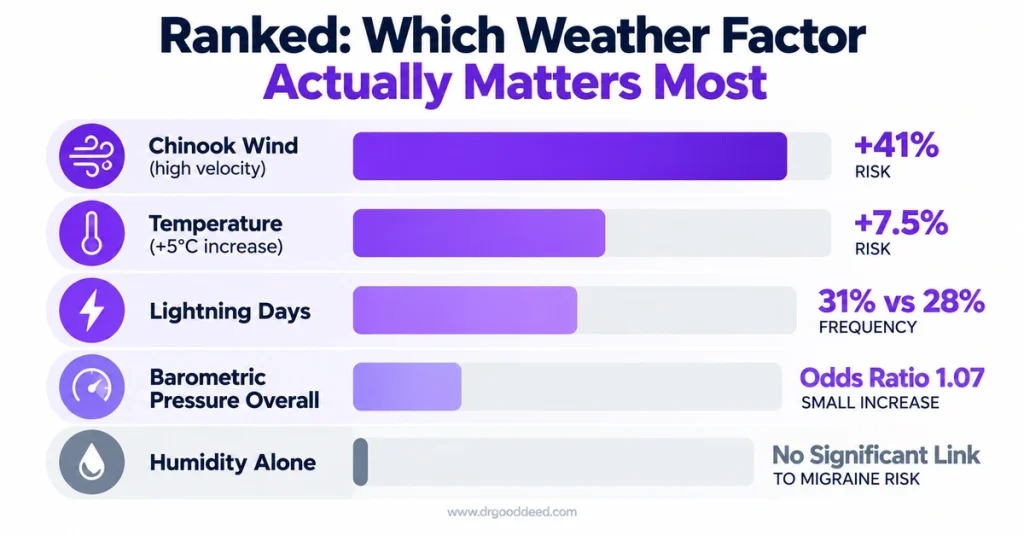
A case-crossover study of 7,054 emergency department patients found that each 5 degree Celsius rise in temperature during the 24 hours before presentation raised the odds of a severe headache visit by about 7.5 percent.
The same research team found that lower barometric pressure in the 48 to 72 hours before a visit also triggered headache, though the effect was weaker than temperature’s.
High Humidity
Humidity has not held up as an independent trigger in the largest analyses
- One 31-study meta-analysis found no significant association between humidity and migraine attacks on its own.
- Storm systems bundle several variables together.
- One study cited in the 2024 weather-migraine review found migraine frequency rose 31 percent on days with lightning strikes compared to 28 percent on non-lightning days, with new-onset attacks climbing 23 percent. That suggests electromagnetic activity, not humidity itself, may drive some storm-related attacks.
High Winds, Air Ionization, and Serotonin Fluctuations
A landmark Canadian study followed 75 patients through Chinook wind events, warm dry winds that sweep down from the Rocky Mountains into southern Alberta.
- Migraine onset increased 24 percent on the day before a Chinook arrived and 19 percent on the day the wind actually hit, compared to non-Chinook days.
- High-wind Chinook days, with gusts above 38 kilometers per hour, carried an even larger risk increase of 41 percent.
- Air ionization: Strong winds may alter airborne ions, which can affect nervous-system activity and potentially contribute to headache susceptibility.
- Serotonin fluctuations: Bariatric surgery can change nutrient absorption and serotonin metabolism, potentially making the brain more sensitive to environmental migraine triggers.
| Weather Factor | Reported Effect on Migraine Risk | Source Type |
| Temperature (+5°C) | About 7.5% higher severe headache risk | ED case-crossover study |
| Chinook wind (high velocity) | 41% increased migraine odds | Prospective diary cohort |
| Chinook wind (any) | 19% same-day increase | Prospective diary cohort |
| Lightning days | 31% vs 28% frequency increase | Retrospective weather-linked analysis |
| Barometric pressure overall | Odds ratio 1.07 | 31-study meta-analysis |
| Humidity alone | No significant association | 31-study meta-analysis |
The Biological Mechanics: Exactly How a Drop in Air Pressure Triggers an Attack
Nobody has confirmed the exact biological pathway, but three theories dominate current research.
- Rapid pressure shifts may activate the trigeminovascular system, the network of nerves and blood vessels responsible for migraine pain signaling.
- Some researchers propose that pressure changes stimulate mechanoreceptors in the inner ear or sinus cavities, sending abnormal signals to the brainstem.
- A third theory points to sympathetic nervous system activation, where sudden weather shifts trigger blood vessel constriction and dilation that irritates already sensitive pain pathways in migraine-prone brains.
The Weatherproof Protocol: How to Prevent Migraines Before the Rain Front Hits
You cannot control the weather, but you can reduce how much it destabilizes your nervous system.
- Keep sleep and meal timing consistent, since irregular schedules amplify sensitivity to any external trigger, weather included.
- Stay hydrated during temperature swings, particularly heat waves, since dehydration independently worsens headache frequency.
- Track a headache diary alongside a weather app for at least two months before assuming pressure is your personal trigger.
- Discuss preventive medication with your doctor if you notice a consistent pattern tied to specific weather events like storms or Chinook-style wind shifts.
- Manage stress proactively during forecasted pressure drops, since weather rarely acts alone and usually combines with other triggers to tip you into an attack.
When to See a Neurologist or Specialized Headache Expert About Weather-Triggered Migraines
See a neurologist or headache specialist if your attacks are becoming more frequent, if over-the-counter medication stops controlling the pain, or if facial pressure keeps getting labeled as sinusitis without imaging or a proper headache history.
Sudden new headache patterns after age 50, or any headache accompanied by fever, vision loss, or neurological symptoms, need urgent evaluation rather than weather tracking.
FAQs
Can moving to a different climate help with weather-related migraines?
No reliable evidence supports this. Migraine sensitivity often persists in new climates because the trigger is rapid weather change itself, not one specific climate type, so attacks frequently resume once the new location develops its own weather swings.
Do weather-related migraines come with warning signs beforehand?
Yes. Many patients report a premonitory phase, including fatigue, neck stiffness, or mood changes, up to 24 hours before pressure actually drops. Recognizing these signs early allows faster use of rescue medication before pain intensity peaks.
Is it barometric pressure or something else in storms that triggers migraines?
Storms bundle pressure drops, humidity, wind, and lightning together, making it hard to isolate one cause. Current data suggests lightning and wind velocity may carry stronger statistical links to attacks than pressure change alone.
Can weather apps predict migraine risk?
Partially. Apps that track pressure changes can flag rapid drops, but they cannot account for individual sensitivity, sleep, hydration, or stress, all of which combine with weather to determine whether an attack actually occurs.
Are weather-related migraines a real diagnosis?
No formal diagnosis exists for “weather migraine.” It remains a subtype of migraine with a reported environmental trigger, not a separate condition recognized in the International Classification of Headache Disorders.
Sources
- Whether Weather Matters with Migraine, Current Pain and Headache Reports, 2024 link
- Weather and air pollution as triggers of severe headaches, Neurology, 2009 link
- Chinook winds and migraine headache, Neurology, 2000 link
- Sinus migraine: a systematic review and meta-analysis, Headache Medicine, 2025 link
- Migraine diagnosis in patients with sinus headache symptoms, Egyptian Journal of Otolaryngology, 2025 link
- Association between weather conditions and migraine: a systematic review and meta-analysis, 2025 link
- Impact of Barometric Pressure Changes on Migraine Attacks: A Systematic Review, Cureus, 2025 link
- Weather Related Migraines and Barometric Pressure, MigreLief link
- American Migraine Foundation, Migraine and Weather link
- International Classification of Headache Disorders (ICHD-3), International Headache Society link
Medical Disclaimer: This article is for general information only and is not medical advice. It does not replace a diagnosis, treatment plan, or guidance from a qualified healthcare professional. Always talk to your doctor about your own symptoms and before starting, stopping, or changing any treatment. If you think you may be having a medical emergency, call 911 or go to your nearest emergency room.