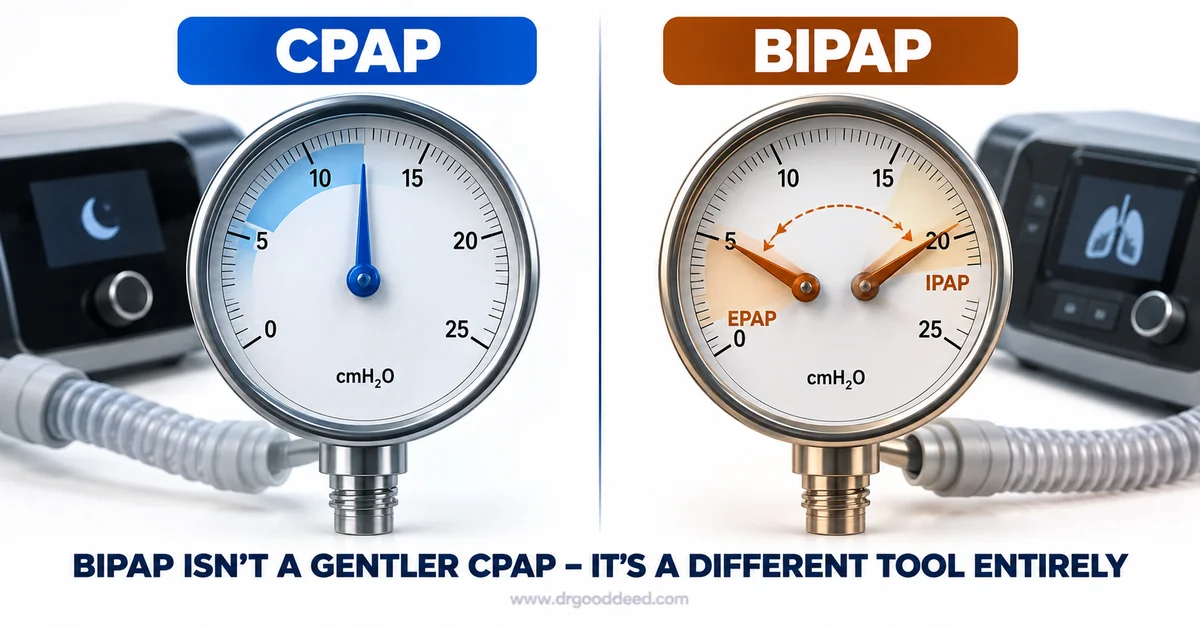

CPAP (Continuous Positive Airway Pressure) delivers a constant, single level of positive airway pressure throughout the breathing cycle and is commonly used to treat obstructive sleep apnea.
BiPAP (Bilevel Positive Airway Pressure) provides two different pressure levels: higher pressure during inhalation (IPAP) and lower pressure during exhalation (EPAP), making it useful for patients who need greater ventilatory support or have difficulty exhaling against continuous pressure, such as in some cases of COPD or respiratory failure.
Key Takeaways
- CPAP vs BiPAP differs mainly in pressure delivery. CPAP gives one constant pressure. BiPAP gives two separate pressures for inhaling and exhaling.
- BiPAP is not simply a softer CPAP setting. It is the preferred therapy for central sleep apnea, severe COPD, and certain heart or neuromuscular conditions.
- CPAP remains the first-line treatment for standard obstructive sleep apnea (OSA), according to Mayo Clinic guidance.
- Insurance, including Medicare, usually requires a documented CPAP trial before approving BiPAP.
- Your sleep specialist chooses between the two based on your diagnosis, not personal preference alone.
CPAP vs BiPAP at a Glance (Comparison Table)
Before choosing between CPAP or BiPAP for sleep apnea, it helps to see the mechanical and clinical differences side by side. The table below summarizes pressure delivery, primary medical use, who typically needs each device, and how insurance treats the cost difference. Use it as a quick reference, then read the sections below for the reasoning behind each row.
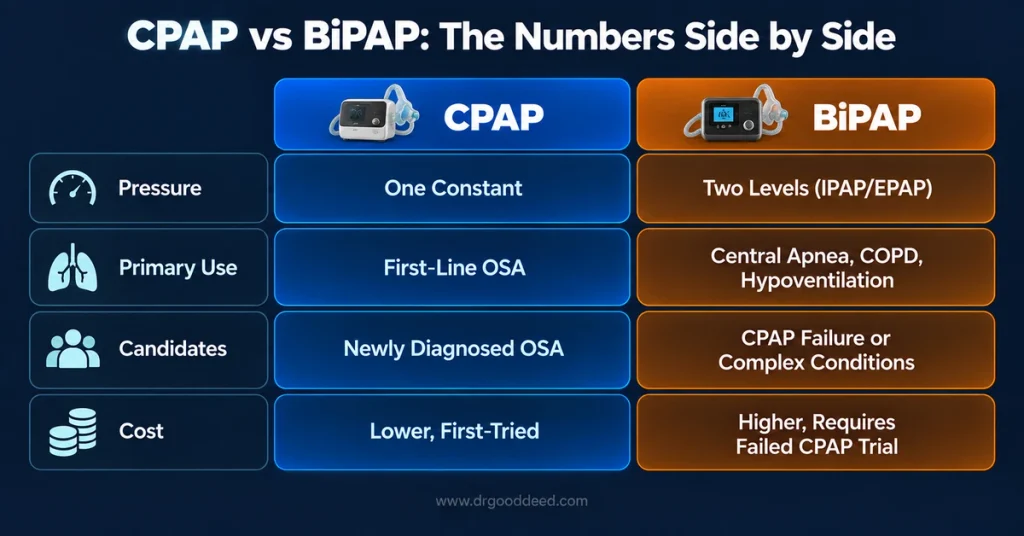
| Feature | CPAP | BiPAP |
| Pressure delivery | One constant pressure throughout the breath cycle | Two pressures: higher on inhale (IPAP), lower on exhale (EPAP) |
| Primary use | First-line treatment for obstructive sleep apnea | Central sleep apnea, severe OSA, COPD overlap, hypoventilation |
| Typical candidates | Newly diagnosed OSA patients with no complicating conditions | Patients who fail CPAP, or have COPD, heart failure, or neuromuscular disease |
| Cost and insurance | Lower cost, first device tried | Higher cost, Medicare requires proof CPAP failed first |
What Is CPAP?
Continuous positive airway pressure, or CPAP, delivers one fixed level of air pressure through a mask worn over the nose or nose and mouth. That constant pressure acts like a splint, physically holding your throat open so tissue cannot collapse and block airflow.
CPAP devices maintain a steady level of pressure throughout the breath cycle, and this treatment delivers continuous, constant pressure slightly stronger than the surrounding air. Because the setting never changes, some people find exhaling against that pressure uncomfortable, especially at higher settings.
What Is BiPAP?
Bilevel positive airway pressure, or BiPAP, uses two distinct pressure settings instead of one. It delivers a higher pressure when you inhale, called IPAP, and automatically drops to a lower pressure when you exhale, called EPAP. This IPAP and EPAP provides actual pressure support that helps push air into the lungs and assists the muscles involved in breathing.
Providers use BiPAP to treat heart failure, chronic obstructive pulmonary disease (COPD), obstructive and central sleep apnea, and hypercapnic respiratory failure, where carbon dioxide builds up because exhalation is not effective enough.
CPAP vs BiPAP: Key Differences
The gap between these two therapies shows up in three practical areas: how pressure is delivered, how each feels to use, and which medical conditions each one is built to treat.
How Pressure Delivery Differs
CPAP holds one number all night, for example 10 cm H2O whether you are inhaling or exhaling. BiPAP splits that into two numbers, such as 14 cm H2O on inhale (IPAP) and 8 cm H2O on exhale (EPAP). This ipap epap gap is measured in centimeters of water pressure and is set individually during a titration sleep study.
A wider gap between IPAP and EPAP generally means more ventilatory support, which matters for patients whose breathing muscles need real assistance, not just an open airway.
Comfort and Tolerance
Many patients report that exhaling against a single fixed CPAP pressure feels like breathing against resistance, particularly at pressures above 15 cm H2O. Because BiPAP lowers pressure the moment you exhale, some people find it easier to tolerate. However, comfort alone does not justify switching.
Recent studies have not consistently shown BiPAP improves long-term adherence over auto-adjusting CPAP for routine OSA, so tolerance benefits vary by individual rather than applying universally.
Conditions Each Is Used For
- Standard obstructive sleep apnea (OSA): CPAP is the first-line therapy recommended by most sleep specialists, since a single pressure is usually enough to keep the airway open.
- Central sleep apnea (CSA): BiPAP, sometimes with a backup breathing rate, addresses the brain’s failure to signal breathing rather than a physical airway blockage.
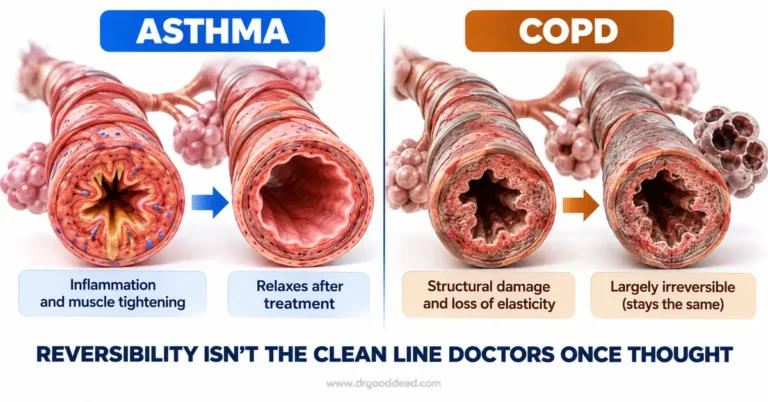
- COPD with overlap sleep apnea: BiPAP assists exhalation in patients who already struggle to push air out of damaged lungs.
- Obesity hypoventilation syndrome: BiPAP provides ventilatory support when a patient is not clearing carbon dioxide effectively during sleep.
- CPAP intolerance or CPAP failure: When a documented trial shows a patient cannot adjust to constant pressure, BiPAP becomes the next step.
BiPAP Isn’t Just “Gentler CPAP”
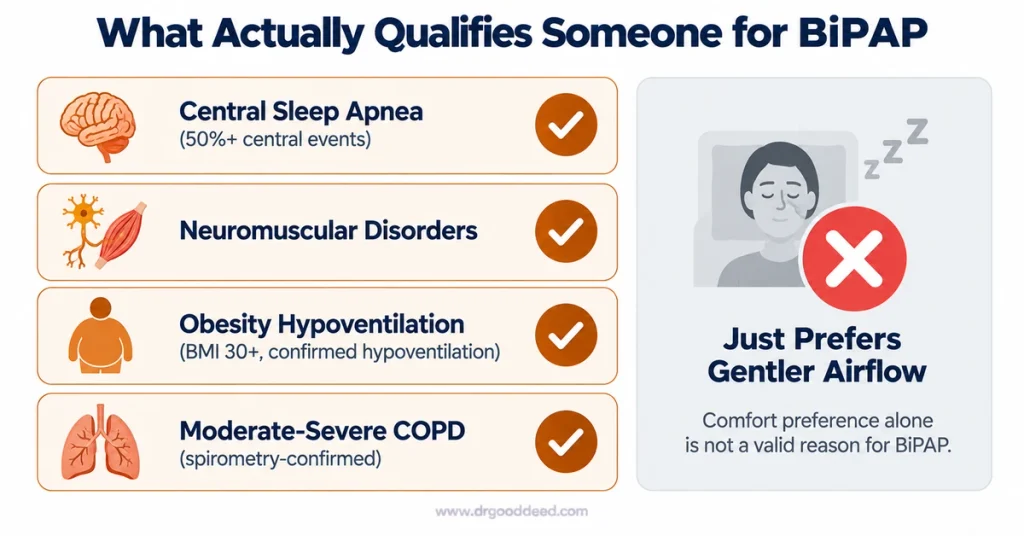
BiPAP is not a softer, more forgiving version of CPAP for people who dislike constant pressure. It is a distinct clinical tool built around actual ventilatory support.
- Coverage guidelines from major insurers list specific triggers for BiPAP, including central sleep apnea, defined as at least 50 percent central events or more than 5 central events per hour, neuromuscular disorders, and obesity hypoventilation syndrome with a BMI over 30 and confirmed hypoventilation.
- Moderate to severe COPD, confirmed through spirometry, is also a recognized indication.
- In other words, BiPAP earns its place through documented physiology, carbon dioxide retention, central apneas, or a damaged respiratory drive, not through a patient simply preferring gentler airflow.
Expert Insight: A clinician evaluating CPAP failure should distinguish true intolerance from inadequate pressure titration or poor mask fit before recommending BiPAP, since many patients labeled “CPAP intolerant” actually need a mask refit or pressure adjustment, not a different device category entirely.
Who Might Need BiPAP Instead of CPAP
Several patient groups are more likely to be prescribed BiPAP after their sleep study. This includes people with confirmed central sleep apnea, moderate to severe COPD with overlapping OSA, certain neuromuscular conditions that weaken the breathing muscles, and heart failure patients whose central apneas increase with disease severity. CPAP intolerance is another common path.
If you have tried CPAP consistently for several weeks and still feel exhausted, snore loudly, or struggle against the pressure, that pattern is worth raising with your sleep specialist.
What to Expect When Switching or Starting Either Therapy
Starting or switching PAP therapy usually follows a structured process rather than a one-time equipment swap.
- Expect an adjustment period of several weeks, mask fitting sessions to solve leaks or discomfort, and a titration sleep study to fine-tune your specific pressure settings.
- Medicare and most private insurers require a documented trial period, typically 90 days, with usage tracked at a minimum of 4 hours per night on at least 70 percent of nights, before permanently approving the device.
- If CPAP does not work, your treating physician must document the specific reason for failure, whether that is inadequate AHI reduction, confirmed intolerance, or newly identified central apneas, before BiPAP is approved.
Pro Tip: Keep a simple sleep log during your first two weeks on either device, noting mask leaks, waking with a dry mouth, or morning headaches, since this information speeds up your titration follow-up far more than a vague “it feels uncomfortable” complaint at your next appointment.
When to Talk to Your Doctor
Contact your sleep specialist if you consistently cannot tolerate your current pressure setting, if daytime sleepiness continues despite regular use, or if you notice new symptoms like morning headaches or unexplained weight gain. These signs can indicate inadequate titration, progression to central sleep apnea, or an underlying condition like COPD or heart failure that a single-pressure device cannot fully address.
FAQs
Can you switch from CPAP to BiPAP if it’s not working?
Yes. Your doctor documents CPAP failure through a therapeutic trial, then orders BiPAP. Medicare and most insurers require this proof before approving BiPAP as a replacement device.
Is BiPAP more expensive than CPAP?
Yes. BiPAP machines typically cost roughly two to three times more than standard CPAP devices, since bilevel technology and added ventilatory support require more complex internal components.
Does insurance cover BiPAP?
Yes, when medical necessity is documented. Insurers, including Medicare, require a failed CPAP trial, a qualifying sleep study, and physician notes showing central apneas, COPD, or intolerance before approving coverage.
Can BiPAP be used for conditions other than sleep apnea?
Yes. BiPAP treats COPD flare-ups, hypercapnic respiratory failure, obesity hypoventilation syndrome, and heart failure related breathing problems, beyond standard obstructive or central sleep apnea.
Is BiPAP harder to get used to than CPAP?
Not necessarily. Some patients adjust faster to BiPAP’s changing pressure, while others find CPAP’s constant airflow simpler. Individual response varies more than device type predicts.
Sources
- Mayo Clinic: Obstructive Sleep Apnea, Diagnosis and Treatment link
- Mayo Clinic Press: Sleep Apnea Treatment, Which Option Is Right for You link
- Mayo Clinic: Central Sleep Apnea, Diagnosis and Treatment link
- Cleveland Clinic: BiPAP Machine, Uses, Benefits, and Side Effects link
- Carelon Medical Benefits Management: Sleep Disorder Management Clinical Guidelines link
- SleepDr: Insurance Coverage for Bi-Level PAP link
- ResMed: Reimbursement Fast Facts for CPAP and Bilevel Devices link
- Mutual of Omaha: Sleep Apnea and Medicare Coverage link
- Respiratory Therapy: BiPAP Noninvasive Ventilation for COPD link
Medical Disclaimer: This article is for general information only and is not medical advice. It does not replace a diagnosis, treatment plan, or guidance from a qualified healthcare professional. Always talk to your doctor about your own symptoms and before starting, stopping, or changing any treatment. If you think you may be having a medical emergency, call 911 or go to your nearest emergency room.