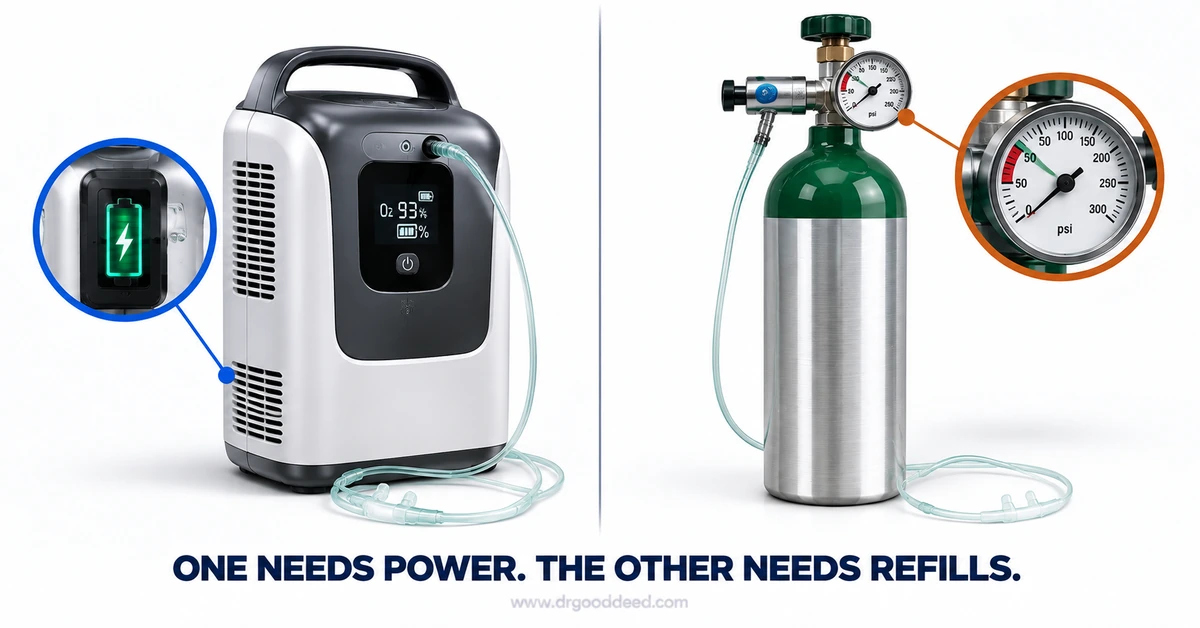

An oxygen concentrator is an electric device that takes oxygen from room air and continuously delivers concentrated oxygen, making it convenient for long-term use at home without needing refills. An oxygen tank stores compressed oxygen and works without electricity, but it has a limited supply and must be refilled or replaced.
The right pick among home oxygen therapy options depends on your flow rate, your mobility, and whether reliable electricity is available where you live.
Key Takeaways
- Oxygen concentrators draw oxygen from ambient air and need a continuous power source: an outlet, a car adapter, or a charged battery.
- Oxygen tanks store a fixed supply of compressed or liquid oxygen and work with zero electricity.
- Concentrators carry a higher oxygen concentrator cost upfront, roughly $1,000 to $2,500 for a portable unit, but cost less over years of daily use.
- Tanks cost less to buy but carry ongoing oxygen tank refill cost, plus scheduled deliveries or exchanges.
- Portable concentrators often default to pulse-dose delivery, which can fail to trigger during shallow or irregular breathing, especially during sleep.
- This decision belongs to you, your doctor, and your DME provider, based on your specific oximetry results and daily routine.
Oxygen Concentrator vs Oxygen Tank at a Glance (Comparison Table)
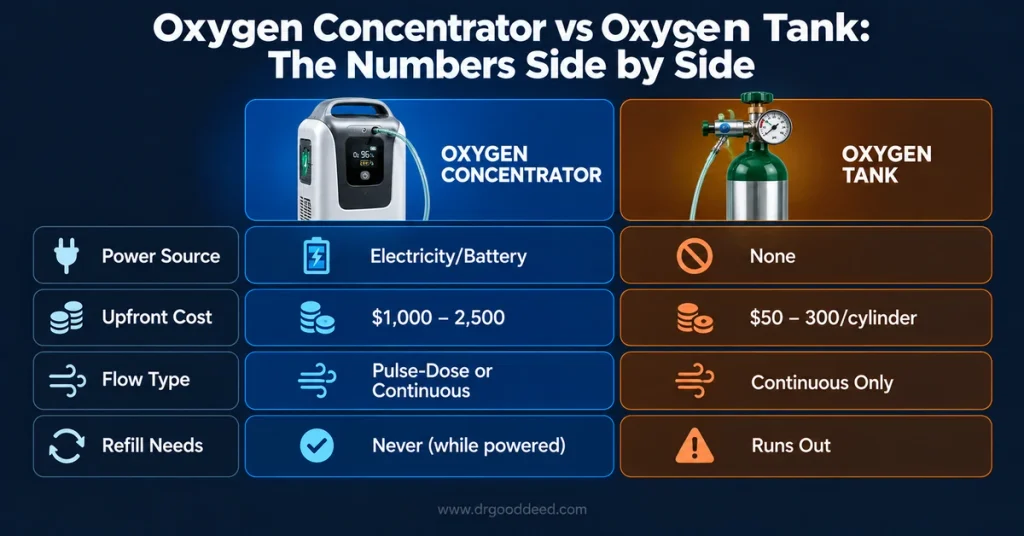
The table below compares the five factors that matter most in daily life: power source, flow type, portability, cost pattern, and refill needs. Use it as a quick reference before your appointment, then confirm your exact flow rate with your doctor.
| Factor | Oxygen Concentrator | Oxygen Tank |
| Power source | Electricity, car adapter, or battery | None, fully self-contained |
| Flow type | Pulse-dose (most portables) or continuous flow (stationary and select portables) | Continuous flow only |
| Portability | Portable units weigh 3 to 20 lbs | Small cylinders portable; large tanks are not |
| Upfront cost | $1,000 to $2,500 for a portable unit | $50 to $300 per cylinder |
| Ongoing cost | Electricity, filters, occasional servicing | Repeated refills or cylinder exchanges |
| Refill needs | Never runs out while powered | Runs out and must be refilled or swapped |
What Is an Oxygen Concentrator?
An oxygen concentrator is a medical device that draws in ordinary room air, strips out nitrogen through a process called pressure swing adsorption, and delivers concentrated oxygen, typically 87% to 96% purity, through a nasal cannula.
- Stationary units plug into a wall outlet and stay in one room.
- Portable concentrators run on rechargeable batteries and weigh as little as 3 pounds.
- People managing chronic lung disease, including some living without part of a lung after surgery, often rely on a concentrator for long-term oxygen therapy.
- Portable models are also the only oxygen source accepted on commercial flights, since FAA rules ban compressed tanks from the cabin.
What Is an Oxygen Tank?
An oxygen tank is a pre-filled cylinder holding a fixed volume of medical oxygen, either compressed gas or liquid oxygen, under pressure.
- A regulator sets the flow rate, and the tank empties as you breathe from it.
- Compressed cylinders range from small M6 units, good for roughly an hour at typical settings, up to large H cylinders that last a full day at low flow.
- Liquid oxygen systems pack more oxygen into less space but slowly evaporate even when not in use.
- Once a tank runs dry, it must be exchanged or refilled through your DME supplier. No electricity is required at any point.
Oxygen Concentrator vs Oxygen Tank: Key Differences
The oxygen concentrator vs oxygen tank decision hinges on how oxygen reaches your lungs, whether you depend on electricity, and what you’ll actually spend over time.
How Oxygen Is Delivered
- Concentrators deliver oxygen two ways: continuous flow, a steady stream measured in liters per minute, or pulse-dose, a burst timed to your inhalation.
- Tanks deliver continuous flow only, since gas simply flows out at a set rate once the regulator opens.
- Continuous flow suits patients who need oxygen every second, awake or asleep.
- Pulse-dose conserves oxygen by releasing it only when a sensor detects an inhalation, extending battery and cylinder life, but only if that inhalation is strong enough to detect.
Power Dependency
Every concentrator needs a power source: wall electricity, a car outlet, or a charged battery.
- An oxygen concentrator power outage turns a working device into a dead one within one to eight hours, once the internal battery drains.
- Tanks need no power at all; a full cylinder works identically during a blackout or a hurricane.
- Keep a backup tank of oxygen gas on hand for outages, even if a concentrator serves as your primary device.
Cost Over Time
- The oxygen concentrator cost for a portable unit typically runs $1,000 to $2,500 to buy outright, though Medicare covers concentrators as rented equipment rather than a purchase.
- A single compressed cylinder runs $50 to $300 depending on size and refill service.
- Tally the oxygen tank refill cost over a full year of regular use, and it often exceeds what a concentrator would have cost upfront.
Pulse-Dose vs Continuous Flow: Why This Matters
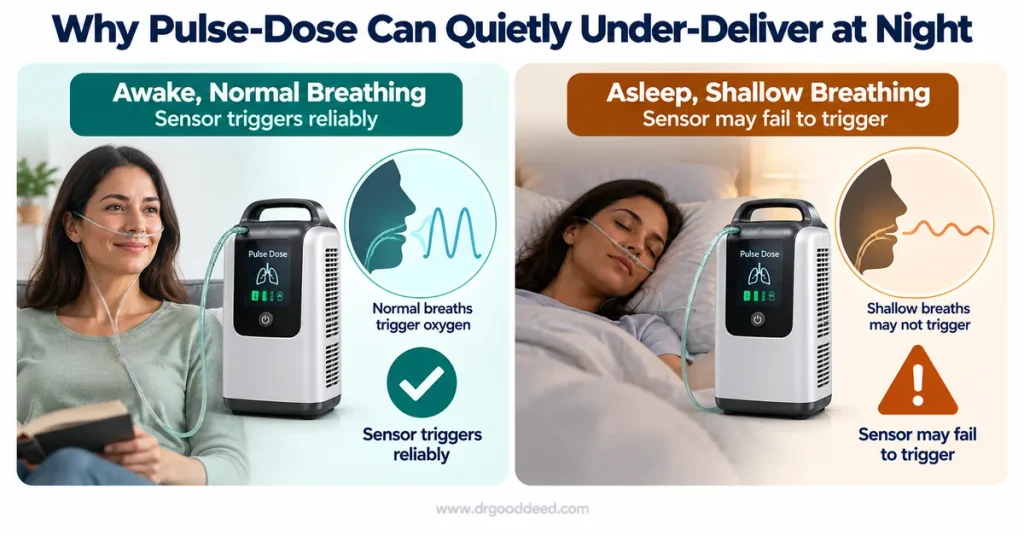
- Portable concentrators typically default to pulse-dose to stretch battery life, releasing an oxygen bolus only when a sensor detects the start of an inhalation.
- This works well for many active patients during the day. It becomes unreliable for patients with shallow, irregular, or mouth breathing, particularly during sleep, when a weak inhalation may fail to trigger the sensor at all.
A bench-testing study published through the National Institutes of Health’s National Library of Medicine found meaningful differences in triggering reliability among devices during simulated sleep breathing, even though the same devices performed well during rest and exertion.
If your prescription covers nighttime or exertional use, ask your doctor whether continuous flow, available on tanks, stationary concentrators, and select portable models, better protects your oxygen saturation.
Expert Insight: Many clinicians titrate pulse-dose settings using resting oxygen saturation alone, then never confirm performance during actual sleep or exertion, the two conditions where trigger failure is most common. A dial setting that holds 92% saturation while sitting still can quietly under-deliver at night, which is why overnight oximetry, not the prescription number alone, should confirm whether pulse-dose truly meets your needs.
Who Might Need a Tank Instead of a Concentrator
- Patients prescribed very high flow rates, beyond what portable concentrators can generate, often need tanks or stationary units instead.
- Households with unreliable electricity or frequent outages need at least one backup tank regardless of which device serves as the primary source.
- Patients whose pulse-dose trigger fails during sleep may need a continuous-flow tank overnight instead of a portable concentrator.
- If you also rely on a nebulizer vs inhaler for separate airway treatment, your respiratory therapist can coordinate both devices into one home setup.
Pro Tip: Ask your DME supplier for the exact battery runtime at your specific pulse setting, not the device’s maximum advertised runtime, since higher settings drain batteries far faster than marketing figures suggest. Pack a spare battery rated for at least your total time away plus a 50% buffer, especially on travel days with unpredictable delays.
Safety Considerations for Both
Oxygen itself does not burn, but it makes nearby materials ignite faster and burn hotter.
- Never smoke, use open flames, or run a gas stove within 5 to 10 feet of either device.
- Store spare cylinders upright, secured, and away from heat sources.
- Check tubing regularly for cracks, since damaged tubing can cause skin or facial burns during a flash fire.
- Carry a physician’s letter and extra batteries when traveling with oxygen concentrator equipment through airport security.
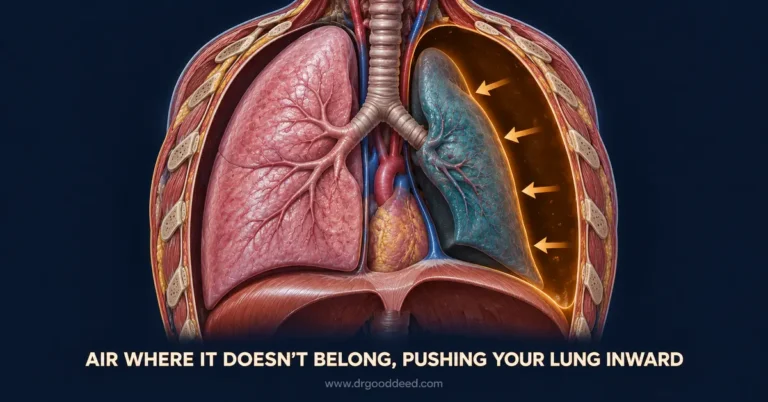
Sudden chest pain or new breathlessness on oxygen needs urgent evaluation. It could signal complications like collapsed lung symptoms, which require immediate medical attention rather than an equipment adjustment.
When to Talk to Your Doctor
Bring specific questions to your next appointment instead of deciding alone. Ask what flow rate you need at rest, during activity, and during sleep, since these often differ. Ask whether pulse-dose delivery has actually been tested against your breathing pattern, not just assumed from your diagnosis.
Discuss which home oxygen therapy options your insurance covers and what backup equipment you need for outages. Your doctor and DME provider, not a retailer, should make the final oxygen concentrator vs oxygen tank recommendation based on your oximetry results.
FAQs
Can you use an oxygen concentrator and a tank together?
Yes. Many patients use a concentrator as their primary source and keep a backup tank for outages or travel. Medicare covers this combination when medically justified. Your DME provider can supply both under one prescription, so the backup tank stays filled and ready.
What happens to an oxygen concentrator during a power outage?
A concentrator stops producing oxygen once its battery drains, usually within one to eight hours depending on the model. Notify your electric utility that you use medical oxygen so your household gets priority restoration.
How long does an oxygen tank last?
A standard E-cylinder lasts about 5 to 6 hours at a continuous flow of 2 liters per minute. Smaller M6 cylinders last roughly 1 hour at the same setting. Higher prescribed flow rates drain any tank faster and shorten this window.
Are portable oxygen concentrators covered by insurance?
Yes, for most patients. Part B covers concentrators as rented durable medical equipment for 36 months, after your Part B deductible, with 20% coinsurance. Coverage requires a doctor’s prescription plus blood oxygen testing confirming medical necessity.
Is it safe to travel by air with an oxygen concentrator?
Yes, with an FAA-approved device. Airlines must accept FAA-approved concentrators under federal disability law, but compressed tanks are banned from the cabin entirely. Carry batteries covering 150% of your total travel time and notify your airline in advance.
Sources
- FAA: Acceptance Criteria for Portable Oxygen Concentrators link
- MedlinePlus (NIH): Using Oxygen at Home link
- MedlinePlus (NIH): Oxygen Safety link
- Medicare.gov: Oxygen Equipment & Accessories link
- CMS: National Coverage Determination for Home Use of Oxygen (240.2) link
- American Thoracic Society: Portable Oxygen Concentrators (Garvey) link
- National Library of Medicine (PMC): Contemporary Portable Oxygen Concentrators and Diverse Breathing Behaviours link
- American Lung Association: Using Oxygen Safely link
- American Lung Association: Oxygen Therapy link
- Cleveland Clinic: Supplemental Oxygen Therapy link
Medical Disclaimer: This article is for general information only and is not medical advice. It does not replace a diagnosis, treatment plan, or guidance from a qualified healthcare professional. Always talk to your doctor about your own symptoms and before starting, stopping, or changing any treatment. If you think you may be having a medical emergency, call 911 or go to your nearest emergency room.