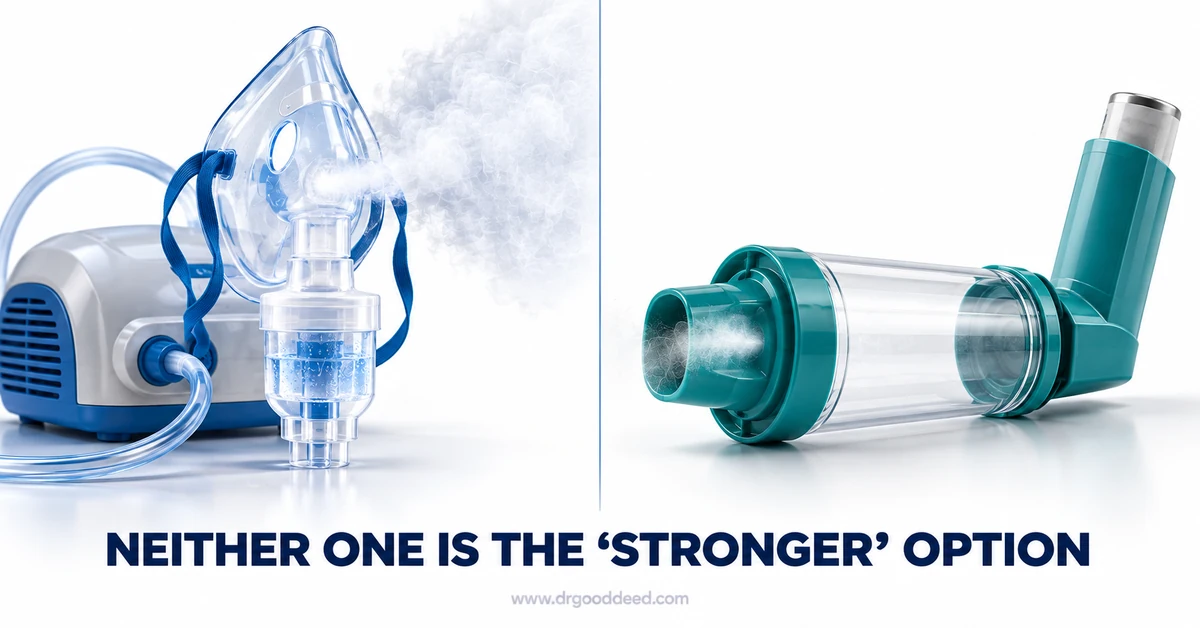

A nebulizer converts liquid medicine into a fine mist that you breathe through a mask or mouthpiece, while an inhaler delivers a measured dose of medicine directly into the lungs through a handheld device. Nebulizers usually take several minutes and can be easier for young children or people who have difficulty coordinating breathing, whereas inhalers are smaller, faster, portable, and convenient for most people. With a spacer, a metered-dose inhaler can be easier to use and deliver medicine effectively.
This guide covers how each device works, who actually needs a nebulizer, and why your doctor may have handed you an inhaler instead of the machine you expected.
Key Takeaways
- A nebulizer converts liquid medication into a fine mist using compressed air or ultrasonic vibration, inhaled through a mask or mouthpiece over 5 to 15 minutes.
- An inhaler delivers a precise dose of medication in a single puff or breath, either as a pressurized spray (MDI) or a powder (DPI).
- The Global Initiative for Asthma (GINA) lists a pMDI with a spacer as equally effective as a nebulizer for treating asthma flare-ups in most age groups, including children.
- Nebulizers remain the better option for infants, people in respiratory distress who cannot coordinate a breath, and anyone unable to hold or trigger an inhaler correctly.
- A poorly cleaned nebulizer can grow bacteria like Pseudomonas aeruginosa and Staphylococcus aureus, turning a treatment device into an infection risk.
Nebulizer vs Inhaler at a Glance
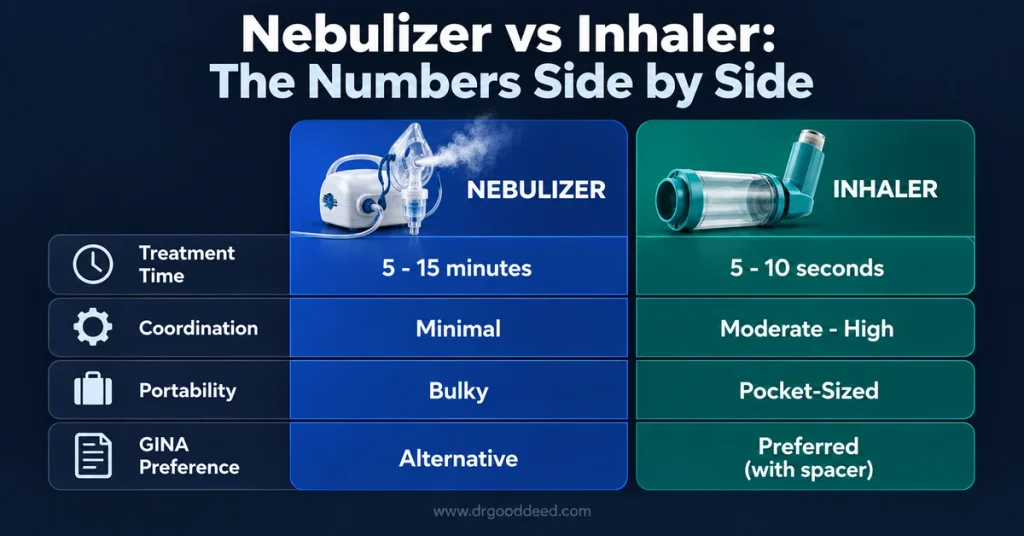
Before choosing between an inhaler vs nebulizer, it helps to see the practical differences side by side. Treatment time, portability, and how much coordination each device demands vary sharply, and these differences usually matter more day to day than which one is technically “stronger.”
| Factor | Nebulizer | Inhaler |
| Delivery method | Liquid medication turned into mist via compressor or ultrasonic wave | Metered puff (MDI) or powder dose (DPI) released directly |
| Treatment time | 5 to 15 minutes per session | 5 to 10 seconds per dose |
| Coordination required | Minimal, normal breathing is enough | Moderate to high, unless paired with a spacer |
| Portability | Bulky, needs a power source or battery | Fits in a pocket or bag |
| Guideline preference (GINA) | Alternative option when equal access exists | Preferred option, pMDI plus spacer, in most age groups |
What Is a Nebulizer?
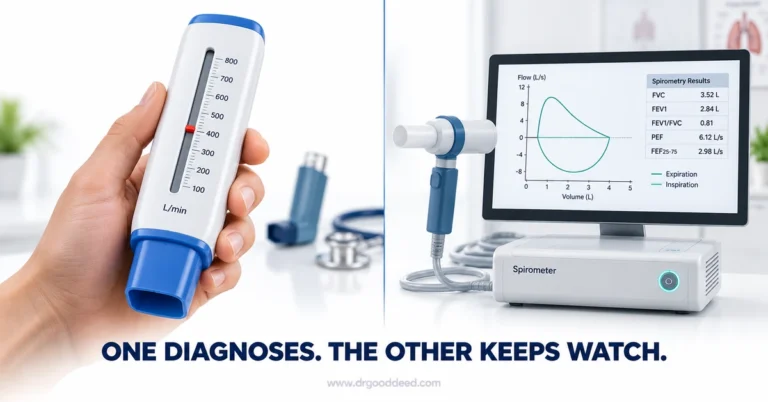
A nebulizer is a medical device that converts liquid bronchodilator or corticosteroid solution into a fine, breathable mist. Compressed air, oxygen, or ultrasonic vibration breaks the liquid into micron-sized droplets small enough to reach the airways. The person breathes this mist through a mouthpiece or a mask over several minutes, so no fast or forceful inhale is required.
Nebulizers exist in three main forms:
- jet nebulizers powered by an air compressor
- ultrasonic nebulizers that vibrate the liquid at high frequency
- newer mesh nebulizers that push liquid through a vibrating mesh for quieter, faster treatments.
Home nebulizer therapy is common for people managing severe asthma, cystic fibrosis, or as part of broader home remedies for COPD management alongside prescribed medication.
What Is an Inhaler?
An inhaler is a handheld device that delivers a fixed, measured dose of medication directly into the lungs in one or two breaths. Three main types exist in the US market, and each works differently at the mechanical level.
- Metered-dose inhaler (MDI): releases a pressurized spray of medication when you press the canister, timed with a slow, deep inhale. Coordination between the press and the breath determines how much medication actually reaches the lungs.
- Dry powder inhaler (DPI): contains powdered medication activated by your own fast, forceful inhale rather than a propellant spray. DPIs require a strong inspiratory effort, which makes them unsuitable for young children or anyone mid-severe-attack.
- Soft mist inhaler (SMI): releases a slow-moving mist over about 1.5 seconds, giving more time to coordinate inhalation than a standard MDI without needing the forceful pull a DPI requires.
Inhalers are the frontline device for daily maintenance therapy and are frequently combined with natural remedies for asthma as part of a broader symptom-management plan discussed with a doctor.
Nebulizer vs Inhaler: Key Differences
The nebulizer vs inhaler decision usually hinges on how the dose reaches your lungs, how much physical coordination you need, and how much time and cleaning the device demands.
How Each Delivers Medication
A nebulizer produces a continuous mist over several minutes, so medication enters the lungs gradually with normal tidal breathing. An inhaler releases the full dose almost instantly, either as a propelled spray or a powder cloud, requiring the lungs to capture it in one or two breaths. Both methods deposit medication in the airways, but the nebulizer’s slower delivery means less depends on perfect timing.
Ease of Use and Coordination Required
Inhalers, especially MDIs, require you to press the canister and inhale at the same moment, a skill known as actuation-inhalation coordination. Studies consistently show many patients, including adults, use MDIs incorrectly without a spacer. A spacer chamber removes most of this timing pressure. Nebulizers need no coordination beyond normal breathing, which is why they remain standard for infants and toddlers.
Setup and Maintenance
A nebulizer treatment involves measuring liquid medication, assembling tubing and a cup, running the compressor, and then cleaning every part afterward. An inhaler needs no setup beyond shaking it and, for MDIs, priming it if unused for weeks. This time difference adds up for people needing multiple daily doses.
Does a Nebulizer Actually Work Better Than an Inhaler?
No, a nebulizer is not inherently stronger or more effective than an inhaler when both are used correctly. This is the most misunderstood point in respiratory care. GINA, the international body that sets asthma treatment standards referenced by US pulmonologists, lists a pressurized metered-dose inhaler used with a spacer as equally effective as nebulized treatment for delivering bronchodilators during asthma flare-ups, across children and adults alike.
Research comparing MDI-with-spacer against nebulized albuterol in pediatric asthma exacerbations has found comparable improvement in symptom scores, with children under six treated by MDI showing a higher discharge-without-relapse rate in at least one recent study. GINA’s own guidance also notes that regular, unsupervised home use of nebulized short-acting beta-agonists is associated with an increased risk of asthma-related death. The perceived “strength” of a nebulizer often comes from the total dose loaded into the chamber, not from the delivery method itself.
Who Might Need a Nebulizer Instead of an Inhaler
Despite the guideline preference for inhalers, nebulizers remain the right choice for specific patients where coordination or severity makes an inhaler impractical.
- Infants and toddlers who cannot follow breathing instructions or hold a mouthpiece seal.
- Older adults with cognitive or motor impairment who struggle to coordinate a press-and-breathe action even with a spacer.
- People in acute, severe respiratory distress, where breathing is too fast, shallow, or labored to reliably use an inhaler technique, similar to the breathing difficulty seen in conditions like bronchitis vs pneumonia, where airway inflammation limits inhale strength.
- Patients requiring high or continuous doses, such as during a hospital-managed asthma or COPD exacerbation.
- People with severe arthritis or hand weakness who cannot physically press an MDI canister.
Keeping Your Device Clean and Safe
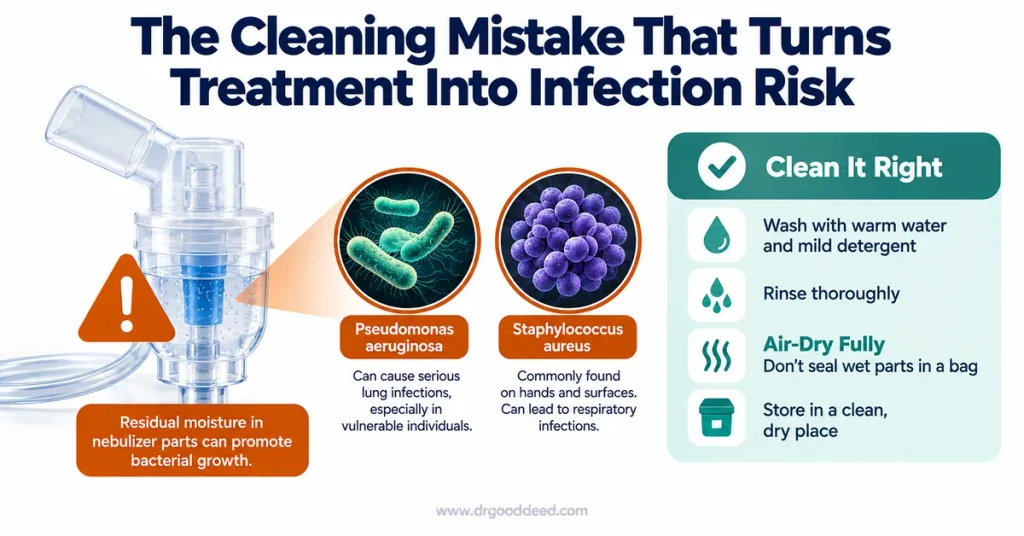
Home nebulizers have repeatedly been found to have bacterial contamination, including Pseudomonas aeruginosa and Staphylococcus aureus, in a large share of devices tested, particularly the mouthpiece and medication cup. A contaminated nebulizer can aerosolize these pathogens directly into your airways during treatment, effectively delivering an infection risk alongside the medication.
- Rinse the nebulizer cup, mouthpiece, and mask with warm water after every single use, and let all parts air-dry completely before the next session.
- Wash removable parts with mild soap and water at least once a day if you use the nebulizer daily.
- Disinfect the cup and mouthpiece weekly using a vinegar-water soak or a manufacturer-approved disinfectant, then rinse and air-dry fully.
- Replace tubing, cups, and filters on the schedule the manufacturer specifies, since worn plastic develops micro-scratches that trap bacteria.
- Never leave a wet nebulizer cup sealed in a bag, since trapped moisture is the single biggest driver of bacterial regrowth between uses.
Inhalers need far less maintenance, generally just wiping the mouthpiece and checking the dose counter, which is one more reason many patients find them easier to manage long-term.
Pro Tip: Store your nebulizer parts in a mesh or open bag rather than a sealed container. Complete air-drying, not just rinsing, is the one most strongly linked to reduced bacterial regrowth between treatments.
When to Talk to Your Doctor
Bring up your device choice at your next visit if you’re using rescue medication more than twice a week, if you struggle to coordinate your inhaler even with a spacer, or if a nebulizer treatment routine has become hard to fit into your schedule. Your doctor can check your inhaler technique in person, since technique errors are common and often invisible to the patient. Device choice should reflect your age, coordination, and condition severity, not a fixed rule about which device is “better.”
FAQs
Is a nebulizer stronger than an inhaler?
No. A nebulizer is not stronger than an inhaler when medication dose and technique are equal. GINA guidelines list MDI-with-spacer as equally effective for asthma flare-ups, and inconsistent inhaler technique, not device type, causes most effectiveness gaps.
Can you use a nebulizer and an inhaler together?
Yes. Many people use a daily maintenance inhaler and keep a nebulizer for severe flare-ups or illness-related breathing difficulty. Always follow your doctor’s specific plan, since combining devices without guidance can lead to overdosing bronchodilators.
How often should you clean a nebulizer?
Rinse and air-dry parts after every use, wash with soap daily if used daily, and disinfect weekly. Skipping the full air-dry step is the most common lapse linked to bacterial contamination in home nebulizers.
Do inhalers work as well as nebulizers for severe asthma attacks?
Yes, when paired with a spacer. GINA recommends pMDI-with-spacer as equally effective as nebulized treatment for moderate to severe exacerbations in most patients, reserving nebulizers for cases where coordination or consciousness is impaired.
Which is better for children, a nebulizer or an inhaler?
It depends on age. Children under four typically need a nebulizer or MDI-with-mask-spacer due to limited breath control. Children over six who can coordinate breathing often do equally well, or better, with an MDI-and-spacer.
Sources
- Global Initiative for Asthma (GINA) 2024 and 2026 Strategy Reports link
- GINA Summary Guide for Asthma Management and Prevention link
- British Thoracic Society, SIGN Asthma Guidelines link
- PMC: Bacterial Surface Detachment during Nebulization with Contaminated Reusable Home Nebulizers link
- PMC: Microbial Contamination of Home Nebulizers in Children with Cystic Fibrosis link
- European Respiratory Society: Nebuliser Hygiene in Cystic Fibrosis link
- American Lung Association: Asthma Treatment and Devices link
- National Heart, Lung, and Blood Institute: Asthma link
- CDC: Guidelines for Preventing Health-Care-Associated Pneumonia link
- Mayo Clinic: Nebulizer and Inhaler Use link
Medical Disclaimer: This article is for general information only and is not medical advice. It does not replace a diagnosis, treatment plan, or guidance from a qualified healthcare professional. Always talk to your doctor about your own symptoms and before starting, stopping, or changing any treatment. If you think you may be having a medical emergency, call 911 or go to your nearest emergency room.