

Screening recommendations change as you age because cancer risk itself changes with age. A test that makes sense at 45 may not make sense at 25, and a test that gets more urgent at 50 might not even be relevant a decade earlier.
This guide breaks down the cancer screening guidelines by age for breast, cervical, colorectal, lung, and prostate cancer, using current guidance from the American Cancer Society (ACS) and the U.S. Preventive Services Task Force (USPSTF).
Why Screening Guidelines Are Based on Age
Cancer incidence rises sharply after certain birthdays. Colorectal cancer rates climb noticeably after 45. Breast cancer risk increases with each decade past 40. Cervical cancer, by contrast, is closely tied to HPV exposure, so screening starts earlier and depends less on age alone.
Guideline groups set age thresholds by weighing how often a cancer actually shows up in that age group against the harms of screening too early, like false positives, unnecessary biopsies, and anxiety over findings that were never going to cause harm.
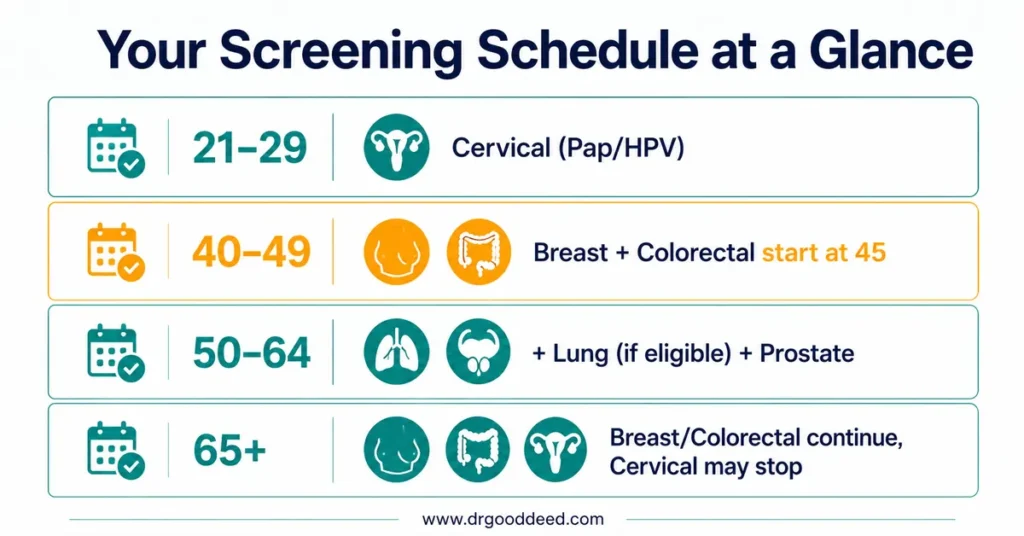
Cancer Screening Guidelines by Age (Complete Chart)
The table below shows when to start cancer screening for each major cancer type at average risk, based on current ACS and USPSTF guidance. Use this cancer screening chart as a starting reference, then confirm your personal schedule with a healthcare provider.
| Age Band | Cancer Type | Test | Frequency |
| 21–29 | Cervical | Primary HPV test or Pap test | HPV every 5 years, Pap every 3 years |
| 21–29 | Breast, Colon | None routine at average risk | Know your family history |
| 30–39 | Cervical | Primary HPV test (preferred) or co-test | Every 5 years (HPV) or every 5 years (co-test) |
| 40–49 | Breast | Mammogram | Optional at 40–44, annual starting at 45 |
| 40–49 | Colorectal | Stool-based test, colonoscopy, or blood-based test | Starts at 45 for everyone at average risk |
| 40–49 | Prostate | PSA discussion, higher-risk men only | Starting at 45, or 40 with multiple affected relatives |
| 50–64 | Breast | Mammogram | Annual through 54, then every 2 years or annually |
| 50–64 | Colorectal | Stool-based test, colonoscopy, or blood-based test | Ongoing, per test type |
| 50–64 | Lung | Low-dose CT scan | Annual, if eligible by smoking history |
| 50–64 | Prostate | PSA discussion, average-risk men | Starting at 50 |
| 65+ | Breast | Mammogram | Every 2 years, or annually by choice |
| 65+ | Colorectal | Stool-based test, colonoscopy, or blood-based test | Through 75, then individualized |
| 65+ | Lung | Low-dose CT scan | Annual through age 80, if eligible |
| 65+ | Cervical | Can often stop | If prior tests were consistently normal |
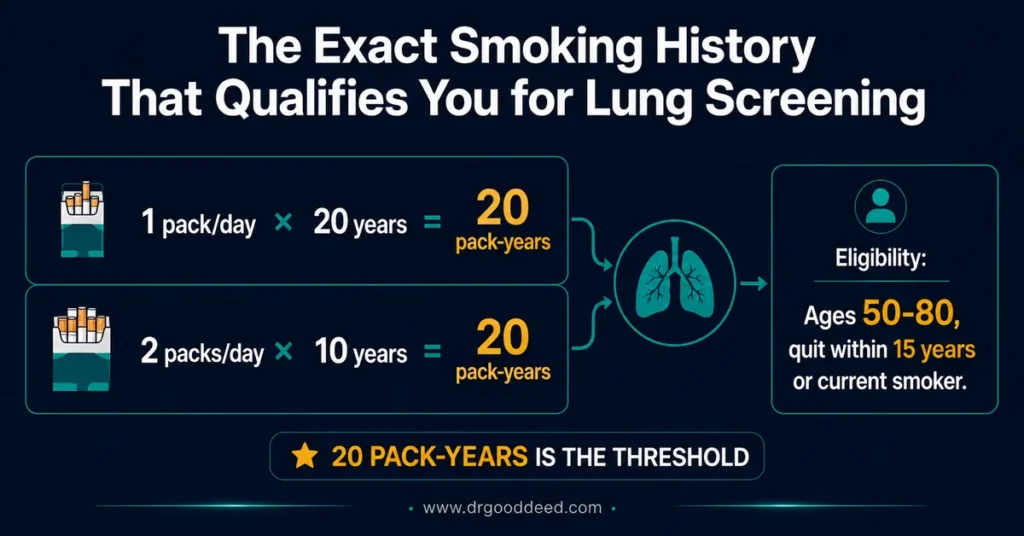
Lung cancer eligibility hinges on pack-years, a measure of smoking history. One pack-year equals smoking one pack a day for one year. A person who smoked two packs a day for ten years also has a 20 pack-year history. Current guidelines recommend annual low-dose CT screening for people ages 50 to 80 with at least a 20 pack-year history who currently smoke or quit within the past 15 years.
Why ACS and USPSTF Guidelines Sometimes Differ
The USPSTF recommends women at average risk start biennial mammograms at age 40 and continue through 74. The ACS recommends annual mammograms starting at 45, with an option to start at 40, then a switch to every 2 years (or continued annual screening) at 55. Both groups agree screening saves lives.
ACS and USPSTF differ on how to balance earlier detection against the higher rate of false positives that comes with starting sooner and screening more often. They reflect different weightings of the same evidence, which is exactly why a personal conversation with a provider matters more than picking a single chart and following it blindly.
Screening Recommendations If You’re at Higher Than Average Risk
Everything above describes average-risk guidance. If you carry a BRCA1 or BRCA2 mutation, have Lynch syndrome, or have a first-degree relative diagnosed with breast, colorectal, or prostate cancer before age 50, your cancer screening guidelines by age look different.
High-risk breast cancer screening often starts in your 30s with annual MRI plus mammogram. High-risk colorectal screening can start a decade before your youngest affected relative’s diagnosis age. Prostate cancer screening moves up to 40 for men with multiple close relatives diagnosed young.
Genetic counseling can clarify your actual risk category before you commit to an earlier or more frequent testing schedule.
Cancers Without a Routine Screening Test
Skin, ovarian, testicular, and pancreatic cancer have no standard population-wide screening test recommended for average-risk adults. This does not mean these cancers get ignored. It means early detection depends on you noticing changes and reporting them fast.
- For skin cancer, that means tracking new or changing moles.
- For ovarian cancer, that means persistent bloating, pelvic pain, or urinary urgency that lasts more than two weeks.
- For testicular cancer, that means monthly self-exams starting in the teen years, since it is most common in men under 40.
- For pancreatic cancer, unexplained weight loss, new-onset diabetes, or yellowing skin warrant a prompt call to a doctor.
None of these substitute for a formal screening test, because none currently exists for average-risk people, but symptom awareness closes part of that gap.
When to Talk to Your Doctor About Screening
Bring up screening at your next physical if you have never discussed a personal schedule, if a close relative was diagnosed with cancer, or if you are approaching one of the age thresholds in the chart above.
A five-minute conversation at 44 can save you from missing your first mammogram window at 45. The same goes for colorectal screening at 45 and lung screening once your smoking history crosses 20 pack-years.
Bring your family history to the appointment, including which relatives were affected and at what age, since that single detail can shift your entire schedule earlier.
FAQs
Do I need cancer screening if no one in my family has had cancer?
Yes. Most cancers occur in people with no family history. Average-risk guidelines apply to you regardless of family history, and they start screening at set ages for exactly this reason.
Can I skip screening if I feel completely healthy?
No. Early-stage cancer rarely causes symptoms. Screening tests are designed to catch disease before you would ever feel sick from it.
What is the difference between average risk and high risk?
Average risk means no major personal or family history of the cancer in question. High risk means factors like genetic mutations or early-onset family history that call for earlier or more frequent testing.
Is an HPV test better than a Pap smear?
The primary HPV test is now the preferred cervical screening option under ACS guidelines. It detects the virus that causes nearly all cervical cancers and requires testing less often than a Pap alone.
Does insurance cover routine cancer screening?
Yes, in most cases. Under the Affordable Care Act, USPSTF-recommended screenings with a grade A or B rating are typically covered without a copay by most private insurance plans.
What age can I stop cancer screening?
It depends on the cancer type and your health status. Cervical screening can often stop at 65, colorectal at 75, and breast and lung screening decisions become individualized based on life expectancy and overall health.
Sources
- American Cancer Society. Screening Guidelines by Age. link
- American Cancer Society. American Cancer Society Guidelines for the Early Detection of Cancer. link
- USPSTF. Breast Cancer: Screening, Final Recommendation Statement (2024). link
- USPSTF. Colorectal Cancer: Screening. link
- USPSTF. Lung Cancer: Screening. link
- American Cancer Society. Cervical Cancer Screening Guidelines. link
- American Cancer Society. American Cancer Society Recommendations for Prostate Cancer Early Detection. link
- American Cancer Society. American Cancer Society Recommendations for the Early Detection of Breast Cancer. link
- National Cancer Institute. Ovarian Cancer Screening (PDQ). link
- Mayo Clinic. Cancer Screening: Understanding Benefits and Risks. link