
Muscle twitching all over the body can feel alarming, and many people worry it means ALS. In most cases, twitching alone does not mean ALS, but new weakness, muscle wasting, or speech and swallowing changes should be evaluated by a clinician. Muscle twitching (also called fasciculations or myoclonus) happens when a small group of muscle fibers contracts involuntarily due to a misfiring nerve signal. It can affect any muscle eyelids, calves, hands, arms, or abdomen and may last seconds to hours.
Key Takeaways
- Muscle twitching all over the body is usually benign fasciculation; new weakness, muscle wasting, or speech and swallowing changes are what point to ALS.
- Fasciculations are common; up to 70% of people notice them at some point. Triggers include stress, fatigue, caffeine, alcohol, nicotine, and hard exercise.
- ALS usually begins with progressive muscle weakness. Speech or swallowing problems are the first symptoms in about 20% to 30% of cases.
- Rare cases of progression from apparently benign fasciculations to ALS have been reported, so changing symptoms should not be ignored.
| Feature | Benign fasciculation | ALS | What matters |
| Weakness | No objective weakness | Progressive weakness is common | New weakness needs evaluation |
| Muscle bulk | Usually normal | Muscle wasting may develop | Compare changes over time |
| Speech/swallowing | Usually normal | Slurred speech or swallowing difficulty can occur | Seek medical assessment |
| Twitching | Can occur at rest | Can occur in affected muscles | Location alone does not distinguish them |
| Follow-up | None of the 121 developed motor neuron disease over 2 to 32 years; rare exceptions reported. | Symptoms progressively worsen | Changes over time matter |
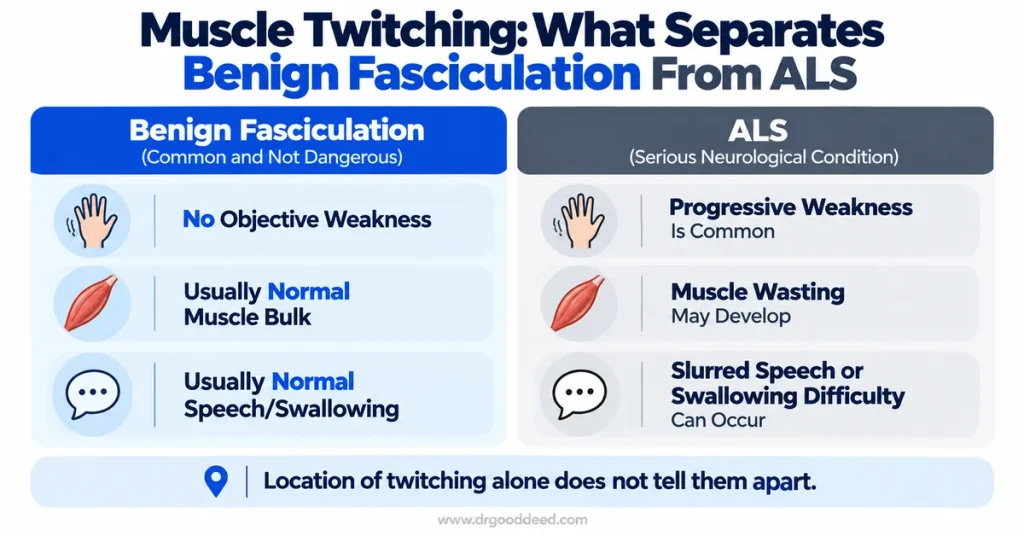
Should You Worry About ALS if Your Muscles Twitch All Over?
Muscle twitching and ALS are often linked because fasciculations can occur in ALS, but twitching alone is not enough to diagnose the disease.
A 2021 Muscle & Nerve study followed 24 people for a median of 4.7 years, 21 with repeat EMG, and none developed motor neuron disease.
However, rare exceptions have been reported. Four published cases described people with fasciculations and cramps who later developed ALS. These reports are rare, but they are why a neurological exam and follow-up if anything changes matter.
The location of twitching does not reliably distinguish benign from serious causes. Twitching in one muscle or several areas can have many explanations. In ALS, fasciculation frequency also does not reliably track weakness or disease duration.
ALS is a rare disease. The annual incidence is estimated to be 1.6 to 2.5 per 100,000 population and the lifetime risk is approximately 1 in 400. This rarity may provide some context, but should not be used as a reason to dismiss the appearance of new neurologic symptoms.
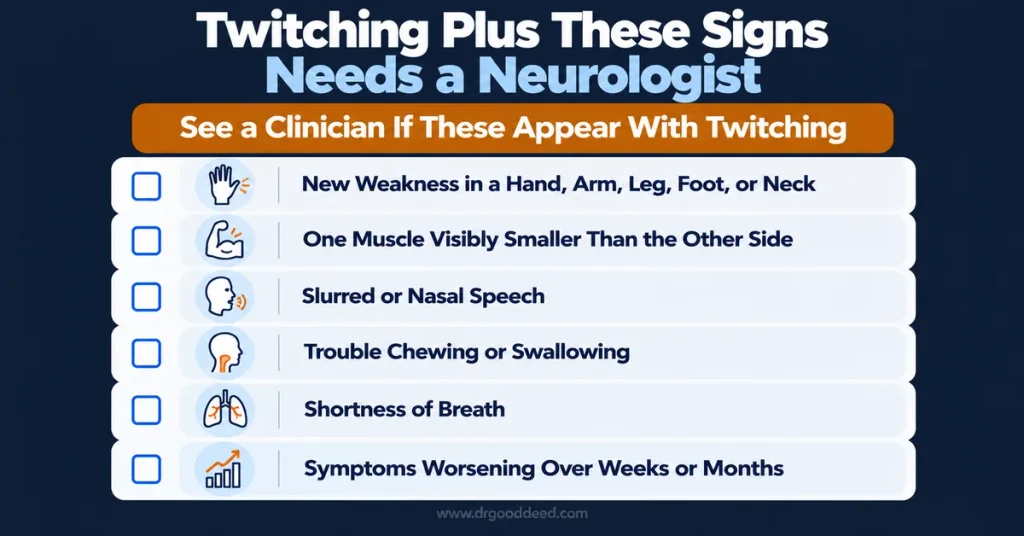
When Muscle Twitching Needs a Neurologist?
When to worry about muscle twitching: seek medical care when twitching occurs with progressive weakness, muscle wasting, speech changes, or swallowing problems.
Early ALS symptoms described by the NIH and NINDS include muscle twitching in the arm, leg, shoulder, or tongue; cramps; stiffness; and weakness. Speech, chewing, and swallowing problems can also occur.
In most cases, the first symptom is new weakness in an arm or leg. About 20% to 30% of people have speech or swallowing problems as their first symptoms.
Watch for:
- New weakness in a hand, arm, leg, foot, or the neck.
- A muscle becoming visibly smaller than the other side.
- Slurred or nasal speech.
- Shortness of breath or trouble breathing.
- Trouble chewing or swallowing.
- Twitching accompanied by cramps, stiffness, or pain.
- Symptoms that progressively worsen over weeks or months.
If you are in the US, start with your primary care clinician and ask about a neurology referral when appropriate. In the UK, your GP can assess the symptoms and arrange referral if needed.
Why Do Muscles Twitch All Over?
Benign fasciculation syndrome causes persistent muscle twitching without another neurological or medical disorder found on evaluation.
A fasciculation is a small, involuntary contraction of a group of muscle fibers. You may see or feel the muscle briefly jump under the skin.
Consider benign fasciculation syndrome when persistent muscle twitching is the main symptom and the exam shows no other neurological disorder. An electromyography (EMG) test may help assess muscle and nerve activity and rule out other possible causes.
What Helps: Management focuses on reducing triggers such as stress, sleep deprivation, and excess caffeine. Adequate rest, hydration, and reassurance may help ease symptoms. Persistent, worsening twitching or twitching accompanied by muscle weakness should be evaluated by a healthcare professional.
Twitching can happen while a muscle is resting and may become less noticeable when the muscle moves.
Cramp-fasciculation syndrome is a separate, treatable condition. It can cause twitching together with cramps, muscle pain, stiffness, and fatigue. A clinician should distinguish it from benign fasciculation syndrome and other neurological conditions.
Sleep-onset jerks are also different from ordinary fasciculations. They are sudden movements that occur as you are falling asleep.
What Causes Muscle Twitching All Over the Body?
Muscle twitching can occur with stress, fatigue, caffeine, strenuous exercise, thyroid problems, and other medical conditions. Twitching is common. Up to 70% of people notice fasciculations at some point (Journal of the Neurological Sciences, 2025).
Possible triggers and associations include:
- Stress or anxiety
- Fatigue and poor sleep
- Caffeine
- Alcohol
- Nicotine
- Strenuous exercise
- Thyroid disease
- Electrolyte or nutritional deficiencies
- Some nerve or muscle disorders
- Recent viral infection
A Mayo Clinic study found that 19 of 121 people with benign fasciculations reported acute onset after a viral infection.
Anxiety and health anxiety are also associated with benign fasciculations. However, anxiety should not automatically be assumed to be the cause. Persistent or changing twitching deserves an appropriate clinical assessment.
Thyroid disorders can also cause neurological and muscle symptoms. Other symptoms may help your clinician decide whether thyroid testing is appropriate.
How Is Muscle Twitching Diagnosed?
Doctors diagnose the cause of muscle twitching by looking at the neurological examination, symptom pattern, and tests such as EMG or blood work when needed.
The evaluation usually begins with your medical history and a neurological examination. Your clinician may ask about:
- When the twitching started
- Where it occurs
- Whether it is becoming more frequent
- Weakness or muscle loss
- Cramps, stiffness, or pain
- Speech or swallowing changes
- Recent illness
- Caffeine, alcohol, nicotine, sleep, and exercise
An EMG (electromyography) uses a thin needle electrode to record electrical activity in muscles. It is often done with nerve conduction studies.
Blood tests may also be appropriate. Depending on the symptoms, a clinician may check thyroid function and electrolyte levels such as magnesium, potassium, or calcium.
Benign fasciculation syndrome is generally considered after other relevant causes have been assessed and no evidence of another neurological or medical disorder is found.
What Helps Muscle Twitching?
Fasciculation anxiety can make twitching more distressing, so treatment may include reassurance, reducing triggers, and addressing anxiety when needed.
There is no specific treatment that reliably eliminates benign fasciculations. Management focuses on identifying triggers and making sure there is no underlying condition that needs treatment.
Helpful steps include:
- Get a neurological exam so any reassurance rests on findings.
- Cut back on caffeine, nicotine, and alcohol if they make it worse.
- Maintain regular, adequate sleep.
- Do not exercise until you are completely exhausted.
- Ask your clinician about anxiety support if worry is taking over.
- Ask whether blood tests are appropriate.
- Avoid taking magnesium or vitamin supplements without medical advice.
If twitching-related anxiety is difficult to manage, learn ways to reduce anxiety-related shaking. Medication for anxiety may sometimes be considered, but this is an individual clinical decision.
Most importantly, reassurance should be based on your symptoms, examination, and appropriate testing rather than on the location of the twitching alone.
Frequently Asked Questions
Why does muscle twitching seem worse at night or when I lie down?
Muscle twitching at night can seem more noticeable because you are resting and there are fewer distractions. Benign fasciculations can occur when muscles are at rest.
How long does benign fasciculation syndrome last?
It may persist for years. In a 2021 study of 24 people followed for a median of 4.7 years, twitching often continued, but none developed motor neuron disease.
Can muscle twitching start after a viral infection?
A Mayo Clinic follow-up study found that 19 of 121 individuals with benign fasciculations experienced sudden symptom onset following a viral infection.
Can low magnesium or a vitamin deficiency cause muscle twitching all over the body?
Deficiencies in magnesium, potassium, or calcium may contribute to muscle twitching.
Medical Disclaimer: This article is for informational and educational purposes only and does not replace professional medical advice, diagnosis, or treatment. Always consult a qualified healthcare professional about your symptoms or health concerns. Never delay or disregard professional medical advice based on information provided in this article.
Sources:
1. Blexrud MD, et al. Long-term follow-up of 121 patients with benign fasciculations. Annals of Neurology. 1993. PubMed link
2. National Institute of Neurological Disorders and Stroke. Amyotrophic lateral sclerosis (ALS) fact sheet [Internet]. Bethesda (MD): National Institutes of Health; [cited 2026 Oct 22]. Available from: https://www.ninds.nih.gov/sites/default/files/migrate-documents/ALS_FactSheet-E_508C.pdf link
3. Centers for Disease Control and Prevention. National Amyotrophic Lateral Sclerosis (ALS) Registry [Internet]. Atlanta (GA): CDC; [cited 2026 Oct 22]. Available from: https://www.cdc.gov/als/ link
4. Montalvo A, Swash M, de Carvalho M.Benign fasciculations: A follow-up study with electrophysiological studies. Muscle & Nerve. 2021;64(6):670–675. doi:10.1002/mus.27411. Available from: https://onlinelibrary.wiley.com/doi/abs/10.1002/mus.27411 link
5. National Institute of Neurological Disorders and Stroke. Amyotrophic lateral sclerosis (ALS) [Internet]. Bethesda (MD): National Institutes of Health; [cited 2026 Oct 22]. Available from: https://www.ninds.nih.gov/health-information/disorders/amyotrophic-lateral-sclerosis-als link
Medical Disclaimer: This article is for general information only and is not medical advice. It does not replace a diagnosis, treatment plan, or guidance from a qualified healthcare professional. Always talk to your doctor about your own symptoms and before starting, stopping, or changing any treatment. If you think you may be having a medical emergency, call 911 or go to your nearest emergency room.