

Autoimmune neurological disorders occur when the immune system attacks the brain, spinal cord, nerves, or muscles, and most have treatments that limit damage. Common types include multiple sclerosis, autoimmune encephalitis, Guillain–Barré syndrome, and myasthenia gravis.
Sudden weakness, vision loss or breathing trouble needs 911 or 999. This guide covers the main types, symptoms, causes, diagnosis, treatment and emergency signs.
Key Takeaways
- Autoimmune neurological disorders occur when the immune system attacks the brain, spinal cord, nerves, or muscles, and most have treatments that limit damage.
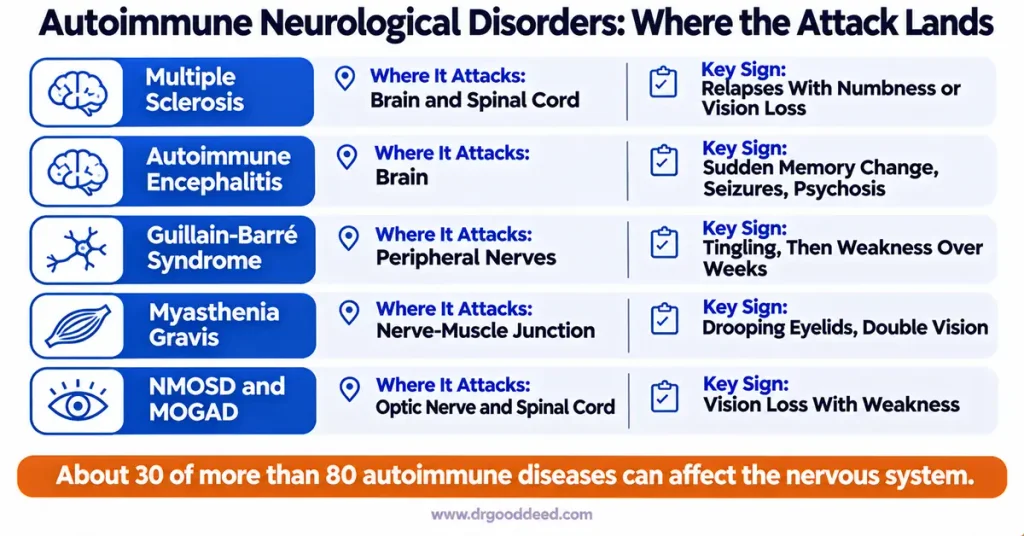
- About 30 of more than 80 autoimmune diseases can affect the nervous system.
- Treatment depends on the disorder. Never stop or change a medicine on your own.
- Sudden weakness, vision loss or breathing trouble: 911 in the US, 999 in the UK.
| Disorder | Where the attack lands | Key sign |
| Multiple sclerosis | Brain and spinal cord | Relapses with numbness or vision loss |
| Autoimmune encephalitis | Brain | Sudden memory change, seizures, psychosis |
| Guillain-Barré syndrome | Peripheral nerves | Tingling, then weakness over weeks |
| Myasthenia gravis | Nerve-muscle junction | Drooping eyelids, double vision |
| NMOSD and MOGAD | Optic nerve and spinal cord | Vision loss with weakness |
What Are Autoimmune Neurological Disorders?
Autoimmune neurological disorders are conditions in which the immune system attacks the nervous system; about 30 of more than 80 known autoimmune diseases can do this. The damage can reach the brain, the spinal cord, the nerves running to the limbs or the muscles themselves.
- Autoimmune: The body’s defenses target its own tissue.
- Neurological: The target is the nervous system, the wiring that carries signals for movement, feeling, thinking, and vision.
- Why location matters: The same immune attack causes very different problems depending on which structure it hits, which is why the types below are grouped by target.
Types of Autoimmune Neurological Disorders
The five main types are best understood by where the attack lands: the brain, the brain and spinal cord, the optic nerve and spinal cord, the peripheral nerves or the nerve-muscle junction.
Other conditions include transverse myelitis, optic neuritis, ADEM (which can follow a viral infection or vaccination), central nervous system vasculitis, neurosarcoidosis, narcolepsy and CIDP (a long-lasting nerve inflammation). About two-thirds of people with isolated transverse myelitis improve, and an isolated episode of myelitis or optic neuritis raises the future risk of MS.
Multiple Sclerosis
MS affects the brain and spinal cord and cannot currently be cured, but treatment can slow its progression and ease symptoms. Symptoms come as relapses (flare-ups) followed by remissions (quieter periods).
- Risk factors: Ages 20 to 50, being a woman, a close relative with MS, smoking and a past Epstein-Barr virus infection.
- Diagnosis: No single test diagnoses it.
Autoimmune Encephalitis
This is inflammation of the brain caused by the immune system. Sudden memory or mental-state changes, new seizures, and psychosis are its symptoms. Psychosis can be the first sign, so anyone with sudden confusion, seizures, or psychosis needs urgent medical care.
- Treatment: Immunosuppressants, monoclonal antibodies or IVIG (intravenous immunoglobulin, a blood-derived protein treatment).
- Timing: Earlier treatment in hospital is more likely to succeed.
Guillain-Barré Syndrome
GBS is rare and needs urgent hospital treatment, usually IVIG or plasma exchange, a procedure that filters harmful antibodies from the blood. It starts with tingling or numbness in the feet and hands, then muscle weakness that worsens over 2 to 4 weeks.
- Recovery: Most people walk within 6 months and recover within a year. Some have fatigue, nerve pain or weakness for longer.
- Trigger: It can follow a mild infection.
Myasthenia Gravis
In myasthenia gravis, the immune system targets proteins that muscles need to work. That causes drooping eyelids, double vision, trouble swallowing, shortness of breath, slurred speech and weakness in the arms, hands, legs or neck.
- Myasthenic crisis: Breathing muscles weaken enough to need a ventilator. This needs immediate emergency care.
- Treatment may include medicines that calm the immune system, IVIG or plasma exchange, and thymus removal.
NMOSD and MOGAD
NMOSD (neuromyelitis optica spectrum disorder) and MOGAD (MOG antibody disease) mainly hit the optic nerve and spinal cord.
- Symptoms include optic neuritis, weakness, severe nausea and vomiting, and bladder or bowel problems.
- NMO is more common in African American and Asian people, and misdiagnosis as MS can lead to harmful treatment.
- NMOSD is often linked to AQP4 antibodies.
- MOGAD has no FDA-approved treatment.
Autoimmune Neurological Disorders Symptoms
Diagnosis usually starts with a primary care doctor or GP and ends with a neurologist, and no single test is enough.
- Limbs: Numbness, tingling or weakness.
- Eyes: Vision loss, double vision or drooping eyelids.
- Brain: Memory change, confusion, seizures or psychosis.
- Whole body: Extreme tiredness, balance trouble and bladder problems.
GBS weakness builds over 2 to 4 weeks (NHS), while MS symptoms come and go in relapses.
What Causes Autoimmune Neurological Disorders?
The cause is often unclear, and genes, infection and environment are all suspected. Researchers have not pinned down a single trigger, and stress or diet should not be blamed.
- MS risk factors: Ages 20 to 50, women, a close relative with MS, smoking and Epstein-Barr virus.
- GBS: It can follow a mild infection.
- Other suspected factors: Low vitamin D and smoking are associated with MS risk. They are not established risk factors for every autoimmune neurological disorder.
How Doctors Diagnose These Disorders
Diagnosis starts with a GP and usually ends with a neurologist, and no single test is enough.
- Referral: The GP refers to a neurologist.
- Exam: Checks of movement, coordination, vision, balance and reflexes.
- Tests: Blood tests, MRI, lumbar puncture (a spinal fluid sample) and nerve-signal tests.
- Antibody tests: Blood tests for AQP4, MOG and oligoclonal bands.
- Autoimmune encephalitis can be linked to an existing or developing cancer (paraneoplastic), which is why doctors may look for one.
Expert Insight: Symptoms alone cannot separate these conditions. MOGAD is sometimes misdiagnosed as MS, so where the attack lands and which tests support it matter more than any single symptom.
Autoimmune Neurological Disorders Treatment
Treatment calms the immune attack, and the choice depends on the disorder. Doctors may use the classes below, and dosage varies by age and condition. Severe cases need hospital care.
- Corticosteroids: Strong anti-inflammatory medicines.
- Disease-modifying therapies: Used to slow conditions such as MS.
- Immunosuppressants: Medicines that dampen the immune system.
- IVIG or plasma exchange: Used in conditions such as GBS and some autoimmune brain inflammation.
- Thymus removal: An operation sometimes used in MG.
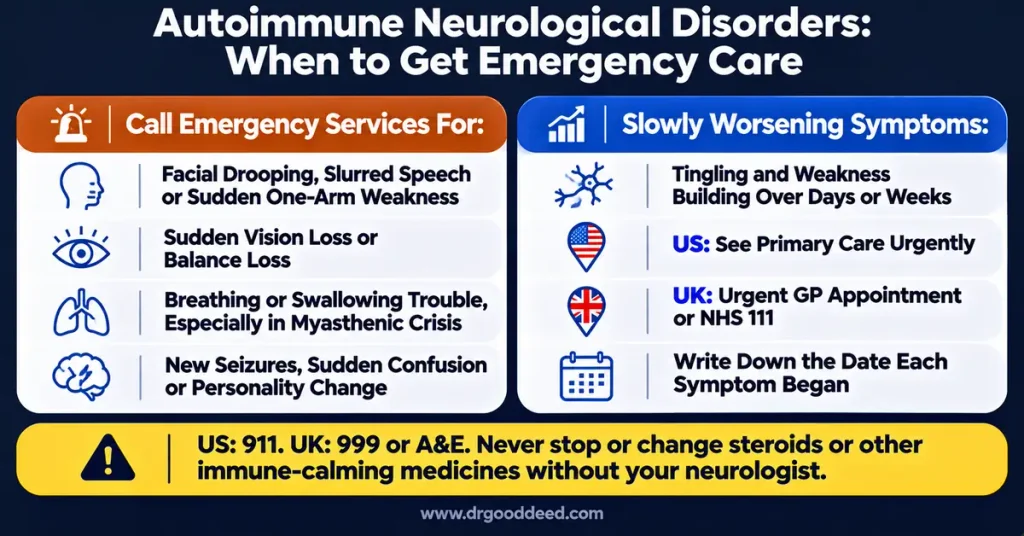
- Do not self-adjust: Do not stop or change steroids or other immune-calming medicines without the neurologist.
Pro Tip: Write down the date each symptom began and how fast it progressed. GBS builds over 2 to 4 weeks, MS comes in relapses and remissions, and sudden onset needs emergency care, so the timeline helps the neurologist narrow the type.
Warning Signs That Need Emergency Care
Call emergency services for stroke-like signs, breathing or swallowing trouble, seizures or sudden confusion.
- Stroke-like signs: Facial drooping, slurred speech, an arm that will not lift, sudden one-arm weakness, sudden vision loss or balance loss. US: 911. UK: 999 or A&E.
- Breathing or swallowing trouble: Especially with myasthenic crisis. Treat as an emergency.
- Brain signs: New seizures, sudden confusion or personality change. The NHS says to call 999.
- Slowly worsening tingling and weakness: US: see primary care urgently. UK: urgent GP appointment or NHS 111.
- Mental-health crisis: US: call or text 988. UK: Samaritans on 116 123.
FAQs
Can autoimmune neurological disorders be cured?
No, not reliably. MS cannot currently be cured, though treatment can slow its progression, and most people with GBS walk within 6 months with treatment.
How many autoimmune diseases affect the nervous system?
About 30 of more than 80 known autoimmune diseases can affect the nervous system. They target the brain, spinal cord, optic nerve, peripheral nerves or the nerve-muscle junction.
Can an infection or stress trigger a flare?
Yes, sometimes. GBS can follow a mild infection, and infection, stress, surgery or a medicine reaction can trigger a myasthenic crisis (Healthline; NINDS). Worsening weakness needs emergency care.
Are autoimmune neurological disorders hereditary?
No, not simply. The NHS lists a close relative with MS as an MS risk factor, but the cause is unclear. There is no clear evidence that the other disorders run in families.
Sources
- Healthline: 15 Neurological Autoimmune Diseases To Know About link
- NHS: Guillain-Barré Syndrome link
- NHS: Multiple Sclerosis link
- NINDS: Myasthenia Gravis link
- NHS: Encephalitis link
- NIMH: Schizophrenia (988 information) link
Medical Disclaimer: This article is for general information only and is not medical advice. It does not replace a diagnosis, treatment plan, or guidance from a qualified healthcare professional. Always talk to your doctor about your own symptoms and before starting, stopping, or changing any treatment. If you think you may be having a medical emergency, call 911 or go to your nearest emergency room.