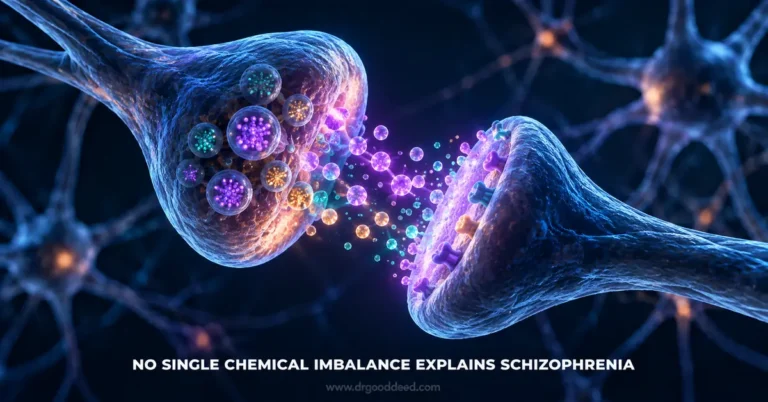

Neuroleptic-induced parkinsonism is a usually reversible movement side effect, where a dopamine-blocking medicine causes tremor, stiffness, and slowness. Older adults and people taking higher doses are at greater risk.
Unlike Parkinson’s disease, it is caused by medication and often affects both sides of the body similarly.
Key Takeaways
- Neuroleptic-induced parkinsonism is a usually reversible movement side effect of dopamine-blocking antipsychotics, causing tremor, stiffness, and slowness.
- Symptoms usually start days to weeks after an antipsychotic is started or raised.
- Most people recover within weeks to months (MedLink), though full recovery can take up to 1 to 1.5 years.
- Do not stop an antipsychotic on your own. Abrupt changes can bring psychiatric symptoms back, so talk to the prescriber first.
- High fever with rigid muscles is an emergency: 911 in the US, 999 in the UK.
What Is Neuroleptic-Induced Parkinsonism?
Neuroleptic-induced parkinsonism is a set of Parkinson-like movement symptoms caused by an antipsychotic, and it is not the same as Parkinson’s disease. It describes a pattern of symptoms, not a diagnosis of Parkinson’s disease.
- The word “neuroleptic”: It is an older term for antipsychotic.
- Parkinsonism versus Parkinson’s disease: Parkinsonism is a group of symptoms. Parkinson’s disease is only one cause of it, and the medicine-related form does not lead to Parkinson’s disease.
- Taking an antipsychotic is not something to feel at fault for, but this is a known side effect that doctors watch for.
Neuroleptic-Induced Parkinsonism Symptoms
Symptoms include tremor, slowed movement, walking changes and muscle rigidity (stiffness), usually starting within days or weeks of a new or higher dose. They tend to worsen over time if the cause is not addressed.
- Tremor: Shaking, often in the hands. Drug-induced parkinsonism has less tremor and is more symmetric but this is not a reliable way to tell it apart from Parkinson’s disease.
- Slowed movement: Everyday actions such as buttoning a shirt or rising from a chair take longer.
- Rigidity: Muscles feel stiff or resist movement.
- Gait and balance changes: Walking may become shuffling or unsteady.
- Both sides: Symptoms often affect both sides. One-sided symptoms do not rule the condition out.
- Timing clue: Symptoms that begin soon after a new or raised dose point toward the medicine.
Which Medicines Cause Drug-Induced Parkinsonism?
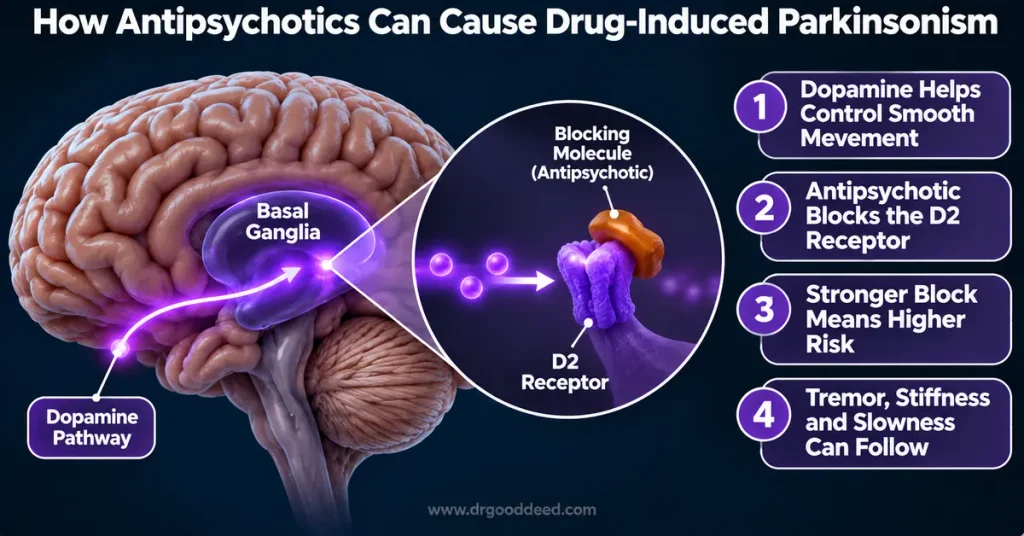
Antipsychotic medicines, older and newer, are the most common cause, and the risk comes from how they act on dopamine. Dopamine is a brain chemical that helps control smooth movement. The involved pathway runs through the basal ganglia, a brain region that coordinates movement.
An antipsychotic causes parkinsonism mainly by blocking the D2 receptor in the basal ganglia, and the stronger the block, the higher the risk (MHRA).
- Potency matters: Potent D2 receptor blockers are more likely to cause it.
- Serotonin effect: Medicines with stronger 5-HT2A antagonism (blocking a serotonin receptor) are less likely to cause it.
- Other drug classes: Anti-nausea drugs, calcium channel blockers, anticonvulsants, gut-movement drugs (prokinetics) and antidepressants.
- Metoclopramide: Waters names this stomach medicine, also used for migraine, as a possible cause.
Who Is Most at Risk?
Higher doses, older age, female sex, and dementia, especially Lewy body dementia, raise the risk (MHRA).
- Higher doses and potent D2 blockers: More blockade means more risk.
- Older age and female sex: Both are listed risk factors. Women are affected more than twice as often as men.
- Dementia: People with Lewy body dementia are especially sensitive to these drugs.
- Other factors: Genetics, brain injury, liver or kidney problems and taking many medicines at once.
Is It Parkinson’s Disease or the Medicine?
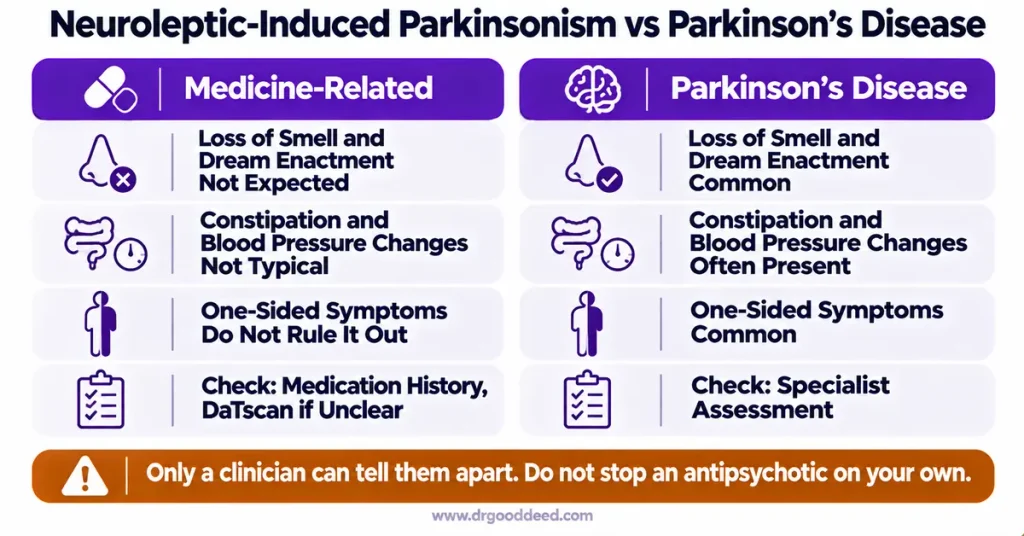
The medicine is a likely cause when symptoms began after a new or increased dose, and certain features differ from Parkinson’s disease. Only a clinician can tell them apart.
| Feature | Medicine-related | Parkinson’s disease |
| Loss of smell, dream enactment (REM sleep behavior disorder) | Not expected | Common |
| Constipation, blood pressure changes | Not typical | Often present |
| One-sided symptoms | Does not rule it out | Common |
| Check | Medication history, DaTscan if unclear | Specialist assessment |
- DaTscan and cardiac MIBG scans: A DaTscan (a brain scan) and a cardiac MIBG scan (a heart nerve scan) can help separate drug-induced parkinsonism from Parkinson’s disease.
- Unmasking: The medicine can sometimes bring out early Parkinson’s disease that was already developing.
How Doctors Diagnose Neuroleptic-Induced Parkinsonism
Doctors diagnose it clinically, using the symptoms, a full medication history and the timing of the symptoms. No single test confirms it.
- Medication history: Which drugs were started or raised, and when.
- Exam: Movement, tone, and walking are checked.
- Improvement after withdrawal: Improvement after the drug is withdrawn supports the diagnosis.
- DaTscan: Used only where doubt remains.
Pro Tip: Bring a written list of every medicine you take, including stomach, anti-nausea and migraine drugs, with start dates. Parkinsonism can come from medicines outside psychiatry, and a dated list helps the doctor link symptoms to a start or dose change.
Neuroleptic-Induced Parkinsonism Management Options
Management starts with the prescriber, never with stopping the medicine. Dosage varies by person and condition, and the prescriber decides any change.
- Dose reduction or a switch: The prescriber may lower the dose or consider another antipsychotic.
- Treating symptoms: Doctors may add anticholinergics to treat the symptoms, but they do not use them routinely to prevent them because they can raise the risk of a later movement disorder (tardive dyskinesia).
- What they are: Anticholinergics, also called antimuscarinics, block the brain chemical acetylcholine, which can ease stiffness and tremor.
- Specialist referral: Persistent cases go to specialist services (MHRA).
- When the medicine must continue: Some people stay on it to control psychiatric symptoms, as Waters notes.
- Therapy support: Physiotherapy and occupational therapy.
- Do not stop alone: Abrupt changes can bring psychiatric symptoms back. Talk to the prescriber first.
Is Neuroleptic Induced Parkinsonism Reversible?
It is usually reversible once the medicine is stopped or changed by the prescriber, and full resolution can take up to a year or a year and a half.
- Variable timelines: Many recover within weeks to months; for some it takes up to 1 to 1.5 years.
- If symptoms persist: Ask the doctor whether underlying Parkinson’s disease should be checked.
- Setbacks: New or worsening symptoms after a dose change should go to the prescriber.
Warning Signs That Need Urgent Care
High fever, unstable blood pressure and rigid muscles in a person taking an antipsychotic can be neuroleptic malignant syndrome, which usually needs hospital care.
- Emergency: Fever with severe stiffness or confusion. US: call 911 or go to the nearest emergency department. UK: call 999 or go to A&E.
- Tardive dyskinesia: A separate problem. It means involuntary, repetitive, purposeless movements of the face, jaw, neck or trunk after long-term use. Tell the prescriber.
- Other warning signs: Falls, swallowing trouble or worsening mood or thoughts.
- Other symptoms: US: primary care or the prescribing psychiatrist. UK: GP, mental health team or NHS 111.
- Mental health crisis: US: call or text 988. UK: Samaritans 116 123.
FAQs
Can antipsychotics cause Parkinson’s disease?
No, not usually. But the medicine can sometimes unmask early Parkinson’s disease, and a DaTscan can check for it. Persistent symptoms after a medicine change are worth raising with a doctor.
How common is drug-induced parkinsonism?
About 3.3 per 100,000 people each year, per Medical News Today, citing a 30-year population study. Rates are higher in people taking an antipsychotic, but no sourced figure exists.
Is it the same as tardive dyskinesia?
No. Parkinsonism brings slowness, stiffness and tremor. Tardive dyskinesia brings involuntary, repetitive movements, usually after long-term use. Both need the prescriber’s review.
Can metoclopramide cause Parkinsonism?
Yes. Waters names this stomach medicine, also used for migraine, as a possible cause, and people with Parkinson’s disease should avoid it. Ask the prescriber before any change.
Sources
- Parkinson’s Foundation: Medication-Induced Parkinsonism link
- MHRA: Antipsychotics Guidance link
- Medical News Today: Drug-Induced Parkinsonism link
- Cadabam’s Hospitals: Neuroleptic-Induced Parkinsonism link
- NHS for neuroleptic malignant syndrome link
- NIMH: Schizophrenia link
- NHS: Help for Suicidal Thoughts link
Medical Disclaimer: This article is for general information only and is not medical advice. It does not replace a diagnosis, treatment plan, or guidance from a qualified healthcare professional. Always talk to your doctor about your own symptoms and before starting, stopping, or changing any treatment. If you think you may be having a medical emergency, call 911 or go to your nearest emergency room.