
A schizophrenia neurotransmitter is a brain chemical, such as dopamine, glutamate or serotonin, that may play a part in the condition. Schizophrenia affects up to 1 percent of adults worldwide and is usually first diagnosed between ages 16 and 30.
Most antipsychotic treatments target dopamine, yet each schizophrenia neurotransmitter theory covers only part of the picture. This guide covers the brain chemicals involved, how they link to symptoms, how medicines work and where to get help.
Key Takeaways
- Schizophrenia is linked to several neurotransmitters, mainly dopamine and glutamate and possibly serotonin, but no single chemical imbalance explains it.
- Most medicines for it block dopamine receptors and mainly help hallucinations and delusions.
- Never stop these medicines without speaking to your care team.
- In the US, call or text 988. In the UK call NHS 111, Samaritans on 116 123, or 999 in an emergency.
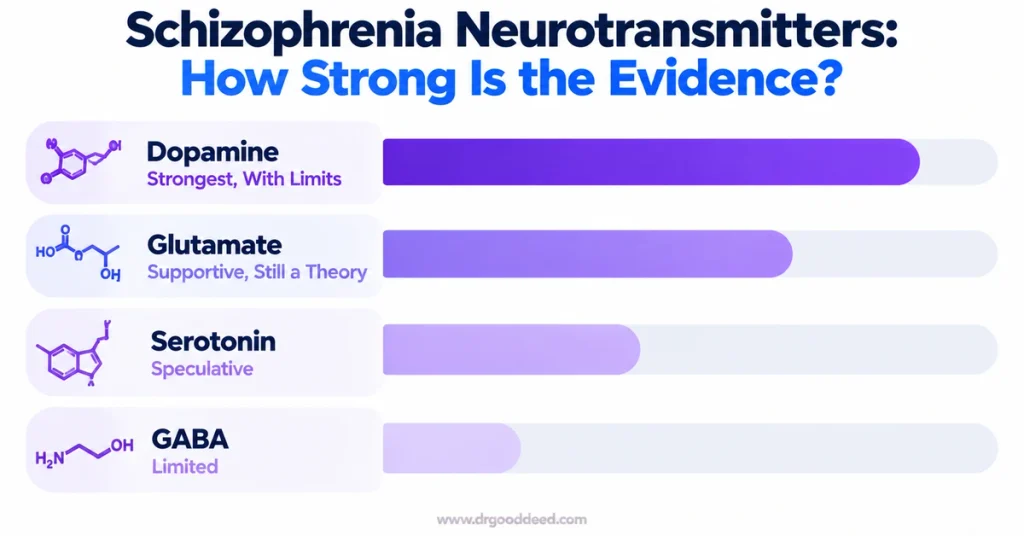
| Neurotransmitter | What the evidence suggests | How sure |
| Dopamine | Drugs that block D2 receptors treat positive symptoms. High dopamine alone does not cause it. | Strongest, with limits |
| Glutamate | Drugs that block its NMDA receptors can cause a similar psychosis. | Supportive, still a theory |
| Serotonin | Some medicines act on serotonin receptors. | Speculative |
| GABA | Named as possibly involved, with little detail. | Limited |
Schizophrenia Neurotransmitter Theories: An Overview
Every schizophrenia neurotransmitter theory is a model of how brain chemicals may affect thinking, and none explains the whole condition. Neurotransmitters are chemical messengers that pass signals between nerve cells.
- Several chemicals, not one: Dopamine and glutamate have the most support. Serotonin and GABA are named as possibly involved.
- Causes are not fully understood: Experts think genes and environment combine. Healthline also lists brain structure, pregnancy and birth complications, trauma and drug use as other factors.
- Who and when: Up to 1% of adults are affected (Healthline). NIMH says people are usually first diagnosed between 16 and 30, after a first episode of psychosis (losing touch with what is real).
- Outlook: Chronic with no cure, but manageable.
- Wording matters: A person with schizophrenia is not defined by it, and “chemical imbalance” overstates what the evidence shows.
The Dopamine Hypothesis of Schizophrenia
The dopamine hypothesis began when a drug that reduces dopamine activity treated some symptoms, but high dopamine alone does not directly cause schizophrenia. It remains the best supported theory, with clear limits.
- Origin: In the 1960s, chlorpromazine, which lowers dopamine activity, was found to ease some symptoms.
- Drug evidence: Most antipsychotics block D2 dopamine receptors (Sawa and Snyder; Healthline). Amphetamines, which release dopamine, can worsen symptoms.
- First complication: Some people with schizophrenia have typical dopamine levels in cerebrospinal fluid (the fluid around the brain and spinal cord).
- Second complication: Some medicines that do not block dopamine still treat symptoms.
- Aberrant salience: This theory proposes that extra dopamine in the mesolimbic pathway (a reward and motivation route) changes how important events seem. It is an idea, not a proven mechanism.
Glutamate and NMDA Receptor Theories
Drugs that block the NMDA receptor can cause a psychosis hard to tell from schizophrenia, which is why glutamate became a leading theory. Glutamate is the brain’s main excitatory messenger, and the NMDA receptor is one of its docking points.
- PCP evidence: PCP (phencyclidine, a dissociative drug) and ketamine block the NMDA receptor and can cause schizophrenia-like symptoms.
- Early research: Glycine, D-serine, and cycloserine act at the receptor’s co-agonist site (a second switch it needs to work). Small early studies reported symptom improvement.
- Limits: This is an early research idea, not a treatment. Nobody should take glycine or any supplement in place of prescribed medicine.
Serotonin and GABA in Schizophrenia
The role of serotonin is largely speculative. Clozapine binds serotonin 5-HT2 receptors more strongly than dopamine receptors, and newer medicines were designed with that profile, which prompted the speculation.
- Gene variant: A 5-HT2A gene variant is associated with schizophrenia, but no functional effect has been established.
- GABA: Disrupted GABA, the brain’s main calming messenger, may upset brain-wave timing that supports memory and perception.
- Why it matters: These ideas show why researchers look beyond dopamine, yet the evidence is thin.
Which Symptoms Link to Which Brain Chemicals?
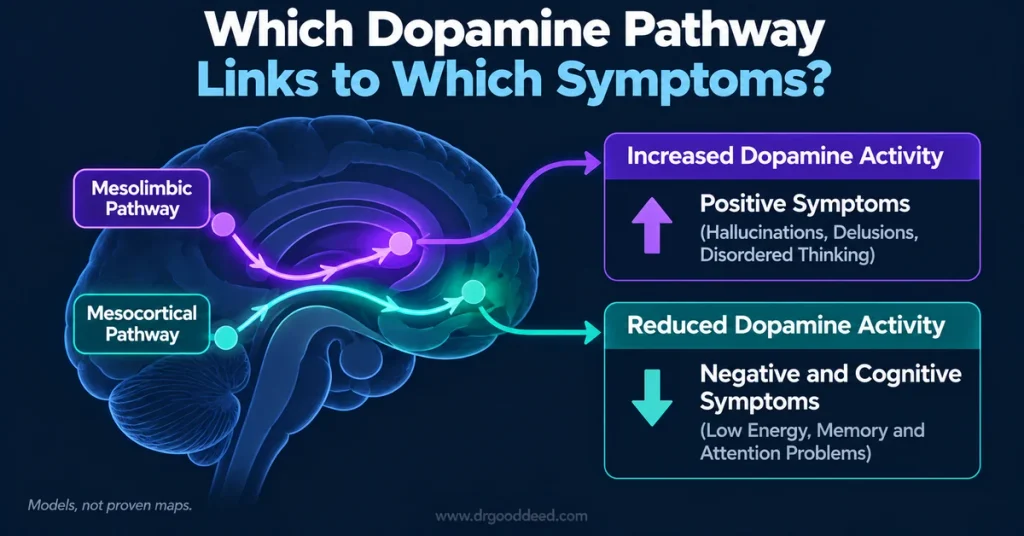
Different dopamine pathways are linked to different symptom groups, though these are models, not proven maps (Healthline).
- Positive symptoms: Hallucinations, delusions and disordered thinking are linked to increased dopamine activity in the mesolimbic pathway.
- Negative and cognitive symptoms: Apathy, low energy, and memory and attention problems are linked to reduced dopamine activity in the mesocortical pathway (a route to the thinking part of the brain).
- Treatment gap: Medicines mainly reduce positive symptoms and do little for negative and cognitive ones, which are usually addressed with psychosocial treatments such as therapy and support.
- Everyday signs: Muddled thoughts and speech, withdrawal, neglecting hygiene and emotional detachment.
How Antipsychotics Target Neurotransmitters
Antipsychotics work by blocking dopamine or other brain chemicals, and people should not stop them without speaking to their care team. They are usually the first treatment for an acute episode.
- Forms: Tablets or depot injections (long-acting shots) given every 1 to 4 weeks.
- Duration: Most people take medicine for 1 or 2 years after a first episode, and longer if symptoms return. Doctors set the plan, and dosage varies by person.
- Common side effects: Shaking, muscle twitches and spasms, drowsiness, weight gain, reduced sex drive, blurred vision, constipation, and dry mouth.
- Monitoring: Blood cholesterol, sugar and pressure may need checking. Healthline adds tardive dyskinesia (repetitive involuntary movements) and diabetes risk.
- Stopping: Do not stop without speaking to your care co-ordinator, psychiatrist or GP, because symptoms may return.
- Beyond medicine: CBT, family therapy, and arts therapy work best alongside medicine. Coordinated specialty care is the recovery-focused approach for early psychosis.
- In 2024, the FDA approved the first antipsychotic that works on muscarinic acetylcholine receptors instead of blocking dopamine.
What Neurotransmitter Theories Cannot Explain
The main weakness is that brain chemistry theories rest largely on drug effects and association data. Sawa and Snyder stated this in a 2002 review, so newer work may add detail.
- Evidence base: Theories come mostly from how drugs change symptoms, not from proven cause and effect.
- Missing tools: The review noted a lack of reliable animal models and no highly reliable candidate gene.
- Other factors: Genes, birth complications, trauma, and drug use also matter. The NHS says stressful events or drug misuse may trigger it.
- Newer work: Treatments targeting other neurotransmitters are being explored.
When to Get Help for Schizophrenia Symptoms
Contact a GP or doctor as soon as possible if symptoms appear, because earlier treatment is better. There is no single test, and diagnosis follows assessment by a mental health professional such as a psychiatrist. No brain scan or neurotransmitter test can diagnose it.
- US: Call or text 988, the 988 Suicide & Crisis Lifeline, or chat at 988lifeline.org. Call 911 in a life-threatening situation. See a primary care doctor or psychiatrist.
- UK: Phone NHS 111 at any time or use 111.nhs.uk. Ask the GP for an emergency appointment. Samaritans on 116 123 is free.
- UK emergency: Call 999 or go to A&E if someone has seriously harmed themselves or may be about to.
- Medicine: Keep taking prescribed medicine until your care team says otherwise.
| Pro Tip: Before a first assessment, write down any recreational drug use, such as amphetamines or PCP. These can worsen symptoms or cause a similar psychosis, so a clinician needs the full picture to interpret what is happening. |
FAQs
Can balancing neurotransmitters cure schizophrenia?
No. Schizophrenia is chronic and has no cure, and no single schizophrenia neurotransmitter fix exists. Treatment combines medicine, therapy and support to manage symptoms.
How common is schizophrenia?
Up to 1 percent of adults worldwide, according to Healthline. Most people are first diagnosed between ages 16 and 30, after a first episode of psychosis.
Can recreational drugs affect these neurotransmitters?
Yes. Amphetamines can worsen symptoms, PCP can cause a psychosis hard to tell from schizophrenia, and the NHS says drug misuse may trigger it. Talk to a doctor if worried.
Can glycine or other supplements treat schizophrenia?
No. Glycine, D-serine and cycloserine were tested in small early studies as add-ons, but that was research, not treatment. Never replace or stop prescribed medicine.
Sources
- Sawa and Snyder: Schizophrenia, Diverse Approaches to a Complex Disease (Science, 2002) link
- Healthline: Schizophrenia and Dopamine link
- NHS: Schizophrenia Overview link
- NHS: Schizophrenia Treatment link
- NIMH: Schizophrenia link
- NHS: Help for Suicidal Thoughts link
Medical Disclaimer: This article is for general information only and is not medical advice. It does not replace a diagnosis, treatment plan, or guidance from a qualified healthcare professional. Always talk to your doctor about your own symptoms and before starting, stopping, or changing any treatment. If you think you may be having a medical emergency, call 911 or go to your nearest emergency room.