

Glycine is an amino acid that supports several essential processes in the body, including protein production and communication between nerve cells. A glycine neurotransmitter helps regulate nerve signaling, particularly in the spinal cord and brainstem. It also participates in hearing-related processing and pain transmission. Although researchers have investigated glycine supplements for sleep and other potential health benefits, the evidence is still limited in several areas.
This guide explains its role, how its receptors function, what studies suggest about sleep, and what to consider before using supplements.
Key Takeaways
- Glycine acts as an inhibitory neurotransmitter and has the effect of reducing activity in nerve cells, particularly in the spinal cord and brainstem.
- Certain disorders that involve glycine transmission can have an effect on muscle control, movement, or a newborn’s neurological function.
- Small, short human studies suggest possible sleep benefits, but stronger research is needed.
- Glycine contributes to protein, collagen, glutathione, and creatine production.
- Consult a doctor before taking supplements, particularly during pregnancy, breastfeeding, or when using medicines.
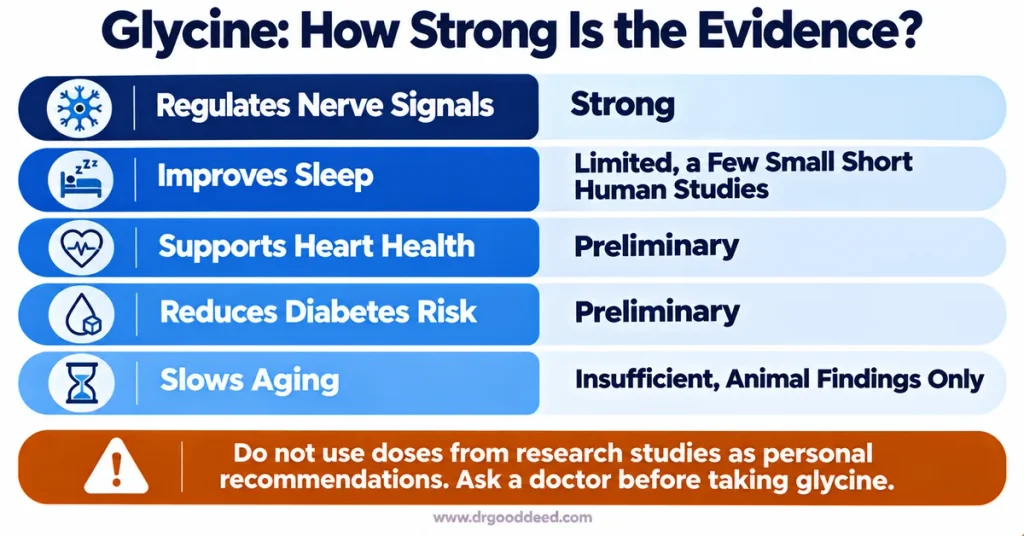
| Claim | What the evidence shows | Evidence strength |
| Regulates nerve signals | Inhibitory signaling in the spinal cord and brainstem is well established. | Strong |
| Improves sleep | A few small, short human studies suggest possible benefits. | Limited |
| Supports heart health | Observational findings are preliminary. | Preliminary |
| Reduces diabetes risk | Associations require further clinical research. | Preliminary |
| Slows aging | Animal findings do not establish benefits in humans. | Insufficient |
What Is the Glycine Neurotransmitter?
Glycine is a naturally occurring amino acid that helps build proteins and acts as an inhibitory neurotransmitter in parts of the nervous system. Glycine is the main inhibitory neurotransmitter in the spinal cord.
An inhibitory neurotransmitter makes it less likely that a nerve cell will pass on a signal. This helps to regulate communication between nerve cells and ensures that the nervous system functions in an organised way.
Glycine has several important roles:
- It helps to regulate the activity in the spinal cord and brainstem.
- The hearing function is involved in the processing within the nervous system of signals that are related to sound.
- It helps to regulate the transmission of sensory signals.
- It plays a role in the production of proteins and other necessary compounds.
Glycine is also a building block for collagen, glutathione, and creatine. These substances support connective tissue, antioxidant defenses, and energy metabolism.
Gamma-aminobutyric acid (GABA), which is also an inhibitory neurotransmitter, has a role in the regulation of nerve cell activity. Glycine and GABA take part in inhibitory signalling in various parts of the nervous system, helping to guarantee normal communication between neurons.
Glycine’s established role in the body does not automatically mean that taking extra glycine will improve sleep or prevent disease.
How Glycine Receptors Work
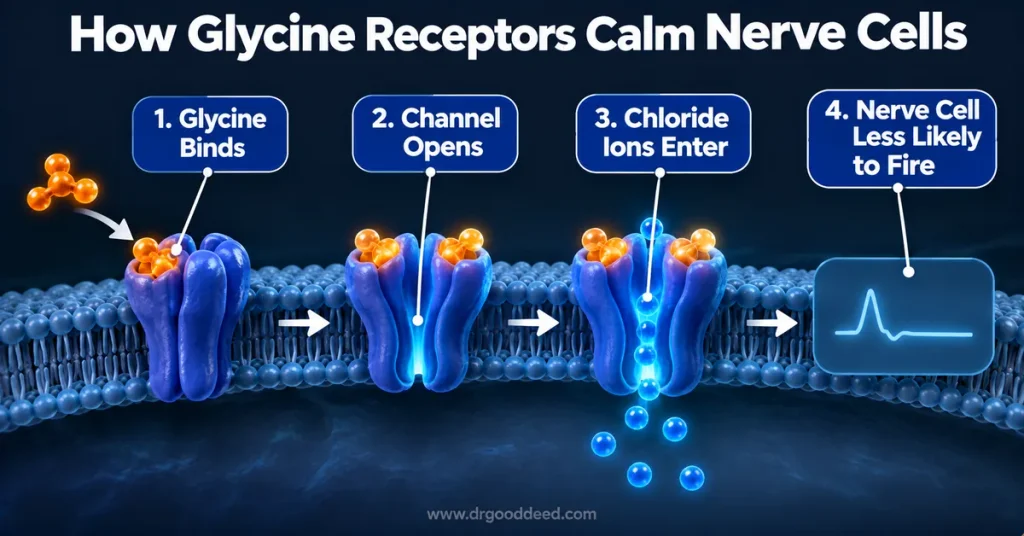
Glycine receptors are specialized channels in nerve-cell membranes that help reduce neuronal activity when glycine binds to them. They are particularly important in the spinal cord and brainstem.
The process works in a few steps:
- Glycine binds to a receptor on a nerve cell.
- The receptor opens a channel that allows chloride ions to move through the cell membrane.
- This changes the cell’s electrical state, generally making it less likely to fire a nerve impulse.
- The reduced activity helps regulate nerve signaling and motor responses.
Strychnine acts by blocking glycine receptors, which interferes with inhibitory signalling and may result in severe muscle spasms. Moreover, certain secondary scientific sources also state that caffeine functions as a competitive antagonist at these receptors, but this particular mechanism should be verified by referring to primary research before it is used in a clinical context.
Glycine works differently in the developing brain than it does in adults. In early life, it can excite nerve cells rather than calm them because immature neurons handle chloride differently. Normal glycine activity is important for coordinating movement and keeping the nervous system functioning properly.
Glycine and NMDA Receptors
NMDA receptors are involved in excitatory signaling in the nervous system, and research into glycine’s relationship with these receptors helps explain certain neurological conditions.
In nonketotic hyperglycinemia, also called glycine encephalopathy, excessive glycine accumulation in the brain can overstimulate NMDA receptors. This contributes to neurological problems associated with the disorder. Specialist-directed treatment may include medicines that target NMDA receptor activity.
It has also been suggested that the possible impact of glycine on sleep might be due to its action on NMDA receptors in the suprachiasmatic nucleus, a part of the brain which helps to regulate circadian rhythms. Yet this is still only a proposed mechanism and not an accepted explanation of how glycine brings about sleep benefits.
Glycine Signaling Disorders
Disorders that result from disrupted glycine signaling are rare neurological or inherited metabolic conditions, and they are different from those caused by normal dietary glycine intake since they are not the result of taking a typical glycine supplement.
Important examples include:
- Hyperekplexia: A rare neurological disorder that can cause an exaggerated startle response and temporary muscle stiffness. Severe episodes may lead to falls.
- Stiff person syndrome: Some cases have been linked to changes in the GLRA1 gene, which is involved in glycine receptor function. Not all cases have this association.
- Nonketotic hyperglycinemia: Also called glycine encephalopathy, this rare inherited metabolic disorder causes glycine to accumulate in the body and brain.
In severe, classic nonketotic hyperglycinemia, symptoms may appear during the first week of life. These can include low muscle tone, seizures, and breathing difficulties.
The condition is inherited in an autosomal recessive manner through families. If both parents have a disease-causing variant, each pregnancy has a 25% chance of an affected child .
These disorders require specialist assessment. Their genetic or metabolic causes should not be confused with the effects of food or over-the-counter supplements.
Glycine for Sleep: What Research Shows
Research into the use of glycine for inducing sleep indicates that there may be some advantages, but it has not yet been established whether glycine supplements actually improve sleep in humans. The human studies that are currently available are small and of short duration.
It has been suggested that glycine might have an effect on sleep by helping to reduce core body temperature, since this kind of physiological change is linked to normal sleep onset. Yet the results from animal experiments do not always lead to any meaningful benefits for humans.
A systematic review from 2023, which was published in GeroScience, looked at 50 studies involving the administration of glycine to humans. In three small studies that lasted between two and four days, improvements in sleep quality, alertness, or fatigue were reported among healthy adults.
The authors of the review stressed that the evidence showing benefits for healthy people is still very limited. GeroScience: Some limitations are important when interpreting these results:
- The studies involved small numbers of participants or short observation periods.
- Longer-term benefits and risks remain uncertain.
- Findings do not establish glycine as a treatment for insomnia.
- Some researchers in this area have worked for a glycine manufacturer, which is relevant when assessing potential conflicts of interest.
Glycine may be worth studying further, but it should not replace established sleep treatments or medical assessment for persistent sleep difficulties.
Is Glycine Supplementation Safe?
Glycine has well-established biological functions, but many claims about additional health benefits remain preliminary. Its role in normal metabolism is better established than claims that supplements prevent disease.
- Protein and collagen production: Glycine contributes to proteins and collagen, which support connective tissues such as skin, tendons, and cartilage.
- Antioxidant production: It is one of the building blocks of glutathione, an antioxidant involved in protecting cells.
- Glycine plays a role in the formation of creatine, which in turn helps muscles and other tissues to manage energy.
- With respect to heart health, observational studies have found associations between glycine levels and cardiovascular markers, but the clinical benefits of taking glycine have not been proven.
- Blood sugar: Associations between glycine levels and type 2 diabetes risk do not establish that taking glycine prevents or treats diabetes.
- Psychiatric research: Glycine has been investigated as an addition to treatment in some psychiatric conditions. Findings from patient studies should not be generalized to healthy people or used to justify self-treatment.
Overall, the glycine neurotransmitter system is an important area of neuroscience, but its established physiological roles should be distinguished from unconfirmed supplement claims.
Glycine Health Benefits: What Research Shows
A glycine supplement can have side effects, and there is no universally agreed-upon recommendation for the amount to be taken; since different doses have been studied according to published sources the results should not be regarded as suggesting a recommended dose.
The 2023 systematic review also showed that impaired sensorimotor gating and reduced cognitive performance took place after a single high dose of 0.8 grams per kilogram in healthy people. This finding underscores the importance of avoiding the idea that higher doses carry no risk.
Before considering a supplement, keep these precautions in mind:
- If you are pregnant or breastfeeding, you should ask a doctor before using it since there is limited information on safety.
- If you are taking prescribed medicines or those that are available over the counter, it is advisable to ask a healthcare professional about possible interactions.
- Side effects include nausea when large quantities are taken, and consuming too much may be harmful.
- Product quality: Dietary supplements are not evaluated in the same way as prescription medicines for premarket effectiveness and safety.
- Dose selection: Do not use doses from research studies as personal recommendations.
Glycine is also available naturally through food. Meat, fish, dairy products, beans, lentils, and gelatin contain glycine. The Sleep Foundation estimates that people typically obtain around 3 to 5 grams daily from their diet, although actual intake varies.
Magnesium glycinate is different from plain glycine. It combines magnesium with glycine and is used as a source of magnesium.
When to See a Doctor About Glycine
Speak with a healthcare professional before starting a glycine supplement if you are pregnant, breastfeeding, or taking medication. Seek medical advice for persistent sleep problems rather than relying on supplements alone.
- As to supplementation, you should ask your doctor or pharmacist regarding safety and possible interactions.
- If you are experiencing persistent sleep problems, you should see your primary care doctor in the United States or your general practitioner in the UK.
- If a baby has seizures, seems abnormally floppy, or shows breathing pauses, seek emergency care right away. In the United States, call 911 and in the UK call 999.
- Possible inherited neurological conditions: Request specialist evaluation when symptoms or family history raise concerns.
Do not stop or change prescribed medicines because of information about glycine. A clinician can help determine whether further assessment or treatment is appropriate.
FAQs
Is glycine excitatory or inhibitory?
In the mature spinal cord and brainstem glycine mainly functions as an inhibitory neurotransmitter, but its effects can be excitatory in certain developing neurons since the chloride balance changes during development.
Is magnesium glycinate the same as glycine?
Number one, magnesium glycinate involves combining magnesium with glycine. Glycine is an amino acid that helps with protein production, metabolism, and neurotransmission.
Which foods contain glycine?
Meat, fish, dairy products, beans, lentils, and gelatin contain glycine. Most people obtain it through their regular diet, although intake varies with food choices.
What is glycine encephalopathy?
Glycine encephalopathy is another name for nonketotic hyperglycinemia, a rare inherited metabolic disorder in which glycine accumulates. Severe cases can cause seizures, low muscle tone, and breathing problems in newborns.
Sources:
1.https://pubmed.ncbi.nlm.nih.gov/23038260/ link
2.https://pubmed.ncbi.nlm.nih.gov/9131721/ link
3.https://pubmed.ncbi.nlm.nih.gov/19915682/ link
4.https://pubmed.ncbi.nlm.nih.gov/15272469/ link
5.https://pubmed.ncbi.nlm.nih.gov/20301531/ link
Medical Disclaimer: The blog is provided for informational and educational use only and should not be regarded as a replacement for professional medical advice, diagnosis, or treatment. It is advisable to consult a properly qualified healthcare professional before taking glycine or any other supplement, in particular if you have a medical condition or are pregnant or breastfeeding or if you are on medication.
Medical Disclaimer: This article is for general information only and is not medical advice. It does not replace a diagnosis, treatment plan, or guidance from a qualified healthcare professional. Always talk to your doctor about your own symptoms and before starting, stopping, or changing any treatment. If you think you may be having a medical emergency, call 911 or go to your nearest emergency room.