

Neuroplasticity exercises are activities that engage the brain through physical movement, learning new skills, solving problems, and connecting with others. These activities may support brain health, although the evidence varies depending on the type of exercise. Research suggests aerobic exercise may help preserve left hippocampal volume, while the benefits of brain-training games and similar activities are less clearly established.
The aim is not to alter your brain at will, but rather to develop regular habits that stimulate your mind and contribute to your general well-being.
Key Takeaways
- Neuroplasticity exercises challenge the brain through activities such as aerobic exercise, learning new skills, and social interaction, but evidence varies by activity.
- Aerobic exercise has the strongest research support among these options, although findings are mixed.
- Small studies suggest that learning new skills may be associated with changes in brain structure.
- Brain-training games have limited evidence for improving everyday memory or preventing cognitive decline.
- After a stroke or brain injury, choose exercises with a qualified rehabilitation professional.
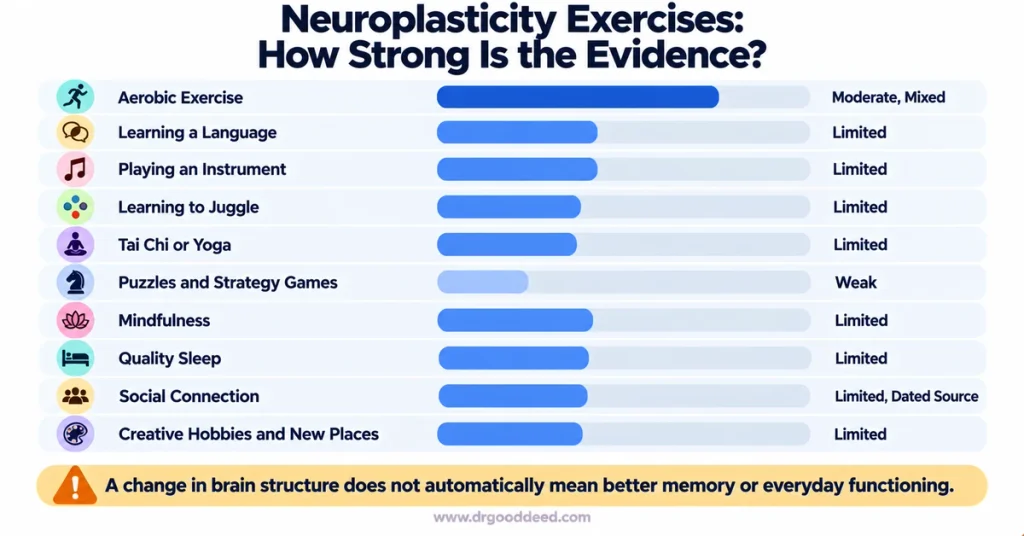
| Exercise | What the research shows | Evidence strength |
| Aerobic exercise | May help maintain left hippocampal volume; overall findings are mixed. | Moderate, mixed |
| Learning a language | Small studies reported changes in gray matter. | Limited |
| Playing an instrument | A demanding skill that may engage learning-related brain processes; specific effects are not established here. | Limited |
| Learning to juggle | A small study reported gray matter changes in a visual-processing region. | Limited |
| Tai Chi or yoga | Involves balance and coordination; brain-specific evidence was not verified in the reviewed sources. | Limited |
| Puzzles and strategy games | Broad claims about brain-training benefits are often overstated. | Weak |
| Mindfulness | May help with focus, but evidence in the reviewed sources is limited. | Limited |
| Quality sleep | Supports general health; the reviewed source did not establish a specific neuroplasticity effect. | Limited |
| Social connection | A 2014 research summary identified social activity as a promising way to support mental health. | Limited, dated source |
| Creative hobbies and new places | Small studies suggest possible benefits from creative skill learning; travel itself is not proven to improve neuroplasticity. | Limited |
What Is Neuroplasticity?
The brain’s capacity for adaptation, reorganization, and the formation of new connections in response to learning, experience, and changes in function is known as neuroplasticity, and this ability persists into adulthood. However, the degree and impact of it differ.
The brain’s ability to be plastic allows it to make adjustments as people acquire new skills, carry out various tasks, and respond to changes in their environment. Following a brain injury, in certain cases, healthy areas can take over some of the functions that have been lost as a result of consistent and repetitive practice.
That does not mean that particular exercises can at once alter the brain or ensure improved memory. The researchers have not yet determined the complete extent of the brain’s ability to adapt.
Everyday activities offer the chance to learn and to get practice. The aim is to select activities that are challenging, safe, and sustainable rather than depending on promises of quick cognitive improvement.
Do Neuroplasticity Exercises Really Work?
Some neuroplasticity exercises may support brain health, but the strength of the evidence depends on the activity, study design, and outcome measured. A change in brain structure does not automatically mean better memory, intelligence, or everyday functioning.
A meta-analysis carried out in 2018 by Firth and his colleagues looked at 14 studies with a total of 737 participants and discovered that there was no significant effect of aerobic exercise on the total hippocampal volume. However, it did find a positive effect on the left hippocampal volume. The authors believed that exercise might help in maintaining this area, but the results do not prove that there is a guaranteed benefit.
There is less evidence regarding other activities. Although small studies have shown changes in brain structure in people who were learning languages or who were juggling, these findings do not prove that there are lasting improvements in everyday cognitive performance.
The findings highlighted physical activity, learning challenging new skills, and social engagement as potentially beneficial approaches, though the source is outdated.
When evaluating a brain-health claim, ask three questions:
- How many people participated in the study?
- What did researchers actually measure?
- Did the study show a real-world benefit or only a change in a brain scan?
10 Neuroplasticity Exercises to Strengthen Your Brain
The following activities offer practical ways to challenge your brain. Some have more research support than others, so treat the evidence carefully and choose activities that fit your abilities and interests.
1. Aerobic Exercise
You can go for a walk, cycle, swim, or dance since these activities involve both physical movement and coordination and concentration. Begin with one that seems comfortable to you and then gradually increase the difficulty as your fitness level permits.
A 2018 meta-analysis of 14 studies involving 737 participants found no significant effect on total hippocampal volume but did find a positive effect on left hippocampal volume. The authors suggested that aerobic exercise may help maintain this region, although earlier human evidence was mixed. This does not prove that exercise prevents cognitive decline.
Select an activity that is safe and that you like, and if you have any health or mobility issues, follow medical advice.
2. Learning a Language
Learning a language challenges you to remember vocabulary, recognize sounds, understand grammar, and retrieve words. You can practice through conversation, reading, listening, or short lessons.
One secondary source described two small studies: one followed 10 students learning German over five months, while the other studied 14 adult interpreters over three months. In both cases, small changes in brain structure were reported. However, these findings do not prove that learning a language improves memory in every adult.
Begin with a language that you are interested in and practice regularly instead of concentrating on speed.
3. Playing an Instrument
One secondary source referred to two small studies: in one, 10 students who were learning German for five months were followed, and in the other, 14 adult interpreters were studied over a period of three months. In both cases, changes in brain structure were reported, but the original studies were not examined for this article. Nevertheless, these findings do not prove that learning a language improves memory in every adult.
Begin with a language that you are interested in and practice regularly instead of concentrating on speed.
4. Learning to Juggle
Juggling demands good visual tracking, a good degree of hand-eye coordination, accurate timing, and motor learning. Start off by using a single soft ball, practice simple throws, and then introduce a second ball when you are at ease doing so.
A secondary source refers to a small study which found an increase in gray matter in one of the areas involved in visual processing among adults who were learning to juggle. However, that study does not show how large the effect was, nor does it prove there are wider improvements in cognitive function.
To carry out practice in an open area and use soft objects to minimise the risk of injury.
5. Tai Chi or Yoga
Tai chi and yoga both include controlled movement, a focus on balance, coordination, and awareness of one’s body position. For those who are just starting, it is possible to choose movements that are easy for beginners or to take a class which is supervised and appropriate for your level of mobility.
Evidence for specific brain benefits from tai chi or yoga remains limited, although these activities can challenge balance, coordination, and attention.
Use modified poses or supported movements if you have balance problems, joint pain, or other physical limitations.
6. Puzzles and Strategy Games
Crossword puzzles, chess, Sudoku, and strategy games encourage planning, recall, and problem-solving. Choose tasks that are enjoyable and gradually become more challenging.
A 2014 summary from the Michael J. Fox Foundation reported that many scientists considered claims about brain-training games overstated. Brain training games can provide mental stimulation, but evidence that they reliably improve unrelated everyday tasks remains limited.
Use games as one part of a varied routine rather than as your only brain-health activity. Avoid spending long, uninterrupted periods playing games.
7. Mindfulness Practice
Mindfulness consists of focusing on your breathing, on the sensations in your body, or on your current experience. As a practice, you might do a short breathing exercise or carry out a guided body scan in a quiet environment.
Although a secondary source has described mindfulness as a possible brain exercise, the material examined failed to show a clear effect on brain structure or on long-term cognitive performance. While mindfulness might assist with focus, more evidence is still required to support the specific claims regarding neuroplasticity.
If your attention starts to drift, then gently bring it back to the point you have selected. The object of this exercise is to develop your ability to concentrate, not to get rid of all the thoughts that distract you.
8. Quality Sleep
Getting consistent and restful sleep is good for your general health and helps you feel alert so that you can learn, concentrate, and carry out the various daily activities. It is important to keep to a regular sleep schedule and to make sure your sleeping environment is comfortable.
The fact that sleep is mentioned as a brain-healthy habit in a secondary source does not mean that the evidence examined has shown a specific effect on neuroplasticity. It therefore follows that one should not make the claim that a particular sleep routine directly increases brain connections or reverses cognitive changes.
If the trouble you have with sleeping continues and it has an effect on your daily life, you should talk it over with a healthcare professional.
9. Social Connection
Conversations, shared activities, and meaningful relationships can involve listening, remembering details, interpreting social cues, and responding thoughtfully.
A summary of the findings by the Michael J. Fox Foundation from 2014 identified staying socially active, exercising, and acquiring demanding skills as promising methods of supporting mental health. Yet, this was only a rather out-of-date summary and not direct evidence that social interaction alters brain structure or prevents cognitive decline.
Allocate some time to having conversations with friends, members of your family, community groups, or people who share your hobbies. Select social activities that seem comfortable and important to you.
10. Creative Hobbies and New Places
Participating in activities such as drawing, painting, photography, doing crafts, and visiting new environments can lead to acquiring new skills and having new experiences. You should try a creative activity that involves observing details, making decisions, and practicing techniques that are unfamiliar.
A secondary source referred to a 2015 study on drawing and painting, but the original research and the effect sizes have not been verified in this article. The material currently available does not show that travel itself leads to an improvement in neuroplasticity.
Focus on learning something new rather than expecting a specific brain benefit. A simple art project, a new walking route, or a different creative technique can provide a manageable challenge.
Build a Weekly Routine for Brain Exercises
A realistic routine of brain exercises combines physical activity, learning a new skill, and social interaction. You do not need to attempt all 10 activities at once. Choose a few that fit your schedule, interests, and physical abilities.
What is more important than the number of activities you carry out is consistency and regular practice. This sample routine should be regarded as a flexible starting point, not as a medically approved prescription.
| Day | Activity idea | Main challenge |
| Monday | Walking or cycling | Movement and coordination |
| Tuesday | Language practice | Learning and recall |
| Wednesday | A conversation or group activity | Social engagement |
| Thursday | Music or drawing | Skill development |
| Friday | A puzzle or strategy game | Problem-solving |
| Saturday | Beginner yoga or tai chi | Balance and coordination |
| Sunday | A creative hobby or new route | Exploration and learning |
Helpful ways to make the routine sustainable:
- Start by choosing two or three activities.
- Select tasks that are difficult but can be handled.
- Practice skills regularly in order to reinforce learning.
- As your confidence increases, the difficulty should be increased gradually.
- Stop to take breaks and don’t have long, continuous sessions in front of the screen.
- Adjust activities to your health, mobility, and energy levels.
There is no single routine proven to maximize neuroplasticity for everyone. Focus on sustainable habits rather than quick fixes.
Neuroplasticity Exercises After Brain Injury
Following a stroke or a brain injury, neuroplasticity can assist the brain in adapting as a result of consistent practice. Nevertheless, the extent of recovery is different for each individual, and therefore rehabilitation exercises should be chosen in accordance with the person’s specific condition, abilities, and recovery objectives.
A physical therapist, an occupational therapist, or a speech therapist will be able to suggest suitable activities and modify them as the person’s condition changes. The type of rehabilitation carried out will depend on the individual’s needs and may include walking, balance, hand coordination, communication, or carrying out everyday tasks.
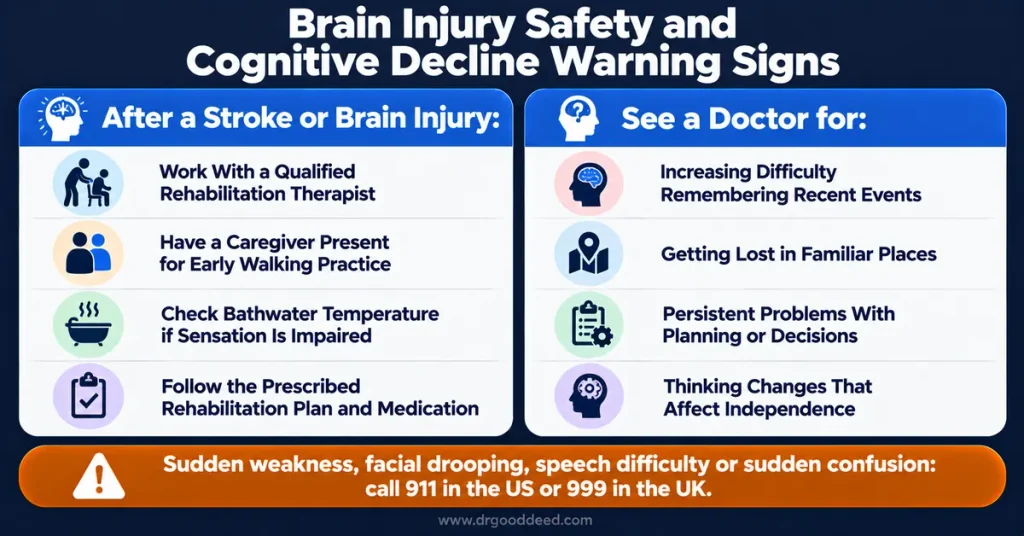
- Important safety measures include:
- It is advisable to work with a qualified rehabilitation therapist.
- It is important to have a caregiver present when carrying out the early heel-to-toe walking practice.
- If you have impaired sensation, then check the temperature of the bathwater first.
- Follow the prescribed rehabilitation plan and medication instructions.
- Stop an activity and seek guidance if it causes concerning symptoms.
Neuroplasticity exercises are not a substitute for medical treatment, prescribed medication, or professional rehabilitation. Do not change or stop medication without consulting the treating clinician.
Cognitive Decline Signs: When to See a Doctor
The fact that someone sometimes forgets doesn’t mean that there’s necessarily a medical issue involved. But if there are new memory or thinking difficulties that get worse and interfere with everyday life, it’s advisable to have them assessed by a healthcare professional.
Arrange a medical review if you or someone close to you experiences:
- Increasing difficulty remembering recent events or familiar information.
- Being lost in places one knows well or having difficulty with everyday tasks.
- Persistent problems with planning, concentration, or decision-making.
- Changes in thinking that progressively affect independence.
In the US, contact a primary care clinician. In the UK, arrange a GP appointment or contact NHS 111 for advice.
Seek emergency care immediately for sudden weakness, facial drooping, speech difficulties, or sudden confusion. These can indicate a stroke. Call 911 in the US or 999 in the UK, or go to the nearest emergency department (A&E in the UK).
Do not assume that new cognitive symptoms are simply part of aging. A clinician can assess possible causes and recommend appropriate care.
Frequently Asked Questions
Can you rewire your brain as an adult?
Yes, the adult brain can adapt and form new connections. However, no exercise has been shown to rewire the brain on demand, and the limits of neuroplasticity remain uncertain.
Do brain training games work?
Although they can offer a mental stimulus, the evidence regarding general improvements in everyday memory and thinking is still very limited.
Can neuroplasticity exercises prevent dementia?
No specific neuroplasticity exercise has been established as a way to prevent dementia. Regular physical activity and other healthy habits may support overall health, but they do not guarantee prevention.
Can neuroplasticity exercises help after a stroke?
Yes, it is true that therapist-led practice, when carried out repeatedly, can help people recover some of their functions following a stroke; the exercises should be adapted to the individual’s specific needs and must not take the place of medical treatment or rehabilitation.
Sources:
1. [Article indexed as PMID 29113943]. PubMed. Available from: https://pubmed.ncbi.nlm.nih.gov/29113943/ link
2. [Article indexed as PMID 27697851]. PubMed. Available from: https://pubmed.ncbi.nlm.nih.gov/27697851/ link
3. Flint Rehab. Neuroplasticity Exercises [Internet]. Available from: https://www.flintrehab.com/neuroplasticity-exercises/ link
4. Michael J. Fox Foundation for Parkinson’s Research [Internet]. Available from: https://www.michaeljfox.org/ link
Medical Disclaimer: This article is for general information only and is not medical advice. It does not replace a diagnosis, treatment plan, or guidance from a qualified healthcare professional. Always talk to your doctor about your own symptoms and before starting, stopping, or changing any treatment. If you think you may be having a medical emergency, call 911 or go to your nearest emergency room.