Finding the best night guard for teeth grinding and headaches starts with understanding why grinding happens. Bruxism affects an estimated 8 to 31 percent of American adults and often shows up first as morning headaches, jaw soreness, or worn teeth.
The right guard protects your enamel and can ease jaw-muscle strain, but it only works when the underlying cause is grinding itself and not an airway problem during sleep. This guide covers the TMJ-headache connection, sleep apnea screening, material choices, and how to pick a guard that actually fits your case.
Key Takeaways
- Bruxism can be a symptom of obstructive sleep apnea, so a sleep evaluation should come before buying a guard.
- Custom night guards made from hard acrylic protect teeth more reliably than soft, over-the-counter versions for moderate to severe grinding.
- Soft, over-the-counter guards can worsen clenching in some people because the give of the material invites more biting force.
- Headaches linked to grinding usually center at the temples and often accompany jaw popping, ear pressure, or morning jaw fatigue.
- The best night guard for teeth grinding and headaches addresses fit, material, and retention together.
How Teeth Grinding Causes Headaches (The TMJ-Nerve Connection)
Grinding overworks the temporalis and masseter muscles, which attach near the temporomandibular joint (TMJ) and share nerve pathways with the head. Both muscles are innervated by branches of the trigeminal nerve, the same nerve that carries pain signals from the face and teeth.
Repeated clenching sends nociceptive signals through this shared pathway, which the brain often interprets as a band-like headache around the temples.
- Trigeminal referral: The trigeminal nerve’s mandibular and maxillary divisions supply the jaw muscles and teeth, so muscle strain from grinding can be felt as head pain instead of jaw pain, a pattern clinicians call referred pain.
- Temporalis muscle fatigue: Since the temporalis muscle sits directly over the temple and closes the jaw during grinding, sustained overuse produces a tight, pressing headache that many people mistake for tension headache or migraine.
- Trigeminocervical overlap: Nerve signals from the jaw and upper neck converge in the brainstem, which is why some grinders also report pain radiating toward the back of the head or upper neck.
- Jaw popping and ear pain as a warning sign: Clicking or popping when opening the mouth, along with localized pain in front of the ear, points to TMJ joint involvement rather than muscle strain alone, and it often needs a dental exam before a guard is fitted.
TMJ-related headaches respond differently than typical tension headaches because they trace back to a mechanical uneven bite force on a joint and muscle group.
Before You Buy: Rule Out Sleep Apnea First
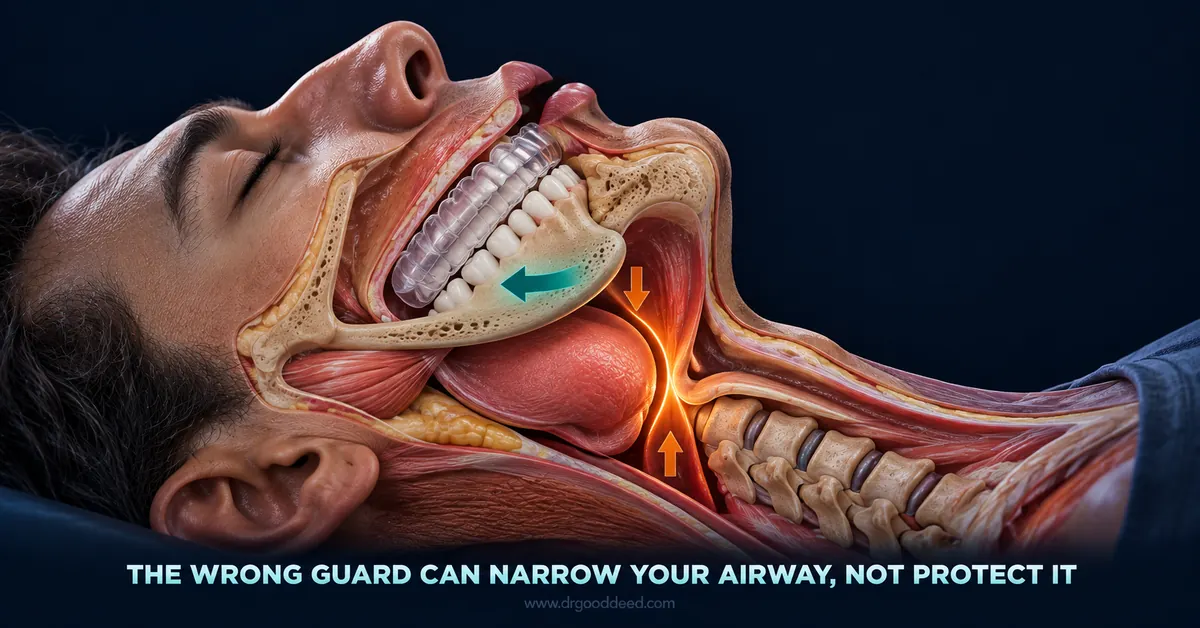
Buying the best night guard for teeth grinding and headaches without checking for sleep apnea can backfire. Sleep bruxism frequently occurs alongside obstructive sleep apnea (OSA), and in some patients grinding is the body’s response to an airway that keeps narrowing during sleep.
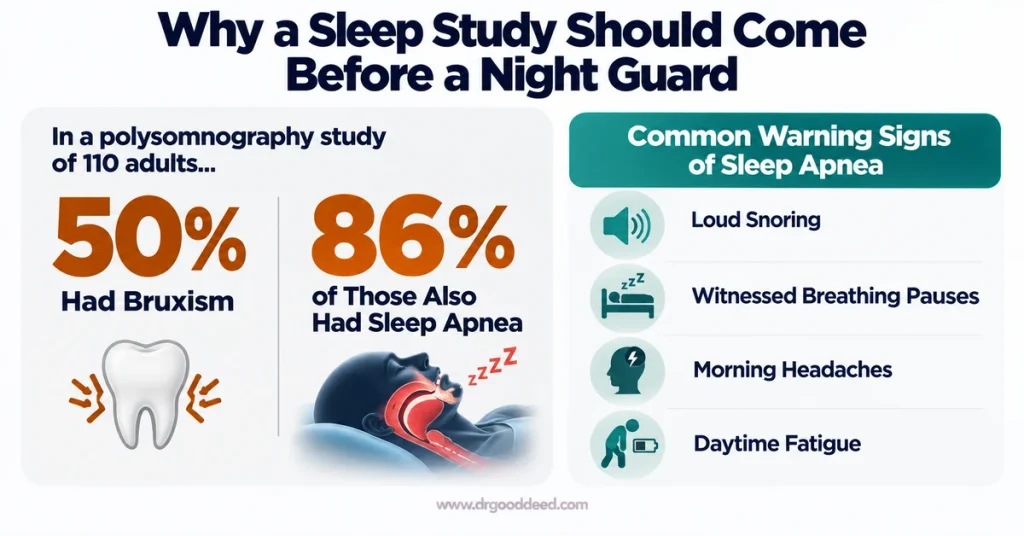
- The overlap is well documented: A polysomnography study of 110 adults found bruxism episodes in 50 percent of participants, with OSA present in over 86 percent of the same group, confirming a strong statistical co-occurrence.
- Grinding can be a protective reflex: Researchers have proposed that jaw movements during bruxism episodes help reopen a partially blocked airway, meaning the grinding is a symptom of the apnea event, not an isolated habit.
- A standard night guard can make OSA worse: Sleep specialists note that some occlusal guards reposition the jaw in a way that narrows airway space further, which can increase apnea severity in undiagnosed patients.
- Warning signs to flag before buying: Loud snoring, witnessed pauses in breathing, morning headaches, and daytime fatigue alongside teeth grinding all warrant a referral for a sleep study before fitting any guard.
- Mandibular advancement devices differ from standard night guards: When OSA is confirmed, dentists sometimes prescribe a mandibular advancement device instead of a flat occlusal guard, since it is designed to hold the airway open rather than simply separate the teeth.
Anyone with apnea symptoms needs a sleep evaluation first, because the wrong appliance can worsen breathing at night.
Custom vs. Over-the-Counter Night Guards
Fit determines whether a night guard actually protects your teeth or ends up in a drawer after a week. Custom night guards are built from a dental impression, while over-the-counter versions rely on a generic mold or a home boil-and-bite process.
| Feature | Custom Night Guard | Over-the-Counter Guard |
| Fit | Matches exact bite, made in a dental lab | Approximate, shaped by the wearer at home |
| Material | Dense hard acrylic or dual-laminate | Softer thermoplastic |
| Durability | Lasts 3 to 5 years with care | Often wears through within months of heavy grinding |
| Cost | Higher upfront, dentist-fitted | Lower upfront, drugstore purchase |
| Best for | Moderate to severe bruxism, TMJ symptoms | Mild, occasional grinding as a short-term measure |
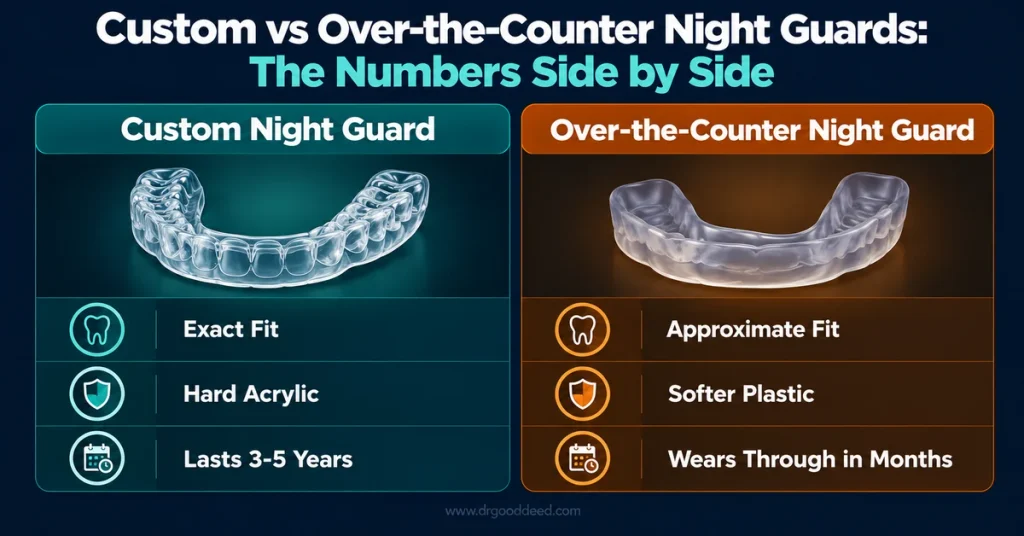
For anyone with visible tooth wear, morning headaches, or jaw soreness, a custom night guard distributes grinding force more evenly and stays seated through the night. Over-the-counter guards can serve as a temporary bridge, but dental sources note they tend to compress and lose protective thickness faster under heavy grinding forces.
Comparing Night Guard Materials
Material choice affects both comfort and how well a guard withstands nightly grinding force, which can reach well beyond normal chewing pressure.
Hard Acrylic (The Clinical Gold Standard)
Hard acrylic guards are the material dentists most often recommend for moderate to severe bruxism. The rigid surface resists wear from heavy grinding and holds its shape for years rather than compressing under pressure. Dentists typically reserve this material for patients who have already damaged teeth or restorations from clenching.
Soft Plastic (And the Clenching Biofeedback Trap)
Soft plastic guards feel comfortable at first, but the cushioned surface can encourage more clenching rather than less. Dental clinicians describe this as a biofeedback trap: the give of the material invites the jaw muscles to bite down harder, which can worsen bruxism intensity over time. Soft guards are generally better suited to occasional, light grinding or short-term use.
Thermoplastic “Boil-and-Bite” Trays
Boil-and-bite trays soften in hot water and are shaped by biting into them at home. They offer a low-cost, immediate option, but the fit depends entirely on how evenly the wearer presses down during molding. Uneven fit can shift during sleep, reducing protection and sometimes irritating gum tissue.
What to Look for When Buying a Dental Guard
Choosing the best night guard for teeth grinding and headaches means checking a short list of features before purchase, since price and marketing claims do not reliably predict fit.
- Retention and stability matter most: a guard that shifts or loosens overnight offers little protection no matter how thick the material is.
- Look for a design that covers all upper or lower teeth evenly, since partial coverage can let opposing teeth grind past unprotected edges.
- Bite-shift prevention is another overlooked factor, since a guard that changes jaw position over months can create a new bite problem.
- Thickness should match grinding severity, with 1 to 2 millimeters typically sufficient for mild grinders and thicker acrylic reserved for heavy grinders with existing tooth damage.
A Night Guard Alone May Not Be Enough: Holistic Daytime Adjustments
A guard protects teeth overnight, but daytime habits often drive the muscle tension behind grinding-related headaches.
- Jaw rest position awareness: Teeth should stay slightly apart at rest, with lips closed and tongue resting on the roof of the mouth, since daytime clenching often carries into sleep.
- Stress and cortisol connection: Bruxism correlates strongly with psychological stress, so relaxation techniques or short breathing exercises before bed can reduce nighttime muscle activity.
- Caffeine and alcohol timing: Both substances are associated with increased bruxism episodes, and cutting intake several hours before sleep can lessen grinding frequency.
- Posture and screen habits: Forward head posture during phone or computer use increases strain on jaw and neck muscles, compounding TMJ-related headache risk.
Pro Tip: Track headache timing against grinding nights using a simple morning log. If headaches cluster the day after high-stress evenings or late caffeine, that pattern points toward a behavioral trigger a night guard alone cannot fix.
When to See a Doctor or Dentist
Some symptoms signal that a night guard is not enough on its own and need professional evaluation first.
- Jaw locking or an inability to fully open the mouth
- Headaches that wake you from sleep or worsen despite guard use
- Witnessed breathing pauses, gasping, or loud snoring during sleep
- Visible cracks, flattening, or chips on teeth
- Ear pain or ringing alongside jaw clicking
A dentist can assess bite alignment and TMJ health, while a physician or sleep specialist can rule out obstructive sleep apnea as the underlying driver of both the grinding and the headaches.
FAQs
Can a night guard stop headaches completely?
No. A night guard reduces tooth damage and can ease muscle-related headaches from grinding, but it will not resolve headaches caused by sleep apnea, migraine, or unrelated conditions.
How long does it take a night guard to work?
Most people notice reduced jaw soreness within 2 to 4 weeks of consistent nightly use. Headache improvement varies and depends on whether grinding is the sole cause.
Are over-the-counter night guards safe to use long-term?
Not ideally. Prolonged use of soft, ill-fitting guards can worsen bite alignment and gum irritation. Dentists recommend them only as a short-term measure before a custom fit.
Can children use night guards for teeth grinding?
Yes, but only under dental supervision. Children’s jaws are still developing, so a guard must be sized and monitored by a pediatric dentist to avoid affecting bite growth.
How do you know if your headaches are from teeth grinding?
Look for temple-centered pain on waking, jaw soreness, tooth sensitivity, and a partner noticing grinding sounds. A dentist can confirm wear patterns consistent with bruxism.
Sources
- National Institute of Dental and Craniofacial Research: TMJ Disorders link
- American Dental Association MouthHealthy: Mouthguards link
- Sleep Foundation: Obstructive Sleep Apnea link
- American Academy of Dental Sleep Medicine: Oral Appliance Therapy link
- PMC: The Relationship between Sleep Bruxism and Obstructive Sleep Apnea Based on Polysomnographic Findings link
- Colgate: Over the Counter vs. Custom Night Guard, Which Is Right for You link
- Journal of Oral Rehabilitation: International Consensus on the Assessment of Bruxism link
- Sleep Review Magazine: We Haven’t Connected All the Dots Between Bruxism and Sleep Apnea link
Medical Disclaimer: This article is for general information only and is not medical advice. It does not replace a diagnosis, treatment plan, or guidance from a qualified healthcare professional. Always talk to your doctor about your own symptoms and before starting, stopping, or changing any treatment. If you think you may be having a medical emergency, call 911 or go to your nearest emergency room.