
Blue light glasses may help some people feel more comfortable while using screens, but they haven’t been shown to reliably prevent or reduce screen-related headaches.
Screen headaches are more often linked to eye strain, prolonged focusing, glare, poor lighting, dry eyes, or an incorrect prescription. Taking regular screen breaks, reducing glare, adjusting screen brightness, blinking frequently, and keeping the screen at a comfortable distance are usually more useful. If headaches are frequent or severe, an eye examination can help rule out vision problems.
Key Takeaways
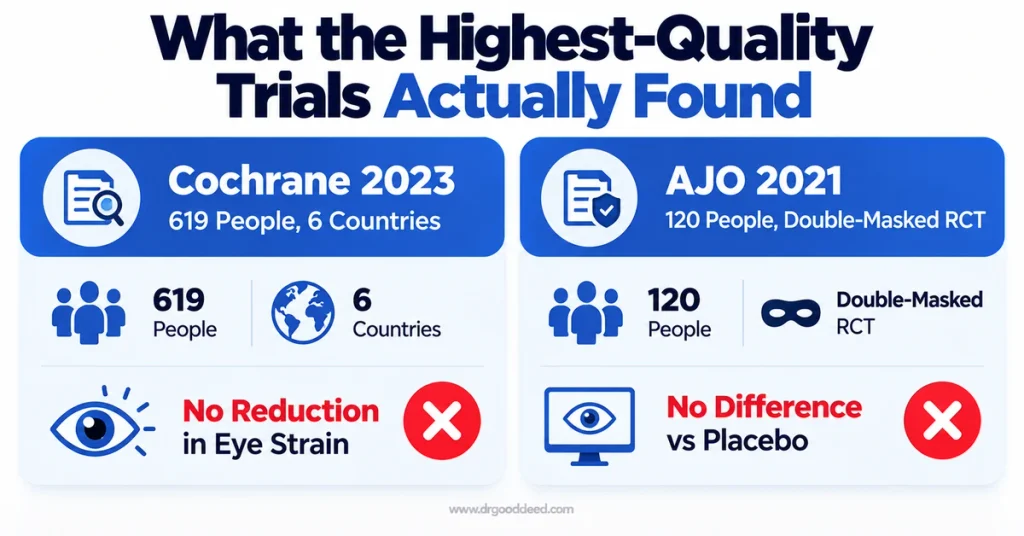
- Blue light glasses for screen headaches data from a 2023 Cochrane review of 619 participants found no meaningful reduction in eye strain versus standard lenses.
- A separate 2021 double-masked randomized controlled trial with 120 computer users found the same result, even when participants believed they had active lenses.
- The real driver of most screen headaches is computer vision syndrome, caused by reduced blinking, poor screen distance, glare, and uncorrected refractive error, not blue light exposure.
- The 20-20-20 rule, proper eyewear prescriptions, and ergonomic screen setup have stronger evidence for relieving screen-related headaches than blue light filtering lenses.
What Screen Headaches Are Actually Caused By
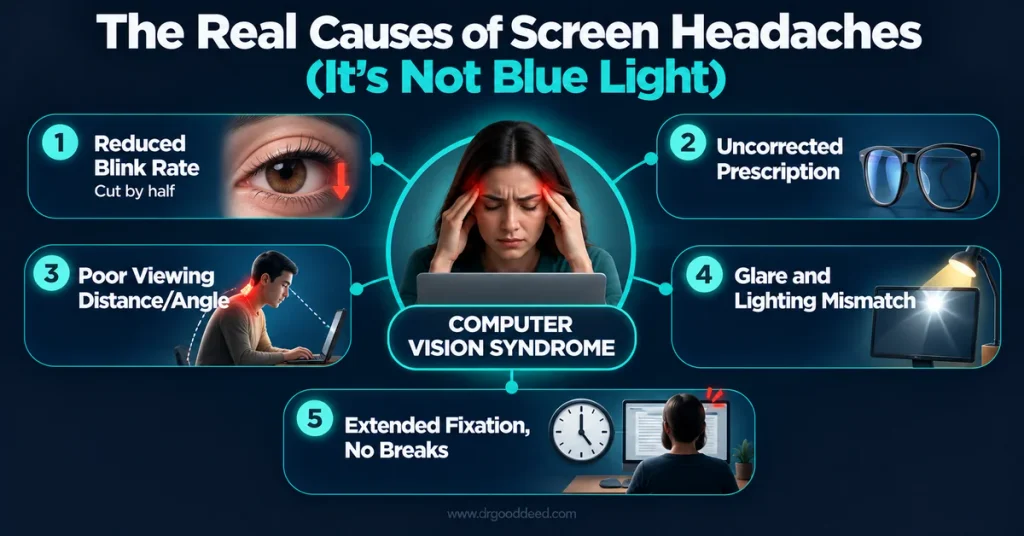
Screen headaches are rarely caused by blue light wavelengths themselves. Most discomfort traces back to computer vision syndrome, also called digital eye strain, a mechanical and behavioral problem rather than a light-exposure problem. Understanding this distinction changes how you should treat the headache.
- Reduced blink rate: People blink roughly 15 times per minute normally, but that rate drops significantly, sometimes by half, when focused on a screen, drying the eye surface and triggering headache-like discomfort around the eyes and temples.
- Uncorrected refractive error: Even a mild, unaddressed prescription change forces the eye muscles to work harder during near-distance screen tasks, producing frontal headaches by the end of a workday.
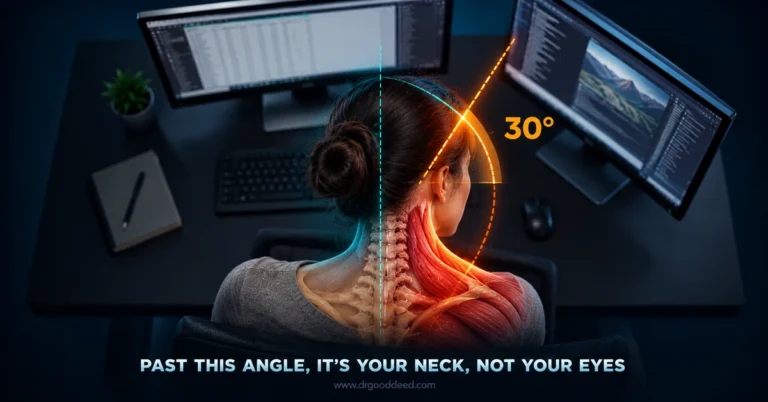
- Poor viewing distance and angle: Screens positioned too close, too far, or above eye level increase muscular strain in the eyes and neck, a factor the Occupational Safety and Health Administration addresses in its computer workstation guidelines.
- Glare and lighting mismatch: Bright overhead lighting or unshielded windows behind a monitor increase pupil workload and contribute to headache onset during extended sessions.
- Extended fixation without breaks: Continuous near-focus work without pauses does not allow the ciliary muscles inside the eye to relax, compounding strain into a dull, pressing headache.
What the Research Actually Shows About Blue Light Glasses
A blue light glasses for screen headaches comparison based on actual trial data tells a consistent story across independent research groups. Below is what the highest-quality studies found when tested head-to-head against standard clear lenses.
| Study | Design | Participants | Result |
| Singh et al., Cochrane Database of Systematic Reviews, 2023 | Systematic review of 17 RCTs | 619 people, 6 countries | No short-term reduction in eye strain from blue light filtering lenses |
| Singh, Downie, Anderson, American Journal of Ophthalmology, 2021 | Double-masked RCT | 120 symptomatic computer users | No difference in eye strain symptoms or objective fatigue measures |
| Radiology residents pilot study, cited in PMC review | Crossover pilot study | 10 residents | Improvement reported, but comparison lens had a yellow tint, not a true clear placebo |
- The 2023 Cochrane review applied GRADE certainty ratings and found low to moderate certainty evidence that blue light filtering lenses provide no measurable short-term advantage for eye strain from computer use.
- The 2021 double-masked trial randomized 120 symptomatic computer users to blue-blocking or clear placebo lenses during a two-hour computer task and found no significant difference in symptom scores or critical flicker-fusion frequency, an objective fatigue measure.
- The pilot study limitation matters clinically: earlier small studies reporting benefit compared blue light lenses against yellow-tinted lenses rather than a genuine clear placebo, which weakens the blinding and inflates apparent effectiveness.
- No meta-analysis was possible across the 17 Cochrane-reviewed trials due to inconsistent outcome measures, meaning claims of “proven” benefit overstate what the data supports.
Expert Insight: A negative Cochrane finding does not mean a product is harmful, it means the evidence for the marketed benefit does not hold up under masked testing. Clinicians should distinguish “no proven benefit” from “definitely useless,” since some patients still report subjective relief tied to placebo response or incidental screen habit changes.
Why the Marketing Claim Doesn’t Match the Science
Blue light glasses marketing often implies screen headaches result from blue wavelength exposure damaging the eye. Three factors drive the disconnect below.
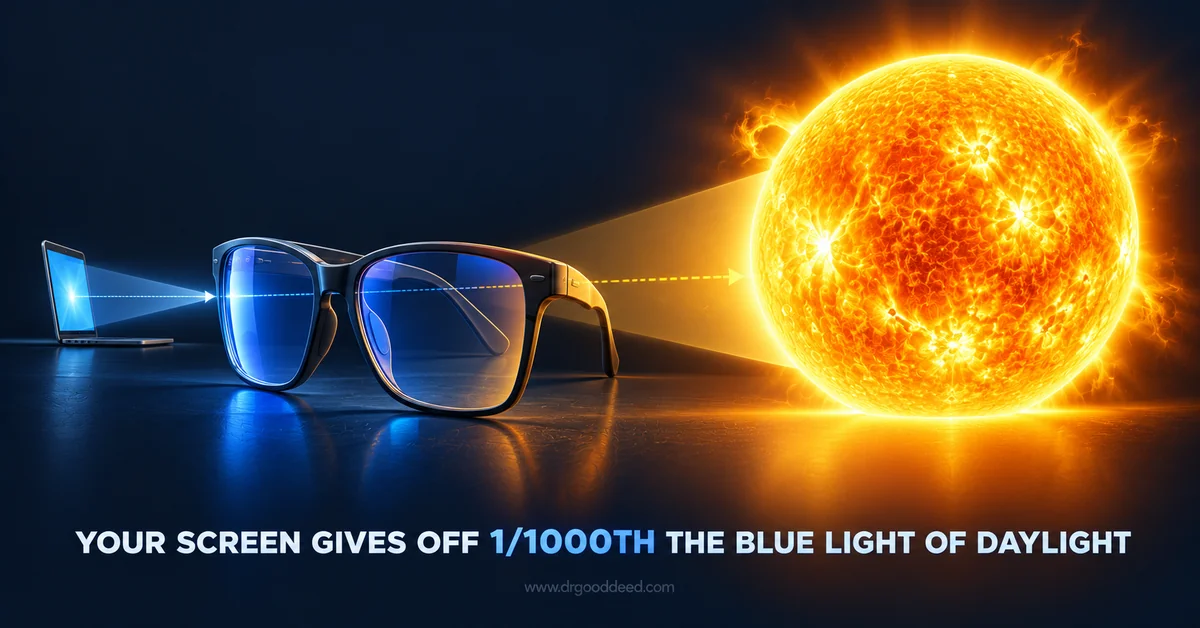
- Blue light exposure from screens is minimal: Researchers at the University of Melbourne note that daily blue light exposure from device screens is roughly a thousandth of what the eyes receive from natural daylight, undermining the premise that screens deliver a uniquely harmful dose.
- Symptom relief may reflect other changes: New glasses often come with anti-reflective coatings, updated prescriptions, or a behavioral nudge toward taking more breaks, any of which could explain reported improvement independent of the blue filter itself.
- Retail marketing predates the evidence base: Blue light lenses became widely prescribed and sold in the early 2000s, years before large randomized trials existed to test the underlying claims, according to Cochrane’s review background.
What Actually Helps With Screen Headaches
Evidence-backed strategies for reducing screen headaches focus on behavior, correction, and environment rather than lens tint.
The 20-20-20 Rule
The 20-20-20 rule asks screen users to look at an object 20 feet away for 20 seconds every 20 minutes. This brief pause allows the eye’s focusing muscles to relax and helps normalize blink rate before dryness sets in. Both major US ophthalmology and optometry associations endorse this practice as a first-line habit for digital eye strain.
Correct Prescription and Ergonomics
- Get an updated eye exam if headaches are new or worsening, since even a small uncorrected prescription change can force focusing muscles to overwork during near-distance screen tasks.
- Position screens at or slightly below eye level, about an arm’s length away, following OSHA’s computer workstation guidance to reduce neck strain and reduce the visual reach required to read text.
- Reduce glare with a matte screen filter or by repositioning the monitor away from direct light sources, since glare forces the pupils to constantly readjust.
Blink Rate and Dry Eye Management
- Consciously blink more often during screen sessions, since focused screen tasks can cut blink frequency significantly below the normal resting rate.
- Use preservative-free artificial tears when eyes feel dry, particularly during long meetings or reading sessions without natural breaks.
- Consider a humidifier in dry office or home environments, since low ambient humidity accelerates tear film evaporation and worsens dryness-related headaches.
Pro Tip: Track exactly when your screen headache starts during the workday. A headache that reliably begins after two continuous hours without a break points to fatigue and dryness, while one tied to a specific document or font size often signals an uncorrected refractive error needing a new prescription.
If You Still Want to Try Blue Light Glasses, What to Look For
If choosing this route, treat it as a low-risk personal trial rather than a proven headache treatment.
- Choose clear lenses over heavily yellow-tinted ones if color accuracy matters for your work, since yellow tints filter more blue light but distort screen colors.
- Pair the glasses with proven habits, including the 20-20-20 rule and regular breaks, rather than relying on the lenses alone to resolve symptoms.
- Prioritize an updated prescription first, since uncorrected vision problems are a documented cause of screen headaches that lens tint cannot fix.
- Set a realistic trial period, such as two to three weeks, and track headache frequency to see if the lenses make an actual measurable difference for you specifically.
When to See a Doctor
Persistent screen headaches deserve a professional evaluation rather than repeated product trials. See an eye doctor or physician if headaches occur most days, worsen despite ergonomic changes, or come with blurred vision, eye pain, or visual disturbances. These symptoms may indicate an uncorrected refractive error, dry eye disease, or a headache disorder unrelated to screen use that requires targeted treatment.
FAQs
Do blue light glasses help with sleep even if they don’t help headaches?
Evidence is mixed and inconclusive. The 2023 Cochrane review found unclear effects on sleep-related outcomes, so blue light glasses should not be relied on as a sleep aid.
Can blue light glasses cause any harm?
No documented direct harm exists. Heavily tinted lenses can distort screen colors and reduce contrast, which may cause more visual fatigue during detailed color-dependent work.
Is computer vision syndrome the same as a migraine?
No. Computer vision syndrome causes eye strain, dryness, and tension-type headaches from screen use, while migraine involves distinct neurological mechanisms, often with light sensitivity and nausea.
How long should screen breaks be?
Take a 20-second break every 20 minutes using the 20-20-20 rule, plus a longer 15-minute break after two continuous hours of screen use.
Can children benefit from blue light glasses?
Evidence in children is limited. Pediatric eye organizations recommend correcting refractive errors and enforcing screen breaks over prescribing blue light filtering lenses.
Sources
- Singh S, Keller PR, Busija L, et al. Blue-light filtering spectacle lenses for visual performance, sleep, and macular health in adults. Cochrane Database of Systematic Reviews, 2023. link
- Singh S, Downie LE, Anderson AJ. Do blue-blocking lenses reduce eye strain from extended screen time? A double-masked, randomized controlled trial. American Journal of Ophthalmology, 2021. link
- American Academy of Ophthalmology. Are Blue Light-Blocking Glasses Worth It? link
- American Academy of Ophthalmology. Digital Devices and Your Eyes. link
- American Academy of Ophthalmology. Should You Be Worried About Blue Light? link
- American Optometric Association. Computer Vision Syndrome (Digital Eye Strain). link
- Impact of blue light filtering glasses on computer vision syndrome in radiology residents: a pilot study. PMC. link
- Cochrane. Blue-light filtering spectacles probably make no difference to eye strain, eye health or sleep quality. link
- Occupational Safety and Health Administration. Computer Workstations eTool, Monitors. link
- American Optometric Association. Most Americans Experience Digital Eye Strain from Overexposure to Computers. link
Medical Disclaimer: This article is for general information only and is not medical advice. It does not replace a diagnosis, treatment plan, or guidance from a qualified healthcare professional. Always talk to your doctor about your own symptoms and before starting, stopping, or changing any treatment. If you think you may be having a medical emergency, call 911 or go to your nearest emergency room.