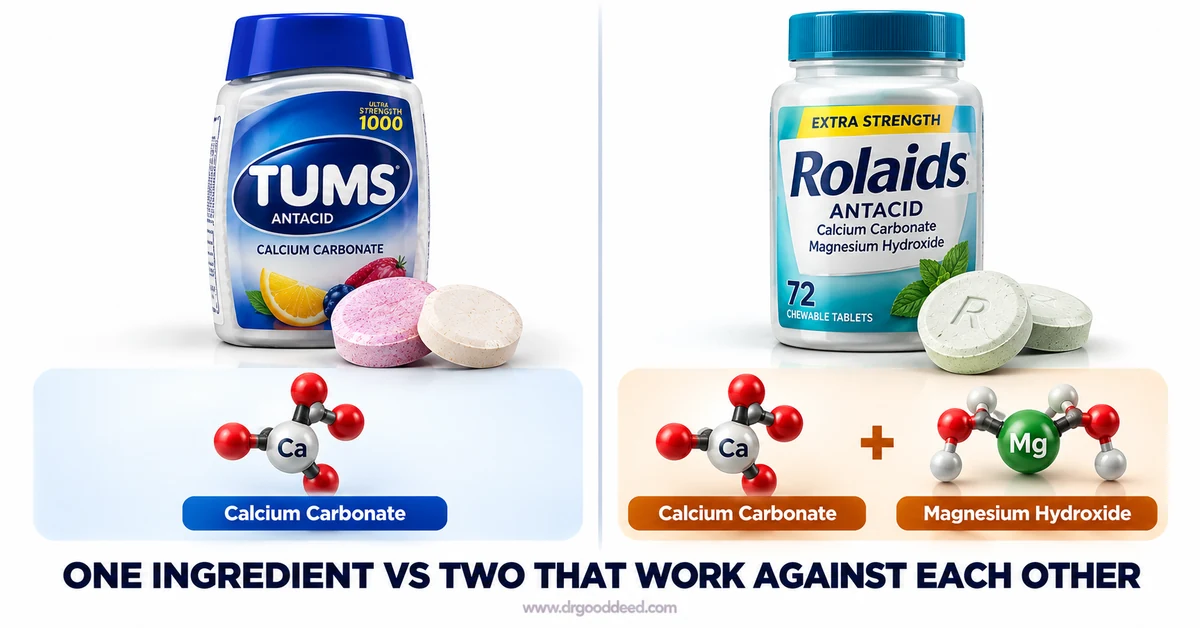

Tums vs Rolaids: Both are OTC antacids that relieve heartburn and indigestion, but they work a little differently. Tums contains calcium carbonate and is a simple, fast-acting option, while Rolaids typically contains calcium carbonate plus magnesium hydroxide, which can provide strong acid neutralization and may work longer.
Tums may be preferable if you want calcium-based relief, whereas Rolaids may be useful if you also want the added effect of magnesium. This guide breaks down what’s actually inside each tablet, what that means for constipation risk and calcium supplementation, and when occasional heartburn stops being a chew-a-tablet problem.
Key Takeaways
- Tums contains only calcium carbonate. Rolaids contains calcium carbonate plus magnesium hydroxide.
- The added magnesium in Rolaids can offset the constipating effect of calcium carbonate, though results vary by person.
- Neither product is meant for daily, long-term use. Both labels cap use at two weeks without a doctor’s supervision.
- Tums’ plain calcium carbonate formula is sometimes used off-label as a calcium source. Rolaids’ combined formula is not an equivalent substitute.
- Frequent heartburn, needing an antacid most days, or symptoms lasting beyond two weeks warrant a doctor’s evaluation.
Tums vs Rolaids at a Glance (Comparison Table)
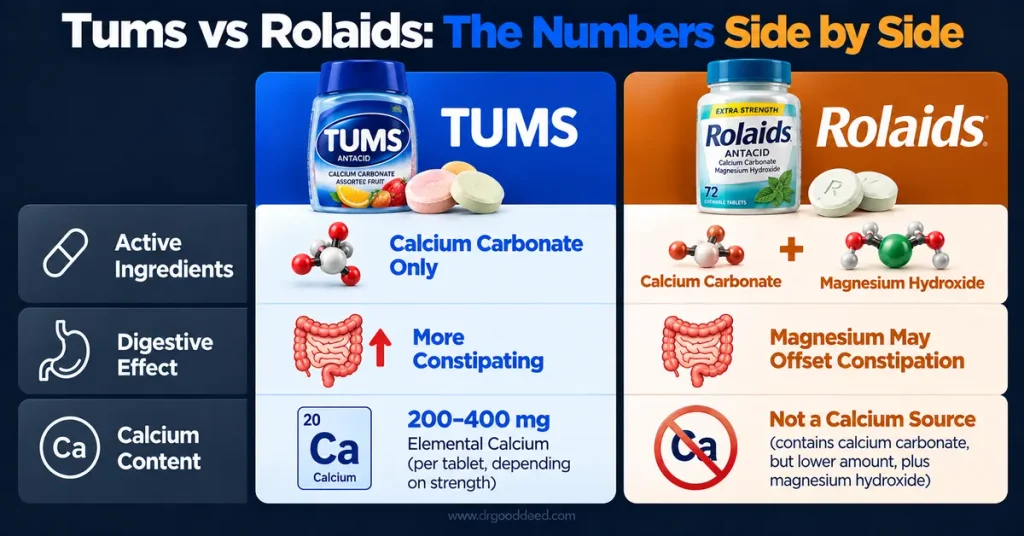
Both Tums and Rolaids treat heartburn, sour stomach, and acid indigestion. The formula difference below is where Tums vs. Rolaids actually splits, and in how it behaves once it’s working.
| Feature | Tums | Rolaids |
| Active ingredients | Calcium carbonate only | Calcium carbonate + magnesium hydroxide |
| Typical effect on digestion | More likely to cause constipation with regular use | Magnesium may offset constipation; can loosen stools in some people |
| Calcium content (per standard tablet) | Roughly 200 to 400 mg elemental calcium, varies by product | Present, but formula is not designed as a calcium source |
| Common uses | Heartburn, acid indigestion, occasional calcium supplementation | Heartburn, acid indigestion, faster-acting relief for some users |
What Is Tums?
Tums is a calcium carbonate antacid first sold in 1930. It neutralizes stomach acid on contact, the same chemistry your chemistry teacher demonstrated with baking soda and vinegar, just tamed into a chewable tablet.
- A standard Tums Ultra Strength tablet supplies 1,000 mg of calcium carbonate, about 410 mg of elemental calcium, according to the manufacturer’s drug facts label.
- Because calcium carbonate is also a recognized calcium source, some people use Tums as a low-cost calcium supplement alongside its intended use for heartburn.
- If nighttime burning sends you searching for relief, this overlaps with what we cover in waking up with chest pain, where Tums and Rolaids both show up as first-line options.
What Is Rolaids?
Rolaids pairs calcium carbonate with magnesium hydroxide, the same compound found in milk of magnesia.
- A Rolaids Ultra Strength tablet contains 1,000 mg of calcium carbonate and 200 mg of magnesium hydroxide, per its FDA drug facts label on DailyMed.
- That second ingredient is a mild laxative in its own right.
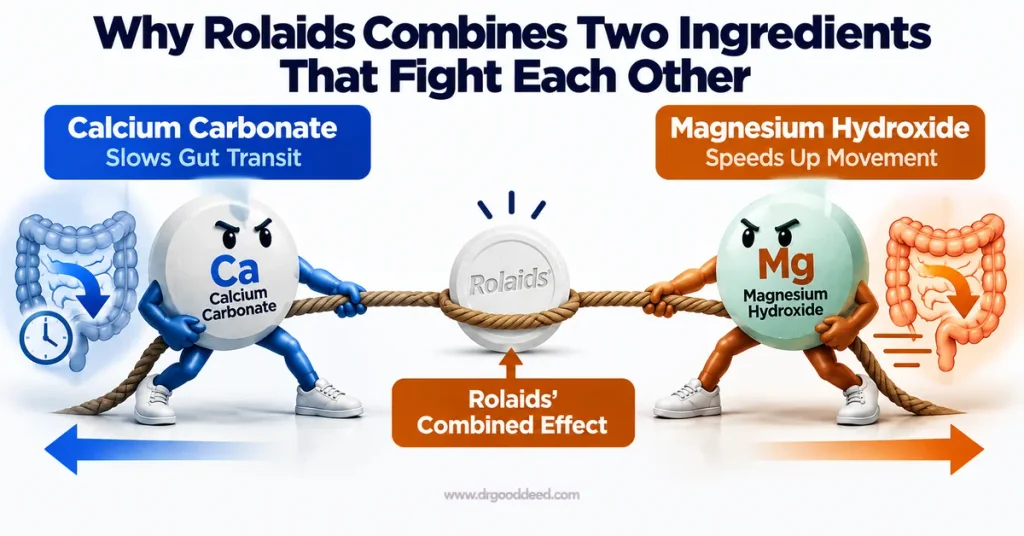
- The combination is designed so the two ingredients work against each other’s side effects.
- Calcium carbonate alone tends to slow the gut down. Magnesium hydroxide tends to speed it up.
Tums vs Rolaids: Key Differences
The active-ingredient gap between Tums vs Rolaids drives into how each affects your bowels, whether either doubles as a calcium supplement, and how each is metabolized. Here’s each one broken down.
Active Ingredients: Tums vs Rolaids
- Tums: Calcium carbonate is the sole active ingredient across every Tums variant, from Regular Strength to Tums Ultra 1000. It neutralizes acid quickly and is the version marketed for calcium supplementation.
- Rolaids: Adds magnesium hydroxide to calcium carbonate in most current formulations. Check the drug facts panel on the specific product you buy, since store shelves also stock Rolaids Extra Strength and Rolaids Advanced, which vary in ratio.
Constipation Risk: Tums vs Rolaids
- Calcium carbonate on its own is documented to slow intestinal transit, which is why regular Tums users sometimes report constipation, particularly at higher, more frequent doses.
- Magnesium hydroxide pulls water into the intestine and stimulates movement, the opposite mechanism, and the reason milk of magnesia is sold as a laxative at higher doses.
- In Rolaids, magnesium hydroxide is dosed to counterbalance calcium carbonate’s constipating tendency, not to actively purge the system. Some users still notice looser stools; others notice no change at all.
If you already deal with constipation, Rolaids’ added magnesium may be the more comfortable daily-use pick. If you have a history of loose stools or IBS-D, Tums’ calcium-only formula may sit better.
Using Tums or Rolaids as a Calcium Supplement
- Tums is genuinely used off-label as a calcium supplement because its only active ingredient is calcium carbonate, and the elemental calcium content per tablet is clearly labeled.
- Rolaids is not an equivalent substitute for a plain calcium supplement. Its added magnesium hydroxide changes the dose profile, and taking enough Rolaids to hit a calcium target means also taking a meaningful magnesium load, which isn’t the goal of most supplementation plans.
Anyone using either product specifically for bone health or calcium intake should talk to a doctor or dietitian about dosing, rather than estimating from an antacid label.
Does the Magnesium in Rolaids Make a Real Difference?
Yes. The magnesium hydroxide in Rolaids is an active laxative compound, chemically identical to what’s sold separately as milk of magnesia, just at a lower, antacid-appropriate dose.
Expert Insight: The clinical nuance most patients miss is that combining calcium carbonate with magnesium hydroxide isn’t just about avoiding constipation, it can also change how quickly the antacid effect wears off, since magnesium-containing antacids are generally cleared faster than calcium-only formulas, meaning some Rolaids users notice heartburn returning sooner than it would with Tums.
Tums or Rolaids: Which Should You Choose?
The right pick depends on your digestive tendencies and why you’re taking it.
- Choose Tums if you want a straightforward calcium carbonate antacid, especially if you’re also using it as a calcium source, or if your gut tends toward looseness rather than constipation.
- Choose Rolaids if you’re prone to constipation from calcium-based antacids and want the magnesium hydroxide to offset that tendency.
- Either way, check the drug facts label on the exact product in hand. Store shelves carry multiple strengths of both brands, and ratios shift between product lines.
- If you’re taking calcium or magnesium supplements, thyroid medication, iron, or a prescription drug, ask a pharmacist before adding either antacid, since both minerals can bind to other medications and blunt their absorption.
When to See a Doctor About Frequent Antacid Use
- Needing an antacid most days of the week, rather than occasionally, is a sign your acid reflux may need more than a chewable tablet.
- Both Tums and Rolaids labels cap maximum-dose use at two weeks without medical supervision, a limit most users never actually read.
- Symptoms that persist despite regular antacid use can point toward gastroesophageal reflux disease (GERD), a peptic ulcer, or another condition that needs its own workup, not repeated dosing.
- If antacid use is tangled up with pain that radiates, worsens with meals, or shows up alongside nausea, it’s worth reading through upper abdominal pain for the fuller symptom picture and when it warrants urgent care.
Pro Tip: Watch the timing, not just the frequency. Needing an antacid within an hour of lying down at night, rather than after meals, is a distinguishing pattern for nighttime acid reflux that a doctor will want to know about specifically, since it often points toward a different management plan than daytime-only heartburn.
FAQs
Can you take Tums and Rolaids together?
No. Both contain calcium carbonate, so combining them risks exceeding the daily calcium limit and going past either label’s maximum dose. Pick one product, follow its label, and don’t stack antacid brands in the same 24-hour window.
Is Tums or Rolaids better for calcium supplementation?
Tums is the better choice. Its formula is calcium carbonate only, with elemental calcium content clearly stated per tablet. Rolaids’ added magnesium hydroxide makes it a poor stand-in for a dedicated calcium supplement.
Can Tums or Rolaids cause constipation?
Yes, Tums more so than Rolaids. Calcium carbonate alone slows gut transit. Rolaids’ magnesium hydroxide offsets some of that effect, though individual response varies and some Rolaids users still notice no change either way.
How many Tums or Rolaids can you take in a day?
Check your specific product’s label, since limits vary by strength. Tums Ultra Strength caps at 7 tablets in 24 hours, 5 if pregnant. Rolaids Ultra Strength also caps at 7 tablets in 24 hours. Neither should be used at maximum dose beyond two weeks.
Do Tums or Rolaids interact with other medications?
Yes. Calcium and magnesium can bind to certain drugs, including some antibiotics, thyroid medication, and iron supplements, reducing absorption. Separate dosing by at least two hours and ask a pharmacist if you take prescription medication regularly.
Sources
- Rolaids Ultra Strength Drug Facts Label – DailyMed, National Library of Medicine link
- Tums Ultra Strength 1000 mg Drug Facts – TUMS Official Site link
- Tums Ultra Drug Facts Label – DailyMed, National Library of Medicine link
- Tums Dosage: How Many Tums Can You Take Safely? – GoodRx link
- What Should I Take for Heartburn: Tums vs. Rolaids? – Marley Drug link
- Tums vs. Calcium Carbonate/Magnesium Hydroxide for Heartburn – GoodRx link
- Calcium Carbonate (Tums) Dosing, Interactions – Medscape Reference link
- Rolaids vs Tums: Key Differences and How Doctors Tell Them Apart – Acibadem Hospitals Group link
- Tums Regular Strength Drug Facts Label – DailyMed, National Library of Medicine link
- Antacids and Drug Interactions – National Institute of Diabetes and Digestive and Kidney Diseases (NIDDK) link
Medical Disclaimer: This article is for general information only and is not medical advice. It does not replace a diagnosis, treatment plan, or guidance from a qualified healthcare professional. Always talk to your doctor about your own symptoms and before starting, stopping, or changing any treatment. If you think you may be having a medical emergency, call 911 or go to your nearest emergency room.