
PCOS does not mean that you will develop cancer, but research suggests it may be associated with a higher risk of endometrial (uterine) cancer, particularly when irregular or absent ovulation leads to prolonged exposure of the uterine lining to estrogen without enough progesterone. Evidence linking PCOS to ovarian and breast cancer is less consistent, so having PCOS should not be viewed as a direct cause of these cancers.
Key Takeaways
- PCOS does not directly cause cancer. The 2023 international PCOS guideline links PCOS to a higher relative risk of endometrial cancer, while the absolute risk stays low.
- Late periods and long stretches without ovulation, not PCOS alone, drive most of this added risk.
- Breast and ovarian cancer links to PCOS remain far less settled than the endometrial cancer connection.
- Routine cancer screening is not recommended for symptom-free women with PCOS.
- Persistent abnormal bleeding, not just an imbalance in hormones, is the signal that needs prompt evaluation.
Can PCOS cause cancer, or does it mainly increase the risk of endometrial cancer?
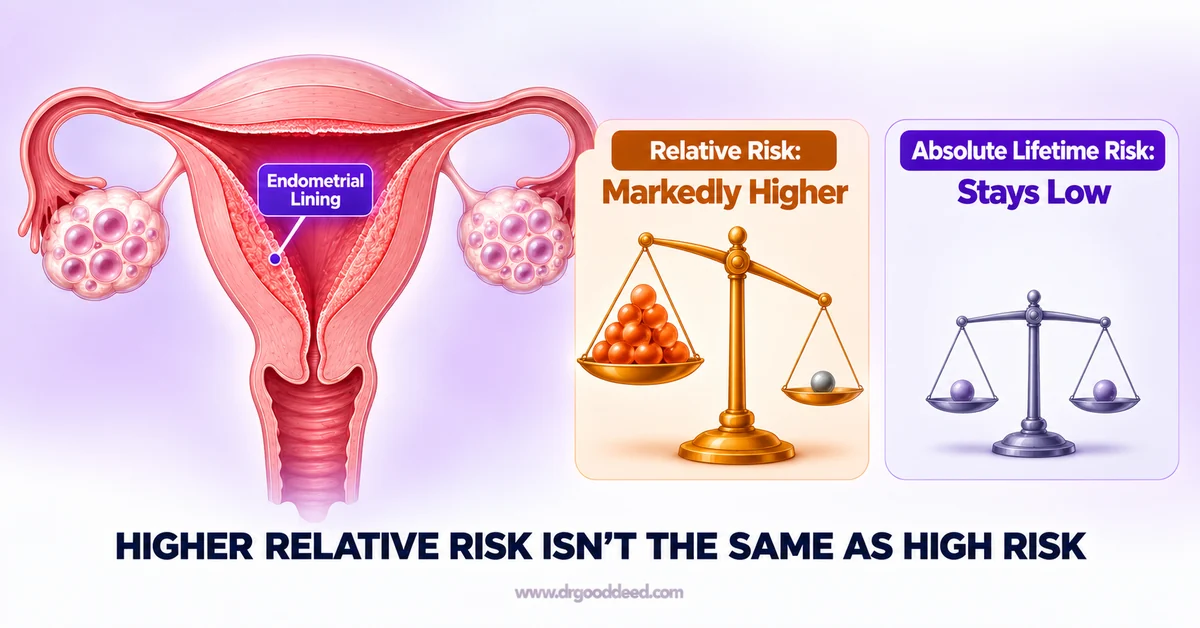
PCOS does not directly cause any cancer the way a virus causes an infection. It raises the relative risk of one specific cancer, endometrial cancer, through a well-documented hormonal pathway, while overall absolute risk stays low for most women.
The 2023 International Evidence-Based Guideline for PCOS, endorsed by 39 medical organizations worldwide, states the following:
- Premenopausal women with PCOS have a markedly higher relative risk of endometrial hyperplasia and endometrial cancer compared with women who do not have PCOS.
- Despite that higher relative risk, the guideline still describes the overall absolute chance of developing endometrial cancer as low across a lifetime.
- Because absolute risk stays low, routine endometrial cancer screening is not recommended in women with PCOS who have no symptoms.
Does having PCOS also mean a higher risk of breast or ovarian cancer?
The evidence for breast and ovarian cancer in PCOS is far less settled than for endometrial cancer.
- Systematic reviews on PCOS and breast or ovarian cancer show inconsistent findings across studies.
- Study results vary widely because researchers use different PCOS diagnostic criteria, age ranges, and body mass index groups.
- No major guideline currently states that PCOS causes breast or ovarian cancer.
The strongest, most consistent cancer association with PCOS is endometrial cancer.
Why does PCOS raise the risk of endometrial cancer?
Imbalance in hormones, specifically prolonged estrogen exposure without enough progesterone, is the biological engine behind this risk.
How can years of anovulation affect the uterine lining?
PCOS commonly involves ovulatory dysfunction, meaning the ovaries release an egg irregularly or not at all during many cycles.
- Without regular ovulation, the body misses its normal cyclic exposure to progesterone, the hormone that matures and sheds the uterine lining.
- The endometrium keeps proliferating under ongoing estrogen stimulation without that regular progesterone counterbalance.
- Over years, this unopposed estrogen pattern can contribute to endometrial hyperplasia, an abnormal thickening that can, in some cases, progress toward cancer.
What is the difference between endometrial hyperplasia, EIN, and endometrial cancer?
| Condition | What it means | Cancer risk |
| Endometrial hyperplasia | Overgrowth of the uterine lining | Not cancer itself |
| Endometrial intraepithelial neoplasia (EIN) | Precancerous cellular changes | Can progress if untreated |
| Endometrial cancer | Malignant cells in the uterine lining | Confirmed cancer diagnosis |
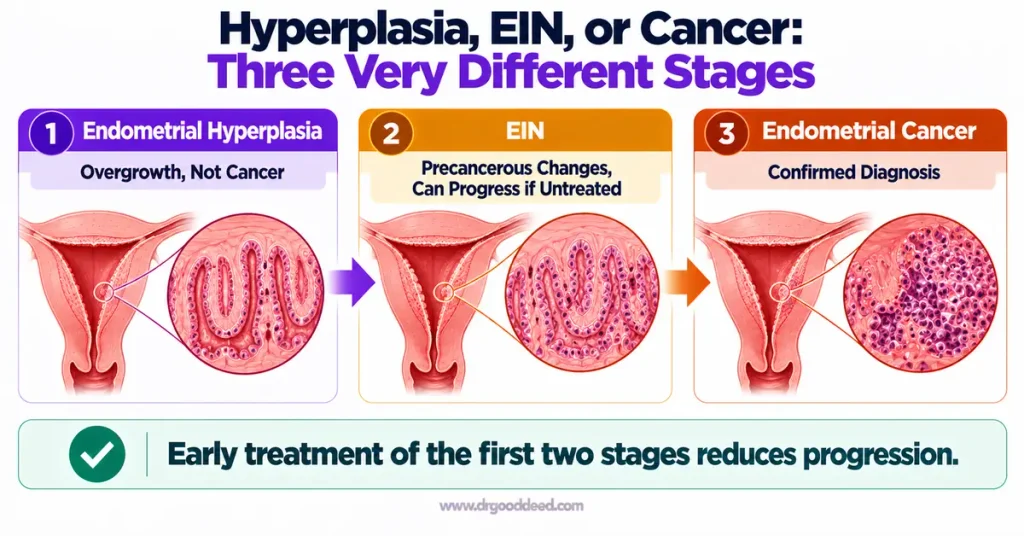
Early identification and treatment of precancerous changes like EIN can reduce progression to invasive endometrial cancer.
Why do weight and type 2 diabetes matter in someone who already has PCOS?
- The 2023 guideline names higher body weight, type 2 diabetes, long-standing untreated amenorrhea, and persistent thickened endometrium as additional risk factors layered on top of PCOS.
- The National Cancer Institute separately identifies obesity, adult weight gain, metabolic syndrome, and diabetes as established endometrial cancer risk factors.
- Fat tissue converts other hormones into additional estrogen, which compounds the unopposed estrogen exposure already present in anovulatory PCOS cycles.
PCOS is one contributor among several. Weight, insulin resistance, and cycle length combine to shape a person’s actual endometrial cancer risk, not PCOS in isolation.
Which PCOS symptoms or patterns should make endometrial cancer evaluation more urgent?
Long-standing untreated amenorrhea is what the 2023 guideline flags as an additional risk factor. Prolonged absence of menstruation from ovulatory dysfunction allows unopposed estrogen exposure to continue unchecked for extended periods.
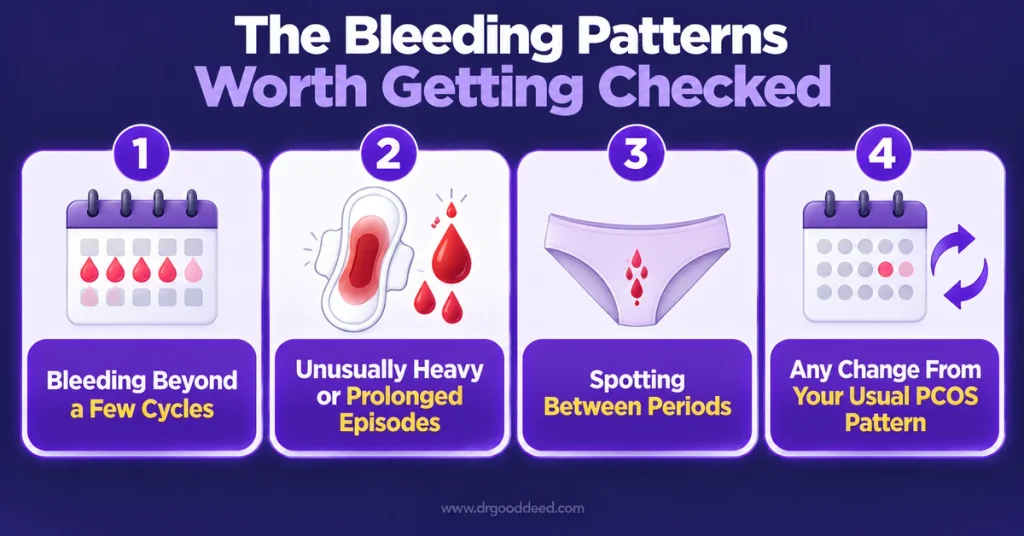
- Persistent abnormal uterine bleeding that continues beyond a few cycles
- Unusually heavy or prolonged bleeding episodes
- Spotting or bleeding between expected periods
- Any bleeding pattern that clearly changes from a person’s usual PCOS baseline
Abnormal bleeding can occur when ovulation is absent, and that persistent abnormal bleeding may warrant endometrial evaluation regardless of age.
How can someone with PCOS actually lower their endometrial cancer risk?
Managing a delay in getting periods is not about making cycles look cosmetically regular. The real clinical goal is protecting the endometrium from prolonged, unchecked estrogen exposure tied to untreated ovulatory dysfunction. The 2023 guideline specifically lists cycle regulation and regular progestogen therapy among its preventive strategies.
Progestogens or combined oral contraceptives can be used for endometrial protection
- Clinician-guided progestogen therapy can protect the endometrium by inducing regular withdrawal bleeds.
- Combined oral contraceptives regulate bleeding while also providing broader hormonal management for appropriate candidates.
- The right choice depends on pregnancy plans, contraindications, symptom severity, and overall metabolic health.
Oral contraceptives are a primary long-term treatment option for PCOS in people not currently planning pregnancy.
When might an endometrial biopsy be considered in a younger woman with PCOS?
Biopsy is never automatic just because someone has PCOS. ACOG states that for women younger than 45 with abnormal uterine bleeding, endometrial sampling may be appropriate when there is a history of unopposed estrogen exposure, such as PCOS or obesity, particularly alongside persistent bleeding or failed medical management.
Pro Tip: Track cycle length and bleeding pattern changes in a simple app or calendar rather than relying on memory. Clinicians rely heavily on the specific duration of amenorrhea and the timing of any bleeding change when deciding whether biopsy is warranted, and vague recall often delays that decision.
Does a thick uterine lining mean cancer in someone with PCOS?
A thickened endometrium is not synonymous with cancer on its own.
- In premenopausal patients, endometrial thickness naturally shifts with hormonal status and cycle phase.
- Clinical context, symptoms, age, and personal risk factors all shape interpretation.
- Tissue sampling, not imaging, is what establishes an actual histologic diagnosis when it is indicated.
Ultrasound is less useful for diagnosing endometrial cancer before menopause, and biopsy decisions should weigh symptoms, age, and overall medical history together.
The ovarian appearance seen on ultrasound in PCOS generally represents follicles that stopped developing partway, not tumors. The cancer concern discussed throughout PCOS guidelines centers on the endometrial lining, not the ovarian follicles themselves.
So, Can PCOS Cause Cancer?
PCOS does not mean a cancer diagnosis is coming. It is associated with a higher relative risk of endometrial hyperplasia and endometrial cancer. The practical focus stays on avoiding prolonged untreated amenorrhea, addressing abnormal bleeding promptly, and regulating cycles when clinically appropriate.
FAQs
Can PCOS cause cancer directly?
No. PCOS causing cancer in a direct sense is not supported by current evidence. PCOS raises the relative risk of endometrial cancer through prolonged unopposed estrogen exposure, not through a direct causal mechanism.
Does untreated PCOS always lead to endometrial cancer?
No. Most women with untreated PCOS never develop endometrial cancer. Long-standing untreated amenorrhea and persistent abnormal bleeding raise concern, not PCOS status alone.
Can birth control pills prevent endometrial cancer in PCOS?
Combined oral contraceptives can protect the endometrium by regulating cycles, but they are prescribed for suitable candidates only, never as a guaranteed cancer prevention tool for everyone.
Should every woman with PCOS get a yearly endometrial ultrasound?
No. The 2023 guideline recommends against routine screening in symptom-free women because absolute endometrial cancer risk remains low.
Does PCOS raise ovarian cancer risk the same way it raises endometrial cancer risk?
No. Evidence for ovarian and breast cancer in PCOS is far less consistent than the well-documented endometrial cancer association.
Sources
- International Evidence based Guideline for the Assessment and Management of PCOS 2023, Monash University link
- ASRM: Recommendations from the 2023 International PCOS Guideline link
- Journal of Clinical Endocrinology and Metabolism: 2023 PCOS Guideline Recommendations link
- ACOG: Management of Acute Abnormal Uterine Bleeding in Nonpregnant Reproductive Aged Women link
- ACOG: Diagnosis of Abnormal Uterine Bleeding in Reproductive Aged Women link
- National Cancer Institute: Endometrial Cancer Risk Factors, PDQ Summary link
- American Cancer Society: Endometrial Cancer Risk Factors link
- NICHD: What Are the Treatments for PCOS? link
- Forslund et al., International Evidence based Guideline on PCOS, A Nordic Perspective, Acta Obstetricia et Gynecologica Scandinavica 2024 link
- Oguz and Yildiz, An Update on Contraception in Polycystic Ovary Syndrome, Endocrinology and Metabolism 2021 link
Medical Disclaimer: This article is for general information only and is not medical advice. It does not replace a diagnosis, treatment plan, or guidance from a qualified healthcare professional. Always talk to your doctor about your own symptoms and before starting, stopping, or changing any treatment. If you think you may be having a medical emergency, call 911 or go to your nearest emergency room.