
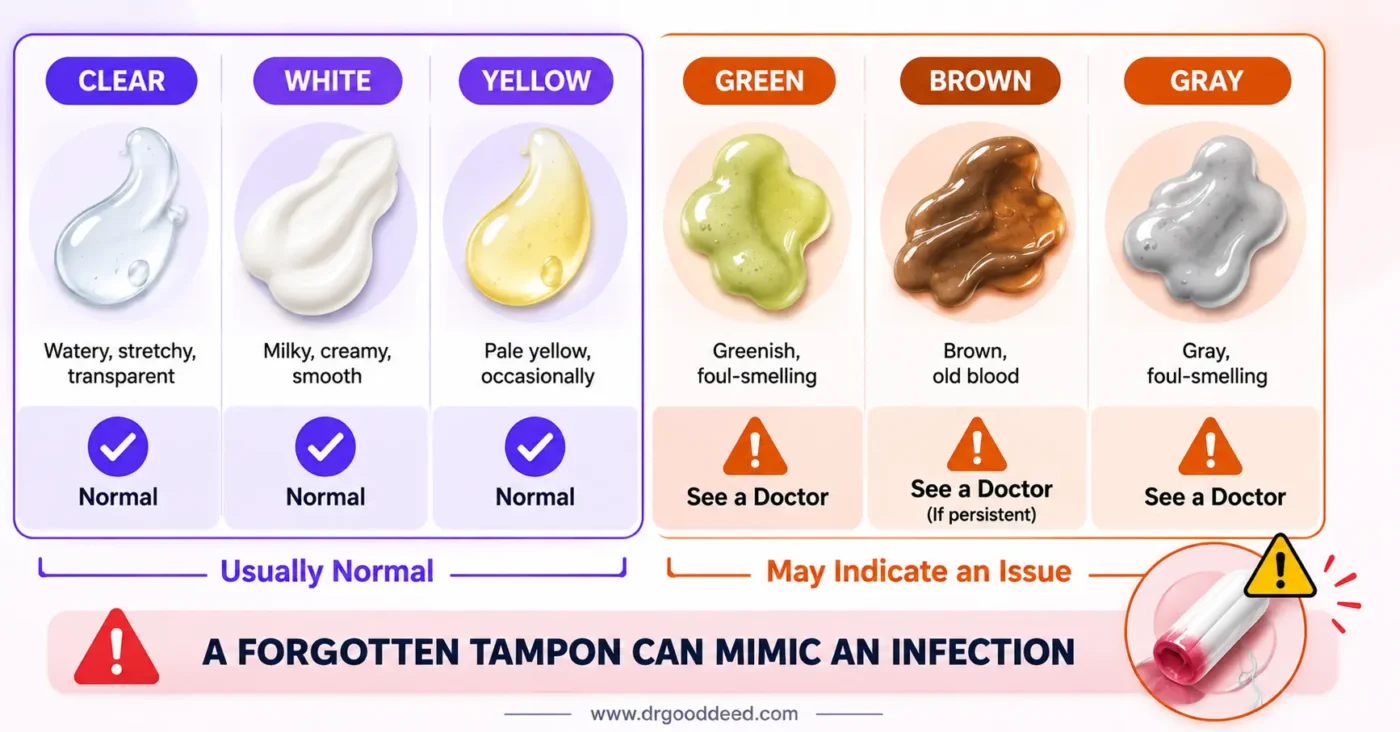

Most changes in vaginal discharge are a normal part of a healthy cycle, not a sign of infection. This vaginal discharge color guide breaks down what clear, white, yellow, green, brown, and gray discharge usually mean, when a color shift signals something worth checking, and how a forgotten tampon can mimic infection symptoms most articles never mention. Use it to match what you are seeing right now against a real clinical reference, not a guess.
Key Takeaways
- Color and texture shift naturally across your cycle, driven by estrogen and progesterone, not by anything wrong with your body.
- Clear and white discharge, whether watery or stretchy, is almost always normal, including around ovulation.
- Green and gray discharge point toward infection far more often than clear or white does, especially with odor or itching.
- Brown or bloody discharge outside your period has several explanations, from old blood clearing out to early pregnancy spotting.
- A forgotten tampon is a commonly missed cause of persistent, foul-smelling discharge that gets mistaken for a chronic infection.
What Does Normal, Healthy Discharge Look Like?
Vaginal discharge, also called leukorrhea, is fluid produced by glands in the cervix and vaginal walls. It carries out dead cells, bacteria, and debris, keeping the vagina self-cleaning. Most women produce about half a teaspoon to one teaspoon of discharge daily during reproductive years, though this amount varies widely and normally drops off after menopause.
Normal discharge is clear, white, or slightly off-white. It may be thin and watery, thick and creamy, or briefly stretchy around ovulation. It should have little to no smell. Practicing sound vaginal hygiene and douching avoidance keeps this natural balance intact, since douching strips protective bacteria and can trigger the very infections it claims to prevent.

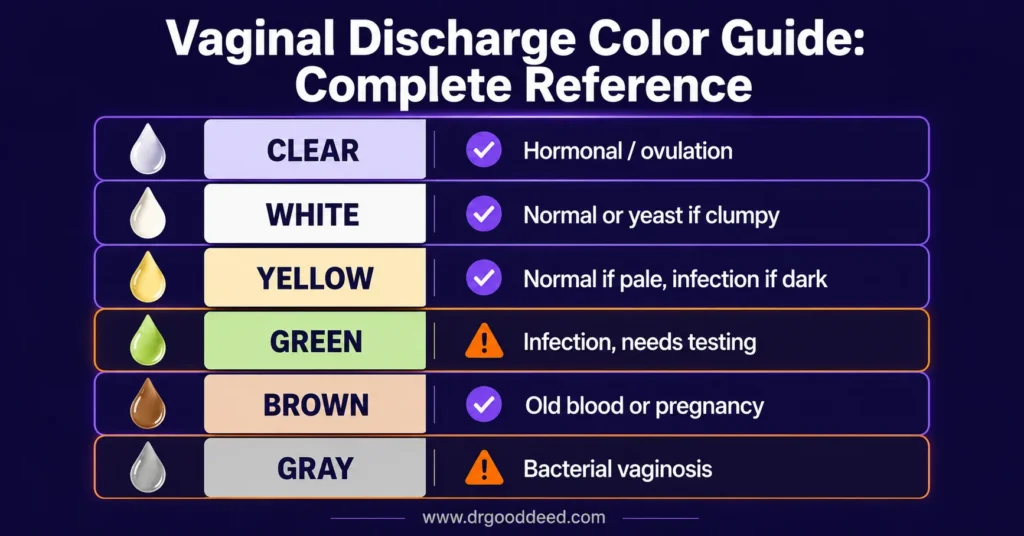
Vaginal Discharge Color Chart
This vaginal discharge color chart organizes what you are seeing by color first, since that is the detail most people notice before anything else. Each entry below covers the typical cause, texture, and whether it warrants a doctor visit. Cross-check color against texture and odor together, since color alone rarely tells the full story.
Clear and Watery
Clear, watery discharge is one of the most common vaginal discharge color guide entries people search for, and it is usually harmless.
- Clear, watery discharge shows up at multiple points in the cycle, often increasing after exercise, sexual arousal, or physical exertion, and can also spike mid-cycle as estrogen rises before ovulation.
- This type carries no odor and causes no itching or burning. If it appears alongside a mild ache low in the pelvis around day 14 of a 28-day cycle, that combination usually confirms ovulation rather than a problem.
- Watery discharge during pregnancy is also expected, provided it stays clear or milky white without odor or blood streaking through it.
Clear and Stretchy
Clear, stretchy discharge is clinically distinct from watery discharge, a nuance most consumer health sites collapse into one generic “clear” category.
- Clear, stretchy discharge is fertile cervical mucus, and it appears in the two to three days directly before ovulation.
- It stretches an inch or more between two fingers without breaking, resembling raw egg white, because rising estrogen thins the mucus and increases its water content to help sperm travel toward an egg.
- Vaginal glands can produce up to 30 times more mucus in the days leading up to ovulation compared with right after it.
- If you are trying to conceive or avoid pregnancy, this texture is the most reliable at-home signal of your fertile window.
Expert Insight: Many people assume any clear discharge means fertility, but only the stretchy, egg-white texture reliably marks the fertile window. Clear watery discharge can occur at almost any cycle phase and carries far less predictive value for ovulation timing.
White
White discharge that is thin to slightly thick, with no strong odor, fits the pattern of white discharge normal for most of the cycle, and it often thickens right before a period starts.
- White discharge can also appear cream colored or pale yellow at the edges without signaling a problem.
- White discharge resembling cottage cheese, especially paired with itching, redness, or burning, typically points to a yeast infection rather than normal secretions.
- That thick, clumpy pattern is the single most useful clue separating white discharge normal variation from a true candida infection needing antifungal treatment.
Yellow
- Yellow discharge with a faint, pale yellow tint, especially when discharge is exposed to air on a pad or underwear, can still fall within a normal range.
- Darker yellow, especially with a thick or clumpy texture, a foul or fishy odor, or itching, more often points to an infection such as trichomoniasis, bacterial vaginosis, or an STI like chlamydia or gonorrhea.
Because the differential diagnosis for yellow discharge is extensive and deserves its own detailed breakdown, see our full guide on yellow vaginal discharge for the complete list of causes and testing options.
Green
Green discharge causes are almost always infectious rather than hormonal, unlike most colors on this chart.
- Green discharge causes most commonly trace back to trichomoniasis, a sexually transmitted parasitic infection that produces a frothy, sometimes bubbly, green or yellow-green discharge with a strong odor.
- Bacterial vaginosis and, less often, gonorrhea can also tint discharge green. Green discharge rarely occurs in isolation.
- It typically comes with at least one additional symptom, such as itching, pain during urination, or discomfort during sex, and it warrants STI testing rather than home treatment.
Brown or Bloody
Brown discharge causes range from completely benign to worth a phone call to your provider.
- Brown discharge causes most often include old blood finishing its way out right after a period, since blood darkens to brown as it oxidizes with air.
- Light brown spotting can also appear mid-cycle around ovulation, or in early pregnancy around the time a period would normally arrive, which is worth confirming with a pregnancy test if there is any chance of conception. Brown discharge tied to recent vigorous sex may simply reflect minor tissue irritation.
- Bright red bleeding outside your period, heavy bleeding, or brown discharge that persists beyond a few days deserves medical evaluation to rule out polyps, fibroids, or hormonal imbalance.
Gray
Gray discharge causes are worth flagging directly, since gray almost never fits within a normal range.
- Gray discharge causes are dominated by bacterial vaginosis, an overgrowth of naturally occurring vaginal bacteria that disrupts the normal microbial balance.
- It typically produces a thin, gray or grayish-white discharge with a distinct fishy odor, often more noticeable after sex or during a period.
- Bacterial vaginosis is not sexually transmitted in the traditional sense, but it is the most common vaginal infection among women ages 15 to 44 and responds well to prescription antibiotics once confirmed.
How Discharge Changes Across Your Cycle and Life Stages
Discharge shifts with hormone levels across the menstrual cycle and across entire life stages.
- Around ovulation: Estrogen peaks, mucus becomes clear, stretchy, and more abundant, then thickens again in the days after.
- During pregnancy: Discharge increases noticeably, staying thin, clear, or milky white, since rising progesterone and increased blood flow to the pelvis boost natural secretions that help guard against infection traveling upward into the uterus.
- In preteens and around menopause: Discharge is typically minimal, since estrogen levels are lower at both ends of the reproductive years.
- During perimenopause and after menopause: Volume often drops sharply as estrogen declines, and the vaginal lining thins, sometimes causing dryness rather than discharge. If dryness or irritation becomes bothersome, our guide to natural remedies for vaginal dryness covers evidence-based options.
Discharge can sometimes mix with urine on a pad or in the toilet bowl, which is why noticing discharge mixing with urine does not automatically mean anything is wrong. If cloudiness in urine itself is the concern rather than discharge, see our separate piece on when pee appears cloudy.
A Commonly Missed Cause: Forgotten Tampons and Foreign Objects
A forgotten tampon or other foreign object left in the vagina can trigger a foul odor along with abnormal discharge that gets mistaken for a recurring infection. The discharge is often gray, brown, or blood-tinged, with a smell far stronger than typical bacterial vaginosis.
Pro Tip: If discharge with a strong odor does not improve after a course of antibiotics or antifungal treatment, ask your provider to specifically check for a retained tampon or foreign object before assuming the infection has simply not cleared, since this cause is frequently overlooked in repeat visits.
This is worth ruling out before assuming you have treatment-resistant bacterial vaginosis, since a retained object will not respond to standard infection treatment until it is physically removed.
When to See a Doctor
Contact a healthcare provider if you notice any of the following alongside a change in discharge:
- A sudden shift in amount, color, texture, or odor that does not match your usual pattern.
- Green, gray, or notably darker yellow discharge, particularly with a foul or fishy smell.
- Itching, burning, redness, or swelling around the vulva.
- Pelvic pain, fever, or pain during urination or sex.
- Bleeding or brown discharge outside your period, or any bleeding after menopause.
- Symptoms lasting longer than a week despite basic home care.
Most discharge changes described in this vaginal discharge color guide resolve on their own or point to a straightforward, treatable cause. Still, a same-week evaluation is the safest route whenever color, odor, or discomfort feels genuinely different from your normal baseline.
Sources
- MedlinePlus: Vaginal itching and discharge link
- MedlinePlus: Vaginitis link
- MedlinePlus: Vulvovaginitis link
- MedlinePlus: Bacterial Vaginosis Test link
- Mayo Clinic: Vaginal discharge, causes and definition link
- Mayo Clinic Press: Vaginal discharge, when to watch, when to work up link
- WebMD: Vaginal Discharge, Causes, Types, Diagnosis and Treatment link
- Cleveland Clinic: Vaginal Discharge, Causes, Colors & What’s Normal link
- Cleveland Clinic: Cervical Mucus, Chart, Stages, Tracking & Fertility link
- AAFP: Vaginitis, Diagnosis and Treatment link
Medical Disclaimer: This article is for general educational purposes and does not replace personal medical advice. See a licensed healthcare provider for diagnosis and treatment of any vaginal symptom.