


If oats hurt your stomach but a slice of wheat toast does not, the cause is rarely gluten. Oats do not contain wheat gluten at all. The real triggers are usually fiber load, a protein called avenin, FODMAP content, or how the oats were prepared and topped.
Key Takeaways
- A large bowl of oats delivers more soluble fiber and beta-glucan than most breakfasts, and a sudden increase can cause bloating and gas on its own.
- Avenin, a protein structurally similar to gluten, affects a small subset of people with celiac disease even when oats are certified gluten-free.
- FODMAP load in oats rises with serving size, so a half-cup serving often sits fine while a large bowl does not.
- Milk, dried fruit, honey, and sweeteners added to oatmeal frequently cause more symptoms than the oats themselves.
- Persistent pain, weight loss, or blood in the stool need medical evaluation rather than repeated self-testing.
Why Can Wheat Feel Fine While Oats Trigger Stomach Pain?
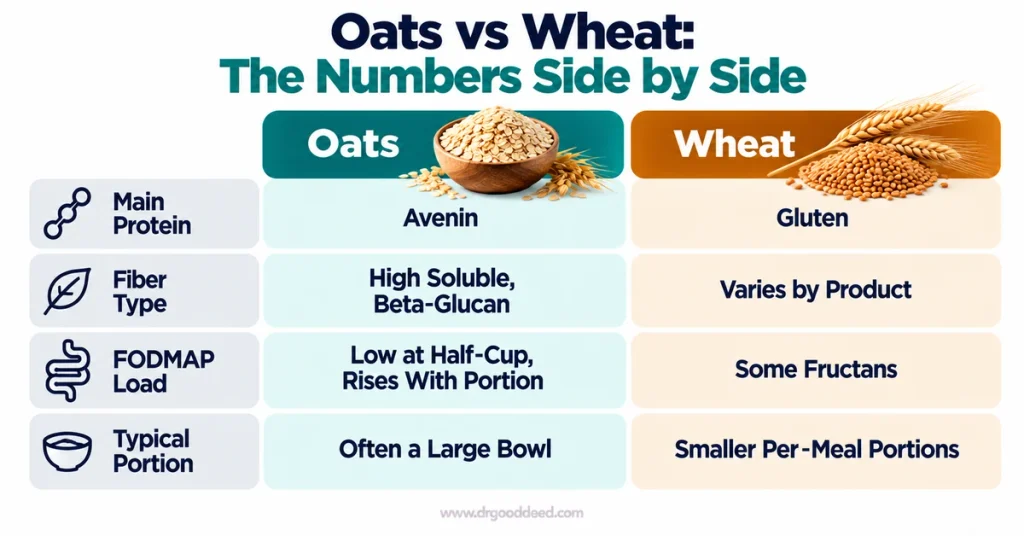
Both oats and wheat are grains, but they contain different proteins, different fiber types, and different FODMAP profiles. Wheat contains gluten proteins, while oats contain avenin and a heavier soluble fiber load. Portion size and food pairing also change how each grain behaves in the gut.
| Factor | Oats | Wheat |
| Main protein | Avenin | Gluten (gliadin, glutenin) |
| Fiber type | High soluble fiber, beta-glucan | Varies by product and refinement |
| FODMAP load | Low at half-cup servings, rises with portion | Some products contain fructans |
| Common prep | Rolled, steel-cut, instant, oat bran | Whole grain, refined flour, sourdough |
| Typical portion | Often a large single bowl | Usually smaller portions per meal |
A wheat-containing food is not automatically safe just because it lacks avenin, and an oat-based breakfast is not automatically safe just because it lacks gluten. The full meal, not the grain label, decides the outcome.
The Fiber Shock: How Beta-Glucan Gel Can Overwhelm a Sensitive Gut
A gut unaccustomed to high fiber intake can react strongly to a single large bowl of oats.
- Oats contain both soluble fiber, mainly beta-glucan, and insoluble fiber.
- Beta-glucan forms a thick gel in the stomach and small intestine, which slows digestion and can cause bloating, gas, or cramping when the serving jumps up quickly.
- The same sudden-fiber pattern shows up with other fiber-dense foods; the concept of fibermaxxing covers this rapid-increase effect directly.
The Avenin Factor: Why Some Celiac Patients React Even to Certified Gluten-Free Oats
Avenin is a protein found in oats that closely resembles gluten in structure. People with celiac disease tolerate gluten-free oats well, but a very small proportion remain sensitive to avenin itself, separate from any contamination issue.
This reaction is not related to portion size or preparation. It reflects an individual immune response to the avenin protein structure, which is why introducing oats gradually under medical guidance is the recommended approach for anyone newly diagnosed with celiac disease.

Can Oats Trigger Symptoms Because of FODMAPs Even Though Oats Are Often Considered Low FODMAP?
FODMAP reactions are dose-dependent, which explains why a small bowl of oats can feel completely fine while a larger portion causes bloating on other days. Monash University research classifies rolled oats as low FODMAP at roughly half a cup uncooked, with fructan and galacto-oligosaccharide content rising as the portion increases.
The hidden FODMAP problem may be what you add to your oats
Many hidden FODMAP triggers come from oatmeal toppings rather than the oats themselves:
- Milk containing lactose, which many adults digest poorly in larger amounts
- Certain fruits like apples, pears, or dried fruit that concentrate fructose
- Honey and high-fructose sweeteners added for flavor
- Flavored or protein-fortified oat products with FODMAP-dense additives
Pro Tip: Before assuming oats themselves are the problem, check the oatmeal’s full ingredient list, since a plain half-cup serving of rolled oats is frequently well tolerated while the same oats loaded with honey, dried fruit, and whole milk push the meal’s total FODMAP load past a comfortable threshold.
Could the Type or Preparation of Oats Be the Reason They Hurt Your Stomach?
Steel-cut, rolled, quick, instant, and oat bran differ in processing but no single type is universally easier to digest for every person. Serving size, cooking method, and toppings change the digestive outcome far more than the specific oat cut.
Why overnight oats may feel different from cooked oatmeal
Overnight oats often feel gentler, but this usually comes down to portion control, simpler ingredient lists, and texture rather than any claim that soaking removes problem compounds. Soaking softens oats and may ease initial digestion, but it does not eliminate avenin or FODMAP content. Individual tolerance still varies from person to person.
Could Gluten Contamination Explain Why Oats Hurt Your Stomach?
Pure oats never contain wheat gluten, but they are frequently grown or milled alongside wheat, barley, or rye, which allows cross-contamination during production.
For people with celiac disease, this is often the deciding factor behind why oats hurt your stomach even though oats are technically gluten-free by nature. Anyone with diagnosed or suspected celiac disease should choose specifically labeled gluten-free oats rather than standard supermarket oats, since standard oats carry a meaningfully higher contamination risk.
This guidance aligns with the same principle covered in an IBS diet plan, which lists plain oatmeal in smaller portions as a generally well-tolerated option.
Why “gluten-free” and “wheat-free” are not interchangeable
A product labeled wheat-free can still contain barley or rye, and a product labeled oat-based is not automatically gluten-free unless it carries certified gluten-free labeling. Someone with suspected celiac disease should never use symptom relief alone to decide whether a food is safe, since avenin sensitivity and low-level contamination can both produce delayed or inconsistent symptoms.
Could You Actually Have an Oat Allergy Instead of a Digestive Intolerance?
True oat allergy is far less common than intolerance, but the distinction matters for safety. Digestive intolerance produces bloating, gas, and abdominal discomfort. A genuine food allergy can produce hives, swelling, wheezing, or vomiting within minutes to hours of eating oats.
Breathing difficulty, throat swelling, or faintness after eating oats are signs of a severe allergic reaction and require urgent medical attention. Self-testing a suspected allergy through repeated exposure at home is not safe and should not be attempted.
How Can You Test Whether Oats Are the Problem Without Randomly Eliminating Foods?
A structured, single-variable test reveals more than guessing which food group to eliminate. Reading about the health benefits of oatmeal afterward can help once the specific trigger is identified, since oats offer real nutritional value once the dose and ingredients are dialed in correctly.
Start by simplifying the oatmeal
- Try a smaller portion, around half a cup uncooked.
- Keep the oat type consistent across each test day.
- Skip multiple new toppings during the test period.
- Leave the rest of the meal unchanged.
- Track symptoms, timing, and severity in a simple log.
- Compare results against a different breakfast on another day.
When you should not do an elimination-and-rechallenge experiment yourself
Skip self-testing and seek medical evaluation if there is concern about celiac disease, food allergy, significant unexplained weight loss, persistent vomiting, blood in the stool, severe or worsening abdominal pain, or persistent diarrhea. These signs need clinical evaluation rather than repeated food challenges at home.
When Does “Oats Hurt Your Stomach” Need Medical Testing?
Consider medical evaluation if symptoms are persistent, reproducible, or getting worse over time. Additional red flags include ongoing diarrhea or constipation, unexplained weight loss, anemia or nutritional deficiencies, blood in the stool, or a family history of celiac disease or inflammatory bowel disease. Anyone suspecting celiac disease should seek testing before starting a strict gluten-free diet, since removing gluten early can interfere with accurate diagnostic results.
FAQs
Are steel-cut oats structurally easier to digest than instant oats?
No. Steel-cut oats are less processed, but digestibility depends more on portion size and added ingredients than on cut type. Instant oats often cause more symptoms simply because servings and sweetener content tend to be larger.
Can you have a true allergy to oats specifically?
Yes, though it is uncommon. A true oat allergy triggers immune symptoms like hives, swelling, or wheezing, unlike avenin sensitivity or FODMAP-related bloating, which stay confined to the digestive tract.
How much oatmeal is too much in one sitting?
More than one cup cooked in a single sitting often raises FODMAP and fiber load beyond comfortable levels for a sensitive gut. Half a cup uncooked, roughly one cup cooked, is the typical low-FODMAP threshold.
Does soaking oats overnight reduce stomach issues?
Soaking softens texture and often accompanies smaller, simpler portions, which helps symptoms indirectly. It does not remove avenin or FODMAP content, so soaking alone does not guarantee a symptom-free result.
Is oat milk gentler on the stomach than whole oats?
Often yes, since oat milk contains far less FODMAP and fiber per serving than a full bowl of whole oats. Individual tolerance still varies, especially with added sweeteners or gums in flavored versions.
Sources
- Coeliac UK: Oats and the gluten free diet link
- NHS: Coeliac disease link
- Monash University FODMAP link
- NIDDK: Celiac disease link
- Celiac Disease Foundation: Oats link
- Cleveland Clinic: Food intolerance link
- American College of Gastroenterology: Irritable bowel syndrome link
- Academy of Nutrition and Dietetics: Fiber link
- American Academy of Allergy, Asthma & Immunology: Food allergy link
Medical Disclaimer: This article is for general information only and is not medical advice. It does not replace a diagnosis, treatment plan, or guidance from a qualified healthcare professional. Always talk to your doctor about your own symptoms and before starting, stopping, or changing any treatment. If you think you may be having a medical emergency, call 911 or go to your nearest emergency room.