

If food comes back up into your mouth soon after eating, without retching and often without nausea, rumination syndrome is one likely reason. It is easily confused with acid reflux or vomiting, but it has a different cause and can be treated. Knowing the signs can help you explain your symptoms to your doctor.
Key Takeaways
- Rumination syndrome makes recently eaten food come back up without effort, often without nausea, and breathing retraining can treat it.
- It is often confused with acid reflux and gastroparesis, causing delays in receiving appropriate treatment (AGA, 2018).
- The first-line treatment is diaphragmatic breathing, taught by a trained clinician (AGA, 2018).
- Trouble swallowing or vomiting blood points to another problem and needs prompt medical care.
What Is Rumination Syndrome?
Rumination syndrome is a gut-brain disorder in which recently eaten food rises back into the mouth without effort or retching, then is rechewed, swallowed or spat out. Vomiting, by contrast, usually comes with nausea and forceful retching.
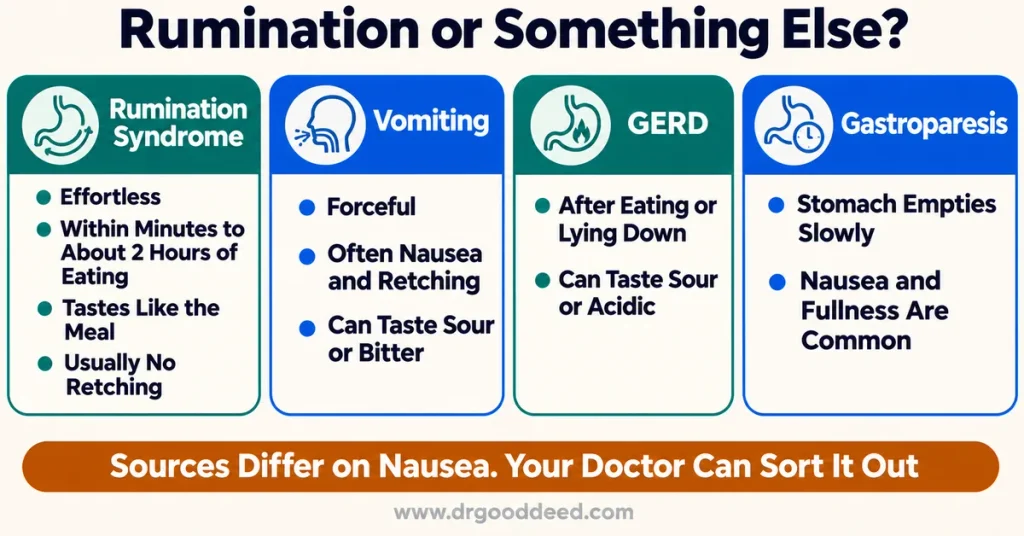
When food comes back up after eating and tastes the same as the meal, rumination is more likely than reflux, vomiting or gastroparesis (Johns Hopkins; Mayo Clinic, 2025; AGA, 2018; Cleveland Clinic, 2025). Gastroparesis usually causes nausea and feeling really full after eating rather than effortless regurgitation.
| Condition | Action | Timeframe | Taste | Other signs |
| Rumination syndrome | Effortless regurgitation | Within minutes to about 2 hours of eating | Often tastes the same as the food eaten | Usually no nausea or retching |
| Vomiting | Forceful expulsion of gastric contents | Can happen at any time | Sometimes tastes sour or bitter | Often nausea or retching |
| GERD (acid reflux) | Regurgitation of gastric contents into the esophagus | After eating or lying down | Sometimes tastes sour or acidic | Nausea can sometimes occur |
| Gastroparesis | Stomach takes longer to empty | Often after eating | Food can be regurgitated later | Nausea and distension are common |
Signs of Rumination Syndrome
Food often rises back into the mouth without effort within minutes to about 2 hours of eating. It may taste like the meal and can be rechewed, swallowed, or spat out (Johns Hopkins; Mayo Clinic, 2025).
Timing: Regurgitating food tends to happen after most meals, not just now and then (Cleveland Clinic, 2025).
Taste: The food tastes like the meal, not sour or bitter like acid or vomit (Johns Hopkins).
Pressure: Some people feel pressure or fullness in the belly that eases once the food comes up (Mayo Clinic, 2025).
Weight loss and other effects: Over time it can cause weight loss, bad breath and worn teeth, and untreated it can damage the esophagus (Mayo Clinic, 2025).
Nausea: Sources disagree. Cleveland Clinic (2025) says rumination does not involve nausea, Mayo Clinic (2025) lists nausea as a symptom, and the AGA (2018) says nausea makes rumination less likely but does not rule it out.
What Causes Rumination Syndrome?
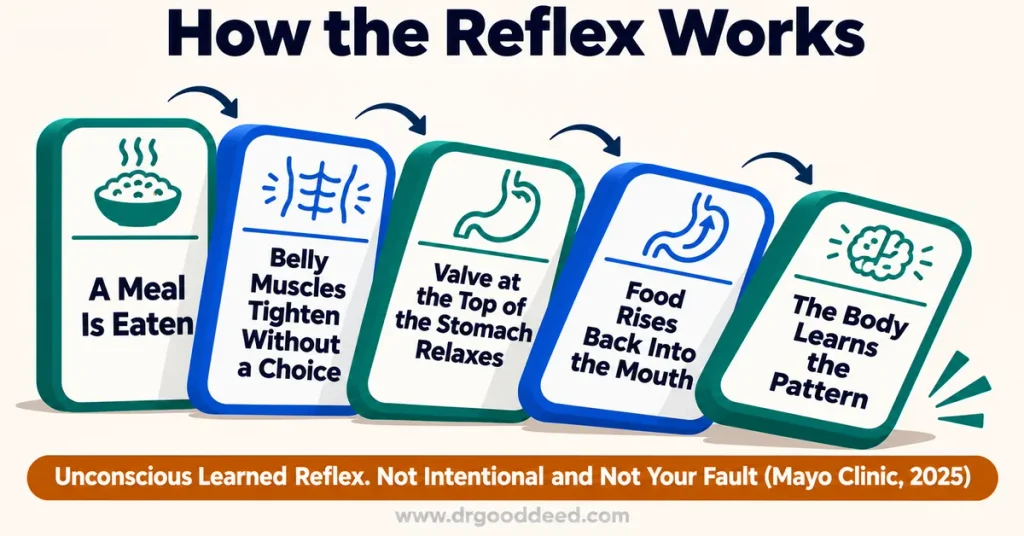
Rumination syndrome is an unconscious, learned reflex. The abdominal muscles tighten, causing regurgitation, while the valve at the top of the stomach relaxes (Cleveland Clinic, 2025; Mayo Clinic, 2025).
It is linked to:
- Learned behavior: The body learns to bring food back up after eating. It can be hard to control because the reflex happens without you choosing it.
- Stress and mental health: It can be linked to stress, anxiety or depression (Mayo Clinic, 2025). It is not intentional and is not the person’s fault.
- Other conditions: In some people, it is linked to a pelvic floor disorder that causes ongoing constipation (Mayo Clinic, 2025).
Rumination syndrome is classed as a disorder of gut-brain interaction because it involves both the digestive system and the brain (Murray et al., 2019).
How Rumination Syndrome Is Diagnosed
Rumination syndrome is mostly diagnosed from your history, after tests rule out other conditions. It is often misdiagnosed as GERD or gastroparesis (AGA, 2018; Murray et al., 2019).
Your doctor will want to know about:
- Retching and taste: Whether food comes up without retching and tastes like what you ate.
- Timing: Whether it happens soon after eating, and at most meals.
- Other symptoms: Any nausea, trouble swallowing, pain or weight loss.
Your doctor may check your symptoms against the Rome IV criteria, which look at how food comes back up and for how long it has been happening (AGA, 2018). Tests may be done first to rule out other digestive problems.
High-resolution esophageal manometry with impedance can support the diagnosis (AGA, 2018). It measures pressure in the esophagus and can show the rise in belly pressure that pushes food back up.
Rumination is often mistaken for acid reflux, and reflux treatment usually does not help it (Johns Hopkins). The right assessment helps you get the right treatment.
Reflux often worsens at night, a pattern covered in stomach pain when lying down.
How Rumination Syndrome Is Treated
The first-line treatment for rumination syndrome is diaphragmatic breathing. This is taught by a trained professional and performed around mealtimes to help prevent the reflex (AGA, 2018; Murray et al., 2019).
Treatments may include:
- Diaphragmatic breathing: A trained clinician teaches you to breathe with your diaphragm at meals, which works against the belly-muscle squeeze behind the reflex (AGA, 2018).
- Biofeedback: Some clinicians use biofeedback to help you learn to control these muscles.
- Behavioral therapy: A behavioral health professional may help if symptoms continue or stress plays a part.
- Medicine: A doctor may add medicine for some people who do not respond to breathing retraining.
In a small trial of 23 people, diaphragmatic breathing cut daily regurgitation by 74%, compared with 1% in the placebo group (Barba et al., cited in Murray et al., 2019). The result is promising, but the trial was small.
It is best to have treatment guided by a professional who understands rumination syndrome. There is nothing to feel guilty about, and it can be managed.
When to See a Doctor
If you are regurgitating often or losing weight, you should see a doctor (Mayo Clinic, 2025). A primary care doctor or gastroenterologist will be able to help assess your symptoms and find the cause.
Get medical care if you have:
- Weight loss: Frequent regurgitation can make it hard to get enough nutrients.
- Trouble swallowing: Get it checked soon. If you can’t swallow because food feels stuck in your throat or chest, go to the nearest ER (Mayo Clinic, 2026).
- Vomiting blood: If you vomit blood or have black, tarry stools, seek immediate medical care (Mayo Clinic, 2026).
- Signs of shock or trouble breathing: Call 911 if you have signs of shock, such as fainting, pale or clammy skin or a rapid pulse, or if a blockage makes it hard to breathe (Mayo Clinic, 2026).
- Eating-disorder support: If rumination is tied to worries about weight or body shape, the National Alliance for Eating Disorders helpline is 1-866-662-1235, Monday to Friday, 9 am to 7 pm ET.
If your stomach hurts after eating but food does not come back up, see our guide on why your stomach hurts after eating.
If you think you have rumination syndrome, ask your primary care doctor or a gastroenterologist about an evaluation and breathing retraining.
Frequently Asked Questions
Is Rumination Syndrome Dangerous?
Rumination syndrome is not usually life-threatening, but untreated it can cause weight loss, poor nutrition, worn teeth and damage to the esophagus (Mayo Clinic, 2025). Food can also go into the airway, which can cause choking or pneumonia (Cleveland Clinic, 2025). Getting assessed and treated lowers the risk of these problems.
How Rare Is Rumination Syndrome?
No one knows exactly how rare rumination syndrome is. Self-reported studies put it at 0.8% to 10.6% of community samples (Murray et al., 2019). Johns Hopkins calls it rare and underdiagnosed, and it is often mistaken for acid reflux or gastroparesis (AGA, 2018).
Can Rumination Syndrome Go Away?
Yes, for most people. Rumination syndrome usually stops over time once people learn diaphragmatic breathing and use it at meals (Johns Hopkins; Murray et al., 2019). Some also need behavioral therapy. The right plan depends on your symptoms, so it helps to work with a clinician who understands rumination syndrome.
Can Children Get Rumination Syndrome?
Yes. Rumination syndrome can affect children, teens and adults. It was first described in infants and people with developmental disabilities, but it can affect anyone (Mayo Clinic, 2025; Cleveland Clinic, 2025). If your child often brings food back up after eating, a pediatrician can help find the cause and advise on treatment.
Is Rumination Syndrome an Eating Disorder?
It can be classed as one: the psychiatric manual calls it rumination disorder, while gut-disorder criteria call it rumination syndrome, and both describe the same pattern (Murray et al., 2019). It is not bulimia, which is driven by weight concerns. If weight control is part of it, eating-disorder care helps; the National Alliance for Eating Disorders helpline is 1-866-662-1235.
Sources
- American Gastroenterological Association, AGA Clinical Practice Update on the Diagnosis of Rumination Syndrome (2018). link
- American Journal of Gastroenterology, Diagnosis and Treatment of Rumination Syndrome: A Critical Review (2019). link
- Mayo Clinic, Rumination Syndrome: Symptoms and Causes (2025). link
- Johns Hopkins Medicine, Rumination Syndrome. link
- Cleveland Clinic, Rumination Syndrome (2025). link
- Mayo Clinic, Dysphagia: Symptoms and Causes (2026). link
- Mayo Clinic, Gastrointestinal Bleeding: Symptoms and Causes (2026). link
Medical Disclaimer: This article is for general information only and is not medical advice. It does not replace a diagnosis, treatment plan, or guidance from a qualified healthcare professional. Always talk to your doctor about your own symptoms and before starting, stopping, or changing any treatment. If you think you may be having a medical emergency, call 911 or go to your nearest emergency room.