

Barrett’s esophagus surveillance means repeat upper endoscopies with biopsies, and how often you need one depends on your biopsy result and the length of your Barrett’s segment. If you were just told you have Barrett’s, or you’re holding a report and wondering when the next scope is, we cover the schedule by result, when surveillance can stop, and which symptoms shouldn’t wait.
Key Takeaways
- Barrett’s esophagus surveillance usually means an endoscopy every few years, with the schedule set by your biopsy result and segment length.
- Segment length: ACG (2022) sets 3 years for segments of 3 cm or more and 5 years for shorter ones, when there is no dysplasia.
- Dysplasia: Abnormal cells that aren’t cancer change the plan toward closer follow-up or treatment.
- Stopping: AGA’s August 2026 update says older adults shouldn’t automatically continue surveillance, so ask about it.
- Warning signs: Chest pain, trouble swallowing, weight loss, bloody vomit or black stools shouldn’t wait for your next date.
What Is Barrett’s Esophagus Surveillance?
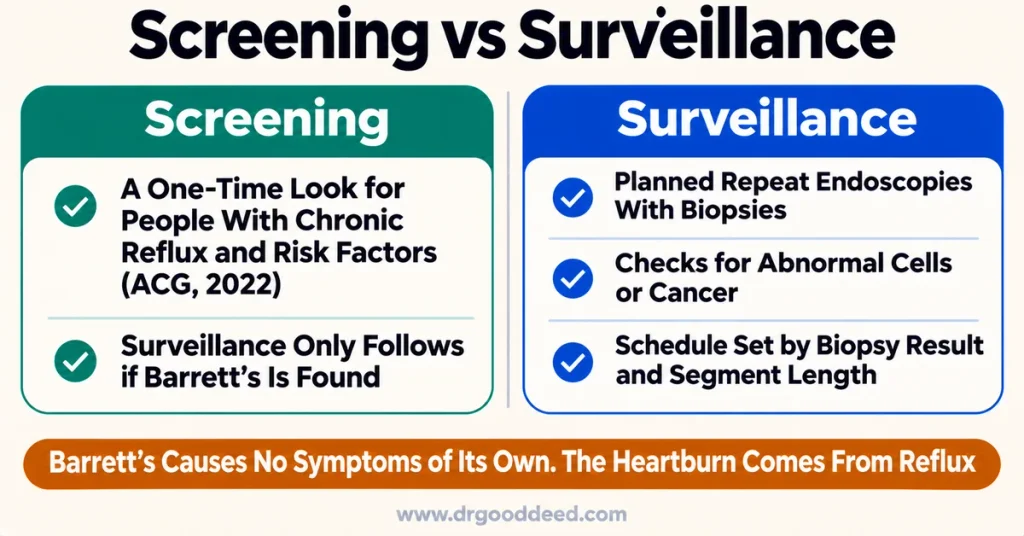
Barrett’s esophagus surveillance is a planned series of upper endoscopies with biopsies that check for abnormal cells or cancer. Barrett’s esophagus is a change in the lining of the lower esophagus.
- Why it exists: The AGA (2025) calls Barrett’s the only known precursor to esophageal adenocarcinoma, a cancer of the esophagus. Most people with Barrett’s never get cancer, says the NIDDK, and Barrett’s causes no symptoms of its own. The heartburn some people feel comes from reflux. Some people have reflux without heartburn, known as silent reflux.
- How common it is: The NIDDK (2024) says about 5% of US adults, while an AGA news page gives 1 to 2% without naming its source.
Surveillance follows a known finding, unlike the routine tests in these cancer screening guidelines by age.
How Often Should Barrett’s Esophagus Be Monitored?
Barrett’s esophagus should be monitored on a schedule set by biopsy result and segment length. Segment length is how much of the esophagus lining has changed, measured in centimeters. ACG (2022) says 3 years at 3 cm or more and 5 years under 3 cm.
How often you need an endoscopy also depends on which society your doctor follows. For nondysplastic Barrett’s esophagus surveillance, the AGA Patient Center (2025) gives a looser range of 3 to 5 years depending on length.
The table below shows Barrett’s esophagus surveillance intervals by biopsy result and segment length, as AGA and ACG describe them.
| Biopsy result | Next endoscopy, according to guidelines | Source |
| No dysplasia, 3 cm or more | Every 3 years | ACG, 2022 |
| No dysplasia, under 3 cm | Every 5 years | ACG, 2022 |
| No dysplasia, any length | Every 3 to 5 years, depending on length | AGA Patient Center, 2025 |
| Under 1 cm, no neoplasia | AGA suggests against routine surveillance | AGA, 2025 |
| Indefinite for dysplasia | Better acid control, then repeat within 6 months | AGA Patient Center, 2025; ACG, 2022 |
| Low-grade dysplasia | Treatment suggested. If declined, repeat at 6 months, then every 12 months | AGA Patient Center, 2025 |
| High-grade dysplasia or early cancer | Endoscopic treatment strongly recommended | AGA, 2025 |
Mayo Clinic (2026) says indefinite for dysplasia calls for a repeat endoscopy within one year, which differs from the 6 months above.
Doctor’s Tip: After each endoscopy, ask for the segment length and the biopsy result, because both set the next date.
What Your Barrett’s Biopsy Results Mean
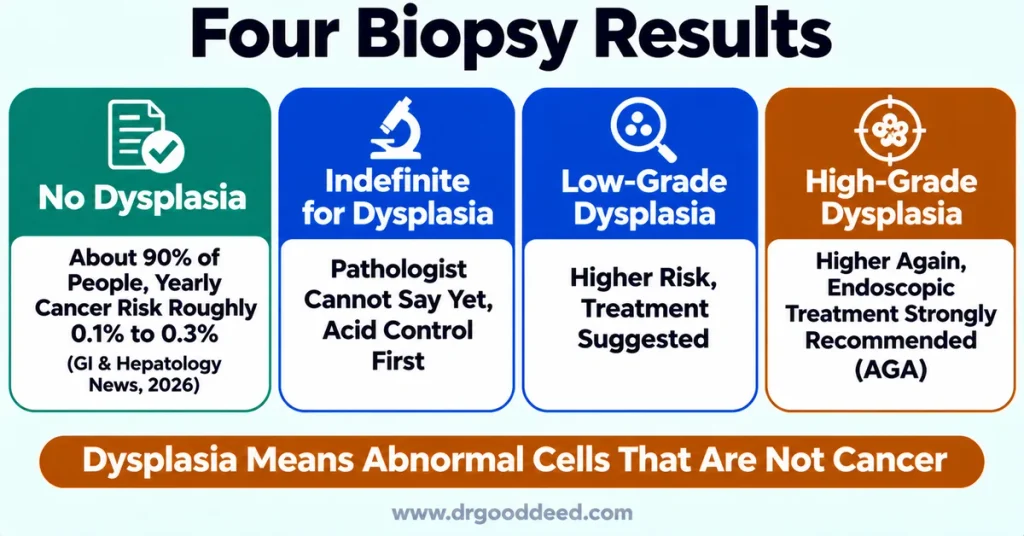
Barrett’s esophagus biopsy results fall into four groups, and each carries a different cancer risk. Dysplasia means abnormal cells that aren’t cancer.
- No dysplasia: About 90% of people have it, with a yearly cancer risk of roughly 0.1% to 0.3%, according to GI & Hepatology News (2026).
- Indefinite for dysplasia: The pathologist can’t say yet. Acid control comes first, then a repeat look.
- Low-grade dysplasia: Higher risk than no dysplasia, which is why treatment is suggested.
- High-grade dysplasia: Higher again. The AGA strongly recommends endoscopic treatment.
Is Barrett’s esophagus a big deal? For most people, it isn’t cancer, and most never develop cancer, according to the NIDDK. It does need follow-up, and the next step depends on which of the four biopsy results you have.
What Happens During Surveillance Endoscopy
A surveillance endoscopy looks at the lining with a camera and takes biopsies. You’re sedated, and the scope goes down your throat.
- Imaging: The AGA (2025) recommends high-definition white light plus chromoendoscopy, a technique that highlights the tissue pattern.
- Biopsies: The Barrett’s esophagus biopsy protocol samples the lining in an organized pattern, with biopsies about every 1 to 2 cm, per the AGA. If dysplasia turns up, a second GI pathologist should confirm it (ACG, 2022). Some centers add extra lab tests on the samples, so ask what yours uses.
- Acid control: The AGA (2025) suggests daily acid-reducing medicine over none, and over surgery, to lower the risk of progression. Whether you take it is your doctor’s call. Nighttime reflux can also cause stomach pain when lying down, which has its own red flags.
Endoscopy Schedule After Endoscopic Eradication Therapy
Endoscopic eradication therapy removes or destroys abnormal tissue, and follow-up endoscopies continue afterward. Treatment usually takes 3 to 4 sessions, spaced 2 to 3 months apart.
- AGA Patient Center (2025): After low-grade dysplasia, follow-up is at 12 months, then every 3 years. After high-grade dysplasia, every 3 to 6 months in the first year, then every 12 months.
- ACG (2022): After low-grade dysplasia, 1 year, then 3 years, then every 2 years. After high-grade dysplasia, 3, 6, and 12 months, then yearly.
When Can Barrett’s Surveillance Stop?
Barrett’s surveillance can stop when the risks and burden outweigh the benefit, a decision made with your doctor. There is no single age limit, so stopping depends on the person.
- Older adults: The AGA’s August 2026 clinical practice update says older adults shouldn’t automatically continue. It asks doctors to weigh health, life expectancy, ability to have treatment, and preference. Modeling put the best stopping age between 69 and 81 years (GI & Hepatology News, 2026).
- ACG (2022): Stopping is reasonable when estimated survival is under 5 years, or when someone isn’t fit for endoscopy or treatment.
- What happens now: In a Medicare study cited by ACG (2022), 79% of men aged 80 to 84 still had a repeat endoscopy within 5 years. That tells you stopping is a decision that has to be raised, not a default.
The evidence for surveillance is thinner than most patients assume. The BOSS trial found no survival difference between endoscopy every 2 years and endoscopy only when symptoms appeared, yet the AGA (2025) still suggests surveillance, citing limits in the study (GI & Hepatology News, 2026). That’s why stopping is a conversation.
When to See a Doctor Between Endoscopies
Warning signs between endoscopies don’t wait for the schedule. The signs below need immediate help.
The table below lists warning signs and where to go for care.
| Sign | Where to go |
| Chest pain | Call 911 or go to the ER |
| Vomiting blood, or vomit that looks like coffee grounds | ER |
| Black, tarry or bloody stools | ER |
| Trouble swallowing | Call your doctor the same day or visit urgent care |
| Unintended weight loss | Call your primary care doctor soon |
Other stomach symptoms, such as feeling full after a few bites, have their own causes and warning signs.
New warning signs matter more than your next scheduled date, so do not wait for Barrett’s esophagus surveillance if one appears.
Frequently Asked Questions
Do ACG and AGA Agree on Barrett’s Esophagus Surveillance Guidelines?
Barrett’s esophagus surveillance guidelines from ACG and AGA agree on the broad range but differ in some details. ACG (2022) uses 3 years at 3 cm or more and 5 years under 3 cm, while the AGA Patient Center (2025) says 3 to 5 years depending on length. Your doctor applies one of them.
Who Should Get Barrett’s Esophagus Screening?
ACG (2022) suggests one screening endoscopy for people with chronic GERD (acid reflux) symptoms plus three or more risk factors: male sex, age over 50, White race, smoking, obesity, or a family history. Screening is a one-time look. Surveillance only follows if Barrett’s is found.
Do I Need Surveillance if My Barrett’s Is Under 1 cm?
Usually not, when there is no neoplasia. The AGA (2025) suggests against routine surveillance endoscopy for segments under 1 cm with intestinal metaplasia and no neoplasia. Neoplasia means abnormal growth, and your biopsy report shows whether it’s present. Ask your doctor whether your report fits.
Can I Skip Surveillance if I Have No Symptoms?
No, not on your own. Barrett’s causes no symptoms of its own, and nearly half of people diagnosed report no heartburn (Mayo Clinic, 2026), so feeling fine says little. Reflux can reach beyond the chest too, as this guide to acid reflux and headaches explains.
Do I Still Need Reflux Medicine With Barrett’s?
Yes, in most cases. The AGA (2025) suggests daily acid-reducing medicine over none, and over surgery, to lower the risk of progression. That’s a suggestion, and the decision stays with your doctor. Don’t start, stop or change any medicine on your own.
Sources
AGA GI Patient Center, Barrett’s esophagus: Understanding surveillance guidelines (2025). link
American Gastroenterological Association, Surveillance of Barrett’s esophagus (2025). link
American Journal of Gastroenterology, Diagnosis and Management of Barrett’s Esophagus: An Updated ACG Guideline (2022). link
GI & Hepatology News, AGA update sets limits on endoscopic surveillance in older adults (2026). link
National Institute of Diabetes and Digestive and Kidney Diseases, Barrett’s Esophagus. link
Mayo Clinic, Barrett’s esophagus: Symptoms and causes. link
American Gastroenterological Association, Experts urge risk-based monitoring as Barrett’s esophagus care moves beyond one-size-fits-all (2025). link
American Gastroenterological Association, Barrett’s esophagus: surveillance best practices. link
Medical Disclaimer: This article is for general information only and is not medical advice. It does not replace a diagnosis, treatment plan, or guidance from a qualified healthcare professional. Always talk to your doctor about your own symptoms and before starting, stopping, or changing any treatment. If you think you may be having a medical emergency, call 911 or go to your nearest emergency room.