
Nexium (esomeprazole) and Prilosec (omeprazole) are both proton pump inhibitors (PPIs) that reduce stomach acid and are commonly used for conditions such as heartburn, GERD, and stomach ulcers.
Nexium (esomeprazole) is a refined version of Prilosec (omeprazole), built from a single active component of the older drug. For most adults in the USA, the real deciding factor is not effectiveness. It is cost, insurance coverage, and how your own body responds.
Key Takeaways
- Both drugs belong to the same medication class and block the identical stomach enzyme.
- Head-to-head research shows a small statistical edge for Nexium in some trials, but the real-world difference is minor for most patients.
- Esomeprazole vs omeprazole is really a story of one molecule split into two products through pharmaceutical patent strategy.
- Generic omeprazole almost always costs less than generic esomeprazole at the pharmacy counter.
- A doctor or pharmacist should confirm which option fits your specific health history, especially if you take blood thinners.
Nexium vs Prilosec at a Glance
Nexium is the S-isomer of omeprazole, while Prilosec contains both S- and R-isomers; in practice, both are generally effective for acid-related conditions, though individual response can vary.
Nexium may provide slightly more consistent acid suppression in some people, but it is often more expensive, while Prilosec is widely available as a lower-cost generic.
This table lines up the two drugs on the details that actually change how you take them. Use it as your quick reference, then read on for the safety details that don’t fit in a table.
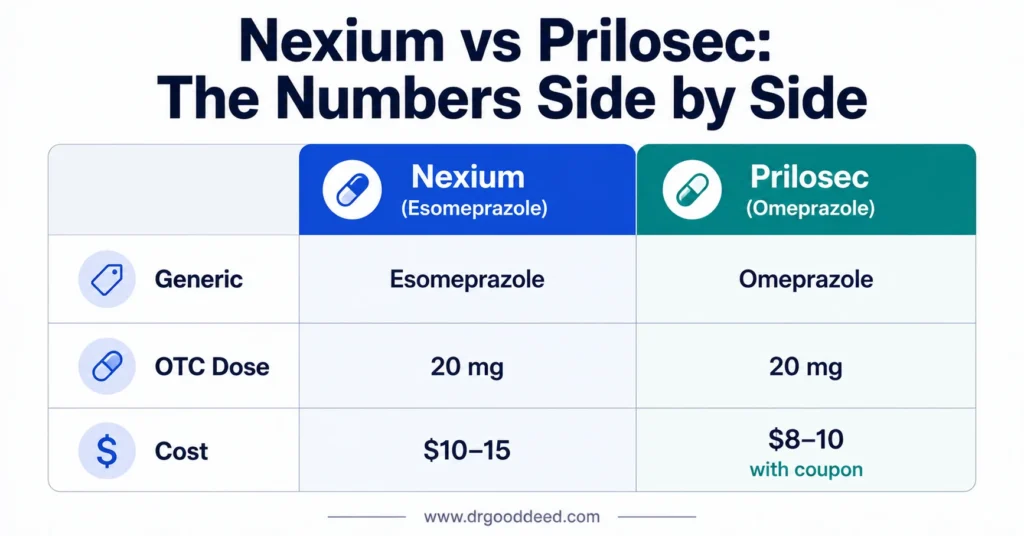
| Feature | Nexium | Prilosec |
| Generic name | Esomeprazole | Omeprazole |
| Drug class | Proton pump inhibitor (PPI) | Proton pump inhibitor (PPI) |
| OTC form | Nexium 24HR, 20 mg | Prilosec OTC, 20 mg |
| Prescription form | 20 mg, 40 mg capsules | 10 mg, 20 mg, 40 mg capsules |
| Standard adult OTC dose | One capsule daily for 14 days | One capsule daily for 14 days |
| Typical OTC treatment course | Up to three 14-day courses per year | Up to three 14-day courses per year |
| Approved OTC use | Frequent heartburn, 2+ days a week | Frequent heartburn, 2+ days a week |
What Nexium and Prilosec Have in Common
Nexium and Prilosec are two names for chemically related molecules that bind to the proton pump in your stomach lining, the enzyme that produces acid, and switch it off for roughly 24 hours per dose. Nexium and Prilosec need three to four days of consistent use to reach full acid suppression.
Both drugs are FDA-approved for the same core conditions:
- Gastroesophageal reflux disease (GERD)
- Erosive esophagitis, where stomach acid has damaged the esophagus lining
- Stomach and duodenal ulcers, including ulcers linked to H. pylori infection
- Long-term prevention of ulcers in people taking NSAIDs regularly
Is Nexium More Effective Than Prilosec?
Early industry-funded trials compared Nexium 40 mg against Prilosec 20 mg, an unequal dose that made Nexium look stronger than it actually is at matched strengths. A 2015 meta-analysis pooling data from 10,286 patients found esomeprazole 40 mg healed erosive esophagitis at a modestly higher rate than omeprazole 20 mg, with a relative risk of 1.07. But the small margin of independent reviewers has questioned whether it is large enough to justify Nexium’s higher price for most patients. At matched doses, the two drugs perform closer to identically.
Why Do Nexium and Prilosec Exist as Separate Drugs?
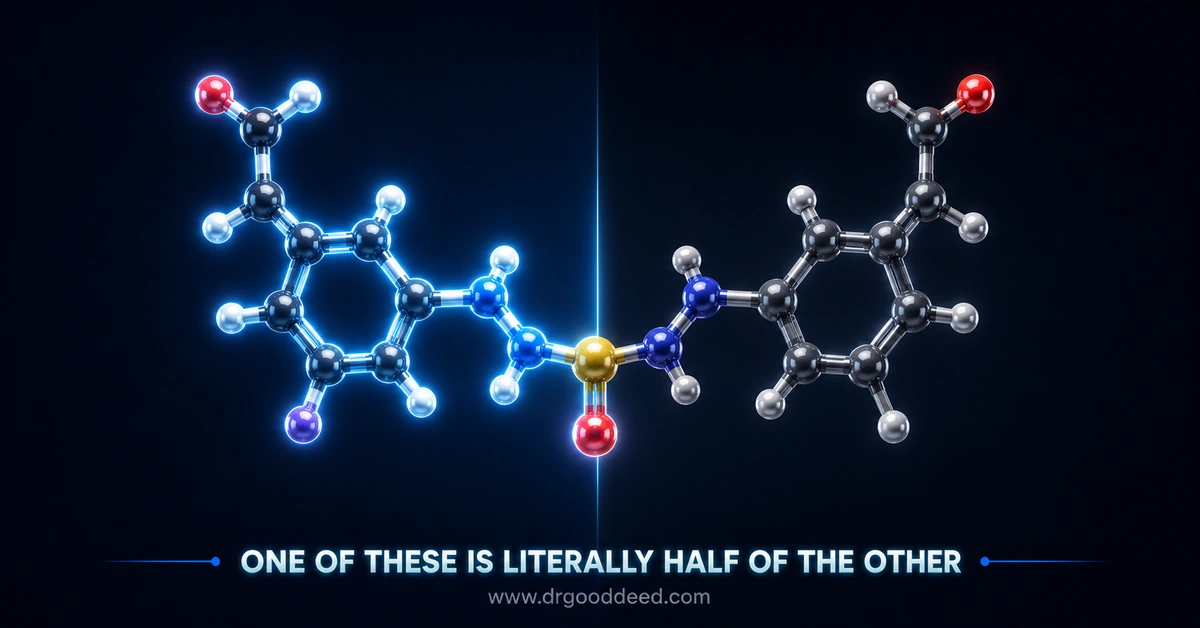
- Omeprazole is what chemists call a racemate, a 50-50 mix of two mirror-image molecules called the R-isomer and S-isomer.
- Esomeprazole is purified down to just the S-isomer, the half believed to be metabolized more slowly and predictably by the liver.
- AstraZeneca patented this single-isomer version as Nexium right as Prilosec’s original patent was expiring in 2001, a move critics in the pharmaceutical industry nicknamed a “me too” reformulation.
- It gave the company a new patent window on a molecule already inside an existing, cheaper drug.
Side Effects and Long-Term Risks to Know
Nexium side effects and Prilosec side effects overlap almost entirely because they share a mechanism. Short-term use commonly causes headache, nausea, gas, and diarrhea or constipation. The risks that matter more show up with long-term daily use beyond several months:
- Low magnesium levels. The FDA warned in March 2011 that PPI use of a year or longer can cause hypomagnesemia, which can trigger muscle spasms, irregular heartbeat, and seizures in severe cases.
- Bone fracture risk. An FDA warning first issued in 2010 and revised in 2011 links high-dose, long-term PPI use to increased risk of hip, wrist, and spine fractures.
- Clostridioides difficile infection. A February 2012 FDA warning noted that acid suppression from PPIs raises the risk of this intestinal infection, particularly in hospitalized patients.
- Vitamin B12 deficiency. Reduced stomach acid impairs B12 absorption over years of continuous use, which can affect nerve function and red blood cell production.
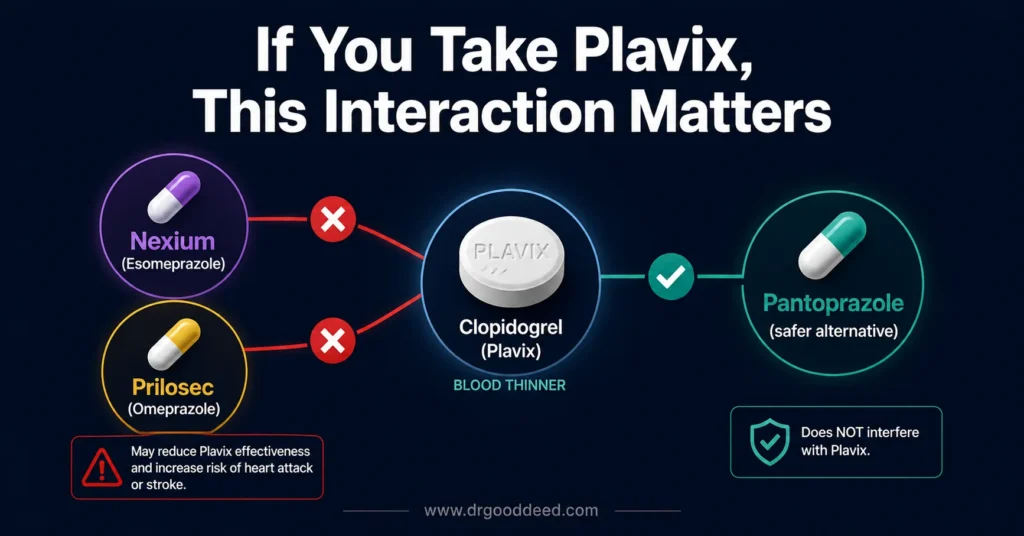
If you take clopidogrel (Plavix) after a heart attack, stent, or stroke, the FDA’s current Plavix label instructs patients to avoid omeprazole and esomeprazole together with clopidogrel, because both significantly cut the blood thinner’s ability to prevent clots.
This warning first targeted Prilosec specifically in 2009, but the label has since expanded to include Nexium too. If you take a CYP2C19-inhibiting PPI alongside clopidogrel, ask your cardiologist about pantoprazole instead, which interferes far less with the enzyme.
The FDA’s omeprazole label recommends a lower starting dose for patients of Asian descent, because a genetic variation in the CYP2C19 liver enzyme is far more common in Asian populations, up to 20% carry a poor-metabolizer version, compared to roughly 3% of White and Black patients in the US.
Which One Costs Less?
- Generic omeprazole is one of the least expensive PPIs sold in the US, with cash prices as low as $8 to $10 for a month’s supply using a pharmacy discount coupon.
- Generic esomeprazole runs slightly higher, often $10 to $15 with a coupon, though both are far cheaper than their brand-name versions, which can list well above $80 to $160 per month before any discount.
- Insurance formularies vary by plan: some prefer omeprazole as the covered first-line option and require a prior authorization for esomeprazole.
Check your plan’s formulary tier before assuming either drug is automatically cheaper for you.
Lifestyle Changes That Can Reduce How Much Medication You Need
Several everyday habits directly lower how much acid your stomach produces or how often it backs up into your esophagus:
- Losing excess weight reduces abdominal pressure pushing acid upward, one of the most consistent GERD improvements documented in clinical research.
- Avoiding meals within three hours of bedtime gives your stomach time to empty before you lie down.
- Quitting smoking helps the lower esophageal sphincter, the muscle that keeps acid down, work correctly again.
- Cutting back on alcohol, caffeine, and fatty or fried foods reduces episodes for many people, though triggers vary person to person.
Pro Tips for Taking a PPI
- Take your dose 30 to 60 minutes before your first meal of the day. PPIs only block acid pumps that are actively working, so timing around food matters.
- Never crush or chew delayed-release capsules. The coating protects the drug from stomach acid before it reaches your intestine.
- Don’t stop abruptly after months of continuous use. Suddenly quitting can trigger rebound acid hypersecretion, where symptoms temporarily worsen.
- Use the lowest effective dose for the shortest time that controls your symptoms, then reassess with your doctor.
Related Reading on Heartburn and Acid Reflux
If you’re still working through your options, these related topics fill in the gaps this comparison doesn’t cover in full:
- What causes GERD and how it’s diagnosed
- H2 blockers vs PPIs: how the two drug classes differ
- Natural and dietary approaches to acid reflux
- When heartburn signals something more serious
How to Decide With Your Doctor or Pharmacist
Prilosec and omeprazole are the same drug under different names. Generic omeprazole, given its track record, low cost, and equivalent performance at matched doses. Switch to esomeprazole if your insurance prefers it, if omeprazole hasn’t controlled your symptoms, or if your doctor has a specific clinical reason tied to your health history. Bring your full medication list to that conversation, especially if clopidogrel is on it.
FAQs
Is Nexium stronger than Prilosec?
No. At matched doses, research shows only a small statistical difference. Nexium’s higher-dose trials made it look stronger, but comparable doses perform nearly the same clinically.
Can I switch from Prilosec to Nexium without talking to my doctor?
No. Both are available over the counter, but switching without guidance skips checks for drug interactions like clopidogrel, and for whether you actually need a stronger prescription-strength dose.
How long does it take Nexium or Prilosec to work?
Full acid suppression takes three to four days of consistent daily use. Some symptom relief starts within 24 hours, but peak effect isn’t reached until day three or four.
Is it safe to take Nexium or Prilosec every day for years?
Long-term daily use carries documented risks, including low magnesium, bone fracture, B12 deficiency, and C. difficile infection. Annual reassessment with your doctor is recommended for continuous use beyond one year.
Which is cheaper, generic Nexium or generic Prilosec?
Generic omeprazole (Prilosec) is typically cheaper, often $8 to $10 monthly with a discount coupon, versus $10 to $15 for generic esomeprazole (Nexium) at the same discount tier.
Sources
- FDA: Reduced Effectiveness of Plavix (Clopidogrel) in Patients Who Are Poor Metabolizers of the Drug link
- PLAVIX (clopidogrel bisulfate) FDA-Approved Label link
- Comparative Effectiveness and Tolerability of Esomeprazole and Omeprazole in GERD: Systematic Review and Meta-Analysis, PubMed link
- Comparative Efficacy of Esomeprazole and Omeprazole: Racemate to Single Enantiomer Switch, NCBI link
- Omeprazole Therapy and CYP2C19 Genotype, Medical Genetics Summaries, NCBI Bookshelf link
- Pharmacogenomics in Asian Subpopulations and Impacts on Commonly Prescribed Medications, PMC link
- Proton Pump Inhibitors and Hypomagnesemia: A Meta-Analysis of Observational Studies, PMC link
- FDA Warns PPIs Impact Effectiveness of Clopidogrel, Drug Safety Communication Coverage link
- Omeprazole Pricing, GoodRx link
- Esomeprazole vs. Omeprazole: Similarities and Differences, GoodRx link