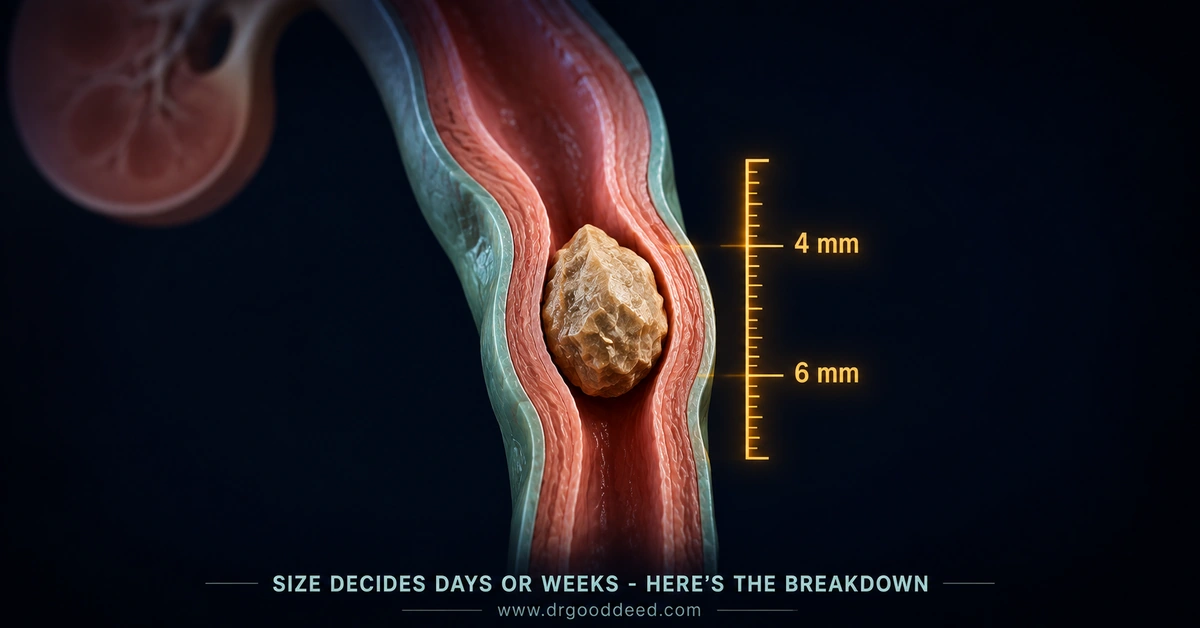

How long kidney stones last depends on size. A stone under 4mm often clears the urinary tract within one to three weeks. A stone over 6mm can take a month or longer, and many never pass without help. Location in the ureter, hydration, and individual anatomy shift that timeline in either direction.
This guide breaks down passage time by size, explains why different medical sources report different averages, and covers recovery time if you end up needing a procedure.
Key Takeaways
- Small stones (under 4mm) usually pass in about 31 days, with an 80% success rate on their own, according to Healthline’s clinical data.
- Larger stones (over 6mm) rarely pass unassisted and often require a procedure.
- Reputable sources disagree on exact averages because study populations and stone types differ.
- Kidney stone recovery time after a procedure like lithotripsy is a separate question from natural passage time, and it runs its own 4 to 8 week course.
- Pain that won’t ease after two to four weeks, fever, or an inability to urinate means it’s time to call a doctor, not wait longer.
How Long Does It Take to Pass a Kidney Stone by Size?
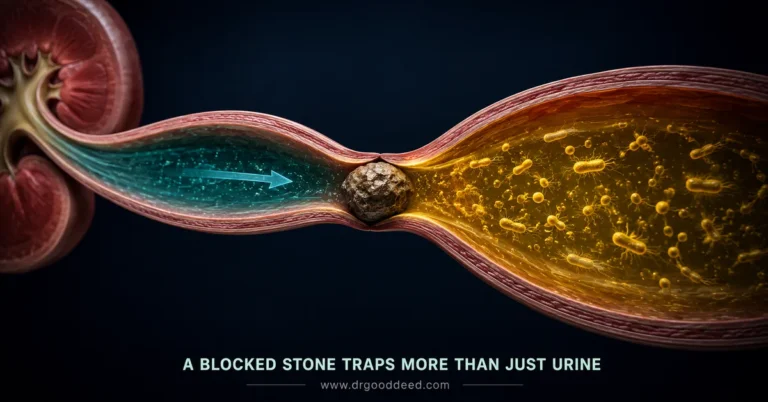
How long kidney stones take to pass once they start moving comes down to millimeters. Smaller stones slide through the ureter with little resistance. Larger ones snag on the ureter’s narrowest points, and the body needs weeks to work them loose.
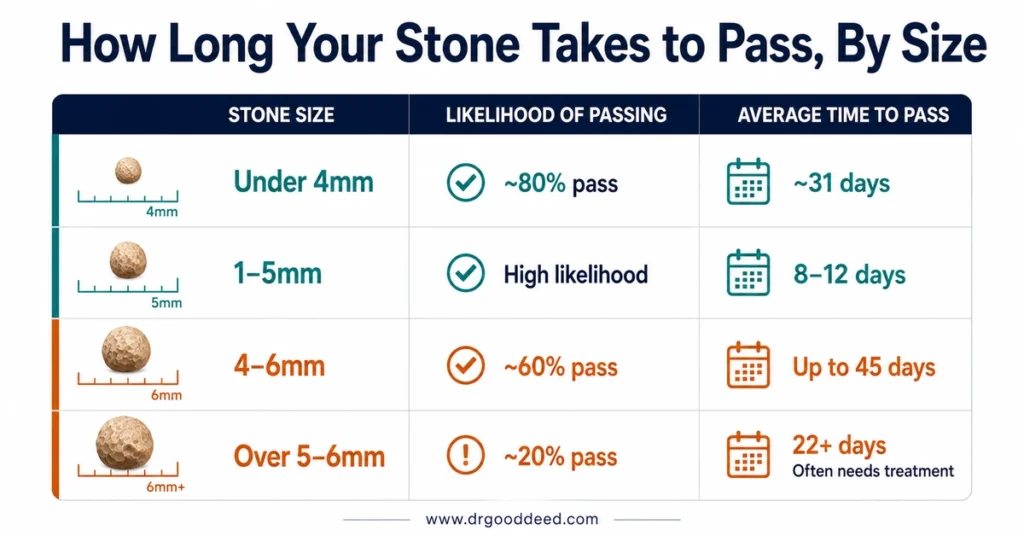
| Stone size | Chance of passing unassisted | Typical time to pass |
| Under 4mm | About 80% | Roughly 31 days on average (Healthline) |
| 1 to 5mm | Varies by exact size | 8 to 12 days on average (UCI Urology) |
| 4 to 6mm | About 60% | Up to 45 days |
| Over 5 to 6mm | About 20% | 22 days or longer, often requiring treatment |
Healthline reports stones under 4mm clear in about 31 days on average. UCI Urology’s data tells stones sized 1 to 5mm average just 8 to 12 days. Both figures come from real clinical observation, and both are correct for their specific patient groups.
Why Duration Estimates Vary So Much
Ask three urologists how long a stone takes to pass, and you’ll get three different ranges. It reflects real variation in the patients each study tracked, the imaging methods used to confirm passage, and the mineral makeup of the stones themselves.
- Study population differences: Healthline’s 31-day average for sub-4mm stones comes from a broader patient pool, while UCI Urology’s 8 to 12 day figure for 1 to 5mm stones draws from a narrower surgical case series. Different samples produce different medians.
- Stone composition: Calcium oxalate stones, the most common type, tend to have rougher surfaces than uric acid stones, which can slow their movement through the ureter even at a similar size.
- Measurement method: Some studies confirm passage through imaging follow-up, others rely on patient-reported symptom resolution, and self-report tends to underestimate actual passage time.
- Individual anatomy: A wider or straighter ureter moves a stone faster than one with natural narrowing, and that anatomy varies person to person regardless of stone size.
Expert Insight: A stone’s average passage time reported in a study reflects the median of the group tracked, not a guarantee for any one patient. Two people with identical 3mm stones can differ by two or three weeks in actual passage, because ureteral anatomy and stone surface texture affect friction more than size alone.
How Long Does Recovery Take After a Procedure?
Kidney stone recovery time after a procedure follows a different clock than natural passage. If a stone is too large or too painful to pass on its own, doctors often use shock wave lithotripsy to break it into smaller fragments the body can pass more easily.
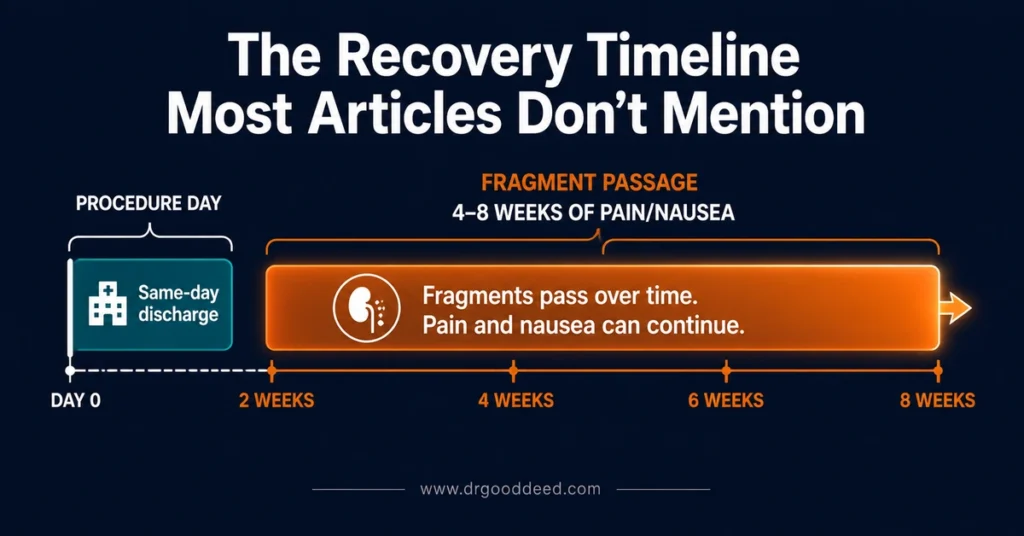
- Immediate aftermath: Most patients go home the same day, and normal activity often resumes within one to two days.
- Blood in urine: MedlinePlus notes this is normal for a few days up to a few weeks after the procedure, as the treated tissue heals.
- Pain and nausea from fragments: This is the part most articles skip. MedlinePlus specifically states that pain and nausea from passing broken-up stone fragments can last 4 to 8 weeks after treatment, well beyond the procedure day itself.
- Follow-up imaging: Doctors typically order an X-ray or ultrasound two to four weeks out to confirm how much fragment material has cleared.
- Ureteroscopy alternative: If a stent is placed during ureteroscopy, stent-related discomfort commonly lasts 4 to 7 days, a shorter window than lithotripsy fragment passage.
Lithotripsy recovery time is not the same as the procedure’s short outpatient window. The fragments still have to travel through your body, and that process, with its own pain and bleeding pattern, can run for two months.
Pro Tip: Ask your provider for a urine strainer before you leave the hospital after lithotripsy or ureteroscopy. Straining every void for several weeks lets you catch passed fragments for lab analysis, which identifies stone type and directly shapes prevention advice, a step many patients skip because no one mentions it at discharge.
What Affects How Long a Stone Takes to Pass
Size gets most of the attention, but it isn’t the only variable. Location, hydration, and physical differences between patients all shift the timeline independently of how big the stone actually is.
- Location in the ureter: A stone near the bladder passes faster than one still close to the kidney, since it has less distance and fewer narrow points left to clear.
- Hydration level: Adequate fluid intake increases urine flow, which physically pushes a stone forward, while dehydration slows the process and raises pain intensity.
- Anatomical variation: A naturally narrow ureter or prior scarring from a past stone can extend passage time regardless of the current stone’s size.
- Stone surface texture: Jagged or irregular stones catch on ureteral tissue more than smooth ones, which is one reason two similarly sized stones pass at different speeds.
- Underlying pain pattern: Understanding whether your pain resembles kidney stone pain or a different condition matters here. Comparing kidney pain vs back pain helps rule out musculoskeletal causes that don’t follow the same passage timeline at all.
None of these factors override size as the primary predictor, but together they explain why two people with the same size stone can have very different experiences.
When “Wait and See” Isn’t Working Anymore
Most urologists give a stone two to four weeks of observation before shifting strategy, assuming there’s no infection, no uncontrolled pain, and no kidney blockage. During this window, supportive care does real work.
- Hydration and monitoring: Drinking enough fluid to keep urine pale and using over-the-counter pain relief as directed are the backbone of home management during the wait period. For more supportive strategies during this stage, established kidney stone home remedies cover hydration targets and dietary adjustments in more depth.
- Medical therapy: If a stone hasn’t moved after roughly two weeks, doctors frequently add an alpha-blocker like tamsulosin, which relaxes ureteral muscle and can shorten passage time for stones in the 5 to 10mm range.
- The four-week checkpoint: If there’s no progress by four weeks, most urologists move from watchful waiting to active intervention, since prolonged blockage raises the risk of kidney damage.
- A stone that isn’t moving: How long is safe to leave a kidney stone without treatment is typically capped at four to six weeks; beyond that, the risk of silent kidney damage from sustained blockage starts to outweigh the benefit of continued waiting.
When to See a Doctor
Most kidney stones don’t need emergency care, but certain signs mean the situation has moved past a wait-and-see approach.
- Fever above 100.4°F or chills alongside stone symptoms, which can signal a kidney infection behind an obstruction.
- Pain that suddenly worsens or stops responding to prescribed medication.
- Inability to urinate at all, a sign of complete blockage.
- Persistent vomiting that prevents you from staying hydrated.
- No progress after four to six weeks of home monitoring, even without severe symptoms.
If you’re still working out whether your symptoms point to a stone in the first place, a full breakdown of the signs of kidney stones covers the complete symptom picture this article doesn’t repeat here. Persistent or worsening symptoms always warrant a same-day call to a provider rather than another day of waiting.
Sources
- Healthline, How Long to Pass a Kidney Stone link
- UCI Urology, How Long Does It Take to Pass a Kidney Stone? link
- MedlinePlus, Kidney Stones and Lithotripsy: Discharge link
- MedlinePlus, Kidney Stones link
- National Institute of Diabetes and Digestive and Kidney Diseases, Kidney Stones link
- Cleveland Clinic, Kidney Stones: Causes, Symptoms, Diagnosis and Treatment link
- Cleveland Clinic, Extracorporeal Shock Wave Lithotripsy link
- PubMed, Time to Stone Passage for Observed Ureteral Calculi: A Guide for Patient Education link
- Kaiser Permanente, Shock Wave Lithotripsy: What to Expect at Home link
- Mayo Clinic, Kidney Stones link