
A heart attack can sometimes lead to cardiac arrest, but they are not the same condition. A heart attack occurs when blood flow to part of the heart muscle is blocked, causing damage to the heart, while cardiac arrest occurs when the heart suddenly stops pumping blood effectively, causing the person to lose consciousness and stop breathing normally.
A person having a heart attack may remain conscious and have symptoms such as chest pain, sweating, nausea, or shortness of breath, whereas cardiac arrest is an immediate life-threatening emergency requiring CPR and an AED as quickly as possible.
Key Takeaways
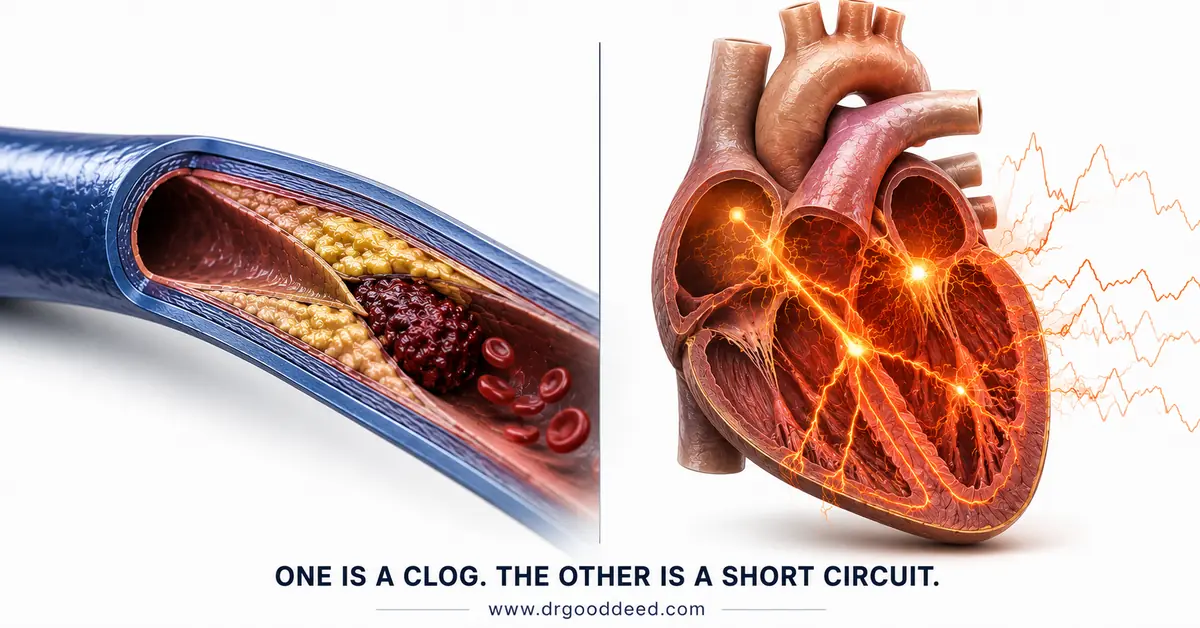
- A heart attack is a circulation problem. An artery gets blocked and part of the heart muscle starts to die from lack of oxygen.
- Cardiac arrest is an electrical problem. The heart’s rhythm short-circuits and stops pumping blood entirely.
- A heart attack can trigger cardiac arrest, but most heart attacks do not.
- The person having a heart attack is usually conscious. Someone in cardiac arrest is not.
- Call 911 for both. For cardiac arrest, start CPR and grab an AED without waiting.
- Learning the difference between heart attack and cardiac arrest ahead of time is what makes bystanders act fast instead of freezing.
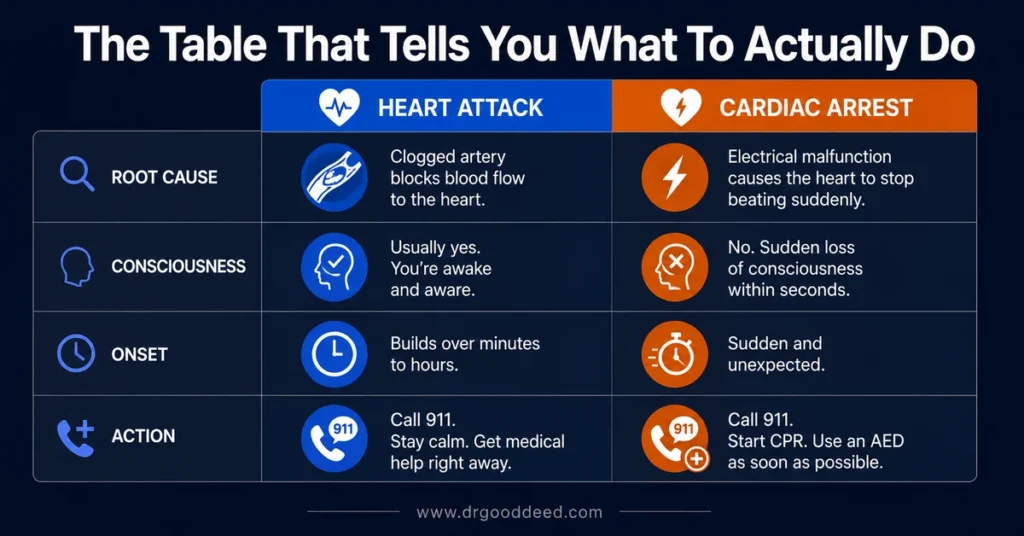
Heart Attack vs Cardiac Arrest at a Glance
The difference between heart attack and cardiac arrest is that a heart attack does not always cause cardiac arrest, but a severe heart attack can trigger one; a heart attack is mainly a blood-flow problem, whereas cardiac arrest is primarily an electrical problem causing the heart to stop pumping normally.
The table below shows why that distinction changes what you do in the first minute.
| Feature | Heart Attack | Cardiac Arrest |
| What it is | Blood flow to heart muscle is blocked | Heart stops beating effectively |
| Root cause | Clogged or ruptured coronary artery | Electrical malfunction, often ventricular fibrillation |
| Is the person conscious | Usually yes, breathing and talking | No, unconscious within seconds |
| Warning signs | Chest pressure, pain radiating to arm or jaw, nausea, sweating | Sudden collapse, no pulse, no normal breathing |
| Onset | Can build over minutes to hours | Sudden, often with zero warning |
| Immediate action | Call 911, chew aspirin if advised, keep the person calm and seated | Call 911, start CPR immediately, use an AED |
| Medical term | Myocardial infarction | Sudden cardiac death if untreated |
What Is a Heart Attack? The Plumbing Problem
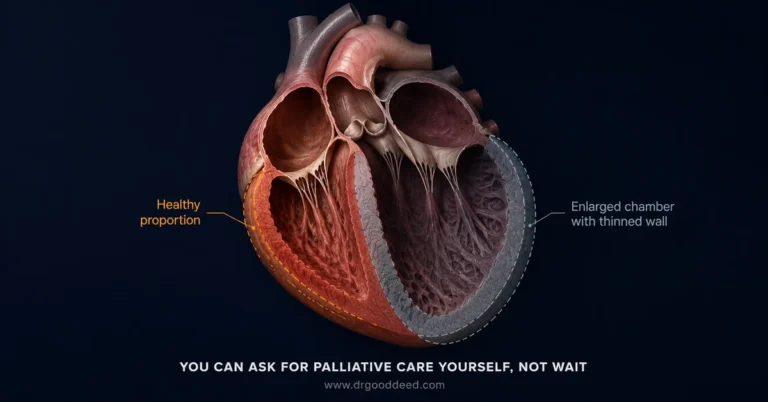
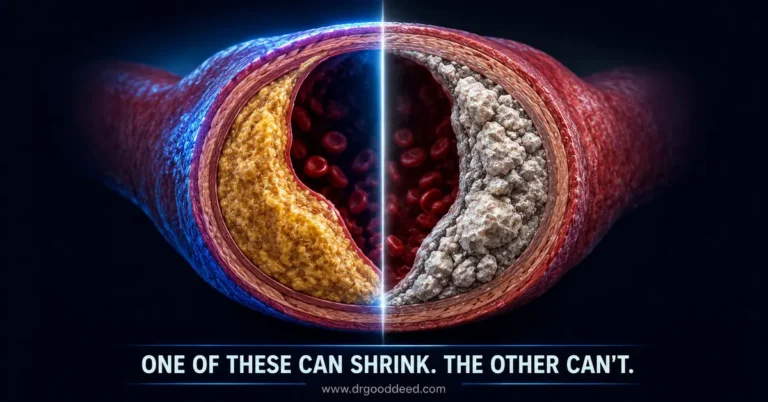
A heart attack, medically called myocardial infarction, happens when a coronary artery narrows or closes off. Cholesterol plaque ruptures, a clot forms on top of it, and blood stops reaching part of the heart muscle; that tissue starts dying within twenty to forty minutes without oxygen.
The person is almost always awake. Symptoms build rather than strike all at once:
- Chest pressure or squeezing that lasts more than a few minutes
- Pain spreading to the arm, jaw, neck, or back
- Shortness of breath, cold sweat, nausea
- In women, fatigue and back pain sometimes replace classic chest pain
Roughly 800,000 Americans have a heart attack every year, according to hospital cardiology data.
What Is Cardiac Arrest? The Electrical Problem
Cardiac arrest is not a blocked artery. The heart’s electrical signal, the one that keeps the beat steady, misfires and throws the lower chambers into a fast, useless quiver called ventricular fibrillation. Blood stops moving to the brain and every other organ within seconds.
Cardiac arrest drops a person instantly, with no pulse and no normal breathing, sometimes with a single gasp that looks like breathing but is not. Without a shock from a defibrillator or CPR to keep blood moving, death follows in minutes.
How a Heart Attack Can Trigger Cardiac Arrest
A heart attack starves part of the heart muscle of oxygen; that dying tissue becomes electrically unstable. It can fire chaotic signals into the heart’s conduction system.
When that happens, the heart tips into ventricular fibrillation and stops pumping. The person goes from having a heart attack, conscious and talking, to sudden cardiac arrest, unconscious with no pulse, sometimes within minutes of the first symptom. Not every heart attack does this. A heart attack that is caught and treated early rarely has time to destabilize the heart’s electrical system.
What to Do in Each Emergency
Knowing the difference between heart attack and cardiac arrest only matters if it changes your actions, and it does. Here is the split, with zero ambiguity.
If you suspect a heart attack, and the person is conscious:
- Call 911 immediately. Do not drive them yourself.
- Have them sit or lie down, stay calm, and loosen tight clothing.
- Give aspirin only if they are not allergic and a dispatcher advises it.
- Stay with them until EMS arrives.
If you suspect cardiac arrest, and the person is unconscious with no normal breathing:
- Call 911 or have someone else call while you act.
- Start chest compressions immediately: push hard and fast in the center of the chest, about 100 to 120 compressions per minute.
- Send someone for the nearest AED and use it as soon as it arrives. The device will guide you with voice prompts.
- Do not stop CPR until EMS takes over or the person starts breathing normally.
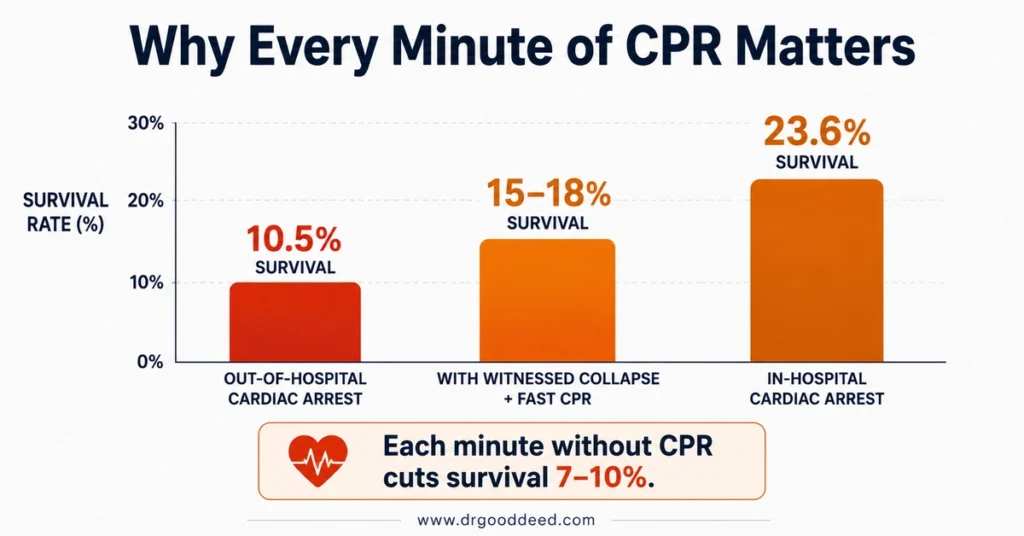
Survival Rates and Why Every Minute Counts
Survival numbers make the difference between heart attack and cardiac arrest brutally clear. Heart attack patients who reach a hospital in time survive at high rates because the heart is still beating. Cardiac arrest survival depends entirely on speed.
- Out-of-hospital cardiac arrest survival to hospital discharge sits at about 10.5% nationally, per the American Heart Association’s 2025 CPR and Emergency Cardiovascular Care guidelines.
- In-hospital cardiac arrest survival is higher, around 23.6% for adults, since a defibrillator and trained staff are already on hand.
- Survival nearly doubles, to roughly 15 to 18%, when someone witnesses the collapse and CPR starts fast.
- Every minute without CPR or defibrillation cuts survival odds by about 7 to 10%.
- Bystander CPR can double or triple a person’s chance of walking out of the hospital.
Waiting for symptoms to pass during a heart attack costs heart muscle.
When to See a Doctor After Either Event
Anyone who survives a heart attack needs cardiology follow-up, usually starting with an outpatient visit within a week of discharge to review medications, order stress testing, and set up cardiac rehab. Survivors of cardiac arrest need an even faster workup, often before leaving the hospital, since doctors’ workup typically includes an echocardiogram, coronary angiogram, and sometimes an implantable defibrillator.
FAQs
Is cardiac arrest the same as a heart attack?
No. A heart attack is a blocked artery cutting off blood flow. Cardiac arrest is an electrical failure that stops the heartbeat. One can cause the other, but they are distinct medical events.
Can a heart attack cause cardiac arrest?
Yes. Oxygen-starved heart tissue from a heart attack can trigger ventricular fibrillation, which stops the heart. This happens in a minority of heart attacks, not most.
What are the first signs of cardiac arrest?
Sudden collapse, no pulse, and no normal breathing. Unlike a heart attack, there is usually no buildup of chest pain beforehand.
Should you do CPR for a heart attack?
No, not unless the person becomes unconscious and stops breathing normally. A conscious heart attack patient needs 911 and calm monitoring, not chest compressions.
How long can someone survive cardiac arrest without treatment?
Brain damage can start within 4 to 6 minutes without CPR or defibrillation. Survival odds drop by 7 to 10% for each minute that passes untreated.
Does surviving a heart attack mean you avoided cardiac arrest risk?
No. Heart attack survivors carry higher long-term cardiac arrest risk from scar tissue that can disrupt future electrical signals, which is why cardiology follow-up matters.
Sources
- American Heart Association: Heart Attack or Sudden Cardiac Arrest, How Are They Different link
- American Heart Association: 2025 Guidelines for CPR and Emergency Cardiovascular Care link
- American Heart Association: CPR Facts and Stats link
- American Heart Association Newsroom: CPR and Updated Guidelines 2025 link
- American Heart Association: 2025 Heart Disease and Stroke Statistics At-A-Glance link
- American Heart Association Policy Fact Sheet: Out-of-Hospital Cardiac Arrest link
- University Hospitals: Sudden Cardiac Arrest vs Heart Attack link
- Froedtert and the Medical College of Wisconsin: Cardiac Arrest or Heart Attack, What’s the Difference link
- UnitedHealthcare: Know the Difference Between a Heart Attack and Cardiac Arrest link
- Mass General Brigham: Cardiac Arrest vs Heart Attack, Understand the Difference link