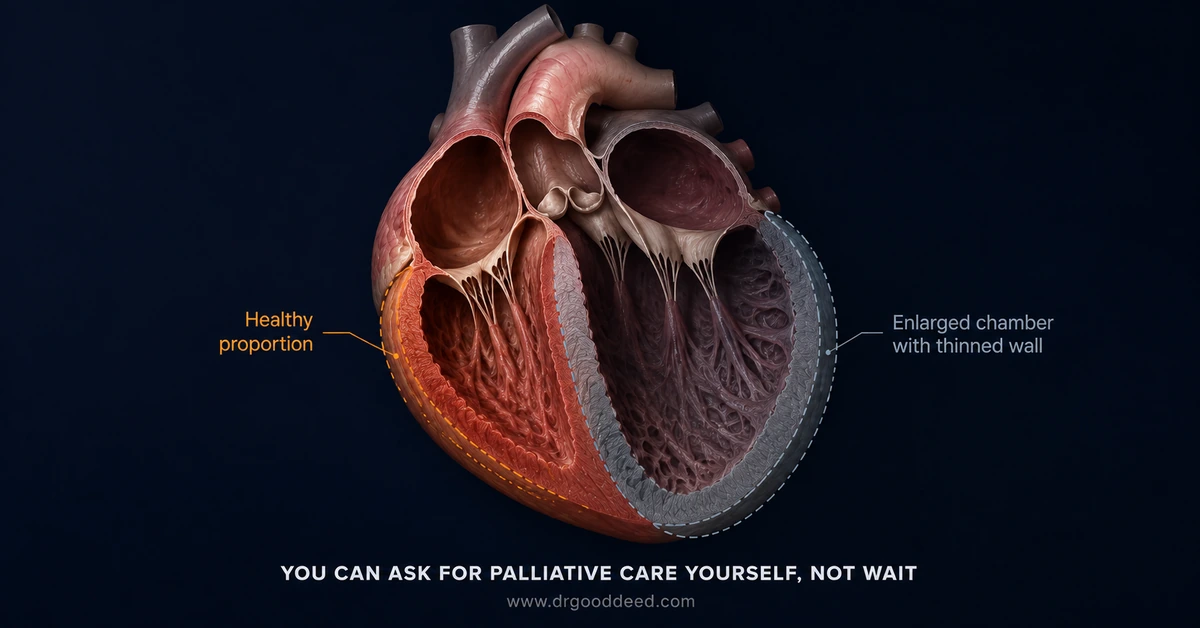

End-stage heart failure means that the heart has become so severely weakened or stiff that it can no longer adequately supply the body with blood, despite the best available treatments. It is often called advanced heart failure or Stage D heart failure.
What Does End-Stage Heart Failure Mean?
End-stage heart failure is the most advanced form of heart failure, also called stage D heart failure or NYHA class 4 heart failure. At this point, the heart muscle can no longer pump enough blood to meet the body’s needs, even while resting.
The American College of Cardiology stages (A through D) track disease progression over time. The New York Heart Association classes (I through IV) describe how symptoms limit daily activity right now.
A person can have stage D heart failure on the structural scale and NYHA class 4 heart failure on the symptom scale at the same time. Both labels point to the fact that standard medications and lifestyle changes are no longer enough to control the condition, and the care conversation shifts toward advanced therapies, devices, or comfort-focused treatment.
Symptoms of End-Stage Heart Failure
End-stage heart failure symptoms show up even during rest, and that is the key difference from earlier stages. Recognizing this shift early helps you and your care team adjust treatment before a crisis hospitalization becomes necessary.
Common symptoms include:
- Shortness of breath while sitting still or lying flat
- Extreme fatigue after minimal effort, such as walking to the bathroom
- Swelling in the legs, ankles, or abdomen from fluid buildup
- A persistent cough, sometimes with pink or white frothy mucus
- Rapid or irregular heartbeat
- Loss of appetite and unintentional weight loss
- Confusion or trouble concentrating, often from reduced blood flow to the brain
- Kidney or liver complications from chronic poor circulation
Frequent hospital admissions for fluid overload, sometimes called decompensation, are also common in end-stage heart failure.
Do Symptoms Look Different in Women?
Yes, research comparing men and women with heart failure, including a 2024 review in the Methodist DeBakey Cardiovascular Journal, found women report higher rates of dyspnea on exertion, exercise intolerance, and lower-extremity edema than men with comparable heart function.
Women are also more likely to have heart failure with preserved ejection fraction, a form where the heart’s pumping strength looks normal on tests even though filling is impaired. If end-stage heart failure symptoms in a woman are being brushed off as stress or deconditioning, a request for an echocardiogram and BNP blood test is a reasonable next step.
What Is the Life Expectancy With End-Stage Heart Failure?
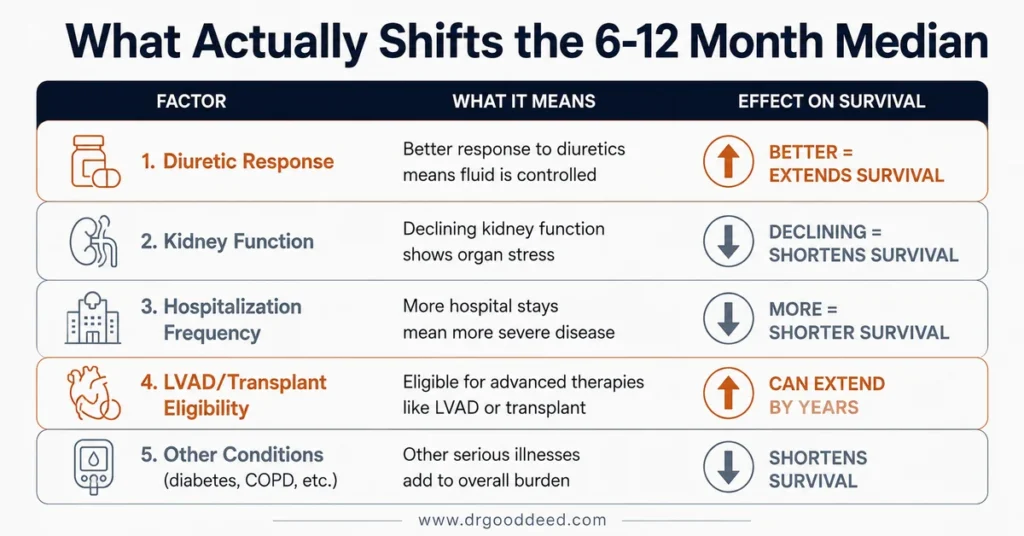
End-stage heart failure life expectancy carries a median of 6 to 12 months, based on a widely cited 2018 clinical review, though individual outcomes vary enormously. Some people live only weeks after diagnosis. Others stabilize on advanced therapy and live for years.
Several factors shift this timeline in either direction:
| Factor | Effect on Prognosis |
| Response to diuretics and medication adjustments | Better response extends survival |
| Kidney function | Declining kidney function shortens survival |
| Frequency of hospitalizations | More frequent admissions signal shorter survival |
| Eligibility for LVAD or transplant | Can extend survival by years |
| Presence of other conditions (diabetes, COPD) | Additional conditions shorten survival |
Why Heart Failure Patients Often Get Less Palliative Care Than Cancer Patients
A 2020 JAMA Network Open study of over 57,000 US patients found that people with heart failure were referred to heart failure palliative care later than cancer patients, and were half as likely to be referred to hospice.
Heart failure follows an unpredictable up-and-down course rather than cancer’s more linear decline. Palliative care programs also grew up around oncology, so referral habits still lean that way by default.
You do not have to wait for your cardiologist to bring it up. You can ask directly: “Can we get a palliative care consult to help manage my symptoms and plan ahead, even while we keep treating the heart failure?” Palliative care works alongside cardiology, and studies show it improves symptom control and reduces hospital readmissions in end-stage heart failure.
Understanding Your Treatment Options: Transplant, Devices, or Comfort-Focused Care
At this stage, patients are typically evaluated along one of two equally legitimate tracks. Framing this as heart transplant vs comfort care misses the point that both are active, valid choices depending on your goals and eligibility.
Track one, aggressive intervention:
- Heart transplant evaluation, if age, overall health, and organ function qualify
- Left ventricular assist device (LVAD), a mechanical pump that can extend life by years and sometimes bridges someone to transplant
- Continuous IV inotrope medications to strengthen heart contractions
Track two, comfort-focused care:
- Symptom management through medication adjustment, oxygen, and diuretics
- Home-based or inpatient hospice when the focus shifts fully to comfort
- Palliative care support alongside ongoing cardiac treatment
Choosing comfort-focused care is choosing to prioritize quality of life and time with family over aggressive procedures that may not extend life meaningfully. Cleveland Clinic cardiologists describe both paths as legitimate outcomes of the same evaluation process, not a hierarchy.
The ICD Deactivation Conversation
If you or your loved one has an implantable cardioverter defibrillator, ICD deactivation is a conversation worth having early. An ICD is designed to shock the heart back into rhythm during a dangerous arrhythmia.
Deactivating the shock function does not stop the heart or hasten death. It simply turns off one specific feature while leaving pacemaker function intact if needed. Research shows many patients are never told this is even possible, and families are sometimes caught off guard by a shock during a natural dying process. This decision belongs entirely to the patient and family, guided by the cardiology and palliative teams, and it can be revisited at any point.
How to Support Emotional and Spiritual Wellbeing
Fear, grief, and even relief can show up together, and none of that is unusual.
Practical ways to support well-being:
- Ask your hospital or hospice about chaplain or spiritual care services, regardless of religious background
- Consider a social worker referral for family counseling and advance care planning support
- Keep space for honest conversations about fears, hopes, and unfinished business
- Look into support groups specifically for end-stage heart failure caregivers, since the unpredictable course creates unique stress
Anticipatory grief, the grief that begins before a death occurs, is real and common, and talking with a counselor or chaplain can help process it.
When to Talk to a Palliative Care Team
Ask for a heart failure palliative care referral as soon as symptoms limit daily activity, not only when treatment options run out. Earlier involvement generally means better symptom control.
Bring it up if you notice frequent hospitalizations, symptoms that interfere with sleep or daily tasks, or uncertainty about next steps. A palliative care consult does not mean stopping cardiac treatment. It adds a second layer of support focused entirely on comfort, decision-making, and quality of life alongside it.
A Family’s Experience
Robert Ellison, a 71-year-old retired electrician in Ohio, was told he had reached end-stage heart failure after his third hospitalization in four months. His daughter asked directly for a palliative care referral, something his cardiologist had not yet raised. Within two weeks, a palliative team helped adjust his medications, reduced his breathlessness, and walked the family through the ICD deactivation conversation before it became urgent. Names and details in this story have been changed to protect privacy; it reflects a composite of common patient experiences.
FAQs
Is end-stage heart failure the same as stage D heart failure?
Yes. Stage D heart failure is the clinical staging term for what is commonly called end-stage heart failure, referring to advanced disease that no longer responds to standard therapy.
What does NYHA class 4 heart failure mean day to day?
It means symptoms occur even at rest. Walking across a room or standing to get dressed can cause breathlessness under NYHA class 4 heart failure.
How accurate is the 6 to 12-month life expectancy estimate?
It is a median, not a guarantee. End-stage heart failure life expectancy varies widely based on kidney function, hospitalization frequency, and treatment response.
Should I choose heart transplant vs comfort care?
There is no universally right answer. Heart transplant vs comfort care depends on your eligibility, overall health, and personal goals for quality versus quantity of life.
Does ICD deactivation cause immediate death?
No. ICD deactivation only stops the shock function. It does not stop the heart and does not hasten death on its own.
Sources
- Medical News Today, reviewed by Angela Lee, MD, FACC link
- Cleveland Clinic, Stage D Heart Failure link
- Mass General Brigham, End-Stage Heart Failure link
- JAMA Network Open, Comparison of Hospitalized Patients With Heart Failure and Cancer Referred to Palliative Care, 2020 link
- Palliative Medicine, Heart Failure and Palliative Care: Time for Action, 2018 link
- PLOS One, Palliative Care Among Heart Failure Patients in Primary Care: A Comparison to Cancer Patients link
- Methodist DeBakey Cardiovascular Journal, Heart Failure in Women link
- PMC, A Disease of Her Own? Unique Features of Heart Failure in Women link
- American Heart Association, Heart Failure Resources link
- PubMed, The Last Six Months of Life for Patients With Congestive Heart Failure, SUPPORT Study link