
When choosing the best home blood pressure monitor, prioritize a validated automatic upper-arm device rather than wrist, finger, or cuffless models, and make sure the cuff fits your arm correctly because an improper cuff size can produce inaccurate readings.
Useful features include a clear display, memory for storing readings, averaging, and optional data sharing with your healthcare professional, but accuracy and clinical validation should come before smart features.
Key Takeaways
- FDA clearance and independent clinical validation are two different things, and most shoppers assume they’re the same.
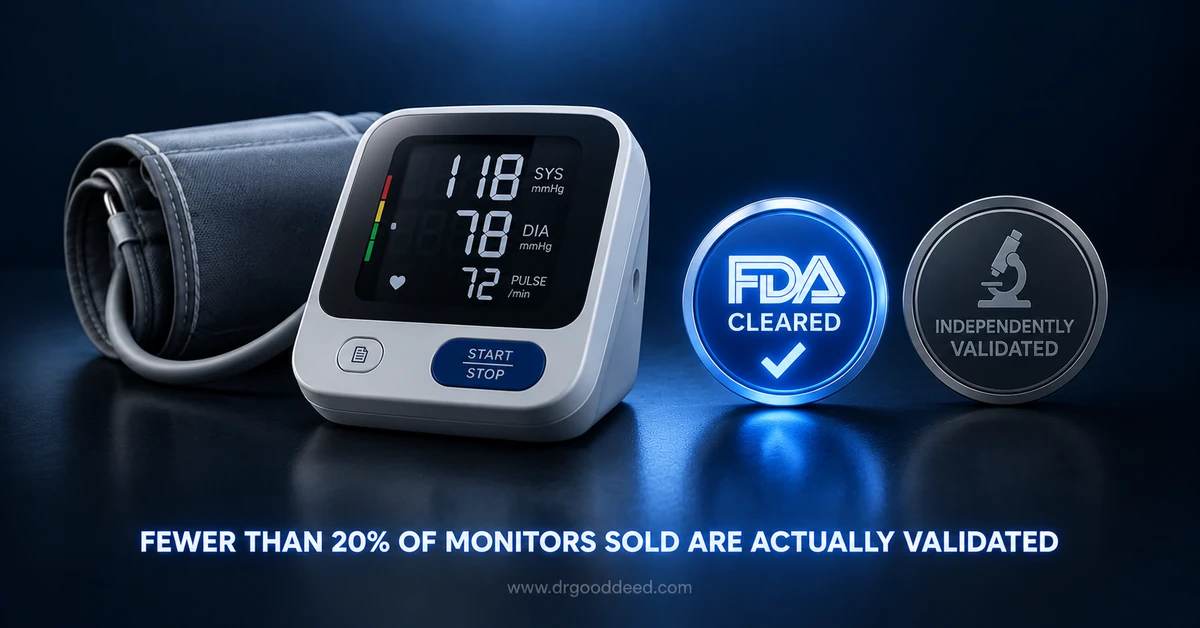
- Fewer than 20% of blood pressure monitors sold on Amazon appear on the official validated device list.
- Cuff size affects accuracy more than brand or price; a wrong-size cuff can throw off readings significantly.
- Upper-arm monitors consistently outperform wrist monitors in independent testing.
- Take three readings, one minute apart, and average them for the most reliable number.
FDA Cleared Isn’t the Same as Clinically Validated
An FDA-cleared home blood pressure monitor simply means the manufacturer showed it’s substantially equivalent to a device already on the market, a 510(k) clearance pathway that doesn’t require independent testing of the device’s actual measurement accuracy.
Clinical validation is a separate, more rigorous process, one where a device gets independently tested against a formal accuracy protocol, such as the AAMI/ESH/ISO 81060-2 standard, and results get published on the official validated device listing maintained through ValidateBP.org.
According to data cited by clinical researchers, fewer than 20% of blood pressure monitors sold on Amazon appear on the validated device list, meaning most shoppers are buying a device that’s legal to sell but never independently confirmed to measure accurately.
Expert Insight: A monitor can carry FDA clearance and still produce systematically inaccurate readings, since 510(k) clearance evaluates equivalence to an existing device, not measurement performance against a reference standard, which is why checking the validated device list matters more than checking for an FDA badge.
Why Cuff Size Is the Biggest Accuracy Killer
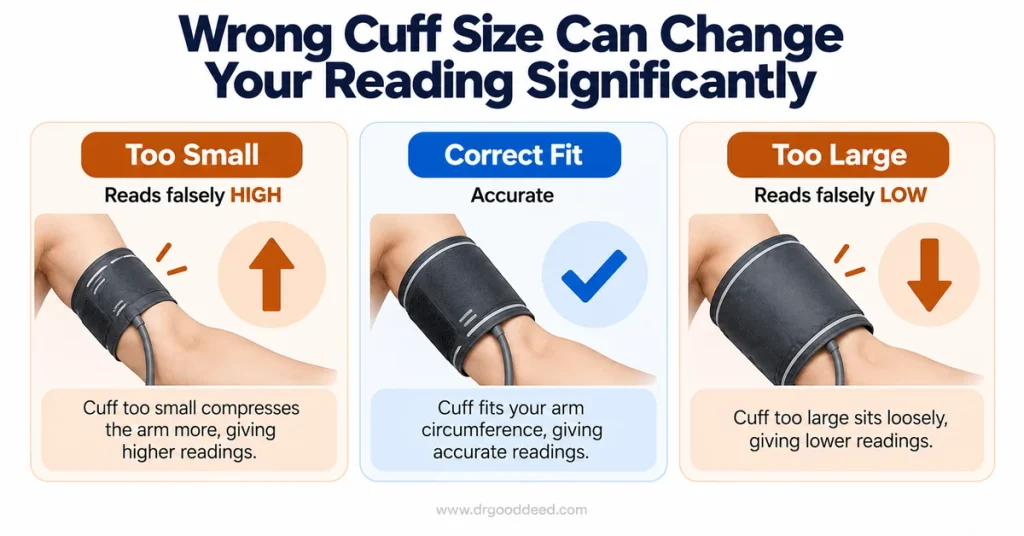
Cuff size affects blood pressure monitor accuracy more than most people realize, and it’s an error that’s completely avoidable once you know your actual arm circumference. A cuff that’s too small for your arm tends to compress tissue unevenly, producing an artificially high reading, while a cuff too large produces a falsely low one, and either error can be significant enough to change a treatment decision.
- Measure your upper arm circumference at the midpoint between your shoulder and elbow using a soft tape measure, then match that number to the cuff size chart; most standard cuffs fit 22 to 32 centimeters, but larger and smaller options exist.
- Check the cuff range printed on the device, since many bundled cuffs default to a “standard” size that doesn’t fit larger or smaller arms accurately.
- Re-measure periodically if your weight has changed meaningfully, since arm circumference shifts with weight change and an old cuff size may no longer fit correctly.
Getting cuff size right costs takes two minutes, yet it’s the single most overlooked accuracy factor in home monitoring.
Home Blood Pressure Monitors Compared (Comparison Table)
Among devices with published validation status, these three represent common options across price points and connectivity features, since the right choice depends on cuff fit and personal tracking needs.
| Feature | Omron Platinum | Withings BPM Connect | Omron Bronze/3 Series |
| Validation status | Listed on validated device database | Listed on validated device database | Listed on validated device database |
| Approximate price | 100 | 100 | 40 |
| Connectivity | Bluetooth, app tracking | Wi-Fi and Bluetooth, app tracking | None, display only |
| Cuff range | Standard and large cuffs included | 9-17 inch adjustable cuff | Standard cuff, 9-13 inches |
How to Take an Accurate Reading at Home
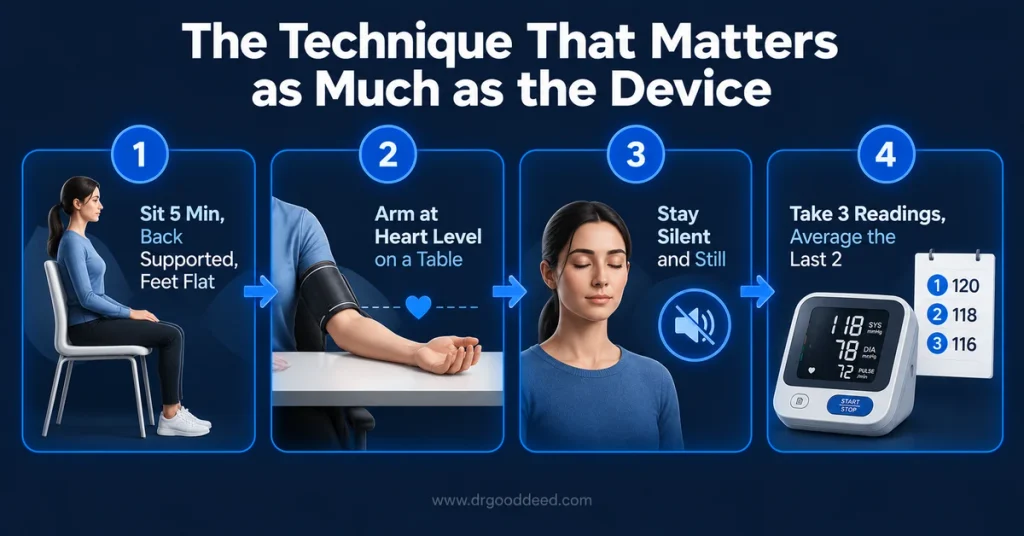
Reading technique changes results as much as device quality does. Following a consistent process each time makes your readings genuinely comparable over weeks and months.
- Sit quietly for five minutes before measuring, with your back supported and feet flat on the floor, avoiding legs crossed, since crossed legs alone can raise systolic pressure measurably.
- Position your arm at heart level, resting on a table rather than held up or hanging down, since arm position below heart level tends to read falsely high.
- Stay silent and still during measurement; talking or moving during the reading is a well-documented source of falsely elevated numbers.
- Take three readings, one minute apart, and average the second and third, discarding the first, since the initial reading is often higher due to residual nervousness.
Consistent technique, more than any single device feature, is what makes home blood pressure monitors genuinely useful for tracking trends over time.
Wrist vs Upper-Arm Monitors: Which Should You Choose
Upper-arm monitors remain the clinical standard, and independent testing from organizations like Consumer Reports has confirmed arm monitors outperform wrist monitors for accuracy under typical home use conditions.
Wrist monitors are more sensitive to positioning error, since the wrist must be held exactly at heart level throughout measurement, a harder position to maintain consistently than resting an arm on a table.
Pro Tip: A validated wrist monitor can still be reasonable for someone with a very large arm circumference that no standard upper-arm cuff fits comfortably, but only if the specific wrist model appears on the validated device list, since unvalidated wrist monitors carry the highest error rates of any home monitoring format.
When to Bring Your Readings to a Doctor
Bring your logged readings to a doctor if home numbers consistently run higher or lower than office readings, since that gap can point to white coat hypertension or masked hypertension, two patterns our guide on does anxiety cause high blood pressure explains in more detail. Also flag any reading above 180/120, or any reading paired with chest pain, shortness of breath, or vision changes, for immediate medical attention.