
A chronic disease self-management program is a structured, peer-led education course that teaches people with ongoing health conditions how to handle daily symptoms, medications, and decisions on their own. It is not a treatment, and it does not replace your doctor. The best-known version, CDSMP, came out of Stanford University and now runs in community centers, libraries, and clinics across the US.
Key Takeaways
- A chronic disease self-management program is a peer-led, structured education course, not a support group or therapy session.
- The original Stanford chronic disease self-management program was designed for people with heart disease, lung disease, stroke, or arthritis, and it now covers many more conditions.
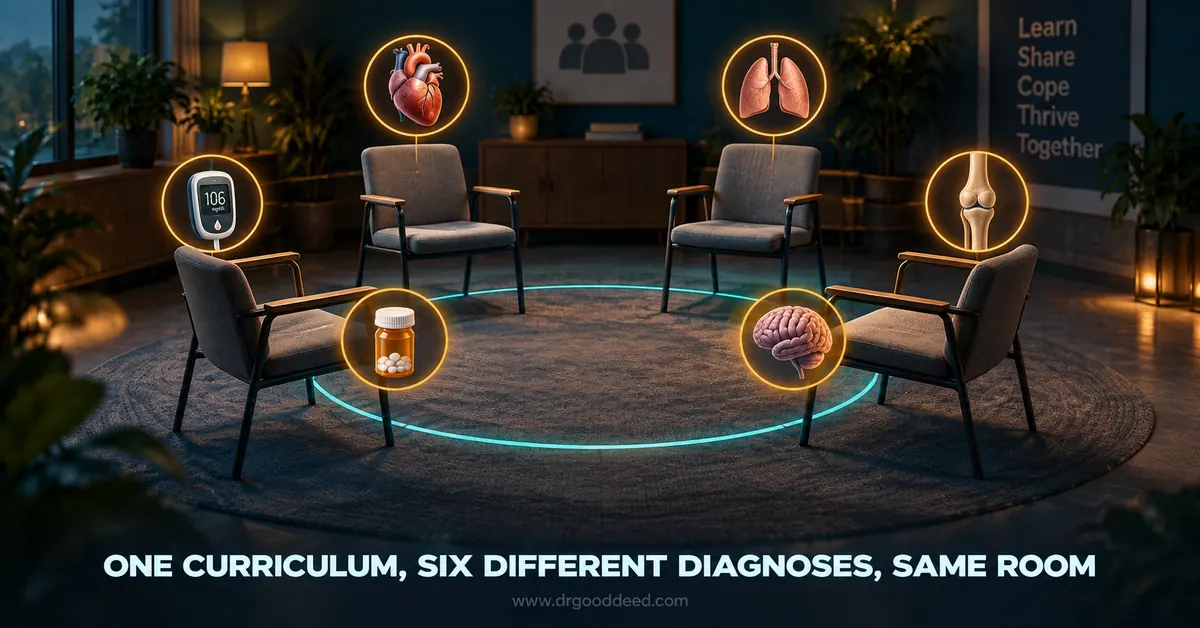
- One curriculum teaches six general skills that apply across almost any chronic illness, so the same workshop can seat someone with diabetes next to someone managing depression.
- A 1999 randomized trial found measurable drops in hospital days and emergency visits among participants, with newer research flagging gaps for lower-income and socially isolated groups.
- Most programs run six weeks, cost little or nothing, and are found through a doctor’s office, hospital, or local aging services agency.
What These Programs Actually Teach
These workshops build self-management skills for chronic illness around six repeatable tasks rather than disease-specific medical facts. Each skill applies whether the underlying diagnosis is arthritis, COPD, or heart failure. Participants practice the skills weekly and report back on what worked.
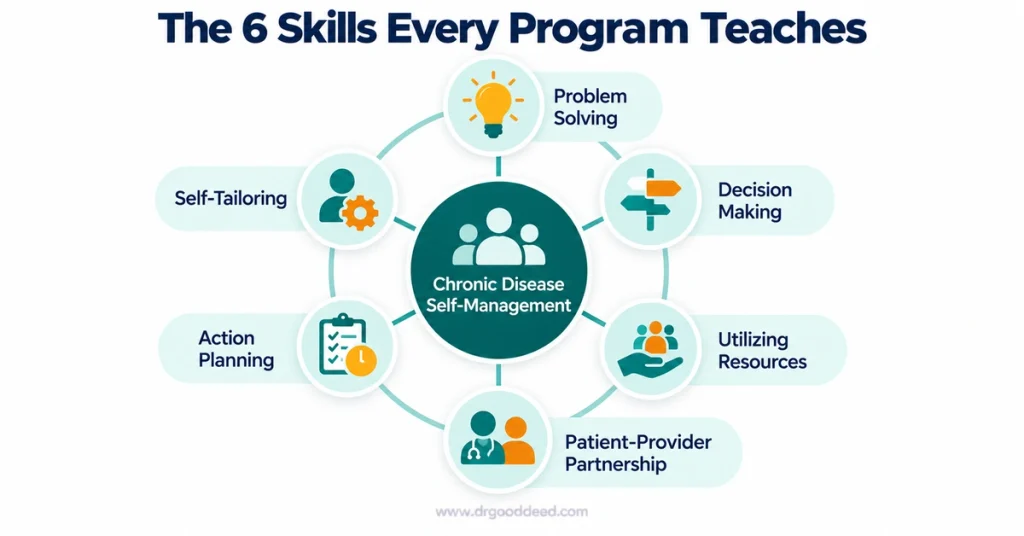
- Problem solving. Participants learn to break a daily obstacle, like pain that disrupts sleep, into small testable steps rather than treating it as unsolvable.
- Decision making. The course teaches how to weigh options when symptoms change, including when a symptom is minor versus when it needs a same-day call to a provider.
- Utilizing resources. People learn to identify and use community services, transportation help, and financial assistance programs they didn’t know existed.
- Forming a patient-provider partnership. Sessions cover how to prepare questions before appointments and how to report symptoms clearly, so visits become two-way conversations.
- Action planning. Each week ends with a specific, short-term, personally chosen goal, such as walking ten minutes three times that week, then reporting progress next session.
- Self-tailoring. Participants adapt every technique to their own condition, energy level, and daily routine instead of following a generic checklist.
Why One Program Works Across Many Different Conditions
A chronic disease self-management program is built to be disease-agnostic on purpose. It teaches the skill of managing illness itself, not facts about any one illness. Because problem-solving, action planning, and communicating with a doctor look almost identical whether the diagnosis is diabetes or arthritis, the same six-week curriculum works without being rewritten for each condition.
The original Stanford chronic disease self-management program trial enrolled 952 adults over age 40 with a physician-confirmed diagnosis of heart disease, lung disease, stroke, or arthritis, deliberately mixing them in the same workshops. Since then, condition-specific spinoffs have been built on the same skeleton, including a diabetes self-management program version and a cancer-recovery version called Cancer Thriving and Surviving. The core skills stay the same across every version; only the examples change.
Does It Actually Work? What the Research Shows
Yes, with caveats. The founding study on this chronic disease self-management program model is a six-month randomized controlled trial published by Kate Lorig and colleagues in Medical Care in 1999.
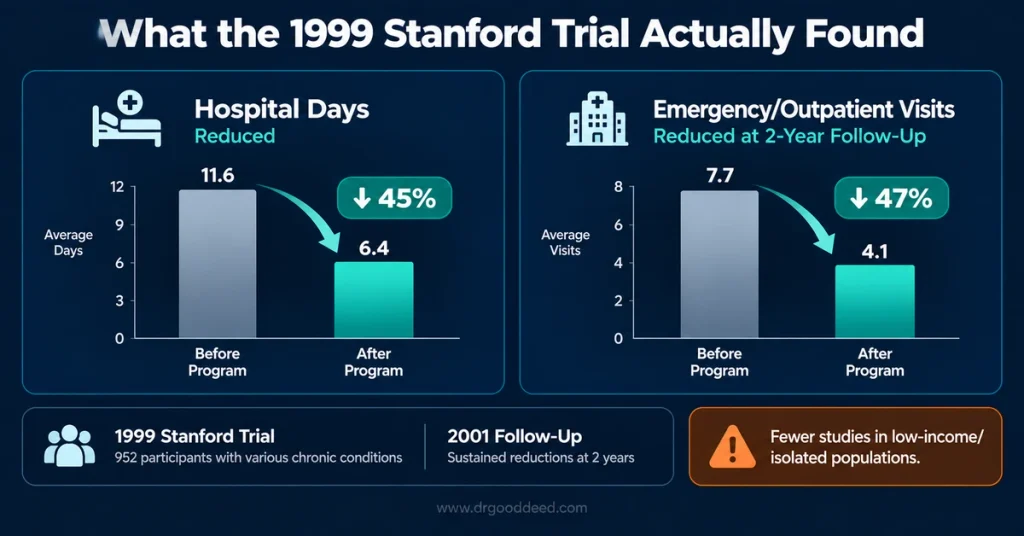
- The 1999 trial randomized 952 adults 40 and older with heart disease, lung disease, stroke, or arthritis to either the program or a wait-list control group.
- Participants who completed the program showed improved health status across measures including energy, health distress, and self-rated health compared with the control group.
- Hospital days dropped, an effect that held even while national hospital stay lengths were trending upward at the time of the study.
- A 2001 two-year follow-up in the same journal confirmed reduced emergency and outpatient visits and sustained self-efficacy gains among the original cohort.
- A Kaiser Permanente system-wide replication run afterward found similar reductions in hospitalization, which is part of why insurers and community agencies still fund the program today.
- More recent research, including the EFFICHRONIC project across five European countries, notes that most existing evidence comes from general chronic disease populations, and that fewer studies have specifically tested outcomes in socioeconomically vulnerable or isolated groups.
Who Might Benefit Most
Anyone managing an ongoing physical or mental health condition can typically join, and you do not need a single specific diagnosis to qualify. People newly diagnosed with a chronic condition often benefit from the structure early, before habits around avoidance or overwhelm set in.
- Adults living with any single chronic condition, including diabetes, arthritis, heart disease, chronic pain, or depression.
- Adults managing two or more overlapping conditions at once, since the trial specifically tested and supported this comorbid group.
- People newly diagnosed who want a practical starting framework rather than a general pep talk.
- Caregivers supporting someone with a chronic illness, who are explicitly welcomed in most program formats.
- Anyone whose current symptom management feels reactive rather than planned, meaning problems get handled only after they escalate.
How These Programs Are Typically Delivered
A standard chronic disease self-management program runs six weekly sessions of two and a half hours each, led by two trained peer facilitators, at least one of whom manages a chronic condition personally.
- Format options include in-person workshops at community centers or clinics, live virtual sessions, and in some regions, a mailed toolkit paired with weekly phone calls.
- Cost is usually free or low-cost, often funded through hospitals, Area Agencies on Aging, or public health grants rather than charged directly to participants.
- Facilitators are trained peer leaders, not clinicians, though physicians and other health professionals review all workshop content before it’s used.
- Related versions exist for specific needs, including a Spanish-language format called Tomando Control de su Salud and a condition-specific diabetes self-management program.
- Materials typically include a companion book, Living a Healthy Life with Chronic Conditions, which expands on each week’s topic for independent reading between sessions.
Pro Tip: Ask specifically whether attendance credit requires four or more of the six sessions, since most licensed programs count that as completion for outcome tracking, and missing early sessions on problem solving and action planning makes the later ones on communication and self-tailoring harder to apply.
How to Find a Program Near You
The most reliable route is asking a source already connected to a licensed provider rather than searching independently, since these workshops require a licensed local organization to run.
- Ask your primary care doctor or specialist directly, many now refer patients as part of routine chronic care management.
- Call your local hospital’s patient education or community health department.
- Contact your local Area Agency on Aging, which funds and tracks many workshops nationally.
- Check with your county or city public health department for current community health education offerings.
FAQs
Is a chronic disease self-management program the same as therapy?
No. It is structured skills education delivered by trained peers, not licensed mental health treatment. It teaches practical self-management skills for chronic illness like action planning and communication, and does not diagnose or treat psychological conditions.
Do you need a specific diagnosis to join?
No. Programs accept adults with any chronic physical or mental health condition, including people managing multiple conditions at once. The founding trial deliberately mixed diagnoses like arthritis and heart disease in the same sessions.
Are these programs free?
Usually low-cost or free, funded through hospitals, aging agencies, or public health grants. Exact cost varies by local licensed provider, so confirm pricing directly with the organization running your specific workshop before enrolling.
Can caregivers attend too?
Yes. Caregivers are explicitly welcomed in standard CDSMP formats and can enroll alongside or independently of the person they support, learning the same six core skills for managing daily challenges.
How is this different from a support group?
Support groups center on shared emotional experience with looser structure. This program follows a fixed six-week curriculum teaching specific, testable skills like weekly action plans, with measured health outcomes in published research.
Sources
- Lorig KR, et al. Evidence suggesting that a chronic disease self-management program can improve health status while reducing hospitalization: a randomized trial. Medical Care, 1999. link
- Lorig KR, et al. Chronic disease self-management program: two-year health status and health care utilization outcomes. Medical Care, 2001. link
- Chronic Disease Self-Management Program: Insights from the Eye of the Storm. Frontiers in Public Health. link
- Self-Management Resource Center: Chronic Disease Self-Management Small Group program details. link
- National Council on Aging: Get the Facts on Chronic Disease Self-Management. link
- CDC archive: Self-Management Education Programs overview. link
- USDA SNAP-Ed: Chronic Disease Self-Management Program intervention summary. link
- Rural Health Information Hub: Chronic Disease Self-Management Program project summary. link
- EFFICHRONIC study protocol: efficiency of a chronic disease self-management programme in socioeconomically vulnerable populations. BMJ Open, 2019. link
- Fracso D, et al. The chronic disease self-management programme: a phenomenological study for empowering vulnerable patients included in the EFFICHRONIC project. Health Expectations, 2022. link
Medical Disclaimer: This article is for general information only and is not medical advice. It does not replace a diagnosis, treatment plan, or guidance from a qualified healthcare professional. Always talk to your doctor about your own symptoms and before starting, stopping, or changing any treatment. If you think you may be having a medical emergency, call 911 or go to your nearest emergency room.