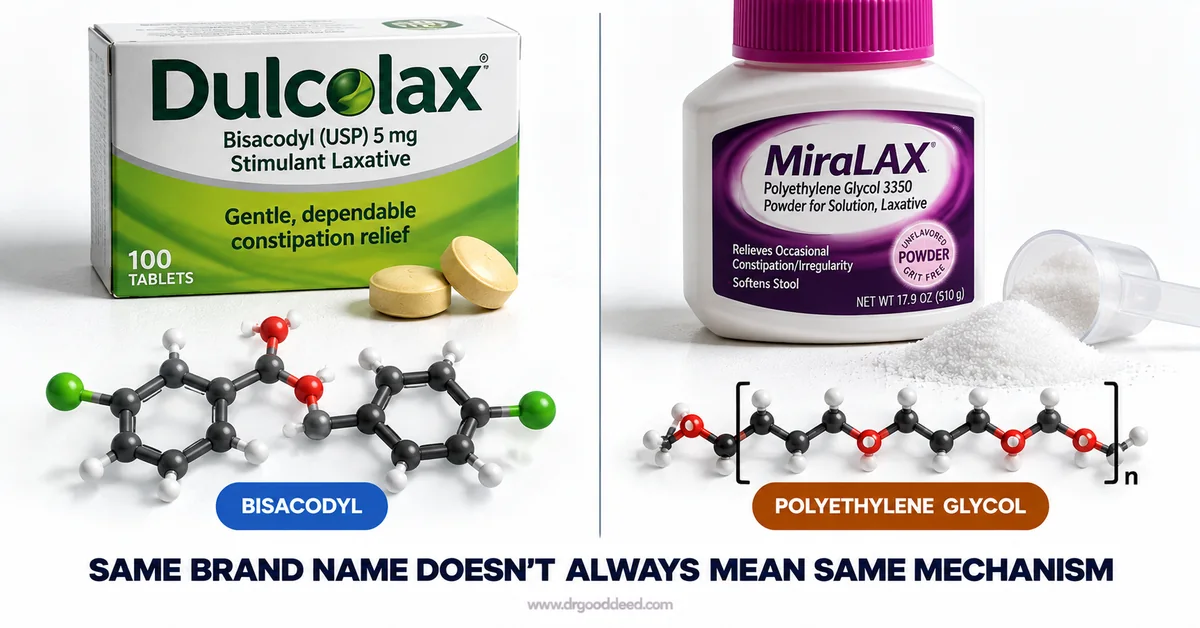

Dulcolax vs. MiraLAX: Both are laxatives used to relieve constipation, but they work differently. Dulcolax (bisacodyl) is a stimulant laxative that triggers bowel contractions and generally works faster, while MiraLAX (polyethylene glycol 3350) is an osmotic laxative that draws water into the stool and is usually gentler but may take longer to work. For occasional constipation, the better choice depends on how quickly you need relief and your individual needs.
Key Takeaways
- Classic Dulcolax tablets and suppositories use bisacodyl, a stimulant laxative that triggers muscle contractions in the colon.
- MiraLAX uses polyethylene glycol 3350, an osmotic laxative that pulls water into the colon to soften stool.
- Dulcolax also sells a Saline Laxative Soft Chews product built on magnesium hydroxide, an osmotic ingredient, so “Dulcolax” does not always mean stimulant.
- Regular stimulant laxative use is linked to dependence, so MiraLAX is generally the better pick for routine, long-term management.
Dulcolax vs MiraLAX at a Glance (Comparison Table)
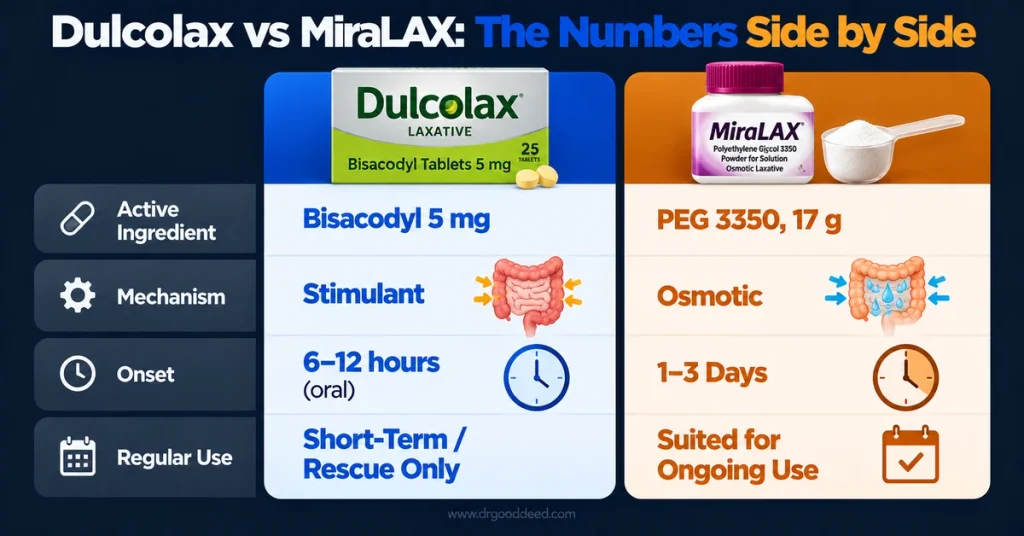
This table lays out the dulcolax vs miralax comparison by active ingredient, mechanism, onset time, and suitability for regular use. Use it as a quick reference before reading the detailed breakdown below.
| Feature | Dulcolax (Classic Tablets) | MiraLAX |
| Active ingredient | Bisacodyl 5 mg | Polyethylene glycol 3350, 17 g |
| Mechanism | Stimulant laxative | Osmotic laxative |
| Typical onset | 6 to 12 hours (oral); 15 to 60 minutes (suppository) | 1 to 3 days |
| Suitability for regular use | Short-term or rescue use only, per gastroenterology guidelines | Suited to ongoing, daily management |
What Is Dulcolax?
Dulcolax is a brand name. The classic tablets and suppositories contain bisacodyl, a stimulant laxative that acts directly on the nerves lining the colon wall.
- Bisacodyl triggers rhythmic muscle contractions and draws fluid into the bowel, producing a bowel movement.
- The FDA label lists Dulcolax tablets for adults and children 12 years and older, with lower doses for children 6 to 11.
- Suppositories act faster than tablets because they bypass digestion and act directly on the rectal lining.
- The brand also sells chewable and liquid products under the Dulcolax name that use a completely different active ingredient, which the next section covers in detail.
What Is MiraLAX?
MiraLAX contains polyethylene glycol 3350, an osmotic laxative that works differently from any stimulant product.
- PEG 3350 is a large, inert molecule that the gut cannot absorb, so it stays in the intestine and holds onto water.
- That retained water softens hard stool and increases stool volume, which triggers a natural urge to go.
- The FDA label states MiraLAX generally produces a bowel movement in 1 to 3 days.
- It is approved for adults and children 17 and older, though pediatricians commonly recommend it off-label for younger children under medical supervision.
Dulcolax vs MiraLAX: Key Differences
The dulcolax vs miralax comparison is based on how each drug works, how fast it acts, and how each one feels in the body.
Stimulant vs Osmotic: How Dulcolax and MiraLAX Work
Bisacodyl in Dulcolax stimulates colon nerve endings directly, forcing contraction whether or not the bowel is ready. PEG 3350 in MiraLAX does not stimulate nerves at all. It simply adds water volume, letting the bowel respond on its own timeline.
How Fast Dulcolax and MiraLAX Work
Dulcolax suppositories act fastest, producing a bowel movement in 15 to 60 minutes. Dulcolax oral tablets take longer, working in 6 to 12 hours, which is why the label suggests taking them at bedtime for a morning result.
MiraLAX moves at a different pace entirely. It typically takes 1 to 3 days of use to produce a bowel movement, since it depends on cumulative water retention rather than a single triggered contraction.
Cramping and Side Effects: Dulcolax vs MiraLAX
Stimulant laxatives like Dulcolax tablets are more likely to cause cramping, urgency, and abdominal discomfort because they force muscle contraction. MiraLAX is marketed as a cramp-free option, since it does not force contraction and instead relies on gradual water absorption.
Why Dulcolax Isn’t Always a Stimulant Laxative
Dulcolax’s classic tablets and suppositories use bisacodyl, a stimulant. But the brand also makes Dulcolax Saline Laxative Soft Chews, and that product uses magnesium hydroxide, not bisacodyl. Magnesium hydroxide is an osmotic and saline laxative, working through the same water-retention principle as MiraLAX rather than through nerve stimulation.
According to the product’s Drug Facts label, the soft chews generally produce a bowel movement in half an hour to six hours. So a shopper who assumes every Dulcolax product is a stimulant laxative is working from incomplete information, and that assumption can lead to the wrong product for daily use.
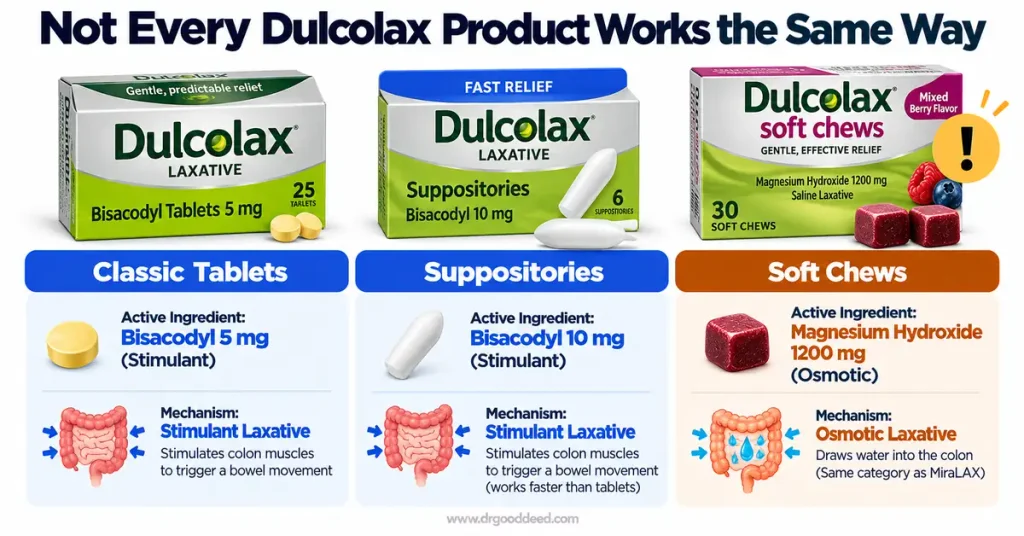
Pro Tip: Before buying, always check the Drug Facts panel rather than relying on brand recognition. Dulcolax tablets and suppositories list bisacodyl as the active ingredient, while Dulcolax Soft Chews list magnesium hydroxide, a mechanism identical in category to MiraLAX. This one label check prevents someone with a stimulant sensitivity from picking the wrong Dulcolax product by mistake.
Dulcolax vs MiraLAX: Which Is Better for Long-Term Use?
Joint guidelines from the American Gastroenterological Association and the American College of Gastroenterology recommend stimulant laxatives like bisacodyl only for short-term or rescue use, generally defined as daily use for four weeks or less.
- A 2023 to 2024 multicenter study published in the Journal of Gastroenterology found that regular stimulant laxative use, three or more times weekly for over a year, was linked to significantly higher rates of dependence and tolerance-related symptoms among people with chronic constipation.
- Dulcolax dependency concerns like these are exactly why osmotic laxatives are the preferred first-line option for people managing constipation month after month.
- MiraLAX carries no comparable dependency warning in current gastroenterology guidance, and clinicians frequently pair it with fiber strategies discussed on our best probiotic for constipation guide for ongoing bowel regularity.
Dulcolax or MiraLAX: Which Should You Choose?
The choice largely comes down to timeline and frequency.
- If constipation is a one-time or occasional problem and fast relief matters, Dulcolax tablets or suppositories deliver a predictable result within hours.
- If constipation is a recurring pattern that needs daily management, MiraLAX fits better because osmotic laxatives are considered safer for repeated, ongoing use.
- Anyone weighing dulcolax or miralax for constipation should also factor in tolerance for cramping, since stimulant laxatives carry a higher likelihood of that side effect.
- Miralax for daily use has stronger backing in gastroenterology guidelines than any stimulant product, including Dulcolax tablets.
When to See a Doctor About Constipation
Occasional constipation usually resolves with an OTC laxative and basic lifestyle changes. See a doctor if constipation lasts longer than seven days despite treatment, if you notice rectal bleeding, unexplained weight loss, or severe abdominal pain, or if constipation keeps recurring despite regular laxative use.
Persistent straining can also worsen unrelated issues, including the link between constipation and back pain from prolonged pelvic floor tension. A doctor can rule out underlying conditions that OTC products cannot fix.
FAQs
Can you take Dulcolax and MiraLAX together?
Yes, doctors sometimes combine them for stubborn constipation, since bisacodyl and PEG 3350 work through different mechanisms. Do not combine them without medical guidance first, since stacking laxatives raises the risk of dehydration and electrolyte imbalance.
Is MiraLAX safer than Dulcolax for daily use?
Yes, for daily use. Gastroenterology guidelines classify MiraLAX as suitable for ongoing management, while they restrict stimulant laxatives like Dulcolax tablets to short-term or rescue use due to dependence risk.
How long can you safely use Dulcolax?
Dulcolax’s own label limits use to seven days without a doctor’s input. Gastroenterology guidelines define safe short-term stimulant use as daily dosing for four weeks or less, with breaks in between.
Does MiraLAX cause cramping like Dulcolax?
No, not typically. MiraLAX works by adding water volume rather than forcing muscle contraction, so it is marketed as cramp-free. It can still cause bloating, gas, or loose stool in some users.
Can children use Dulcolax or MiraLAX?
Dulcolax tablets are labeled for children 12 and older, with lower doses for ages 6 to 11. MiraLAX is FDA-approved only for ages 17 and up, though pediatricians often prescribe it off-label younger.
Sources
- DailyMed: DULCOLAX (bisacodyl tablet) Label, National Library of Medicine link
- FDA Structured Product Label: MiraLAX (polyethylene glycol 3350) link
- DailyMed: Dulcolax Soft Chews (magnesium hydroxide) Label link
- Dulcolax Official Site: Soft Chews Saline Laxative Product Information link
- Dulcolax Official Site: Laxative Tablets Dosing Information link
- GoodRx: Bisacodyl Dosage Guide for Adults and Children link
- GoodRx: MiraLAX Dosage Guide for Kids and Adults link
- GoodRx: How Long Does MiraLAX Take to Start Working? link
- American Journal of Gastroenterology / PMC: Highlights From the AGA/ACG Guideline on Pharmacologic Management of Chronic Idiopathic Constipation link
- Gastroenterology Advisor: Regular Stimulant Laxative Use May Promote Dependence, Journal of Gastroenterology study coverage link
Medical Disclaimer: This article is for general information only and is not medical advice. It does not replace a diagnosis, treatment plan, or guidance from a qualified healthcare professional. Always talk to your doctor about your own symptoms and before starting, stopping, or changing any treatment. If you think you may be having a medical emergency, call 911 or go to your nearest emergency room.