


If you are looking for home remedies for motion sickness, start with your eyes, not your stomach. Looking at the road ahead or a distant horizon can reduce the sensory mismatch that triggers nausea, while closing your eyes may remove a useful visual reference. Motion sickness, also called kinetosis, affects travelers in cars, boats, planes, and other moving settings.
For wider trip preparation, see how to stay healthy while traveling.
Key Takeaways
- Motion sickness starts when the eyes, inner ear, and body position sense disagree.
- A fixed point on the horizon helps most people. Closing your eyes helps some and backfires for others.
- Ginger trials disagree, so treat it as a low-risk extra rather than a proven fix.
- Ondansetron, a strong anti-nausea drug, did no better than placebo in motion sickness trials.
- Children aged 2 to 12 and pregnant women should check with a clinician before taking any medicine.
Why Motion Sickness Happens: The Sensory Conflict
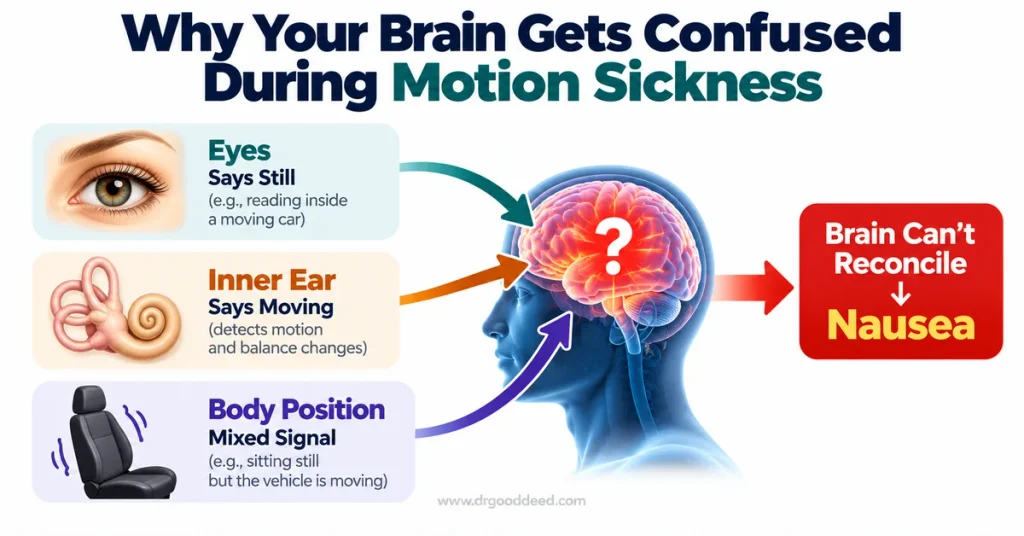
Motion sickness happens when your brain receives conflicting signals from your eyes, inner ear, and body position sense. The medical name is kinetosis, and it can affect anyone with a working vestibular system, the balance organs of the inner ear.
Picture reading on a phone in a moving car. Your eyes report a still screen. Your inner ear reports turns, braking, and bumps, and receptors in your muscles and joints add a third account. The brain cannot reconcile the three, and nausea follows. Below deck on a ship the conflict runs the other way, because a steady cabin wall tells your eyes nothing is moving.
The Counterintuitive Fix: Why Closing Your Eyes Can Make It Worse
For many people, closing your eyes removes the visual information the brain needs to settle the conflict. A fixed point in the distance gives your eyes a signal that matches what your inner ear is reporting.
With your eyes shut, only the inner ear signal remains, and there is nothing visual to check it against. Derebery said in tips reported by Malay Mail that the key to recovering within minutes is to look toward the movement, which reorients the inner ear. On a plane, that means watching the clouds or the ground through the window. She also warned against reading, watching video, and texting.
CDC lists shutting your eyes, lying down, or sleeping among prevention options, and an NHS clinician briefing from South West London advises keeping them closed for the whole journey. A workable rule: use the horizon when you can see one. With no outside view, as in an interior cabin or on a dark road, closing your eyes with your head supported is a reasonable fallback.
Natural and Positional Remedies That Genuinely Help
The most dependable home remedies for motion sickness cut head movement and give your eyes something stable to follow. Most car sickness remedies that work on the road carry over to boats and planes. Ginger and acupressure are weaker bets, though low in risk.
- Sit in the front seat of a car or bus, where motion is felt least.
- Take a window seat on flights and trains.
- On a boat, choose the middle, where motion is smallest.
- Rest your head against the headrest, because less head sway means fewer mixed signals.
- Eat light before travel and skip fried, spicy, or rich food.
- Sip water through the journey, since CDC lists hydration as a prevention step.
- Test ginger one to two hours before departure, in capsule or chew form.
- Try P6 acupressure wristbands, knowing the evidence is limited.
Why Common Anti-Nausea Medication Doesn’t Work for This
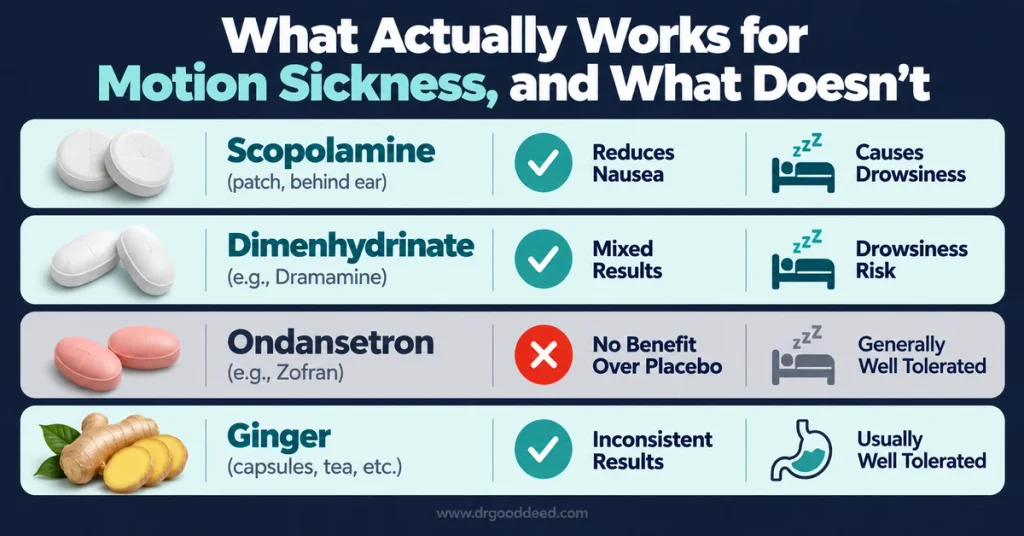
Ondansetron, a common prescription anti-nausea medication, is not effective for motion sickness. It blocks 5-HT3 receptors, which drive nausea after chemotherapy and surgery, but motion sickness travels through the balance system, where anticholinergic and antihistamine drugs act.
The trial record is fairly consistent. A 2007 randomized trial of 63 highly susceptible people found neither ondansetron nor dimenhydrinate beat placebo. An at-sea study of 16 susceptible sailors found no benefit from 8 mg of ondansetron. The 2012 American Family Physician review advises against it, and against second-generation antihistamines such as cetirizine.
What does work, at least for nausea, is scopolamine and first-generation antihistamines such as dimenhydrinate. Scopolamine does not reduce vomiting. Both cause drowsiness, and scopolamine often brings dry mouth and blurred vision, so neither suits a driver.
| Option | Evidence in motion sickness | Main drawback |
| Scopolamine | Reduces nausea, not vomiting | Drowsiness, dry mouth, not for children |
| Dimenhydrinate | Reduces nausea in some trials, failed in highly susceptible people in one | Drowsiness, risky oversedation in young children |
| Ondansetron | No benefit over placebo in several trials | Not useful for this purpose |
| Ginger | Inconsistent results | Unclear mechanism, no standard dose |
Motion Sickness in Children and During Pregnancy
Motion sickness is most common in children aged 2 to 12, and women are more susceptible, especially when pregnant. CDC notes that infants and toddlers are generally immune, and that risk drops after age 50.
The CDC Yellow Book warns that oversedation of young children with antihistamines can be life-threatening, and that scopolamine can cause dangerous effects in children and should not be used. Some children become overactive instead of sleepy. Dosing is weight-based, so ask a pediatrician rather than adapting an adult label.
For motion sickness in children, car sickness remedies without drugs come first: a forward view, no screens or books, light snacks, and breaks for fresh air. During pregnancy, the NHS briefing says to discuss any over-the-counter travel sickness medicine with a doctor or midwife first. Check with an OB-GYN before taking anything.
When to See a Doctor
Motion sickness that is severe, lingers long after the trip ends, or starts without any movement needs evaluation. Sudden severe headache, one-sided weakness, slurred speech, double vision, or trouble walking point away from motion sickness and call for emergency care. Home remedies for motion sickness suit ordinary episodes, not new neurological symptoms. For episodes that keep limiting travel or school, book a routine visit with a primary care doctor, who can refer you to a neurologist or ENT specialist for vestibular testing.
FAQs
Can poor gut health make motion sickness worse?
No established evidence links gut health or the microbiome to motion sickness. Stomach rhythm does turn irregular during an attack, but ondansetron trials suppressed that rhythm without preventing nausea, so it appears to follow the sensory conflict. Heavy, fried, or spicy meals matter more.
Can neck posture affect how prone you are to car sickness?
Posture alone is unproven, but head movement matters. In a 2021 study by seat engineers at NHK Spring, a headrest that limited head roll cut reported carsickness by 42 to 51 percent. Keep your head against the headrest on winding roads.
How long before travel should you take ginger for it to work?
Trials mostly gave 500 mg to 1 g of powdered ginger roughly one to two hours before exposure. They tested prevention, not relief after nausea starts. Because results are inconsistent, pair ginger with a horizon view and a forward-facing seat.
Sources
- CDC Travelers’ Health: Motion Sickness link
- CDC Yellow Book: Motion Sickness link
- American Family Physician, 2012: Best medication for motion sickness link
- Aviation, Space, and Environmental Medicine, 2007: High dose ondansetron in highly susceptible subjects link
- Ondansetron for the prevention of seasickness in susceptible sailors link
- Aviation, Space, and Environmental Medicine, 2000: 5-HT3 antagonists and gastric tachyarrhythmia link
- Walstab et al., 2013, Neurogastroenterology and Motility: ginger and 5-HT3 receptors link
- European Journal of Pharmacology: gingerols and shogaols at 5-HT3 receptors link
- PeaceHealth: Motion Sickness (ginger trials) link
- Malay Mail: Dr Jennifer Derebery’s motion sickness tips link
- NHS South West London: Self Care Briefing for Clinicians, Travel Sickness link
- NHK Spring, 2021: Effects of head motion on motion sickness link
Medical Disclaimer: This article is for general information only and is not medical advice. It does not replace a diagnosis, treatment plan, or guidance from a qualified healthcare professional. Always talk to your doctor about your own symptoms and before starting, stopping, or changing any treatment. If you think you may be having a medical emergency, call 911 or go to your nearest emergency room.