
If you need to select all that are functions of neurons and glial cells, the answer is: neurons send and receive signals, while glial cells insulate, nourish, clear debris and defend them. The human brain holds about 86 billion neurons and roughly as many non-neuronal cells. Glial cells cannot fire action potentials (electrical signals), but they are active partners and not just “glue.”
Sudden weakness, slurred speech or vision loss needs 911 in the US or 999 in the UK. This guide covers each cell type, the answer key, the ten-to-one myth, and when to see a doctor.
Key Takeaways
- Neurons send electrical and chemical signals, while glial cells support, insulate, nourish and defend neurons but do not fire action potentials.
- Glial cells make myelin, clear debris, regulate the brain’s chemistry and guide development.
- The old ten-to-one glia-to-neuron ratio is a myth. The numbers are close to one-to-one.
- Sudden weakness, slurred speech, or vision loss needs 911 in the US or 999 in the UK.
Neurons vs glial cells at a glance:
| Feature | Neurons | Glial cells |
| Main job | Send and receive signals | Support, insulate, nourish, defend |
| Fire action potentials | Yes | No |
| Communicate | Electrically and chemically | Chemically |
| Form myelin | No | Yes (oligodendrocytes, Schwann cells) |
| Immune role | No | Yes (microglia) |
| Approximate number | About 86 billion | Roughly similar to the non-neuronal count |
“Glia,” “glial cells” and “neuroglia” all mean the same thing. CNS means the central nervous system (brain and spinal cord), and PNS means the peripheral nervous system (the nerves outside them).
Select All That Are Functions of Neurons and Glial Cells
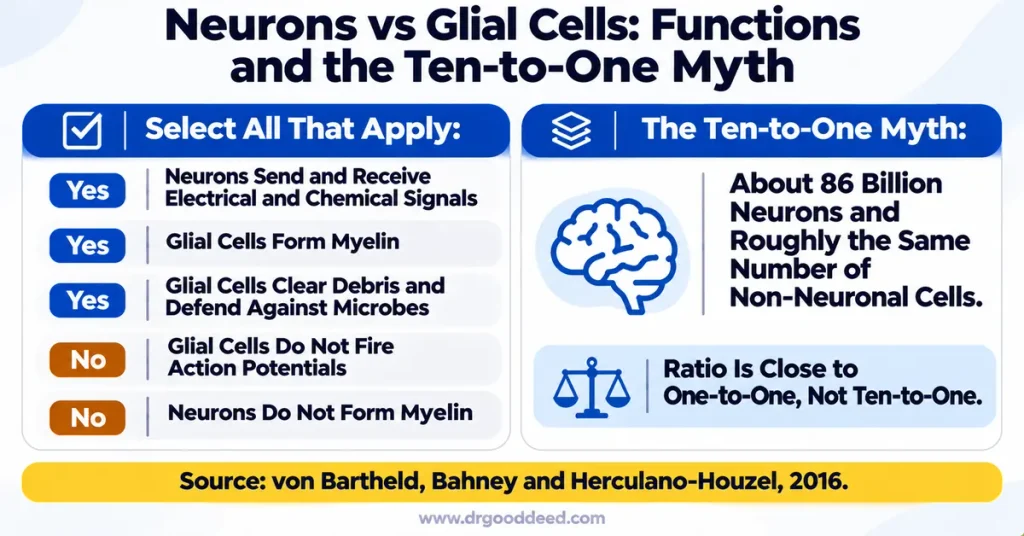
Functions of neurons and glial cells: transmitting signals (neurons), and forming myelin, clearing debris, defending against microbes and regulating the brain’s chemistry (glial cells).
If your question lists these options, the answers are below. Check with your teacher for course-specific wording.
| Statement | Select? | Reason |
| Neurons send and receive electrical and chemical signals | Yes | Core neuron function (Dana Foundation) |
| Neurons pass information to muscles and other tissues | Yes | Dana Foundation |
| Glial cells form myelin, the insulating wrap around axons | Yes | Oligodendrocytes and Schwann cells (Lumen) |
| Glial cells clear debris and defend against microbes | Yes | Microglia (Dana; Lumen) |
| Glial cells fire action potentials | No | They cannot (Dana) |
| Neurons form myelin | No | Glial cells do |
| Glial cells outnumber neurons ten to one | No | Myth, the ratio is below 1:1 (von Bartheld 2016) |
| Glial cells only hold neurons in place | No | Outdated, they take part in signaling (Dana) |
Functions of Neurons: How Signals Travel
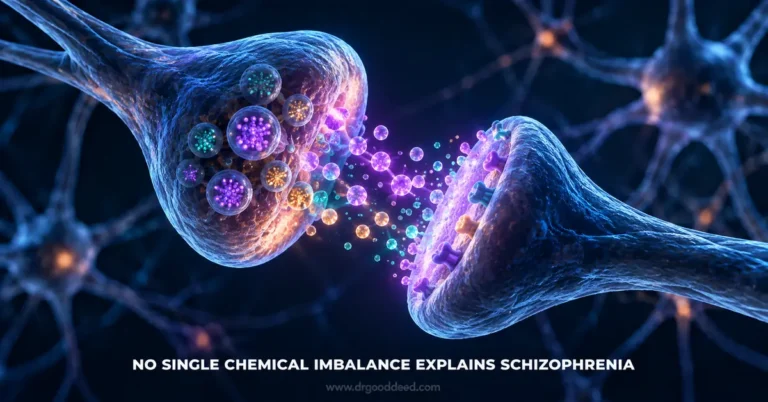
Neurons are the brain’s signaling cells. They send and receive electrical and chemical messages via neurotransmitters and pass information to other neurons, muscles and tissues.
- Cell body: The neuron’s control center.
- Dendrites: Branch-like extensions that receive signals from other cells.
- Axon: The long fiber that sends signals onward, often wrapped in a myelin sheath made by glial cells.
- Neuron types: Sensory neurons carry information in, motor neurons carry commands out, and interneurons connect them.
Functions of Glial Cells by Type
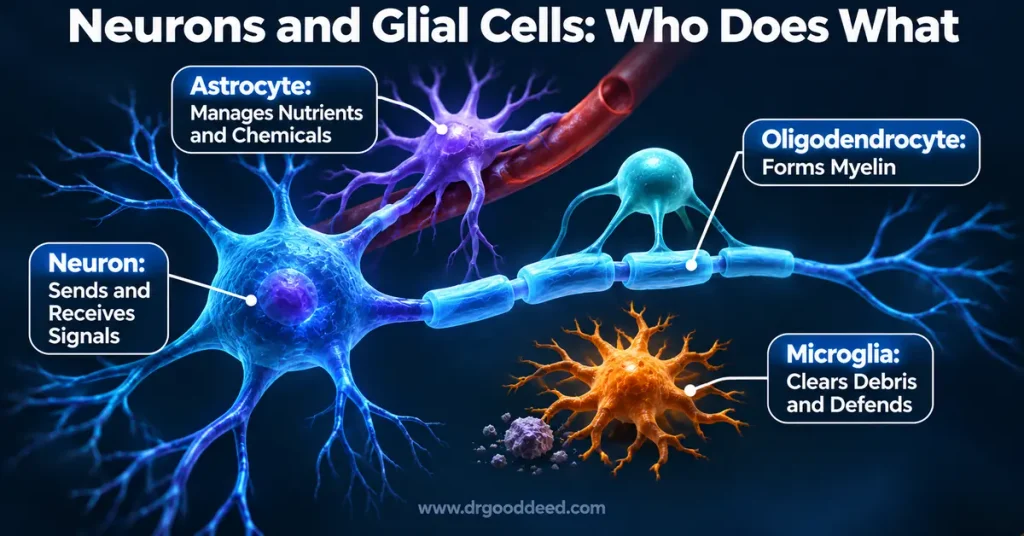
Glial cells nourish, insulate, clean up and defend the nervous system. They cannot fire action potentials, but they communicate chemically and help strengthen messages. The Greek root of “glia” means glue, which is why they were once seen as filler.
| Cell | Where | Main function |
| Astrocytes | CNS | Manage nutrients, ions and chemicals around neurons, support synapses and form the blood-brain barrier |
| Microglia | CNS | Remove dead cells and protect against microorganisms, acting as the brain’s immune cells |
| Oligodendrocytes | CNS | Form the myelin sheath, and one cell can wrap several axons |
| Ependymal cells | CNS | Line the brain’s fluid-filled spaces and help make cerebrospinal fluid |
| Radial glia | CNS | Guide developing neurons and also give rise to new neurons (neurogenesis) |
| Satellite glia | PNS | Supply nutrients and support |
| Schwann cells | PNS | Form myelin, with one cell per axon |
Astrocytes support synapses and the blood-brain barrier, while microglia act as the brain’s immune cells.
Do Glial Cells Outnumber Neurons Ten to One?
No, the ten-to-one ratio is a myth. A 2016 review in the Journal of Comparative Neurology concluded that the ratio is below 1:1 and that glial cells number fewer than 100 billion (von Bartheld, Bahney and Herculano-Houzel).
- Newer counts: About 86 billion neurons and roughly the same number of non-neuronal cells.
- Regional variation: Parts of the cortex have two or three glia per neuron, while the cerebellum has far fewer than one per neuron.
- Terminology catch: “Non-neuronal” is not identical to “glial.” Some non-neuronal cells are other types, such as blood vessel cells.
- Outdated claims: Textbook and web figures such as “ten to one,” “5 to 10 times” or “90 percent” should not be repeated.
When Neurons or Glial Cells Go Wrong
Glial cells normally protect neurons but can cause damage when they malfunction.
- Brain diseases: Animal studies suggest glia-driven inflammation is linked to Parkinson’s disease, Alzheimer’s disease and multiple sclerosis.
- Multiple sclerosis: The immune system attacks the brain and nerves. It is not described as a glial disease.
- Brain tumors: OpenStax says malfunctioning glia are linked to most brain tumors.
When to Get Medical Help
Call emergency services for stroke-like signs.
- Emergency signs: Facial drooping, slurred speech, an arm that will not lift, sudden one-arm weakness or numbness, sudden vision loss or blurring, or sudden loss of balance. US: call 911. UK: call 999 or go to A&E.
- New or lasting symptoms: Numbness, weakness, memory change or balance problems. US: see primary care or a neurologist.
- UK routes: See a GP, or call NHS 111 if unsure. The GP refers to a neurologist.
FAQs
What does the word glia mean?
It comes from the Greek word for glue. Scientists once thought these cells only held neurons in place, but they are now known to support, insulate and signal (Dana Foundation).
What is the difference between Schwann cells and oligodendrocytes?
Both form myelin, but oligodendrocytes work in the brain and spinal cord, and one cell can wrap several axons. Schwann cells help peripheral nerves regrow; oligodendrocytes do not support regrowth in the same way.
Can neurons divide or regenerate?
Mostly no. Neurons generally do not divide, while glial cells can. Whether adults make new neurons is still debated.
Sources
- Dana Foundation: Cells of the Brain link
- Lumen Learning (OpenStax Biology 2e): Glial Cells link
- von Bartheld, Bahney and Herculano-Houzel, Journal of Comparative Neurology (2016) link
- BrainFacts: How Many Neurons Are in the Brain? link
- NHS: Multiple Sclerosis link
- NHS: Guillain-Barré Syndrome link
Medical Disclaimer: This content is for informational purposes only and is not a substitute for professional medical advice, diagnosis, or treatment. Always consult a qualified healthcare professional for medical concerns.
Medical Disclaimer: This article is for general information only and is not medical advice. It does not replace a diagnosis, treatment plan, or guidance from a qualified healthcare professional. Always talk to your doctor about your own symptoms and before starting, stopping, or changing any treatment. If you think you may be having a medical emergency, call 911 or go to your nearest emergency room.