


Lumps at an insulin injection site are often caused by lipohypertrophy, a buildup of fat and fibrous tissue due to repeated injections in the same spot. These lumps can affect insulin absorption and lead to unpredictable high and low blood sugar levels. Understanding why lumps at an insulin injection site develop and how to manage them can help you maintain better blood sugar control.
Key Takeaways
- Lumps at an insulin injection site are commonly lipohypertrophy, firm tissue that can change how your body absorbs insulin.
- Repeatedly injecting insulin into the same area can cause fatty tissue to build up under the skin.
- Moving injections to healthy skin can improve insulin absorption and cause low blood sugar, so speak with your care team first.
- A lump that is red, warm, painful, or swollen should be checked by a medical professional.
What Are Lumps at an Insulin Injection Site?
Lumps at an insulin injection site are usually firm or rubbery areas under the skin caused by repeated injections in the same place. This condition is medically known as lipohypertrophy.
Lipohypertrophy occurs when fatty tissue builds up beneath the skin. Changes to protein and fibrous tissue may also occur. These lumps can feel raised, firm, or rubbery. Some areas may also feel less sensitive.
Diabetic bumps can vary in size and texture. Common signs include:
- Texture: They may feel firm, rubbery, or thick under the skin.
- Size: They can range from small bumps to areas as large as a golf ball or fist (Cleveland Clinic, 2022).
- Location: They are often found on the stomach or thighs, which are common insulin injection sites.
- Sensation: Some lumps may feel numb or less sensitive, making the area seem easier to inject.
According to the Cleveland Clinic (2022), up to 64% of people who use insulin may develop lipohypertrophy at some point, while other figures range from almost one in three in a survey to more than 50% in some studies (diaTribe). It can be difficult to identify because the skin may look normal even when the tissue underneath has changed.

Why Insulin Lumps Form at Injection Sites
Insulin lumps form when the same area of skin receives repeated injections. Over time, this can cause the tissue beneath the skin to become firm or hardened. The National Institute of Diabetes and Digestive and Kidney Diseases (NIDDK) explains that repeated injections in the same area can cause tissue hardening.
These lumps can affect people who use insulin to manage type 1 and type 2 diabetes.
Common risk factors include:
- Repeated injections: Not rotating injection sites gives the same area little time to recover.
- Reusing needles: Using the same needle more than once can contribute to tissue damage and injection-site problems.
- Low BMI: People with less body fat may have a higher risk.
- Long-term insulin use: Repeated injections over several years can increase the chance of developing lumps.
Some people continue injecting into a lump because the area may feel less painful. However, doing this can worsen the problem and affect insulin absorption.
Lipohypertrophy, Infection or Reaction: How to Tell
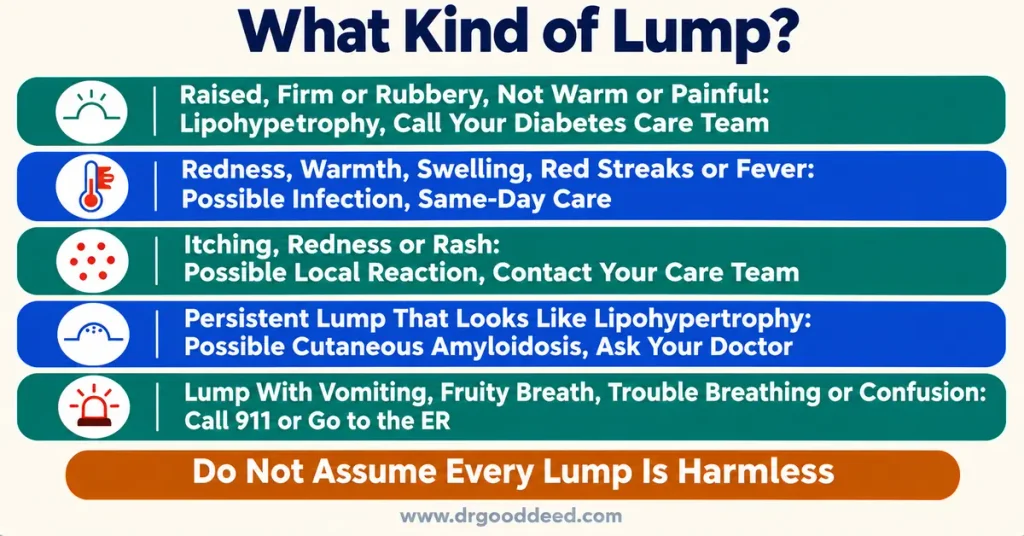
A typical lipohypertrophy lump is usually firm or rubbery. It should not be hot, red, bruised, or painful. If a lump is red, warm, swollen, or painful, it may be an infection or another type of reaction that needs medical attention.
Table: What you notice, what it may be, and what to do
| What you notice | Possible cause | What to do |
| A raised, firm, or rubbery area that is not warm or painful | Lipohypertrophy | Avoid using the area and contact your diabetes care team before changing injection sites. |
| Redness, warmth, swelling, red streaks, or fever | Possible insulin injection site infection | Get same-day care from your doctor or urgent care. |
| Itching, redness, swelling, or a rash | Possible allergic or local site reaction | Contact your care team for advice. |
| A persistent lump that looks or feels like lipohypertrophy | Possible cutaneous amyloidosis | Ask your doctor to examine it. |
| A lump with vomiting, fruity breath, trouble breathing, confusion, or passing out | Possible diabetic ketoacidosis (DKA) or a severe low | Call 911 or go to the ER. |
Cutaneous amyloidosis occurs when an abnormal protein builds up in the skin. It can look similar to lipohypertrophy but may affect insulin absorption differently. The UK’s Medicines and Healthcare products Regulatory Agency (MHRA, 2020) warns that insulin-derived amyloidosis should be considered when a lump develops at an injection site.
If a lump becomes painful, red, warm, swollen, or starts spreading, seek medical advice. Do not assume that every injection-site lump is harmless.
How Insulin Lumps Change Your Blood Sugar
Insulin lumps can affect how quickly and reliably your body absorbs insulin. Injecting into affected tissue may make insulin absorb more slowly or faster than expected (Cleveland Clinic, 2022).
This can cause:
- High blood sugar: Insulin may not work as expected, causing glucose levels to rise. Illness can also raise readings, so see why blood sugar runs high when sick.
- Low blood sugar: Changes in insulin absorption can make its effects harder to predict.
- Unexplained high or low blood sugar: Repeated unexpected readings may be a sign that your injection sites need to be checked.
- Higher A1C: Unpredictable glucose levels can make it harder to stay within your target range. If your A1C looks fine but morning numbers run high, read about A1C normal but fasting glucose high.
- Diabetic ketoacidosis (DKA): Poor insulin absorption can contribute to serious complications, including DKA.
If your blood sugar readings keep fluctuating, compare them with normal blood sugar levels and the targets set by your care team. Speak with your diabetes care team and ask them to check your injection sites.
How to Move Away From a Lump Safely
It is important to avoid injecting into a lump. However, do not move your injections to healthy skin without first speaking with your diabetes care team. Insulin may be absorbed more effectively in healthy tissue, which can increase your risk of low blood sugar if your treatment plan is not reviewed.
The MHRA (2020) warns that suddenly moving injections from a lumpy area to healthy tissue can increase the risk of hypoglycemia, or low blood sugar.
Doctor’s Tip: If you have been injecting into a lump, contact your care team before changing injection sites. Ask whether you need to monitor your blood sugar more closely.
Follow these steps:
- Contact your diabetes care team: Tell them where the lump is, how long it has been there, and whether your blood sugar readings have changed.
- Make a plan: Agree on which healthy areas you can use and whether your treatment plan needs to be reviewed. Never change your insulin dose on your own.
- Monitor blood sugar: Your care team may recommend checking your blood sugar more often during the change.
- Keep a record: Note your readings and any symptoms you experience. Share this information with your healthcare professional.
How to Prevent Insulin Lumps With Site Rotation
A regular site rotation routine can help prevent insulin lumps. It reduces the chance of repeatedly injecting into the same small area and gives the tissue time to recover.
- Rotate injection sites: Follow a written rotation plan from your care team. Use different approved areas instead of repeatedly choosing the same spot.
- Leave enough space: The Cleveland Clinic recommends leaving at least a finger-width between injection points (2022). HealthNet suggests 1 to 2 inches and Diabetes Voice about an inch, so follow the spacing your care team gives you.
- Use a new needle every time: Reusing needles can contribute to tissue damage and injection-site problems.
- Check your skin: Feel the area before injecting. Avoid spots that feel firm, thick, lumpy, or different from the surrounding skin.
- Keep a record: Use a simple plan to remember where you last injected.
- Follow pump guidance: If you use an insulin pump, follow your care team’s advice on changing infusion sites. The Cleveland Clinic (2022) advises changing pump sites every two to three days.
The same rotation habit applies to GLP-1 injection sites if you also use a weekly GLP-1 injection.
When to See a Doctor About an Insulin Lump
If you notice a new lump, repeated unexplained blood sugar changes, or a lump that is not improving, contact your healthcare professional. Your doctor or diabetes care team can examine the area and help determine whether it is lipohypertrophy, an infection, or another condition.
Know which type of care to seek:
- Contact your doctor or diabetes care team: Schedule an appointment for a firm, painless lump, repeated high or low blood sugar readings, or a lump that keeps returning.
- Seek same-day medical care: Get prompt care from your doctor or urgent care if the lump is red, warm, swollen, increasingly painful, or has red streaks around it. A fever may also be a sign of infection.
- Go to the ER or call 911: Seek emergency help if you have possible DKA symptoms, such as vomiting, trouble breathing, fruity-smelling breath, or several DKA symptoms together. The CDC advises emergency care if your blood sugar stays at 300 mg/dL or above.
- Call 911 for a severe low: If someone is unconscious, having a seizure, or unable to safely treat severe low blood sugar, call 911.
During your appointment, your provider may feel the lump, check your injection technique, review your blood sugar readings, and ask where you usually inject. They may also look for signs of infection or other skin problems.
Show any lumps at an insulin injection site to your care team at your next visit, and ask them to check your injection sites.
Frequently Asked Questions
How Do I Get Rid of Insulin Lumps?
Insulin lumps usually shrink only when you stop injecting there, and healing often takes months. The Cleveland Clinic (2022) recommends avoiding the area for at least two to three months. Some lumps may take longer to improve, sometimes years. Severe or persistent lumps may need further evaluation, and surgery may be considered.
Can I Still Inject Into an Insulin Lump?
No. Avoid injecting into a lump because insulin may not be absorbed properly there. However, speak with your diabetes care team before moving to healthy skin. Insulin may work more effectively in the new area, increasing your risk of low blood sugar if your treatment plan is not reviewed.
Why Is There a Small Bump Right After My Injection?
An immediate lump after injection may happen if insulin is delivered too close to the surface of the skin. This is different from lipohypertrophy, which develops over time after repeated injections in the same area. If you regularly notice a bump after an injection, ask your healthcare professional to review your injection technique.
Can an Insulin Pump Cause Lumps Too?
Yes. Insulin pump infusion sites can also develop lumps or tissue changes. Follow your care team’s advice on changing infusion sites and checking your skin. The Cleveland Clinic advises changing pump sites every two to three days. However, follow your own provider’s instructions for the timing of site changes.
Will Insulin Lumps Come Back?
Yes. Lipohypertrophy can return in the same area or develop at another injection site. This is more likely if injection sites are not rotated. Using a new needle each time, checking your skin, and following a regular rotation plan can help reduce the risk.
Sources
Cleveland Clinic, Lipohypertrophy: Symptoms, Causes, Treatment and Prevention (2022). link
Medicines and Healthcare products Regulatory Agency, Insulins (All Types): Risk of Cutaneous Amyloidosis at Injection Site (2020). link
National Institute of Diabetes and Digestive and Kidney Diseases, Insulin, Medicines, and Other Diabetes Treatments. link
Cleveland Clinic, Insulin: What It Is, What It Does, How to Take It and Side Effects. link
MedlinePlus, Subcutaneous (SQ) Injections. link
Centers for Disease Control and Prevention, Diabetic Ketoacidosis. link
National Institute of Diabetes and Digestive and Kidney Diseases, Low Blood Glucose (Hypoglycemia). link
Medically reviewed by Dr. Anshu Alok, Endocrinology.
Medical Disclaimer: This article is for general information only and is not medical advice. It does not replace a diagnosis, treatment plan, or guidance from a qualified healthcare professional. Always talk to your doctor about your own symptoms and before starting, stopping, or changing any treatment. If you think you may be having a medical emergency, call 911 or go to your nearest emergency room.