
Pilates for weight loss works; a single mat class rarely burns huge numbers of calories. Weight loss still depends on a calorie deficit. Pilates supports that deficit quietly, building lean muscle for a leaner shape over months, not days.
This guide covers the science behind pilates for weight loss, calorie burn, a beginner plan, and the signs your body is changing.
Can Pilates Actually Help You Lose Weight?
Yes. Pilates for weight loss works through muscle building and consistency, not a massive single-session calorie burn. A 2021 meta-analysis in Frontiers in Physiology, pooling 11 randomized trials with 393 adults, found Pilates significantly lowered body weight, BMI, and body fat percentage in people with overweight or obesity.
Weight loss happens when you eat fewer calories than your body uses. Cardio burns more calories minute for minute. Pilates burns fewer calories per session but swaps fat for lean muscle even when the scale barely moves. This shift is called body recomposition, often a better long-term marker of progress than weight alone. A person who loses 2 pounds but gains visible muscle definition is winning. This is the piece most articles on pilates for weight loss leave out.
Pilates helps with weight loss by reshaping your body while a deficit shrinks it.
How Pilates Helps With Weight Loss
How pilates helps with weight loss comes down to five effects: more lean muscle, better movement efficiency, flexibility, posture, and lower stress. None show up instantly. All compound over weeks.
Builds Lean Muscle That Slightly Raises Daily Calorie Needs
Pilates targets your core, glutes, and stabilizer muscles using body weight or reformer springs. Muscle burns more calories at rest than fat does. A 2024 randomized trial in Nutrients found women with obesity who did 12 weeks of home-based Pilates plus diet lost more fat mass than diet alone, while also gaining lean mass.
Improves Movement Efficiency
Pilates trains your nervous system to recruit muscles in the right order. Everyday movements like climbing stairs cost less effort. This doesn’t burn extra calories directly, but it keeps you injury-free and active longer, which matters more for weight control than any single workout.
Enhances Flexibility
Tight hips and a stiff spine limit how hard you can push in other workouts. Pilates loosens those areas through controlled stretching built into nearly every exercise, so you can train harder elsewhere without pulling a muscle.
Improves Posture
Pilates strengthens the deep core muscles that hold your spine upright. Better posture makes you look leaner immediately and reduces the back pain that stops many people from exercising consistently.
Lower Stress May Reduce Emotional Eating
Pilates uses slow, controlled breathing similar to stress-research techniques. Lower cortisol links to reduced cravings for high-sugar comfort food in some studies, though this varies by person. Treat it as a supporting factor, not a fix.
How Many Calories Does Pilates Burn?
How many calories does Pilates burn in a real session? It depends on the format. Mat Pilates burns roughly 170 to 250 calories per hour for most adults. Reformer Pilates burns more, typically 250 to 400 calories per hour, because spring resistance adds extra muscular load.
Calories Burned During Mat Pilates
Mat Pilates carries a MET value near 3.0, according to the Compendium of Physical Activities from Arizona State University’s Healthy Lifestyles Research Center. Using that value:
| Body Weight | Calories Burned (60 min) |
| 125 lbs | ~179 |
| 150 lbs | ~204 |
| 180 lbs | ~257 |
| 200 lbs | ~286 |
Calories Burned During Reformer Pilates
Reformer sessions carry a higher MET value, closer to 4.5, because spring tension increases resistance throughout each movement.
| Body Weight | Calories Burned (60 min) |
| 125 lbs | ~269 |
| 150 lbs | ~306 |
| 180 lbs | ~367 |
| 200 lbs | ~408 |
Factors That Affect Calorie Burn
- Pace: Faster transitions between moves raise your heart rate and calorie burn.
- Resistance used: Added springs, bands, or light weights increase effort.
- Session length: A 60-minute class burns roughly double a 30-minute one.
- Your body weight: Heavier bodies burn more calories doing identical movements.
- Experience level: Advanced practitioners engage more muscle groups per rep, which raises energy cost.
Pilates Compared With Other Exercises
Running burns noticeably more per session. Harvard Health Publishing lists 30 minutes of jogging (5 mph) for a 155-pound person at roughly 300 calories, versus 100 to 125 for a beginner Pilates class. Cardio wins on raw burn. Pilates wins on joint safety and long-term adherence, since low-impact workouts cause fewer injuries that force people to quit.
Case Study: How One Woman Used Pilates to Break a Weight Loss Plateau
Rachel Donnelly, a 42-year-old office manager from Austin, Texas, had lost 18 pounds through diet changes but stalled for three months. Her scale weight barely moved.
Her physical therapist suggested tracking waist and hip measurements alongside weight instead of adding more cardio. After 10 weeks of reformer Pilates three times a week, her scale dropped only 3 pounds, but her waist shrank by 2.5 inches and her body fat percentage, measured by a clinic scan, dropped 4 points. The scale had hidden real progress. Her case shows why pilates for weight loss needs more than a bathroom scale to track fairly.
Name and identifying details have been altered to protect privacy.
Pilates Alone vs Pilates Combined With Nutrition
Pilates for weight loss works slower alone than when it’s paired with a food plan. This table shows what to expect from each combination, based on outcomes reported across the studies referenced in this article.
| Situation | Likely Result |
| Pilates only | Better fitness, slow weight change |
| Pilates + calorie deficit | Steady fat loss |
| Pilates + protein + strength progression | Best body recomposition |
| Pilates + walking | Higher total calorie expenditure |
A 500 to 750 calorie daily deficit, the range generally supported by CDC and Mayo Clinic guidance, remains the main driver of fat loss. Pilates adds the muscle-preserving piece that keeps metabolism from crashing during that deficit.
Best Pilates Exercises for Weight Loss
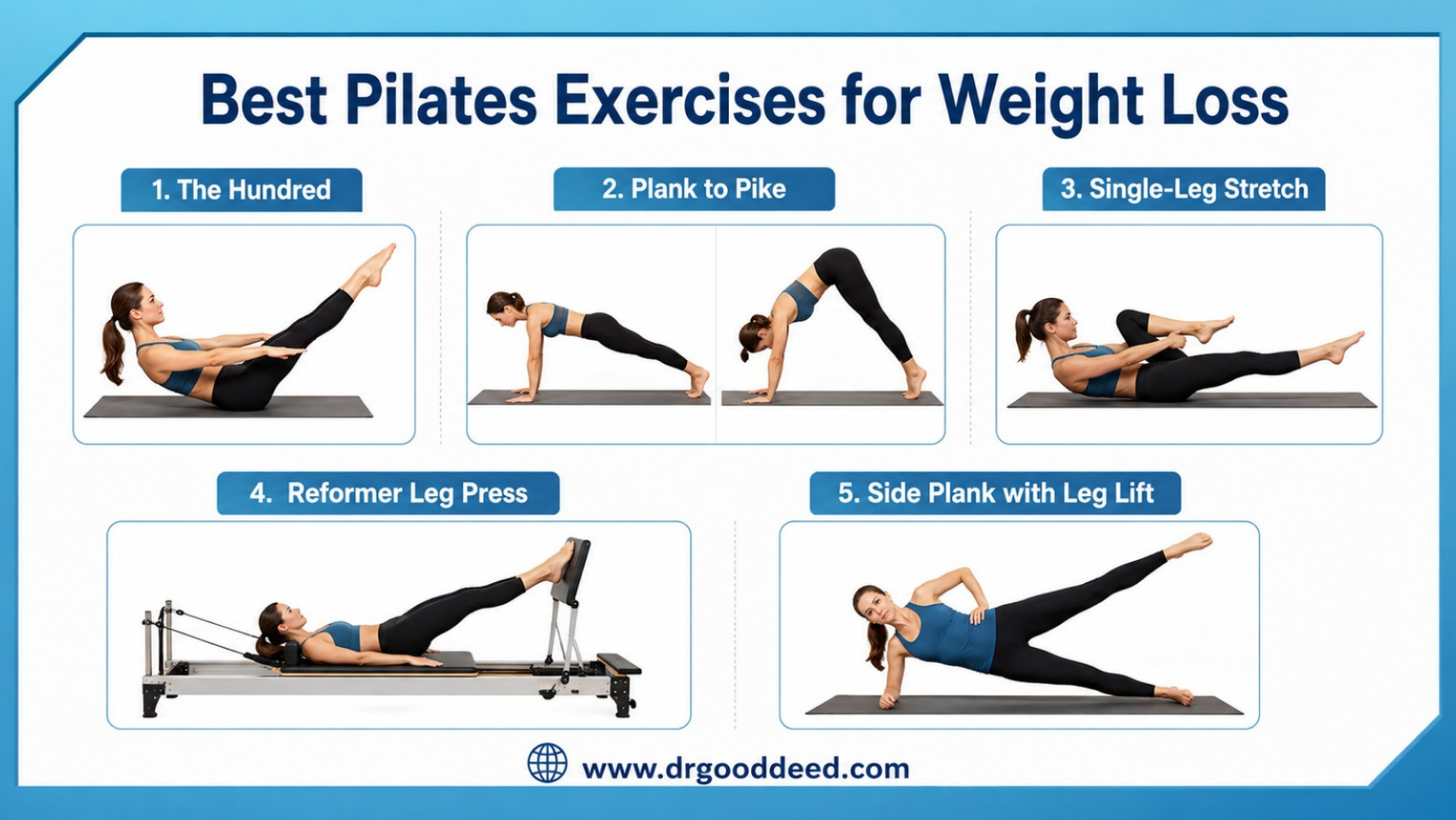
These moves recruit the most muscle at once, raising calorie burn per minute versus isolated exercises.
- The Hundred: Works the entire core while pumping the arms.
- Plank to Pike: Combines core stability with a dynamic hip fold.
- Single-Leg Stretch: Targets the abs while challenging balance.
- Reformer Leg Press: Builds glute and quad strength under spring load.
- Side Plank with Leg Lift: Hits obliques and outer hip muscles together.
The best pilates exercises for weight loss share one trait. They force multiple muscle groups to work at once instead of resting between isolated moves.
Pilates Workout Plan for Beginners
This pilates workout plan for beginners builds gradually so your body adapts without injury, spread across four progressive weeks.
Week 1: Learning the Basics
Focus on breathing patterns and basic moves like the Hundred, Roll-Up, and Pelvic Curl. Sessions run 20 to 30 minutes, 2 times this week.
Week 2: Building Strength
Add Single-Leg Circles and Plank holds. Increase sessions to 3 times this week, 30 minutes each.
Week 3: Increasing Endurance
Reduce rest between exercises. Add Side Plank and Swimming (the Pilates move, not the pool activity). Sessions stretch to 35 to 40 minutes.
Week 4: Full-Body Pilates Routine
Combine everything learned into one continuous 45-minute flow covering core, glutes, arms, and legs.
Weekly Schedule for Beginners
A simple Pilates workout plan for beginners repeats this pattern for 8 to 12 weeks before adding intensity.
| Day | Activity |
| Monday | Pilates (core focus) |
| Tuesday | Rest or walk |
| Wednesday | Pilates (full body) |
| Thursday | Rest or walk |
| Friday | Pilates (strength focus) |
| Saturday | Light cardio, 20 to 30 minutes |
| Sunday | Rest |
How Often Should You Do Pilates for Weight Loss?
Three to five sessions per week produces measurable results within 8 to 12 weeks, based on the intervention lengths used in the RCTs cited above. Fewer than 2 sessions weekly slows progress significantly, since muscle adaptation needs consistent stimulus. Pilates for weight loss works best as a habit, not an occasional workout squeezed in once a week.
Signs Pilates Is Reducing Weight
- Clothes fit looser around the waist even if the scale hasn’t moved much.
- Your posture straightens without consciously thinking about it.
- Daily tasks like carrying bags or climbing stairs feel easier.
- Your resting heart rate drops slightly over several weeks.
- Waist or hip measurements shrink between monthly checks.
These signs confirm that Pilates for weight loss is working even when the scale disagrees. If you’ve been doing the best Pilates exercises for weight loss consistently for 8 weeks and see none of these signs, review your calorie intake first.
Tips for Effective Weight Loss With Pilates
These tips for effective weight loss turn a good Pilates habit into visible results faster.
- Track waist and hip measurements monthly, not just scale weight.
- Eat enough protein to protect the muscle you’re building.
- Add 2 short walks on rest days to raise weekly calorie burn.
- Rotate in the best pilates exercises for weight loss every 2 weeks so muscles keep adapting.
- Progress to reformer or resistance bands once mat moves feel easy.
- Sleep 7 to 9 hours; poor sleep raises hunger hormones and undercuts a calorie deficit.
Among all the tips for effective weight loss, tracking measurements instead of only the scale is the one most beginners skip, and it’s the one that keeps motivation alive during plateaus.
FAQ
Is Pilates good for weight loss?
Yes. Pilates for weight loss works by building lean muscle and improving consistency, though it burns fewer calories per session than running or cycling.
Is Reformer Pilates better than Mat Pilates for weight loss?
Reformer burns more calories per hour, roughly 250 to 400 versus 170 to 250 for mat, since spring resistance raises muscular load. How many calories does Pilates burn ultimately depends on which format you pick.
Can Pilates reduce belly fat?
No, not directly. Pilates cannot spot-reduce belly fat. It strengthens core muscles and, combined with a calorie deficit, contributes to overall fat loss that includes the midsection.
How often should I do Pilates to lose weight?
Three to five sessions weekly for 8 to 12 weeks produces measurable fat loss, based on randomized trial durations used in current research.
Is Pilates better than yoga for weight loss?
Pilates typically burns slightly more calories than yoga due to continuous muscular engagement, but both depend on session intensity and style.
Do I need cardio in addition to Pilates?
Not required, but pairing Pilates with walking or cycling raises total weekly calorie burn and speeds fat loss. This is one of the simplest tips for effective weight loss.
What should I eat while doing Pilates for weight loss?
Prioritize protein, about 1.2 to 1.6 grams per kilogram of body weight daily, to preserve the muscle built during a pilates workout plan for beginners builds during a calorie deficit.
How long does it take to see results from Pilates?
Most randomized trials on pilates for weight loss show measurable body fat and BMI changes between 8 and 12 weeks of consistent practice, 3 sessions weekly.
Can Pilates help tone the body while losing weight?
Yes. This is exactly how pilates helps with weight loss long term: it builds visible muscle definition in the core, glutes, and arms while a calorie deficit strips the fat covering them.
Is Pilates suitable for people with joint pain?
Yes, in most cases. Pilates is low-impact and adjustable, making it a common recommendation from physical therapists for people managing joint pain, though a doctor should confirm safety first.
Sources
- Pilates for Overweight or Obesity: A Meta-Analysis, Frontiers in Physiology
- Effects of Reformer Pilates on Body Composition in Overweight and Obese Women (RCT), Scientific Reports
- The Effects of Online Home-Based Pilates Combined with Diet on Body Composition in Women with Obesity, Nutrients (NIH/PMC)
- Effects of Pilates vs. Aerobic Training in Overweight/Obese Adults, PeerJ
- Counting Calories: Get Back to Weight-Loss Basics, Mayo Clinic
- Burn More Calories Than You Take In, CDC Diabetes Prevention Program
- The 3,500-Calorie Weight Loss Myth, American Institute for Cancer Research
- Calories Burned in 30 Minutes for People of Three Different Weights, Harvard Health Publishing
- Compendium of Physical Activities Tracking Guide, Arizona State University Healthy Lifestyles Research Center
- Rate of Weight Loss Predicted by Patient Characteristics and Intervention Strategies, NIH/PMC
Medical Disclaimer: This article is for general educational purposes only. It does not replace advice from a doctor, physical therapist, or registered dietitian. Talk to a healthcare provider before starting any new exercise or weight loss plan, especially if you have an injury, joint condition, or chronic illness.