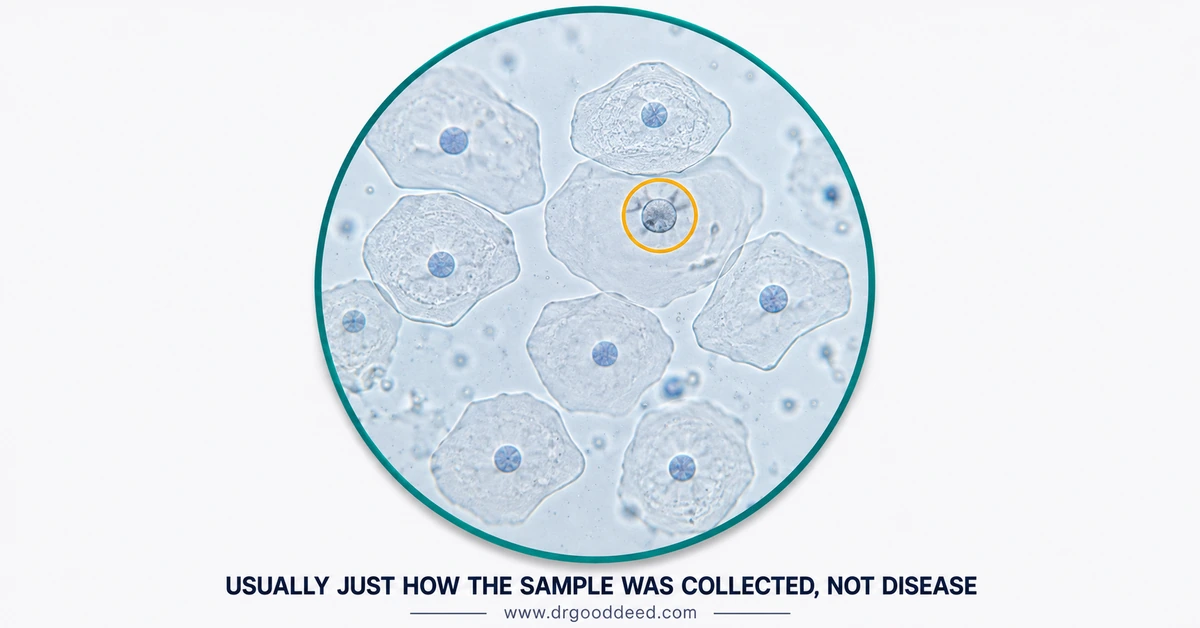

Squamous epithelial cells in urine usually show up because of ordinary skin cell shedding. If your lab report lists sqmenopauseuamous epithelial cells in urine, you are looking at flat cells from the urethra or vaginal opening. Doctors flag this result when the count sits above the typical reference range, and in most cases it points to how the sample was collected rather than a problem inside the bladder or kidneys.
This guide covers what squamous epithelial cells in urine mean, how they differ from renal tubular and transitional cells, when a high count needs a repeat test, and when it’s worth calling your doctor.
What Are Squamous Epithelial Cells?
Squamous epithelial cells are flat, thin cells that form the outer lining of the urethra, the skin near the urinary opening, and the vaginal wall. They shed constantly as part of normal tissue turnover. A small number of squamous cells in urine is a routine, expected finding.
Under a microscope, these cells look large and polygonal, almost like flattened tiles, with a small round nucleus at the center. Lab technicians recognize them instantly because they look nothing like bacteria, red blood cells, or crystals. Their size and shape are come from skin-like surfaces outside the urinary tract itself, not from inside the kidneys or bladder wall.
Squamous vs Renal Tubular vs Transitional Cells
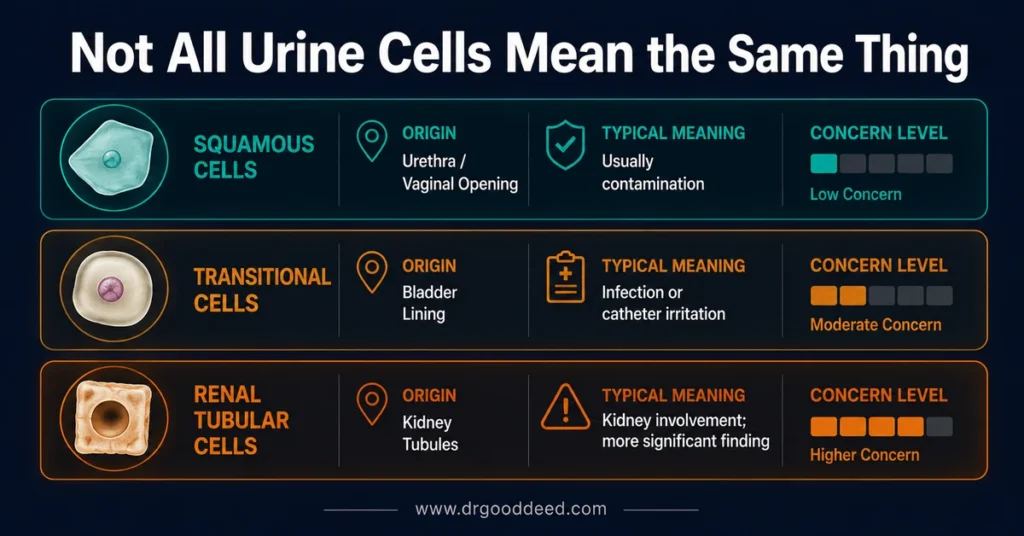
Not every epithelial cells in urine result carries the same weight. Labs typically separate them into three types, and only one of the three points toward a kidney problem.
| Cell Type | Where It Comes From | What a High Count Usually Means |
| Squamous | Urethra, vaginal opening, skin near the urinary opening | Sample contamination, occasionally irritation |
| Transitional (urothelial) | Bladder lining, ureters, renal pelvis | Bladder irritation, infection, catheter use |
| Renal tubular | Kidney tubules | Tubular injury, a more clinically significant finding |
A 2021 laboratory survey published through the National Library of Medicine found that reporting practices for these subtypes vary widely between labs. Some differentiate squamous, transitional, and renal tubular cells individually, while others simply report “squamous” versus “non-squamous,” and some skip subtyping altogether.
Is a Few Squamous Epithelial Cells in Urine Normal?
Yes. Most labs consider zero to five squamous epithelial cells in urine per high power field (HPF) within the normal range, though some labs set their squamous epithelial cells urine normal range as high as 15 to 20 per HPF depending on their internal reference method. Check the specific range printed on your own report, since it can vary by laboratory.
Results are also often reported qualitatively as “rare,” “few,” “moderate,” or “many” rather than as an exact number. A result of “few” or “rare” almost always falls inside the expected range and needs no action on its own. It’s the jump to “moderate” or “many,” especially alongside other abnormal findings, that prompts a closer look.
Why Squamous Cells Usually Mean Sample Contamination
An elevated squamous count is, by far, most often explained by urine sample contamination during collection, not by illness. Skin and vaginal cells naturally sit near the urinary opening, and if the collection technique doesn’t avoid that area, some of those cells end up in the cup.
This happens more often in samples from women, since the urethra sits closer to the vaginal opening. According to the National Library of Medicine’s MedlinePlus, epithelial cells in urine often reflect this kind of skin contact rather than an internal urinary tract problem. A repeat test using a proper clean catch urine sample technique resolves the vast majority of these elevated readings without any further workup.
Are Squamous Epithelial Cells a Sign of Cancer?
No, squamous epithelial cells are not a marker doctors use to screen for or diagnose bladder cancer. The American Cancer Society identifies blood in the urine, known as hematuria, as the primary early warning sign of bladder cancer. Bladder cancer urinalysis screening looks for red blood cells and urine cytology findings, and major medical organizations don’t currently recommend routine bladder cancer screening for average-risk adults with no symptoms.
If your urinalysis shows squamous epithelial cells high with no blood, no unusual urine cytology, and no urinary symptoms, cancer is not what that specific finding is pointing toward. If you do have visible blood in your urine, persistent pelvic pain, or unexplained weight loss alongside these results, raise it with your doctor directly, since those symptoms deserve their own evaluation regardless of the squamous cell count.
Other Possible Causes of Elevated Squamous Cells
A handful of situations besides simple contamination can raise squamous cell counts, and each one has a different next step.
Urinary Tract Infection
A urinary tract infection can inflame the urethra and surrounding tissue, which sheds more cells than usual. The National Institute of Diabetes and Digestive and Kidney Diseases notes that urinalysis is used alongside urine culture to diagnose bladder infections, checking for white blood cells and bacteria at the same time as cell counts. If squamous cells appear alongside high white blood cells, bacteria, or nitrites, a UTI becomes the more likely explanation.
Vaginal or Vulvar Irritation
Yeast infections, bacterial vaginosis, and vaginal dryness related to menopause can all increase local cell shedding. Because the collection path runs directly past the vaginal opening, any active irritation there raises the odds of squamous cells appearing in the sample, independent of anything happening in the bladder itself.
Improper Sample Collection Technique
Not cleaning the genital area first, touching the inside of the collection cup, or catching urine at the very start of the stream instead of midstream are the three most common technique errors. Any of these can introduce enough skin cells to push a normal urine sample into the elevated range on paper.
How to Get a Clean Urine Sample
A properly collected clean catch urine sample eliminates most false elevated readings before they happen. Cleveland Clinic Labs and the National Library of Medicine outline a consistent process:

- Wash your hands with soap and water before starting.
- Open the collection cup without touching the inside of the cup or lid.
- Clean the urinary opening with the provided wipe, front to back for women, tip of the penis for men.
- Start urinating into the toilet first, then move the cup into the stream.
- Collect a midstream sample, filling the cup roughly halfway.
- Finish urinating into the toilet, then seal the cup tightly.
The very first few seconds of urine flush out the urethra itself, which is exactly the area where squamous cells collect.
When Elevated Squamous Cells Need Follow-Up
A high squamous count on its own, with every other part of the urinalysis normal, rarely needs anything beyond a repeat test. Follow-up becomes more relevant when squamous cells show up together with white blood cells above the normal range, visible bacteria, nitrites, or any blood in the urine. That combination shifts the likely explanation from contamination toward an active urinary tract issue that a clinician needs to evaluate directly, sometimes with a urine culture to identify the specific organism involved.
Pregnant patients and people with recurring, unexplained elevated counts across multiple visits are also reasonable candidates for a repeat test using a stricter collection protocol, occasionally including a catheterized sample when clean catch results keep coming back inconsistent.
When to See a Doctor
Call your doctor if elevated squamous epithelial cells in urine show up alongside burning during urination, urgency, frequent urination, pelvic or back pain, fever, cloudy or foul-smelling urine, or any visible blood. These symptoms point toward an infection or another condition that needs direct evaluation, separate from the epithelial cell count itself. A repeat urinalysis with proper clean catch technique is a reasonable first step if you have no symptoms at all and this is an isolated finding on a routine test.
FAQs
Does drinking more water lower squamous epithelial cells in urine?
No. Hydration dilutes urine concentration but doesn’t reduce skin cell shedding. Only improved collection technique, not fluid intake, meaningfully lowers a contamination-related squamous cell count.
Can squamous epithelial cells cause a false UTI diagnosis?
Yes. Heavy squamous contamination can carry skin bacteria into the sample, which is why many labs reject or flag specimens with excessive squamous cells before running a urine culture.
Do squamous epithelial cells in urine show up on a dipstick test?
No. Dipstick strips detect chemicals like protein, glucose, and blood. Squamous cells are only visible under the microscopic portion of a urinalysis.
Is a catheterized sample better if squamous cells keep coming back high?
Yes. Catheterization bypasses skin contact almost entirely, but doctors usually reserve it for cases where repeated clean catch samples keep showing unexplained elevation.
Do squamous epithelial cells in urine increase with age?
Sometimes. Postmenopausal vaginal tissue changes can raise shedding in women. This pattern isn’t formally established for men.
Sources
- MedlinePlus: Epithelial Cells in Urine
(https://medlineplus.gov/lab-tests/epithelial-cells-in-urine/) - MedlinePlus: Clean Catch Urine Sample
(https://medlineplus.gov/ency/article/007487.htm) - National Kidney Foundation: Urinalysis (Urine Test)
(https://www.kidney.org/kidney-topics/urinalysis-urine-test) - NIDDK: Diagnosis of Bladder Infection in Adults
(https://www.niddk.nih.gov/health-information/urologic-diseases/bladder-infection-uti-in-adults/diagnosis) - American Cancer Society: Bladder Cancer Signs and Symptoms
(https://www.cancer.org/cancer/types/bladder-cancer/detection-diagnosis-staging/signs-and-symptoms.html) - American Cancer Society: Can Bladder Cancer Be Found Early?
(https://www.cancer.org/cancer/types/bladder-cancer/detection-diagnosis-staging/detection.html) - Cleveland Clinic: Urinalysis
(https://my.clevelandclinic.org/health/diagnostics/17893-urinalysis) - Cleveland Clinic Labs: Clean Catch Urine Collection Instructions
(https://clevelandcliniclabs.com/laboratory-resources/specimen-collection-transport/collection/clean-catch-urine-collection-instructions/) - National Library of Medicine (PMC): Survey on Reporting of Epithelial Cells in Urine Sediment
(https://www.ncbi.nlm.nih.gov/pmc/articles/PMC8183119/) - Mayo Clinic: Bladder Cancer, Symptoms and Causes
(https://www.mayoclinic.org/diseases-conditions/bladder-cancer/symptoms-causes/syc-20356104)