
Why does menopause cause weight gain? Menopause can cause weight gain mainly because declining estrogen changes where the body stores fat, often shifting it toward the abdomen. At the same time, muscle mass and metabolic rate tend to decrease with age, so the body burns fewer calories at rest. Menopause can also affect sleep, stress, appetite, and insulin sensitivity, which may further promote weight gain.
This guide breaks down the real hormonal mechanism, separates it honestly from ordinary aging, and answers the question almost every reader asks next: can hormone therapy fix it?
Key Takeaways
- Falling estrogen redirects fat storage toward the abdomen, producing the classic menopause belly fat pattern, even when total body weight barely changes.
- Total weight gain cannot be blamed on menopause alone. Muscle loss and lower activity from ordinary aging add to the effect.
- Menopause and metabolism are genuinely linked. Resting energy expenditure drops modestly during the transition itself.
- Hormone therapy may help redistribute fat away from the belly. It has not been shown to cause weight loss.
- Strength training, adequate protein, sleep, and stress management help more reliably than any supplement or pellet.
The Real Mechanism: Why Fat Moves to Your Belly During Menopause
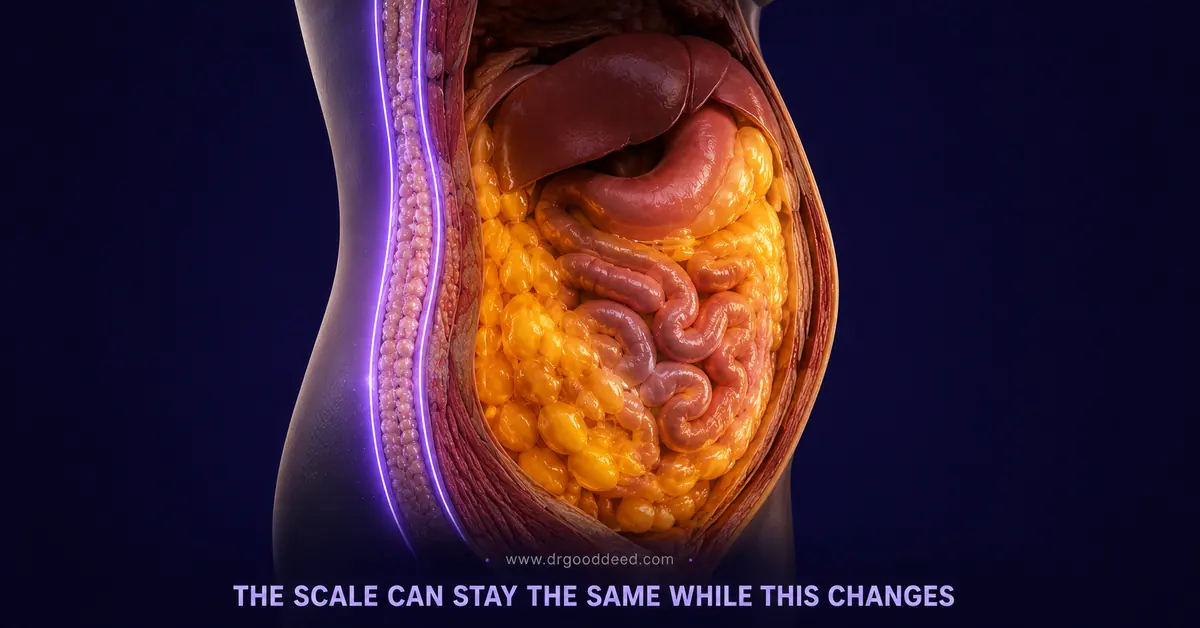
Estrogen normally directs fat storage toward the hips and thighs, a pattern that protects the heart and blood vessels. As estrogen declines through perimenopause, that protective signal weakens, and the body shifts toward storing fat viscerally, deep around the abdominal organs. This is hormonal visceral fat redistribution in menopause.
- Subcutaneous fat, the kind stored just under the skin at the hips and thighs, grows more slowly after menopause.
- Visceral fat, packed around the liver, pancreas, and intestines, increases even when total body weight stays flat.
- Declining estrogen raises follicle-stimulating hormone, which animal research links to greater fat storage and lower calorie burning.
- The shift connects to broader hormonal imbalance, since falling estrogen also reduces insulin sensitivity around the same time.
Hormonal changes make it more likely that weight gain happens around the belly rather than the hips and thighs, though hormones alone rarely explain the full picture.
Expert Insight: Clinicians frequently see patients whose scale weight barely changed yet whose waistline expanded noticeably; this reflects a real shift in where fat sits, not measurement error or a stricter belt. Waist circumference, tracked over months rather than days, is usually a more meaningful marker of this specific hormonal change than body weight alone.
Is It Really Menopause, or Is It Aging?
Dr. Rachel Pope, an OB/GYN and menopause specialist at University Hospitals, notes that even an already active lifestyle can still result in fat redistribution to the belly during the menopause transition, specifically, points to a real, independent hormonal effect.
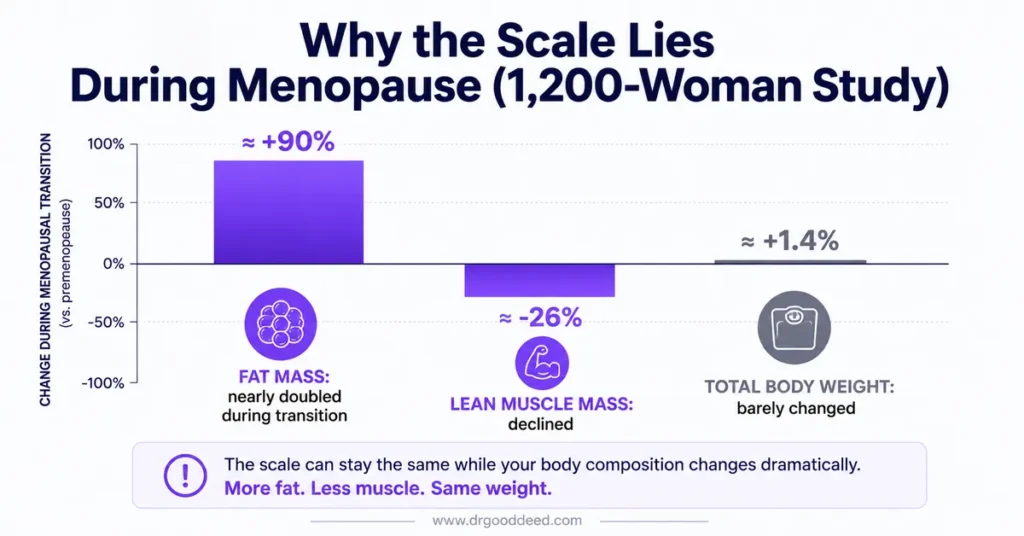
At the same time, a 2019 study in JCI Insight followed more than 1,200 women and found that total body weight did not accelerate at the start of the menopause transition. Fat mass gain nearly doubled during the transition while lean muscle mass declined, even though the scale barely reflected it. A separate 2012 Climacteric review reported weight gain per se cannot be attributed to the menopause transition alone, but the hormonal shift substantially worsens abdominal fat accumulation on top of aging.
Menopause reshapes body composition in a specific, measurable way. Aging-related muscle loss and reduced activity pile on additional pounds.
Does Menopause Slow Your Metabolism?
Yes, modestly. Menopause and metabolism intersect through resting energy expenditure, the calories your body burns simply staying alive. A study comparing postmenopausal and premenopausal women matched for abdominal fat found measurably lower resting and total energy expenditure after menopause. Earlier research recorded increased visceral fat alongside decreased energy expenditure specifically during the transition itself.
- Muscle loss lowers resting metabolic rate, since muscle tissue burns more calories at rest than fat tissue does.
- Fat oxidation, the process of converting stored fat into usable energy, also declines somewhat during the transition.
- These changes are real but rarely explain sudden or dramatic weight gain by themselves.
Small, consistent metabolic changes add up over several years, which is why the shift often feels gradual rather than sudden.
Can Hormone Replacement Therapy Help You Lose Weight?
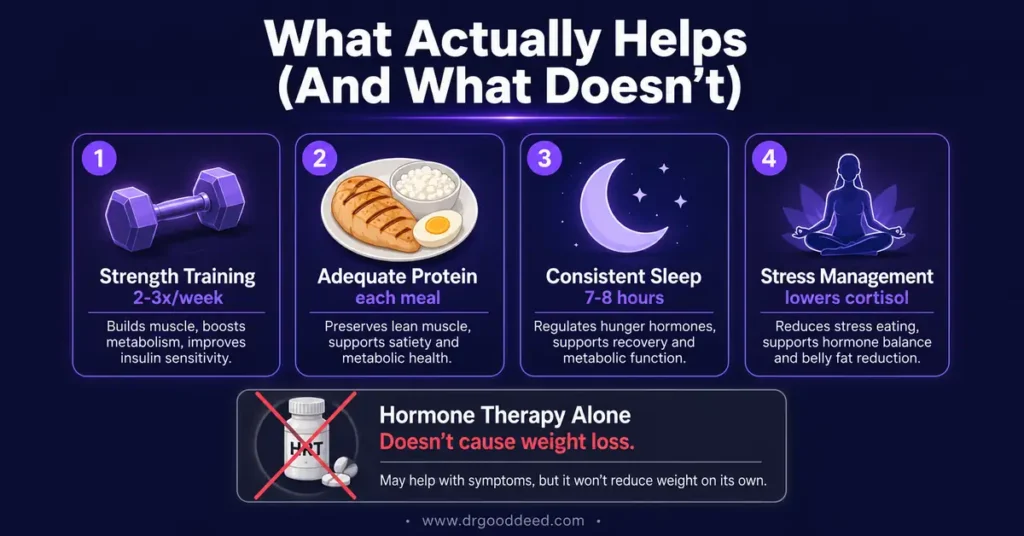
Does HRT help with weight loss? No, not directly. Hormone therapy may help redistribute visceral fat accumulated around the belly, but it has not been shown to cause weight loss.
What hormone therapy can genuinely do:
- Improve sleep by easing hot flashes and night sweats, which indirectly supports weight management over time.
- Shift some fat distribution away from the abdomen, based on Mayo Clinic’s own body composition findings.
- Treat vasomotor symptoms that otherwise make consistent exercise and steady eating habits harder to sustain.
If you are weighing this option, ask your doctor about the signs you need hormone replacement therapy.
What Actually Helps During This Transition
General, sustainable habits ease perimenopause weight gain more reliably than any pill, patch, or proprietary blend.
- Strength training two to three times weekly counters menopause muscle loss and protects resting metabolic rate over time.
- Adequate protein at each meal supports muscle repair and helps curb appetite between meals.
- Consistent sleep, roughly seven to eight hours nightly, helps regulate the appetite hormones ghrelin and leptin.
- Stress management, through walking, breathing exercises, or therapy, lowers cortisol, which otherwise favors abdominal fat storage.
Pro Tip: Track waist circumference at belly-button level every few months instead of relying only on the bathroom scale, since visceral fat can rise well before total body weight shifts enough to notice. A slowly climbing waist-to-hip ratio at a stable weight is often the earliest measurable sign of the hormonal shift described above.
When Weight Changes Need a Doctor’s Attention
Rapid or unexplained weight change during menopause sometimes signals something beyond hormones alone.
- Sudden weight gain paired with fatigue, cold intolerance, or thinning hair warrants thyroid testing.
- Unexplained weight loss, even during menopause, should never be dismissed as a welcome symptom.
- Swelling, shortness of breath, or chest discomfort alongside weight change needs urgent medical evaluation, not a diet plan.
Talk to your doctor if changes feel sudden, severe, or arrive alongside other new symptoms you have not had before.
Sources
- Mayo Clinic: The reality of menopause weight gain link
- Mayo Clinic: Weight gain in women at midlife: the role of menopausal hormone therapy link
- Mayo Clinic Proceedings: Weight Gain in Women at Midlife: A Concise Review link
- University Hospitals: The Connection Between Menopause and Belly Fat link
- Davis SR, et al. Understanding weight gain at menopause. Climacteric, 2012 link
- Greendale GA, et al. Changes in body composition and weight during the menopause transition. JCI Insight, 2019 link
- Hodson L, et al. Lower resting and total energy expenditure in postmenopausal women. J Nutr Sci, 2014 link
- Lovejoy JC, et al. Increased visceral fat and decreased energy expenditure during the menopausal transition. Int J Obes, 2008 link
- Office on Women’s Health: Menopause and your health link
- National Institute on Aging (NIH): What Is Menopause? link