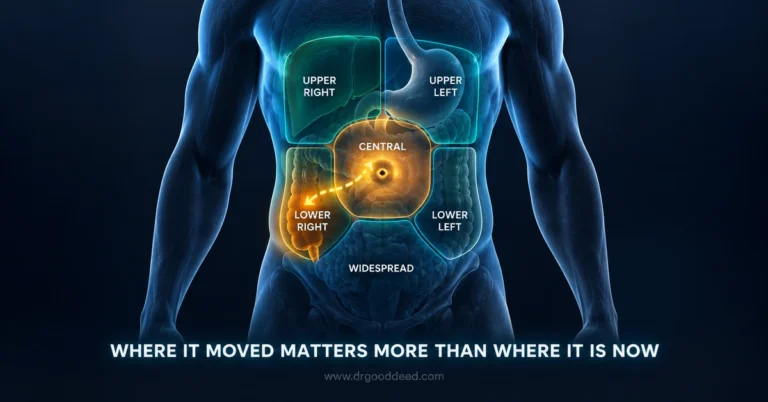

Appendicitis is inflammation of the appendix, a small pouch attached to the large intestine, and roughly 5% of people in the United States will develop it at some point. Sudden lower right abdominal pain is the hallmark sign. But only about half of patients get that textbook pattern. This guide covers appendicitis symptoms by age and sex, two practical checks you can try at home, and exactly when abdominal pain means it’s time for the ER.
Key Takeaways
- Only about half of people with appendicitis get the classic pain pattern that starts near the navel and moves to the lower right abdomen.
- Appendicitis is always a medical emergency. Waiting to see if the pain resolves raises the risk of rupture.
- Skip home remedies. Heating pads, laxatives, and pain medication can mask worsening symptoms and delay diagnosis.
- Appendicitis symptoms in women, children, older adults, and pregnant patients often look different from the standard pattern.
- Any lower right abdominal pain that keeps getting worse deserves same-day medical evaluation, not a wait-and-see approach.
Symptoms by Population at a Glance
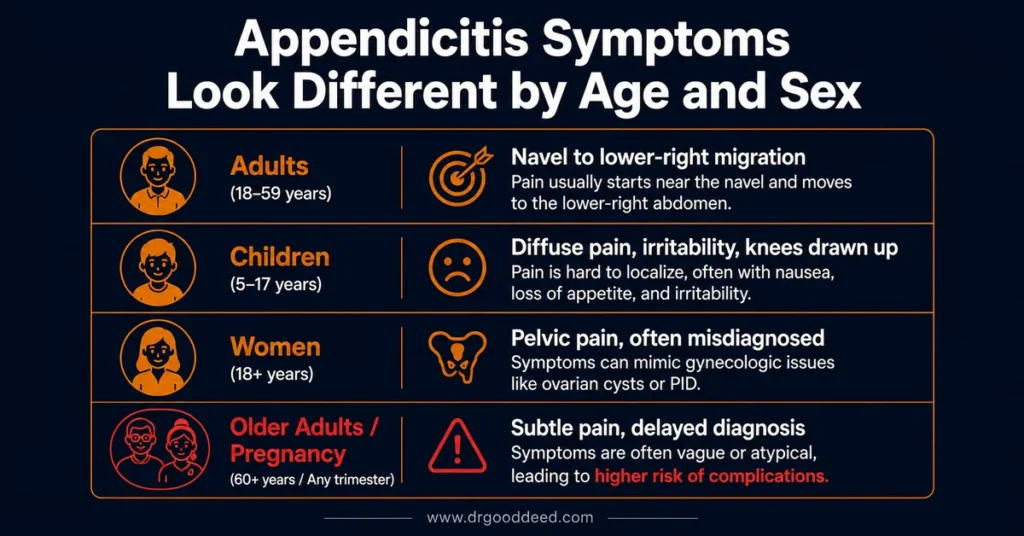
The table below compares how appendicitis symptoms typically show up across four groups, along with the detail most often missed in each one. Treat it as a quick reference, not a diagnostic tool.
| Population | Typical Pain Pattern | Key Signs | Most Often Missed |
| Adults | Starts near the navel, migrates to the lower right over 12 to 24 hours | Nausea, reduced appetite, low-grade fever | Pain that stays vague or moves slowly |
| Children | Diffuse, hard for the child to localize | Irritability, refusal to walk, knees drawn toward the chest | Mistaken for a stomach bug or constipation |
| Women | Pain can feel pelvic or radiate to the lower back | Overlaps with ovarian, menstrual, or urinary pain | Confused with a gynecologic condition |
| Older Adults & Pregnancy | Subtler pain; shifts upward as pregnancy progresses | Blunted fever response, delayed presentation | Diagnosis delayed due to atypical signs |
The Classic Symptom Pattern (And Why Only Half of People Get It)
Appendicitis usually starts as a dull ache around the belly button. The pain often comes and goes for several hours before it intensifies, and nausea or vomiting sets in. Hours later, the pain shifts to the lower right abdomen and turns sharp and constant. This lower right area, near a spot called McBurney’s point, is where the appendix is located.
Cleveland Clinic notes that only about half of people with appendicitis follow this exact pattern. Kids, older adults, and pregnant patients are the least likely to match it. Appendicitis pain location varies more than most people assume, and doctors weigh the full symptom picture rather than one detail alone.
Symptoms That Point to Appendicitis Beyond the Classic Pattern
Beyond migrating pain, reduced appetite is common enough that doctors use it as an appendicitis screening question.
- Low-grade fever, nausea, and vomiting typically follow the pain rather than come before it.
- Bloating, trouble passing gas, and constipation or diarrhea can occur because inflammation disrupts nearby bowel function. Pain sometimes shows up in unusual spots.
- A higher-set appendix can even cause chest and abdominal pain that mimics heartburn.
- Rebound tenderness, where pressure on the abdomen hurts more when it’s released, is another clue providers check for.
- Anxiety can also trigger lower right pain that mimics early appendicitis, which is why it helps to understand can stress cause appendicitis before assuming the worst.
A Simple At-Home Check: The Cough and Appetite Tests
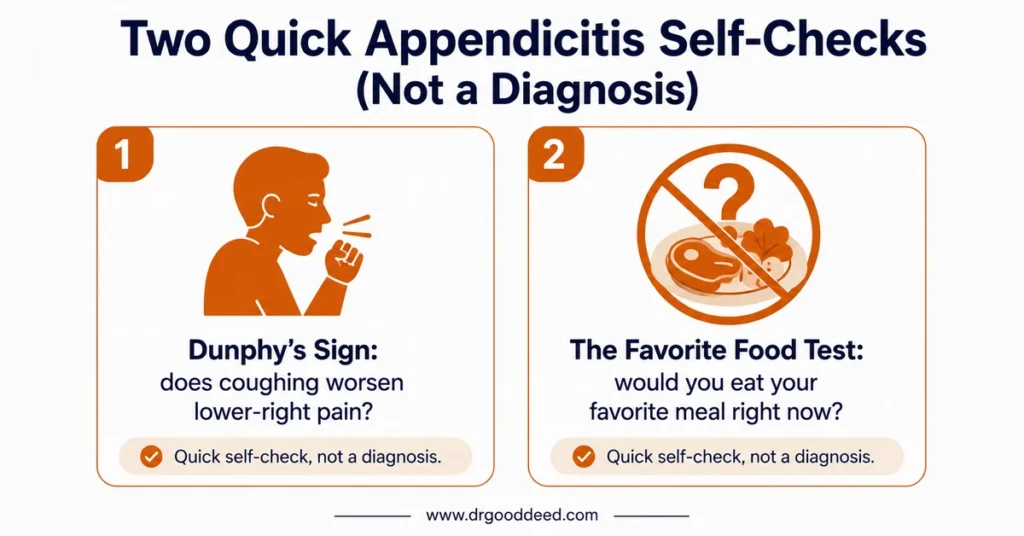
The first is Dunphy’s sign: cough sharply and see what happens. If coughing worsens lower right pain, appendicitis becomes more likely.
Cedars-Sinai surgeon Dr. Rodrigo Alban uses a second approach with his patients. He asks about their favorite food, then asks if they’d want to eat it right now. A firm no, even for a favorite dish, signals appetite loss severe enough to suggest something is genuinely wrong.
A positive cough test or appetite test should prompt a same-day medical visit, not a wait-and-see approach. Never rely on these tests alone to rule appendicitis in or out.
Appendicitis Symptoms in Children
Appendicitis symptoms in children can look nothing like the adult pattern, especially in kids under 5.
- A child may say their whole stomach hurts even when the real problem sits in the lower right side.
- Watch for a child who turns unusually irritable, tired, or clingy rather than one who reports pain directly.
- Some children lie down and draw their knees toward their chest, or bend at the hip, since that position eases pressure on an inflamed appendix.
- Shallow breathing to avoid jostling the abdomen is another quiet clue.
Children younger than 5 face a notably higher rate of ruptured appendix symptoms, largely because the pain is harder for them to describe and for parents to pin down. Persistent belly pain in a young child, paired with reduced appetite or fever, warrants prompt evaluation.
Do Symptoms Look Different in Women?
For appendicitis symptoms in women, reproductive organs sit close enough to the appendix that pain can mimic ovarian cysts, endometriosis, or a urinary tract infection.
A study of women aged 15 to 45 found that 33% were initially misdiagnosed, most often with pelvic inflammatory disease, gastroenteritis, or a urinary infection.
- Pain that feels pelvic or radiates to the lower back shows up more often in women than the textbook lower right pattern.
- Pain starting more than 14 days after the last menstrual period, combined with appetite loss, points more toward appendicitis than a gynecologic cause.
- If pelvic pain intensifies or comes with fever, nausea, or vomiting, treat it as possible appendicitis and get evaluated the same day.
Appendicitis in Older Adults and During Pregnancy
Appendicitis in adults over 60 often presents subtly, which partly explains why outcomes run worse in this age group. Only about 20% of older patients show the classic combination of migrating pain, fever, and appetite loss.
Reduced pain perception and a blunted fever response can mask how serious the situation actually is. Research on patients over 60 found perforation rates as high as 32% to 72%, compared with under 20% to 30% in younger adults, largely because symptoms get recognized later.
As pregnancy progresses, the growing uterus physically pushes the appendix upward and toward the right side. Right lower quadrant pain still dominates in the first trimester, but by the third trimester, pain can appear higher, near the right upper abdomen or flank. Any abdominal pain during pregnancy deserves prompt medical attention.
What Happens If It’s Not Treated in Time
Untreated appendicitis can rupture within roughly 36 hours of the first symptoms, spilling bacteria into the abdominal cavity and triggering peritonitis. Once infection spreads, it can progress to an abscess and, in severe cases, sepsis.
Fever climbing alongside abdominal pain and chills often signals that infection has moved beyond the appendix itself. Appendicitis treated with antibiotics alone, without surgery, has a return rate of 40%. Left completely untreated, appendicitis carries a mortality rate greater than 50%.
When to Get Emergency Care
Treat any of the following as a reason to go to the emergency room: worsening lower right abdominal pain, pain paired with fever or vomiting, a rigid abdomen, or pain that suddenly eases and then returns worse than before.
Don’t take laxatives, use a heating pad, or take pain medication while you wait. These can mask worsening symptoms and delay an accurate diagnosis. Appendicitis vs stomach bug confusion is common early on, but stomach bugs rarely cause fever paired with focused right-sided pain that keeps intensifying. When in doubt, get evaluated.
Sources
- Cleveland Clinic – Appendicitis: Signs, Symptoms and Treatment link
- Cedars-Sinai – Not Just a Stomach Ache: Symptoms of Appendicitis link
- Medscape/eMedicine – Appendicitis Clinical Presentation link
- Medscape/eMedicine – Appendicitis Differential Diagnoses link
- PubMed – Misdiagnosis of Appendicitis in Nonpregnant Women of Childbearing Age link
- Ada Health – Acute Appendicitis: Symptoms, Causes and Treatment link
- Cincinnati Children’s – Appendicitis: Signs, Diagnosis & Treatment link
- NIH StatPearls – Pediatric Appendicitis link
- PMC/NIH – Acute Appendicitis in the Elderly: Risk Factors for Perforation link
- Journal of the American Geriatrics Society – Acute Appendicitis in Elderly Adults: A Difficult Diagnosis link
This article is for informational purposes only and does not replace professional medical advice, diagnosis, or treatment. If you suspect appendicitis, seek emergency medical care right away.