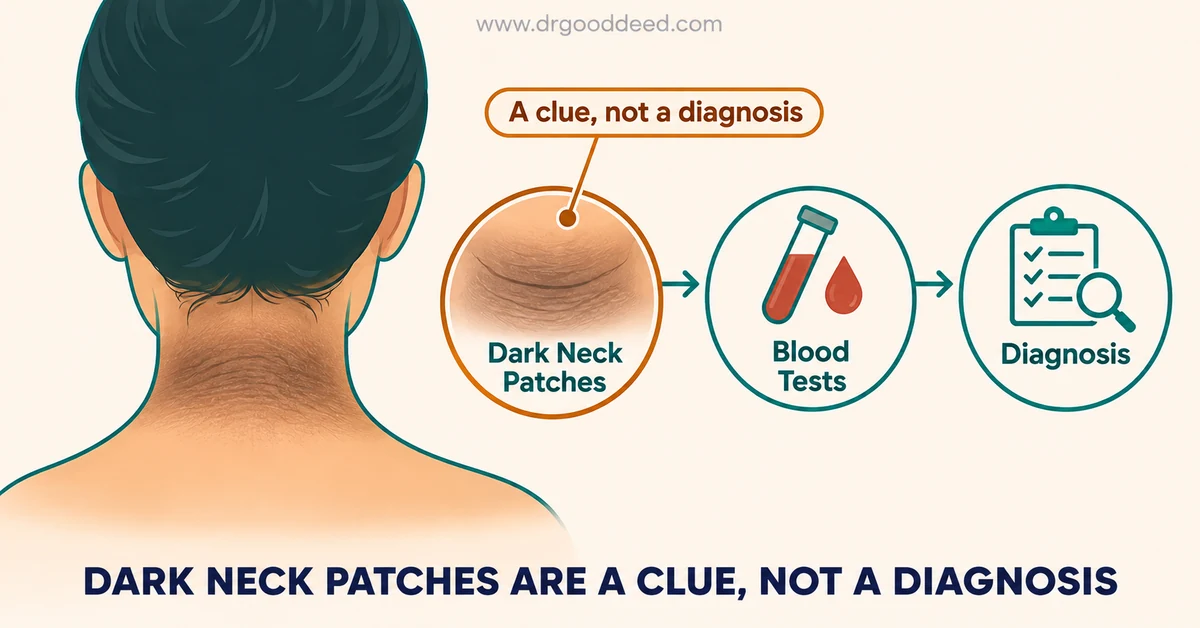

Insulin resistance dark neck patches are usually caused by acanthosis nigricans, a skin change linked to high insulin levels. Dark velvety patches on the neck can be one of the signs of insulin resistance, but they do not diagnose it, because hormonal conditions, medicines, genetic conditions, and normal skin variation can also cause them. A doctor can check your blood sugar and risk factors to find the cause.
Key Takeaways
- An insulin resistance dark neck usually shows acanthosis nigricans, but the patches are a clue, not a diagnosis.
- Acanthosis nigricans usually appears in body folds such as the neck, armpits, and groin.
- It works as a screening clue, not a substitute for blood tests.
- In darker skin, the patches can occur without insulin resistance.
- Treating the cause may improve the skin, but it may not clear completely.
- See a doctor promptly if patches appear suddenly, spread quickly, or come with weight loss.
| Possible cause | Common clues | Next step |
| Insulin resistance, prediabetes, or type 2 diabetes | Symmetric velvety patches, often with skin tags | Doctor visit and blood tests |
| Hormone condition | Other hormonal symptoms | Medical evaluation |
| Medicine-related | Started after certain medicines | Ask the prescriber |
| Rare cancer-associated form | Sudden spread, mucosal changes, weight loss | Prompt medical review |
| Look-alike condition | Different texture or wipes off | Dermatology assessment |
Dark Velvety Patches: What Is Acanthosis Nigricans?
Acanthosis nigricans is a skin change in which areas of skin darken and thicken, often with a velvety feel. It is linked to insulin resistance but is not insulin resistance itself. The patches appear mostly on the sides and back of the neck, under the arms, and in the groin, and they can also develop on the elbows, knees, knuckles, under the breasts, or around the navel.
The dark velvety patches usually develop slowly over months or years and appear on both sides of the body. Some people notice itching or an unpleasant smell, and skin tags may form nearby. A dermatologist can usually diagnose acanthosis nigricans by examining the skin. A biopsy is rarely needed.
Important fact: A dark patch that wipes off with an alcohol swab may be terra firma-forme dermatosis, a different condition.
Is a Dark Neck a Sign of Insulin Resistance?
A dark neck can be one of the signs of insulin resistance and is linked to prediabetes and type 2 diabetes, but it is not a diagnostic test. An insulin resistance dark neck is a clue worth checking, not proof.
The proposed mechanism is that high insulin levels activate IGF-1 receptors on skin cells, which makes the cells multiply so the skin thickens and darkens. The American Diabetes Association’s 2000 consensus statement on type 2 diabetes in children and adolescents lists acanthosis nigricans among the risk factors for type 2 diabetes in young people.
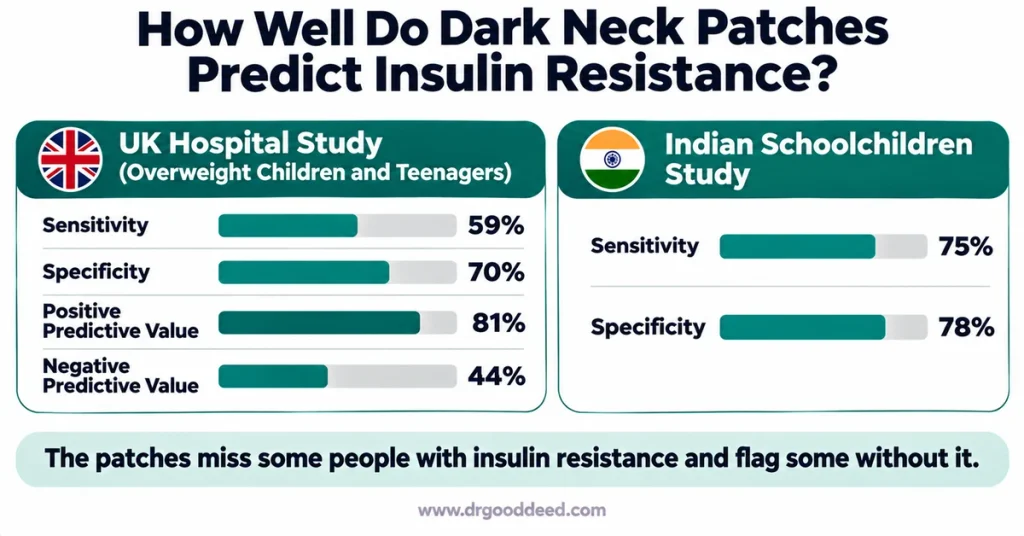
Studies of how well the patches predict insulin resistance give different results. A UK hospital study of overweight children and teenagers found a sensitivity of 59%, a specificity of 70%, a positive predictive value of 81%, and a negative predictive value of 44%. A study of Indian schoolchildren reported a sensitivity of 75% and a specificity of 78%. This means the patches miss some people with insulin resistance and flag some people without it.
A normal fasting glucose does not rule out insulin resistance, because blood sugar can stay normal while insulin levels are high. Other signs of insulin resistance can include a growing waist, skin tags, and, in women, irregular periods or excess hair growth, which can point to PCOS.
Remember: Acanthosis nigricans is a clue that leads to assessment. It cannot tell you alone if you have prediabetes or diabetes.
Does Skin Tone Change What a Dark Neck Means?
Skin tone changes how useful the patches are as a clue. DermNet reports that acanthosis nigricans affects fewer than 1% of Caucasians in the US, compared with an estimated 13.3% of African Americans and 34.2% of Native Americans. DermNet also notes that in darker-skinned individuals, acanthosis nigricans may occur without insulin resistance, and the skin may look darker and more leathery. In practice, patches on darker skin are a weaker clue on their own, so blood tests give a clearer answer than the skin alone.
Other Causes of a Dark Neck
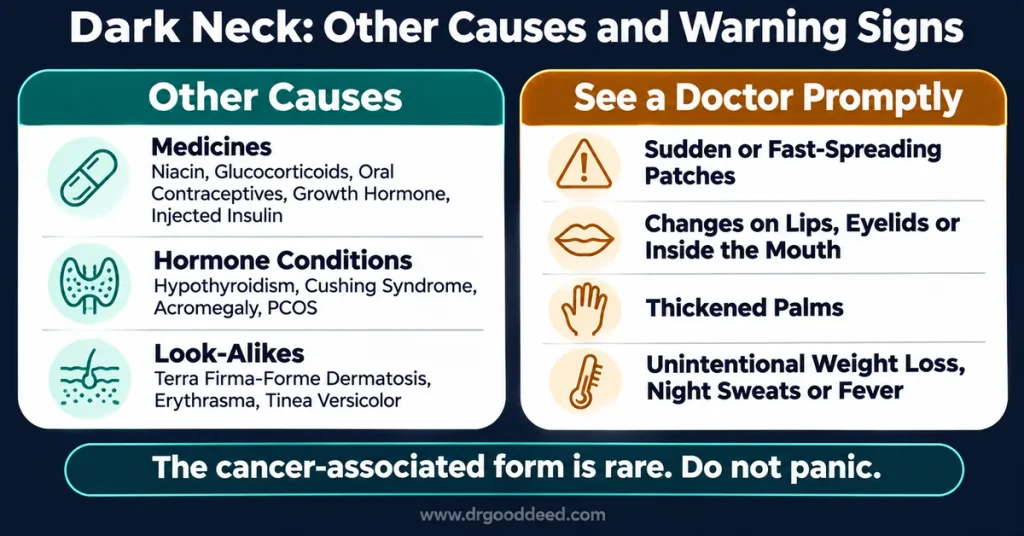
Dark velvety patches on the neck do not always mean insulin resistance. Other causes include medicines, hormone conditions, genetic conditions, and look-alike skin problems.
- Medicines: niacin, glucocorticoids, combined oral contraceptives, growth hormone, and injected insulin at the injection site.
- Hormone conditions: hypothyroidism, Cushing syndrome, acromegaly, and PCOS.
- Look-alike conditions: terra firma-forme dermatosis, confluent and reticulated papillomatosis, erythrasma, and tinea versicolor.
Skin tags can also appear with insulin resistance, although one skin tag is not proof. Never stop a prescribed medicine without talking to your prescriber. If you suspect a medicine is linked to the skin change, ask the prescribing doctor before changing anything.
For background, read our guide on what is diabetes.
When Dark Neck Patches Need Medical Attention
Most insulin resistance dark neck patches are not cancer. A rare cancer-associated form of acanthosis nigricans usually appears after age 40 and spreads quickly. See a doctor promptly if you notice any of these:
- Patches that appear suddenly or spread quickly
- Changes on the lips, eyelids, intimate areas, or inside the mouth
- Thickened or ridged palms
- Unintentional weight loss, night sweats, or fever
- Several new patches after age 40 together with other symptoms
When acanthosis nigricans is linked to cancer, it is most often gastrointestinal adenocarcinoma, especially stomach cancer. Other cancers are linked less often. This form is rare, so dark velvety patches on the neck should not cause panic.
In the US, start with a primary care doctor, who may refer you to a dermatologist or endocrinologist. In the UK, see a GP first.
What Tests Should You Ask For?
If your doctor suspects an insulin resistance-related dark neck, the first step is usually a skin exam and a risk check. Blood tests may follow to look for prediabetes and diabetes.
Depending on your case, tests may include fasting glucose, A1C, lipids, fasting insulin, hemoglobin, and liver enzymes (ALT). There is no established cutoff for fasting insulin, so your clinician needs to interpret the result. Fasting glucose can miss insulin resistance, especially in children, so A1C and the full picture matter. If results conflict or are unclear, ask your clinician to explain them.
For early glucose changes, see What Causes High Blood Sugar Without Diabetes?
How to Treat Dark Neck
How to get rid of dark neck from insulin resistance starts with treating the cause, not the skin. When acanthosis nigricans is linked to insulin resistance or prediabetes, improving insulin sensitivity and losing weight can lighten the skin, but it may not clear completely. The condition is not dangerous in itself, and the American Academy of Dermatology says treating the skin is optional.
Options to discuss with your doctor:
- Treat the underlying hormonal or metabolic condition.
- Ask whether metformin is suitable for you.
- A dermatologist may offer retinoids or other prescription creams if you want clearer skin.
- Do not scrub or bleach the skin. Scrubbing does not help, and bleaches and exfoliants rarely fade the patches and can irritate the skin.
- Avoid supplements sold for skin lightening, and follow your physician’s advice.
For more, see our guide to diabetes causes, symptoms, types and treatment.
Treatment tip: Finding and treating the cause is more important than trying to remove the color with harsh products.
Frequently Asked Questions
Is acanthosis nigricans reversible?
It may improve, but it may not clear completely. Acanthosis nigricans linked to obesity or prediabetes can lighten when the cause is treated and weight is reduced, but the darker spots may not go away completely. A dermatologist can suggest skin treatments if the appearance bothers you.
Can you have acanthosis nigricans without diabetes?
Yes. Acanthosis nigricans can occur without diabetes, and in darker skin it can appear even without insulin resistance. The patches should be read together with other risk factors and blood tests rather than on their own, so ask your doctor which tests make sense for you.
Is a dark neck caused by poor hygiene?
No. Acanthosis nigricans is not caused by poor hygiene, and scrubbing does not remove it. Only a look-alike called terra firma-forme dermatosis wipes off with an alcohol swab, which is why a doctor should confirm what the patches are before you try anything.
Do skin tags also signal insulin resistance?
Skin tags can occur with insulin resistance and acanthosis nigricans, but they are also common in the general population. One or a few skin tags are not one of the signs of insulin resistance on their own, so look at the whole picture with a doctor.
How long does it take for a dark neck to fade?
Fading usually takes months and can be incomplete. The time depends on the cause, how early it is treated, and your skin type. Treating insulin resistance, or changing a causative medicine under a prescriber’s guidance, can help the skin lighten gradually, but results vary.
This article is for general information only and is not medical advice. It does not replace an examination or advice from a qualified healthcare professional. If you are worried about your symptoms, see a doctor.
Meta Title: Insulin Resistance Dark Neck: Causes & Tests | Dr Good Deed
Meta Description: Insulin resistance dark neck patches may be linked to acanthosis nigricans. Know the causes, recommended tests, treatment options, and warning signs.
Sources
DermNet. Acanthosis Nigricans: Causes, Diagnosis, and Treatment. link
Mayo Clinic. Acanthosis nigricans: Symptoms and causes. link
Cleveland Clinic. Acanthosis Nigricans: Causes, Diagnosis & Treatment. link
American Academy of Dermatology. Acanthosis nigricans: Diagnosis and treatment. link
American Academy of Dermatology. Acanthosis nigricans: Tips for managing. link
KidsHealth. Acanthosis Nigricans (AN). link
Hughes EK, Brady MF, Rawla P. Acanthosis Nigricans. StatPearls, 2023. link
Callanan N, Wright N. Single-centre case-control study investigating the association between acanthosis nigricans, insulin resistance and type 2 diabetes in a young, overweight, UK population. BMJ Paediatr Open, 2022. link
[Indian schoolchildren study, 2017: confirm title, authors, journal] link
[PMC11117019: add title, authors, journal, year] link
[American Diabetes Association. Type 2 diabetes in children and adolescents. Diabetes Care, 2000: confirm citation and add link]
Medical Disclaimer: This article is for general information only and is not medical advice. It does not replace a diagnosis, treatment plan, or guidance from a qualified healthcare professional. Always talk to your doctor about your own symptoms and before starting, stopping, or changing any treatment. If you think you may be having a medical emergency, call 911 or go to your nearest emergency room.