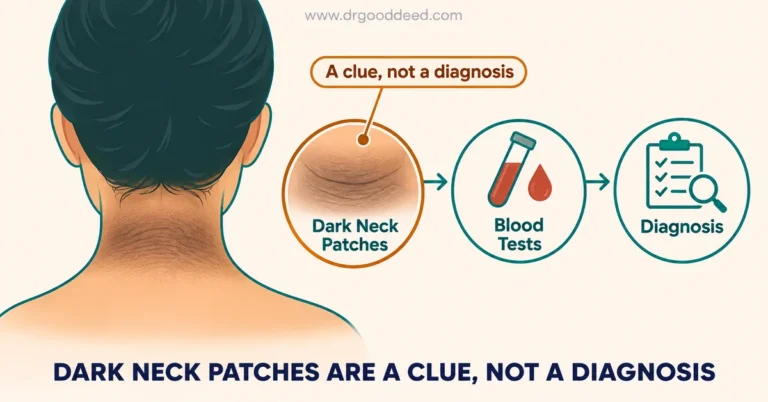

Biotin thyroid test interference happens when biotin skews some lab methods, not the thyroid itself. Biotin is a vitamin found in multivitamins and many hair, skin, and nail supplements, and it does not change thyroid hormone levels directly, but it can cause biotin thyroid test interference by affecting some laboratory methods used to measure them. Biotin thyroid test interference can produce results that look like an overactive thyroid even when the thyroid gland is normal.
Knowing about this interaction can help you avoid unnecessary worry and the wrong treatment. If your thyroid blood test results don’t match your symptoms, tell your doctor about every supplement you take. Your doctor may suggest repeating the test after a proper waiting period.
Key Takeaways
- Biotin thyroid test interference can make TSH look falsely low and T4 or T3 falsely high on affected assays, mimicking hyperthyroidism.
- Biotin and thyroid tests do not always clash. The effect depends on the lab method and how much biotin is in your blood.
- How long to stop biotin before a thyroid test depends on your dose and the lab method, so ask your doctor or lab.
- Repeat an unexpected result before changing treatment. Chest pain, fainting, a racing heart or severe breathlessness needs emergency care.
| Thyroid test | Possible effect on affected assays | What the result may suggest |
| TSH | Falsely low | Overactive thyroid |
| Free T4 | Falsely high | Overactive thyroid |
| Free T3 and total T3 | Falsely high | Overactive thyroid |
| Total T4 | No interference at 5 to 10 mg in one study | Results that look inconsistent with each other |
| TPO antibodies and TRAb | Falsely high | Autoimmune thyroid disease |
| Thyroglobulin | Falsely low | Misleading thyroid cancer follow-up results |
How Does Biotin Thyroid Test Interference Happen?
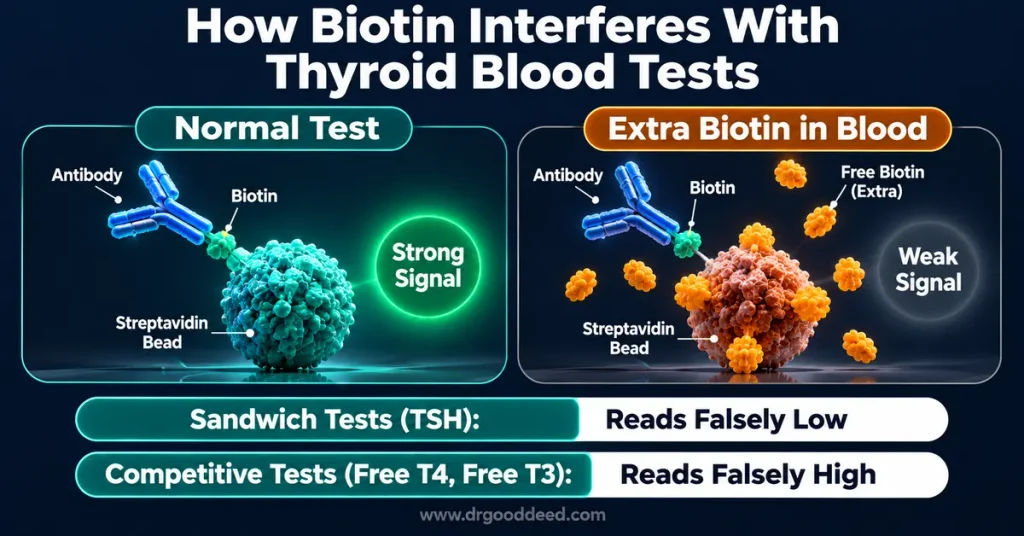
Biotin thyroid test interference happens because many lab tests use biotin as a handle to catch the hormone being measured, and extra biotin in your blood can jam that process. So does biotin affect thyroid test results? On affected tests, yes, and the direction of the error depends on how the test is built.
- Most thyroid blood tests are immunoassays: lab tests that use antibodies, proteins that recognize one specific substance, to find and measure a hormone.
- Many of these tests attach the antibody to biotin. They then use streptavidin, a protein that grips biotin tightly, to hold everything in place while the machine takes its reading.
- When your blood carries a lot of biotin, that extra biotin takes up the streptavidin before the test’s own biotin can.
- In sandwich assays, used for TSH and thyroglobulin, the hormone is caught between two antibodies. Less capture means a weaker signal, so the result reads falsely low.
- In competitive assays, used for free T4, free T3, total T3 and some thyroid antibodies, a weaker signal is read as more hormone, so the result reads falsely high.
This is why a falsely low TSH can appear on affected assays even when your real hormone levels are normal.
Can Biotin Cause False Hyperthyroidism?
Yes. On affected assays, biotin can create false hyperthyroidism: a pattern of low TSH with high free T4 and free T3, even though the thyroid gland is working normally.
This pattern can look like Graves disease or another cause of hyperthyroidism, which is why it can mislead.
One published case report describes a 49-year-old woman with multiple sclerosis who was taking 200 mg of biotin daily. Her TSH ranged from 0.02 to 0.08 mIU/mL, her free T4 reached 7.8 ng/dL, and her free T3 reached 7.38 pg/mL. These results suggested severe thyroid hormone excess, yet she had no symptoms and a normal examination. One week after she stopped biotin, her thyroid tests were completely normal.
That was a single case at a very high dose, so the one-week timeline does not apply to everyone.
A wrong reading can lead to unnecessary scans, antithyroid medicine or a change to a thyroid medicine dose. Doctors should ask about supplements whenever test results don’t fit a patient’s symptoms.
Read more about Graves disease and Hashimoto’s disease to learn how genuine autoimmune thyroid conditions differ from other thyroid problems.
Does Biotin Affect Thyroid Test Results at Every Dose?
No. Whether biotin affects thyroid test results depends on how much biotin is in your blood at the time of the test and on the lab method used, not just on the dose printed on the label.
The American Thyroid Association (ATA) cites a blood level of 10 ng/mL or higher as the point where interference becomes a concern. Higher doses raise blood levels, but smaller doses cannot always be ruled out.
One milligram (mg) equals 1,000 micrograms (mcg), so a 10,000 mcg supplement contains 10 mg of biotin.
| Biotin source | Typical amount |
| Recommended daily intake for adults | 30 mcg |
| Many multivitamins | About 30 to 300 mcg |
| Hair, skin and nail supplements | Often 5,000 to 10,000 mcg (5 to 10 mg) |
| Prescribed high-dose treatment | Can reach 100 to 300 mg a day (the case above was 200 mg daily) |
Multivitamins are less likely to interfere than high-dose supplements, but it is possible. In one reader report, misleading thyroid results were traced to a multivitamin containing 500 mcg of biotin.
Tell your doctor the product you take, the dose, and when you took your last biotin.
Do All Labs Get Biotin and Thyroid Tests Wrong?
No. Biotin and thyroid tests clash only on lab methods that rely on biotin to capture the hormone, and some methods showed little or no interference at the doses studied.
In a 2020 study, people took 5 or 10 mg of biotin daily. Some thyroid tests were affected on Roche cobas and Beckman UniCel platforms, while no interference was found on Abbott Architect under the same conditions.
An ATA summary reported that Roche Cobas 6000 and Siemens Immulite 2000 were significantly affected. Abbott Architect and LC-MS/MS, a method that measures hormones by their mass instead of with antibodies, were minimally affected.
These findings do not make any manufacturer or platform safe. Manufacturers change their assays, and results depend on the specific test. Ask your lab whether its method is sensitive to biotin.
How Long to Stop Biotin Before a Thyroid Test?
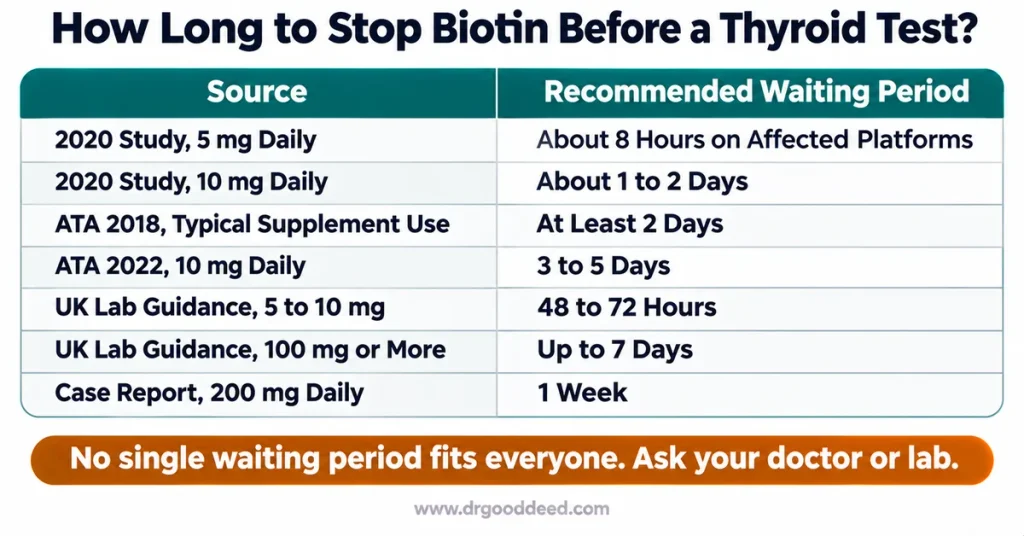
There is no single waiting period that fits everyone. Research and guidance on biotin and thyroid tests give different intervals depending on the dose, the lab method, and the clinical situation.
| Source | Biotin dose studied | Reported waiting period |
| 2020 thyroid assay study | 5 mg daily | About 8 hours on affected platforms |
| 2020 thyroid assay study | 10 mg daily | About 1 to 2 days |
| ATA patient page, 2018 | Typical supplement use | At least 2 days |
| ATA patient page, 2022 | 10,000 mcg (10 mg) daily | 3 to 5 days |
| UK commercial lab guidance (Blue Horizon) | 5 to 10 mg daily | 48 to 72 hours |
| UK commercial lab guidance (Blue Horizon) | 100 mg or more daily | Up to 7 days |
| High-dose case report | 200 mg daily | 1 week for results to normalize |
These figures come from specific studies and guidance, not a personal plan. Ask your doctor or lab how long you need to stop biotin before a thyroid test, because the answer depends on your dose and their method.
If a doctor prescribed high-dose biotin for a medical condition, talk to the prescriber before stopping it, and tell the lab you take it.
Keep taking levothyroxine, methimazole or any other thyroid medicine as prescribed. Don’t change your medicine because of one unexpected result.
What to Do If Thyroid Results Do Not Match Symptoms
You don’t have to act on an unexpected thyroid result straight away. Biotin thyroid test interference is one possible cause, but your doctor will also look for genuine thyroid disease and other explanations before deciding anything.
A falsely low TSH alongside high T4 and T3 can be false hyperthyroidism or the real condition, and a careful repeat test is what tells them apart.
- Tell your doctor and the lab about every supplement, including multivitamins and prenatal vitamins.
- Ask whether your biotin intake could explain the results.
- Repeat the blood test after the waiting period your doctor advises.
- Ask whether a different lab method can confirm the findings.
- Keep taking prescribed thyroid medicine unless your prescriber changes it.
- Follow up with your primary care doctor or an endocrinologist in the US, or your GP in the UK.
Seek emergency care for chest pain, fainting, a racing heart or severe breathlessness. In the US, call 911 or go to the emergency department. In the UK, call 999 or go to A&E. Tell staff you take biotin, and don’t wait for it to clear your system before getting help.
To understand the real condition, see our guide to hyperthyroidism symptoms, causes and treatment.
What Else Can Affect Thyroid Test Results?
Biotin is not the only thing that can throw off a thyroid test. Iodine supplements such as kelp, the timing of your thyroid medicine dose before the blood draw, a recent serious illness, and some medicines can all shift results. Tell your doctor about everything you take and when you took it, and follow their instructions on medicine timing before the test.
Which Other Blood Tests Can Biotin Affect?
Biotin can also interfere with blood tests beyond the thyroid panel. In November 2017, the US Food and Drug Administration (FDA) warned that biotin can interfere with lab tests, naming parathyroid hormone, TSH, T4, T3 and troponin, a test that helps doctors check for heart muscle injury.
The FDA also reported a death linked to a falsely low troponin result in a person taking high-dose biotin. Not every troponin test is affected, but it shows why your supplement history matters.
This is more common than many people think. In one Mayo Clinic study summarized by the ATA, 7.4% of emergency department patients had biotin levels high enough to interfere with common lab tests, and only 2 of 107 had biotin use recorded in their medical records.
If you need emergency care, tell the staff you take biotin. Never delay an emergency assessment because you suspect a lab interference problem.
Frequently Asked Questions
Can biotin affect thyroid tests if you take levothyroxine?
Yes. On affected assays, biotin can make TSH look lower than it really is, which could lead to the wrong levothyroxine dose change. Keep taking levothyroxine as prescribed and ask your doctor whether to repeat the test after a waiting period.
Will 30 mcg of biotin affect thyroid tests?
Interference at 30 mcg is unlikely. That is the recommended daily intake for adults, far below the 5 to 10 mg doses that caused interference in studies. Effects still vary by lab method, so mention any biotin product to your doctor and lab.
Does the biotin in a multivitamin or prenatal vitamin matter?
It can. Most multivitamins contain small amounts, but the risk varies with dose and lab method. Check the supplement label and tell your doctor about your multivitamin or prenatal vitamin before you have blood drawn.
Can biotin shampoo or skin products change thyroid blood tests?
Evidence that ordinary biotin shampoo changes blood test results is limited. The main concern is biotin taken by mouth, especially high-dose supplements. If you are unsure about a product’s ingredients, tell your clinician what you use.
Does biotin damage the thyroid gland itself?
No. Biotin does not damage the thyroid gland or change how much hormone it makes. The concern is that it can interfere with how certain lab assays measure those hormones. Your clinician can decide whether a repeat test is needed to confirm your actual thyroid status.
Sources
- Biotin Interference in Assays for Thyroid Hormones, Thyrotropin and Thyroglobulin (Thyroid, 2020) – https://pmc.ncbi.nlm.nih.gov/articles/PMC7478465/ link
- Effect of High-dose Biotin on Thyroid Function Tests: Case Report and Literature Review (Cureus, 2018) – https://pmc.ncbi.nlm.nih.gov/articles/PMC6103391/ link
- American Thyroid Association, Clinical Thyroidology for the Public, December 2018: Biotin supplement use is common and can lead to the false measurement of thyroid hormone – https://www.thyroid.org/patient-thyroid-information/ct-for-patients/december-2018/vol-11-issue-12-p-3-4/ link
- American Thyroid Association, Clinical Thyroidology for the Public, January 2022: Biotin use can interfere with the management of thyroid diseases – https://www.thyroid.org/patient-thyroid-information/ct-for-patients/january-2022/vol-15-issue-1-p-7-8/ link
- US Food and Drug Administration: Biotin Interference with Troponin Lab Tests – https://www.fda.gov/medical-devices/in-vitro-diagnostics/biotin-interference-troponin-lab-tests-assays-subject-biotin-interference link
- People’s Pharmacy: Beware of Biotin Interfering With Thyroid Tests – https://peoplespharmacy.com/articles/beware-of-biotin-interfering-with-thyroid-tests link
- Testing.com: Biotin Affects Some Blood Test Results – https://www.testing.com/articles/biotin-affects-some-blood-test-results/ link
- Healthline: Does Biotin Interfere with Thyroid Tests? – https://www.healthline.com/health/biotin-and-thyroid-labs link
Medical Disclaimer: This article is for general information only and is not medical advice. It does not replace a diagnosis, treatment plan, or guidance from a qualified healthcare professional. Always talk to your doctor about your own symptoms and before starting, stopping, or changing any treatment. If you think you may be having a medical emergency, call 911 or go to your nearest emergency room.