


Waking up at 3 a.m. every night can be frustrating, especially when you fall asleep easily but struggle to get back to sleep. This pattern may be linked to stress, alcohol, sleep apnea, menopause, nighttime urination, pain, or insomnia. The exact time you wake up usually matters less than how often it happens, how long you stay awake, and how you feel the next day. Understanding these patterns can help you identify possible triggers and decide when to seek medical advice.
Key Takeaways
- Waking up every night at 3 a.m. could be due to sleep disruption, certain lifestyle habits, or an underlying health condition.
- Stress, alcohol, menopause, sleep apnoea, and the need to urinate at night can all disrupt sleep.
- A sleep diary can help identify patterns and provide useful information for your doctor.
- Persistent insomnia may improve with cognitive behavioral therapy for insomnia (CBT-I).
- Seek medical advice if sleep problems continue or affect your daily life.
When Is Waking at 3 a.m. a Problem?
Waking briefly during the night is normal. It becomes a concern when you wake repeatedly, struggle to fall asleep again, or feel tired and unfocused during the day.
A possible cause is so-called sleep maintenance insomnia, which is characterized by difficulty in remaining asleep or in getting back to sleep after having woken up. You may have no trouble falling asleep but could remain awake for long periods during the night.
- Insomnia may be of a short-term or a long-term nature.
- Insomnia that lasts for less than three months is considered to be short-term, while insomnia lasting three months or more is classified as long-term.
- Yet, there is no need to wait three months before getting help if poor sleep is affecting your mood, concentration, or daily activities.
The duration of each awakening also matters, but there is no single waking time that automatically indicates insomnia. Your overall sleep pattern and daytime symptoms provide more useful clues.
What Causes Waking Up at 3 a.m. Every Night?
Your sleep schedule, daily habits, emotional well-being, medicines, and physical health can all influence when you wake up.
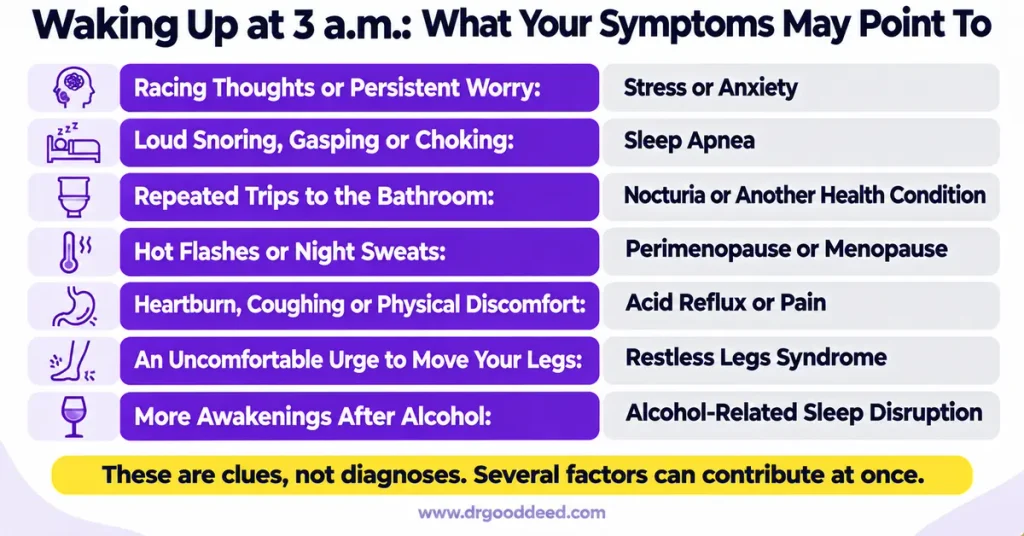
| What you notice | Possible cause |
| Racing thoughts or persistent worry | Stress or anxiety |
| Loud snoring, gasping, or choking | Sleep apnea |
| Repeated trips to the bathroom | Nocturia or another health condition |
| Hot flashes or night sweats | Perimenopause or menopause |
| Heartburn, coughing, or physical discomfort | Acid reflux or pain |
| An uncomfortable urge to move your legs | Restless legs syndrome |
| More awakenings after drinking alcohol | Alcohol-related sleep disruption |
| Sleep changes after starting a medicine | Possible medication effects |
These symptoms are clues, not diagnoses. Several factors may contribute to the same sleep problem.
Stress and Anxiety
Stress can keep your mind alert even when your body is tired. You may wake up thinking about work, family responsibilities, finances, or something that happened during the day.
Anxiety can also make it harder to relax after waking. The more you worry about losing sleep, the more difficult it may become to fall asleep again.
If persistent worry, low mood, or loss of interest in everyday activities accompanies your sleep problems, speak with a healthcare professional.
Understanding your overall sleep habits and sleep health can help you identify patterns that may be contributing to repeated nighttime awakenings.
Sleep Apnea
Obstructive sleep apnea happens when the upper airway narrows or becomes blocked several times during sleep, which interferes with breathing. The episodes can lead to short awakenings that you might not recall the following morning.
The symptoms may be loud snoring, gasping or choking during sleep, morning headaches, and a tendency to feel drowsy during the day. In some cases, people also have to get up frequently to urinate.
It isn’t true that all people who have sleep apnea snore. If you frequently wake up feeling unrested or if someone else observes that you stop breathing while you’re asleep, you should ask your doctor whether or not a sleep study is suitable.
Menopause and Night Sweats
The onset of perimenopause and menopause may cause sleep problems because of hot flashes, night sweats, and other symptoms, so you can wake up feeling hot, wet from sweating, or uncomfortable even if the room is cool.
If the waking you experience at night matches these symptoms, then you should record the times when this happens and the way it affects your sleep. A healthcare professional can then go over the various options available for managing menopause symptoms.
Learn more about sleep apnea without snoring and sleep apnea symptoms in women
Nighttime Urination
Waking up during the night to urinate is called nocturia. Drinking large amounts of fluid close to bedtime, consuming caffeine, and drinking alcohol may contribute to the problem.
Frequent nighttime urination can also be associated with bladder problems, diabetes, sleep apnea, or other medical conditions.
Check whether it is the need to urinate that wakes you up or whether you are awakened for some other reason and then go to use the bathroom. If you experience frequent nighttime urination for the first time, or if it is accompanied by pain or an intense thirst, you should get medical advice.
Pain, Acid Reflux, and Restless Legs
Even if physical discomfort seems tolerable during the day, it can interfere with sleeping, and back pain, joint pain, acid reflux, and coughing may make it hard to stay asleep.
Restless legs syndrome can lead to a discomforting feeling that makes you want to move your legs, especially when you are at rest or in the evening. Although moving may provide only temporary relief, the sensation can still repeatedly disrupt your sleep.
If pain, heartburn, or unusual leg sensations regularly wake you, discuss them with your doctor rather than treating the sleep disturbance alone.
Alcohol, Caffeine, and Medicines
Alcohol may initially make you feel sleepy, but it can disrupt sleep later in the night. Caffeine consumed later in the day may also make it harder to maintain uninterrupted sleep.
Some medicines can contribute to sleep changes or nighttime urination. For example, certain corticosteroids may interfere with sleep, while diuretics increase urine production.
If your sleep pattern changes after starting a medicine or changing its dose, ask your doctor or pharmacist whether it could be contributing. Do not stop a prescribed medicine or change its dose without medical advice.
5. Sleep diary section
A sleep diary can help you understand recurring patterns. For a broader explanation of the possible reasons behind this timing and practical steps to fall back asleep, read our related article, Why Do I Wake Up at 3 a.m.?
How Can You Identify the Cause?
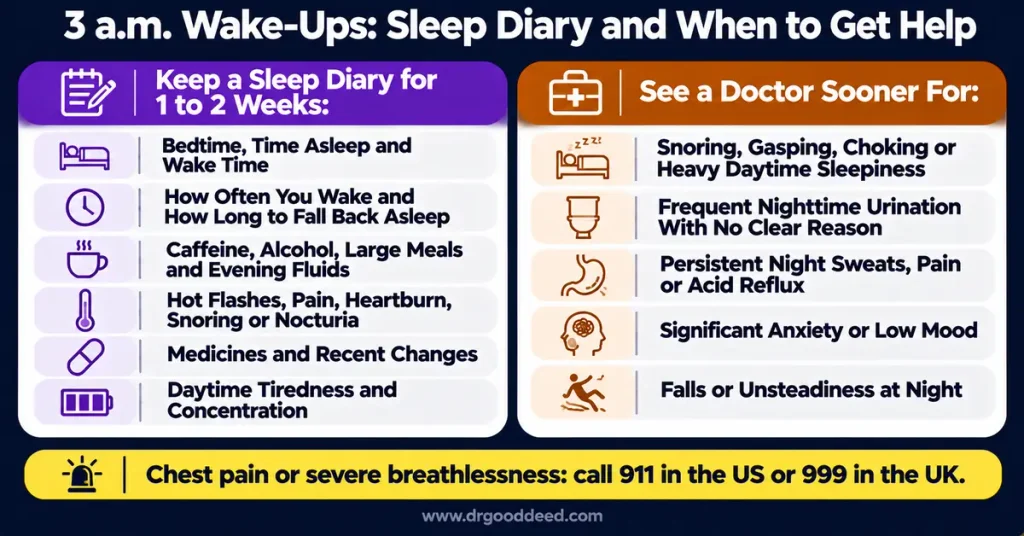
A sleep diary can help you spot patterns that are easy to overlook. Keep one for one to two weeks and record what happens before bedtime, during the night, and the following day.
Include these details:
- For the sleep schedule, note the time you go to bed, the time when you actually fall asleep, and the time you wake up.
- Regarding night wakings: note how frequently you wake and how long it takes you to go back to sleep.
- Note when you eat or drink caffeine, alcohol, large meals, or fluids in the evening.
- Note whether a partner has reported experiencing hot flashes, pain, heartburn, nocturia, anxious thoughts, or snoring.
- Medicines: Provide a list of prescribed medicines, over-the-counter products, and any recent changes.
- When the day is alive, note any feelings of tiredness, irritability, difficulty in concentrating, and unintentional dozing.
Bring your diary to a medical appointment if the problem continues. Your doctor may ask about your medical history, mood, sleep habits, and other symptoms. Depending on the findings, they may review your medicines or assess for conditions such as sleep apnea or restless legs syndrome.
A sleep study may be recommended when a specific sleep disorder is suspected. It is not necessary for everyone who wakes during the night.
How to Stop Waking Up at 3 a.m.?
The best way to reduce nighttime waking depends on what is causing it. Start with consistent sleep habits, but remember that lifestyle changes may not resolve an untreated medical condition.
Change Habits That Disrupt Sleep
Small, consistent adjustments can help improve sleep quality.
- Keep a regular schedule: Go to bed and get up at the same times, even on weekends.
- Review caffeine intake: Reduce caffeine later in the day if it affects your sleep.
- Avoid alcohol as a sleep aid: Alcohol may make you sleepy initially but disrupt sleep later.
- Create a comfortable bedroom: Keep your room dark, quiet, and comfortably cool.
- Develop a wind-down routine: Try reading, gentle breathing exercises, or another relaxing activity before bed.
- Avoid clock-watching: Repeatedly checking the time can increase frustration and make it harder to relax.
If you cannot fall back asleep and feel increasingly frustrated, get out of bed and do something quiet in dim light. Return to bed when you feel sleepy.
If you need to get up in the morning to go to the toilet, think about whether having drinks in the late evening might be the cause. It is not necessary to greatly cut down on fluid intake, particularly if you have been told to stay hydrated or if you have a medical condition which affects fluid balance.
Treat the Underlying Cause
Sleep habits alone may not solve the problem if an underlying health condition is interrupting your rest.
Repeated gasping or loud snoring may warrant an assessment for sleep apnea. Night sweats, persistent pain, acid reflux, or frequent urination may require targeted evaluation and treatment.
If you suspect a medicine is affecting your sleep, ask a healthcare professional to review it. Do not independently change its dose or timing.
Consider CBT-I for persistent insomnia.
Cognitive behavioral therapy for insomnia (CBT-I) is a structured treatment that helps change thoughts and behaviors that interfere with sleep. It can address sleep-related worry, unhelpful bedtime habits, and patterns that make it difficult to return to sleep.
CBT-I is an established treatment for persistent insomnia. It may be delivered by a trained therapist or through an appropriate guided program, and the number of sessions varies.
Sleep aids may help some people for a short period, but they do not necessarily address the cause of nighttime waking. Ask a doctor or pharmacist before using them, particularly if you take other medicines, have existing health conditions, or are at risk of falls.
NHS guidance notes that some pharmacy sleep aids should only be used for a short period, usually one to two weeks. Prescription sleeping pills are generally reserved for selected situations and short-term use.
When Should You See a Doctor?
Arrange a medical appointment if waking up at night continues despite changes to your sleep routine, lasts for months, or affects your concentration, mood, work, or daily activities.
Seek medical advice sooner if you experience:
- Snoring, gasping, choking, or feeling excessively sleepy during the day.
- Waking up often at night to urinate, or needing to urinate at night for no clear reason.
- Night sweats that are persistent, or pain, or acid reflux.
- Significant anxiety or low mood alongside sleep problems.
- Falls or unsteadiness when getting up at night, particularly in older adults.
Chest pain, severe breathlessness, or serious breathing difficulty requires emergency medical assessment. Do not assume these symptoms are simply a sleep problem.
If you are going through a mental health crisis, help is on hand. In the United States, you can call or text 988 to speak to the Suicide & Crisis Lifeline; if the situation is life-threatening, you should call 911. In the UK, you can get urgent advice by contacting your GP or by calling NHS 111, obtain emotional support by phoning the Samaritans on 116 123, or call 999 or go to A&E in an emergency.
Focus on the Cause, Not the Clock
The fact that you wake up every night at 3 a.m. doesn’t necessarily indicate that you have insomnia, a hormonal disorder, or some other particular condition. The more helpful indications are how frequently you wake, whether you are able to go back to sleep, and whether or not you have other symptoms.
Begin by keeping a record of your sleep pattern and look for any possible causes. If the problem persists or has an impact on your daily life, give your sleep diary to a healthcare professional. It is more helpful to understand the cause than to concentrate on the exact hour at which you wake up.
Frequently Asked Questions
Why do I wake up at 3 am every night?
Stress, alcohol, sleep apnea, menopause, the need to urinate at night, pain, and insomnia are all capable of disrupting sleep, and your particular symptoms together with your sleep pattern may help in identifying the possible causes.
What does it mean when you wake up at 3 a.m. every night?
It may reflect a sleep disturbance, a lifestyle trigger, or an underlying health condition. Waking at that exact time does not identify a specific cause.
Is waking up at 3 a.m. normal?
Occasional nighttime waking is common. Frequent waking that makes it difficult to return to sleep or causes daytime symptoms deserves attention.
How do I stop waking up at 3 am?
It is important to keep a regular sleep routine, check the amount of caffeine and alcohol consumed in the late afternoon and evening, and make sure the environment in which you sleep is comfortable. If the problem continues, then you should get medical advice.
What should I do if I wake up at 3 am and can’t fall back asleep?
It’s best not to keep looking at the clock or try to force yourself to go to sleep; if you’re still awake and feeling frustrated, then do a quiet activity in low light and go back to bed when you feel drowsy.
Sources:
1.https://www.nhs.uk/conditions/insomnia/ link
2.https://pubmed.ncbi.nlm.nih.gov/33164742/ link
3.https://pubmed.ncbi.nlm.nih.gov/38016484/ link
4.https://www.nia.nih.gov/health/menopause/sleep-problems-and-menopause-what-can-i-do link
5.https://www.nhlbi.nih.gov/news/2017/sleep-apnea-nhlbi-sheds-light-underdiagnosed-disorder link
Medical Disclaimer: This article is for informational and educational purposes only and does not replace professional medical advice, diagnosis, or treatment. Always consult a qualified healthcare professional about your symptoms or health concerns. Never delay or disregard professional medical advice based on information provided in this article.
Medical Disclaimer: This article is for general information only and is not medical advice. It does not replace a diagnosis, treatment plan, or guidance from a qualified healthcare professional. Always talk to your doctor about your own symptoms and before starting, stopping, or changing any treatment. If you think you may be having a medical emergency, call 911 or go to your nearest emergency room.