
Medically reviewed by Dr Anshu Alok, Endocrinology.
Your CGM and finger stick rarely match exactly, and when you compare CGM vs finger stick accuracy, the gap usually comes from timing, not a broken device. The difference often comes down to how they measure glucose, how quickly your levels change, and whether an error affects the sensor or blood sample. Understanding these differences can help you decide when to check your glucose again and when to contact your healthcare professional.
Key Takeaways
- CGM vs finger stick accuracy differs because a CGM reads fluid under your skin a few minutes behind your blood, so small gaps are normal.
- CGM readings may lag behind blood glucose changes, especially when your levels rise or fall quickly.
- Glucose meters and CGMs have different sources of measurement error, so their readings may not match exactly.
- If your symptoms do not match your CGM reading, check your glucose with a finger stick when appropriate and follow your diabetes care plan.
CGM vs Finger Stick Accuracy: Which Is Right?
Neither test is perfect, and CGM vs finger stick accuracy depends on what you need: a finger stick measures glucose in a blood sample at the time of testing, while a CGM tracks glucose patterns throughout the day.
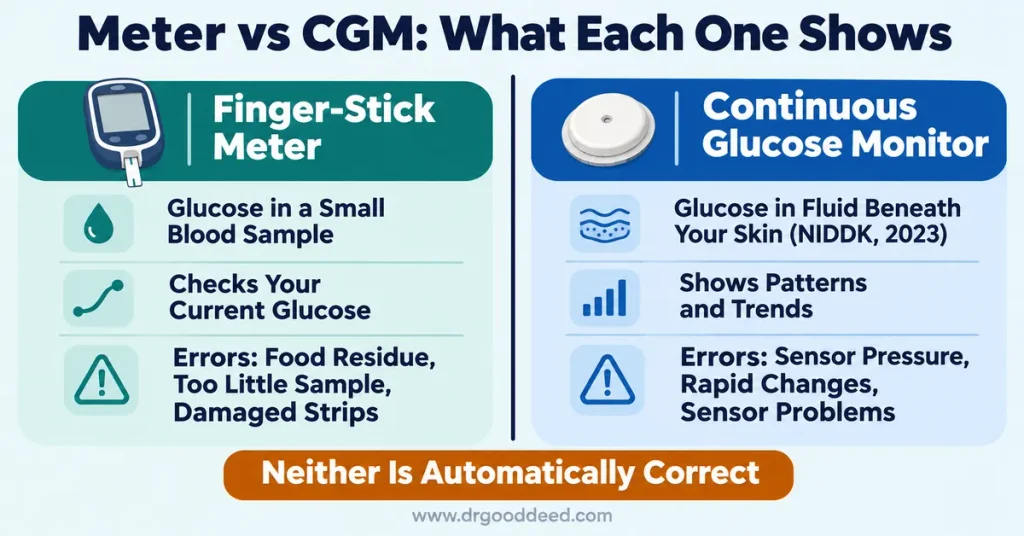
A continuous glucose monitor measures glucose in interstitial fluid, the fluid surrounding your body’s cells (NIDDK, 2023). A finger-stick meter measures glucose in a small blood sample taken from your fingertip.
Because these devices measure glucose differently, their readings may not be identical. A finger stick can help you verify a questionable CGM reading, while a CGM can show whether your glucose is rising, falling, or staying relatively stable.
| Feature | Finger-stick meter | Continuous glucose monitor |
| What it measures | Glucose in a small blood sample | Glucose in the fluid beneath your skin |
| How it works | Provides a reading when you test your blood | Estimates glucose at regular intervals |
| Main advantage | Helps check your current blood glucose | Shows glucose patterns and trends throughout the day |
| Common sources of error | Food residue on fingers, insufficient blood, or damaged test strips | Sensor pressure, rapid glucose changes, or sensor problems |
| When it helps most | When you need to verify a questionable reading | When you want to understand how your glucose changes over time |
Which reading should you trust? If your CGM reading doesn’t match how you feel, a finger stick can help you confirm your glucose. Neither device is automatically correct in every situation, so consider your symptoms, testing conditions, and healthcare professional’s instructions.
Sensor designs also differ, and our guide to monitors without finger pricks explains the available monitoring options.
Why Your CGM Doesn’t Match Your Finger Stick
Your CGM and finger-stick meter measure glucose in different fluids, and the readings may reflect slightly different moments in time. Sensor issues, changes in glucose levels, and testing mistakes can make the difference more noticeable.
Lag Time
CGM lag time refers to the delay between a change in blood glucose and the corresponding change in glucose measured in the fluid beneath your skin. In healthy adults after an overnight fast, this lag was about 5 to 6 minutes (Basu et al., 2013).
For example, after a meal, your blood glucose may rise before your CGM fully reflects that change. The opposite can happen when your glucose begins to fall. This delay is a normal part of how glucose moves between the blood and interstitial fluid, although the total delay varies with the device and circumstances; secondary sources give 2 to 24 minutes, with no single agreed figure.
Trend arrows can help you understand whether your glucose is rising, falling, or remaining steady. However, they do not guarantee that your current blood glucose matches the displayed CGM value.
A New Sensor
A newly inserted CGM sensor may not provide its most reliable readings immediately. Depending on the device, readings may be less consistent during warm-up or early use.
Follow the manufacturer’s instructions about when to start relying on sensor readings and when to use a finger stick for confirmation. If the readings remain inconsistent after the warm-up period, check the device instructions and contact the manufacturer if needed.
Pressure on the Sensor
Sleeping on your CGM sensor or putting pressure on the sensor site can sometimes cause a falsely low reading (Journal of Diabetes Science and Technology, 2014). This is known as a compression low.
Pressure can interfere with the sensor signal, making your glucose appear lower than it actually is. If your CGM shows an unexpected low while you are lying on the sensor, check how you feel and, when appropriate, verify the reading with a finger stick.
Do not assume every overnight low is caused by pressure. Follow your device instructions and diabetes care plan when deciding what to do.
Finger Stick Errors
Sometimes, the finger-stick result is the problem, not the CGM. Small testing mistakes can affect the reading, even when your meter works correctly.
Common causes include:
- Food or sugar residue on your fingers.
- Too little blood on the test strip.
- Expired, damaged, or improperly stored test strips.
- A meter or strips exposed to unsuitable temperatures.
- Incorrect testing technique or a problem with the meter.
Wash and dry your hands before testing, use the correct test strips, and follow your meter’s instructions. If the result seems unusual or does not match how you feel, repeat the test with a fresh strip.
How Much Difference Is Normal?
Some variation between a CGM and a finger-stick meter is expected because both devices have limitations. No single official rule guarantees readings will match or says every difference is harmless.
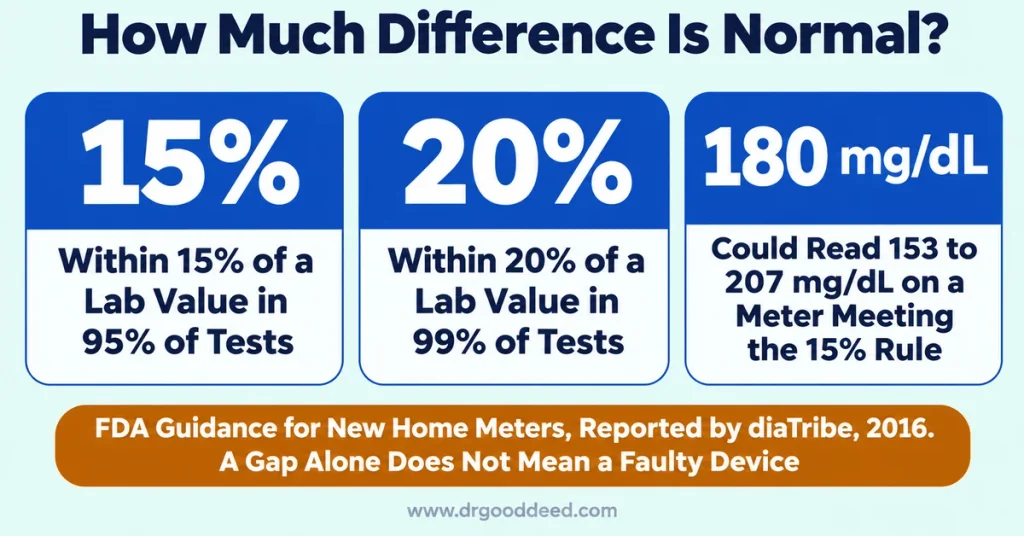
- Glucose meter accuracy: FDA performance guidance for new home glucose meters allows some variation from a laboratory reference value, within 15% in 95% of tests and within 20% in 99% (FDA guidance, reported by diaTribe, 2016). This means a meter can meet its performance requirements without displaying the exact laboratory result every time.
- Worked example: If your true glucose is 180 mg/dL, a meter that meets the 15% rule could show anywhere from about 153 to 207 mg/dL, before any CGM error is added.
- Understanding a reading: A difference between your CGM and finger stick doesn’t automatically mean either device is faulty. Consider how quickly your glucose is changing, whether your hands were clean, and whether the sensor is working as expected.
- What MARD means: Mean absolute relative difference, or MARD, describes the average percentage difference between a device’s readings and a reference measurement across a group of observations. A lower MARD generally indicates closer agreement in that dataset, but it does not guarantee that an individual reading is accurate.
- The so-called 20% rule: You may see advice suggesting that CGM and finger-stick readings should fall within a particular percentage of each other. This is not a universal official standard for deciding whether two readings are interchangeable.
Remember that both devices can have measurement errors. Their readings may differ even when both are operating as intended. If the gap seems unusually large or continues across repeated checks, discuss it with your diabetes care team.
Why Is My CGM Higher or Lower Than My Finger Stick?
Your CGM may read lower than a finger stick when glucose is rising and higher when glucose is falling. This can happen because the sensor reading may lag behind changes in your blood glucose.
The direction of the difference can offer clues about what is happening, but it cannot confirm the cause on its own.
| Pattern | Possible reason | What to do |
| CGM reads lower after a meal | Blood glucose may be rising faster than the sensor reading changes | Consider the trend and verify the reading with a finger stick when appropriate |
| CGM reads higher after exercise | Blood glucose may be falling while the sensor reading catches up | Check your glucose if the reading conflicts with your symptoms or care plan |
| CGM shows an unexpected overnight low | Pressure on the sensor may be interfering with the reading | Check your symptoms and verify the reading when needed |
| Finger stick reads higher after eating | Food residue on your fingers may be affecting the sample | Wash and dry your hands, then repeat the test with a fresh strip |
| Finger-stick readings seem inconsistent | Expired or improperly stored test strips may affect the result | Check your strips and repeat the test according to the meter instructions |
| CGM readings change unexpectedly in hot conditions | The sensor or meter may be outside its recommended operating conditions | Check the device instructions and verify the reading when appropriate |
These patterns may explain the difference, but they don’t prove your device is faulty. If the difference persists despite careful testing, contact your healthcare professional or the device manufacturer.
How to Get a More Accurate Finger Stick
Reliable finger-stick results start with a clean sample and properly handled testing supplies. Small changes to your testing routine can help prevent avoidable errors.
- Wash and dry your hands: Food residue, especially sugar, can affect your result. Clean, dry hands help reduce contamination.
- Use enough blood: Follow your meter’s instructions for collecting the required sample. Too little blood may produce an error or an unreliable reading.
- Check your test strips: Make sure your strips are not expired, damaged, or stored in unsuitable conditions. Keep them in their recommended container.
- Avoid unsuitable temperatures: Use your meter and test strips within the manufacturer’s specified operating conditions.
- Repeat unexpected results: If a reading seems unusual, wash and dry your hands again and test with a fresh strip. If the result remains concerning, follow your care plan or contact your healthcare professional.
Consistent testing habits make it easier to compare your readings and identify patterns that may need further attention.
When to Trust Your Finger Stick Over Your CGM
A finger stick can help verify your glucose when your CGM reading doesn’t match how you feel, when an alert needs confirmation per your device instructions, or when glucose is changing rapidly. The National Institute of Diabetes and Digestive and Kidney Diseases (2023) recommends checking with a finger stick when you doubt a CGM reading or receive a warning that requires confirmation.
- Your symptoms do not match: If you feel shaky, sweaty, dizzy, or unusually unwell despite a normal-looking CGM reading, check your glucose when possible and follow your care plan.
- Your sensor is new: Use a finger stick when your device instructions recommend confirmation during warm-up or early sensor use.
- Your glucose is changing quickly: Blood glucose can change faster than the sensor reading, particularly after meals or physical activity.
- A treatment decision depends on the result: Follow your prescribed care plan and device instructions when confirming readings before making treatment changes.
- An alert seems inconsistent: Verify the reading when appropriate, but don’t delay urgent care if you experience severe symptoms.
Your individual glucose target matters more than a single reading taken out of context. A blood sugar chart by age can provide general context, but your healthcare professional should help you set targets that apply to you.
When to Call Your Doctor About CGM Readings
Contact your diabetes care team if your CGM and finger-stick readings keep differing significantly, your symptoms repeatedly conflict with sensor readings, or your sensor seems unreliable. Your healthcare professional can help determine whether the problem is related to testing technique, sensor performance, or your monitoring plan.
- Repeated differences: Record your CGM reading, finger-stick result, symptoms, and whether your glucose appears to be rising or falling. This information can help your care team assess the problem.
- Possible sensor problems: Follow the manufacturer’s troubleshooting instructions and contact the manufacturer if errors persist or you suspect a defective sensor.
- Concerning glucose levels: Follow your established care plan and seek medical advice if your readings remain outside your prescribed targets.
- Severe low blood sugar symptoms: Call 911 if someone experiences severe symptoms such as confusion, a seizure, or passing out. Do not give food or drink to someone who is unconscious or cannot swallow safely.
If you are newly diagnosed, our overview of diabetes causes and symptoms explains how glucose monitoring fits into diabetes care.
If CGM vs finger stick accuracy gaps stay large over several checks, call your diabetes care team before changing any treatment.
Frequently Asked Questions
Can Medicines or Supplements Affect CGM Readings?
Yes, some medicines and high-dose supplements can interfere with certain CGM models. The effect depends on the substance and the sensor. Check your device instructions for known interferences, and ask your pharmacist or healthcare professional if you are unsure whether a reading is reliable.
Do I Need to Calibrate My CGM?
It depends on your device. Some CGMs require finger-stick calibration, while others are factory-calibrated and shouldn’t be calibrated manually. Follow your device instructions to determine whether calibration is necessary and when you should confirm a reading with a blood glucose meter.
Why Is My CGM Lower Than My Finger Stick at Night?
A CGM reading lower than a finger stick at night is often a compression low, caused by lying on the sensor and pressing on the surrounding tissue. Pressure can interfere with the sensor signal. Check your symptoms and verify the reading with a finger stick when appropriate rather than assuming the low is harmless.
Can You Get an Accurate A1C From a Finger Stick?
A standard home glucose meter cannot provide an A1C result. An A1C test estimates your average blood glucose over the past few months and requires a specific blood test. Some clinics offer point-of-care A1C testing, but this is different from checking your current glucose with a home meter.
Is a CGM Accurate If You Don’t Have Diabetes?
A CGM can show glucose trends in people without diabetes, but those readings should be interpreted cautiously. Over-the-counter CGMs may show how food and activity affect glucose patterns, but they aren’t a substitute for medical evaluation. Our guide to CGMs for non-diabetics explains their potential benefits and limitations.
Sources
Diabetes journal, Time lag of glucose from intravascular to interstitial compartment in humans (2013). link
diaTribe, The FDA publishes final recommendations on blood glucose meter accuracy (2016). link
National Institute of Diabetes and Digestive and Kidney Diseases, Continuous glucose monitoring (2023). link
Journal of Diabetes Science and Technology, A novel method to detect pressure-induced sensor attenuations (PISA) in an artificial pancreas (2014). link
Centers for Disease Control and Prevention, Diabetes testing (2024). link
Medical Disclaimer: This article is for general information only and is not medical advice. It does not replace a diagnosis, treatment plan, or guidance from a qualified healthcare professional. Always talk to your doctor about your own symptoms and before starting, stopping, or changing any treatment. If you think you may be having a medical emergency, call 911 or go to your nearest emergency room.