
A medication overuse headache happens when pain relievers taken too often for headaches start causing more headaches instead of fewer. Medication overuse headache can develop when you use headache medicines too frequently, creating a cycle of temporary relief followed by more headaches. The good news is that a clinician-guided treatment plan can help you break this cycle.
Key Takeaways
- A medication overuse headache is a rebound headache caused by using headache medicines too often for months.
- You may notice headaches on most days, with relief that wears off and pain that returns.
- The medicine-day limit depends on the type of pain reliever, and using different types can still add up.
- Treatment usually involves a clinician-guided plan to reduce overuse and manage the underlying headache condition.
- Call 911 or go to the ER for a sudden, severe headache or headache with stroke-like symptoms.
What Is a Medication Overuse Headache?
A medication overuse headache is a headache on 15 or more days a month that develops in someone with an existing headache disorder who regularly overuses acute headache medicine for more than 3 months, according to the International Headache Society’s ICHD-3 criteria.
An acute headache medicine is a medicine you take to relieve a headache after it starts. When you use it too often, it may begin to contribute to the headaches you are trying to control.
You may hear this condition called a rebound headache.
How does the cycle happen?
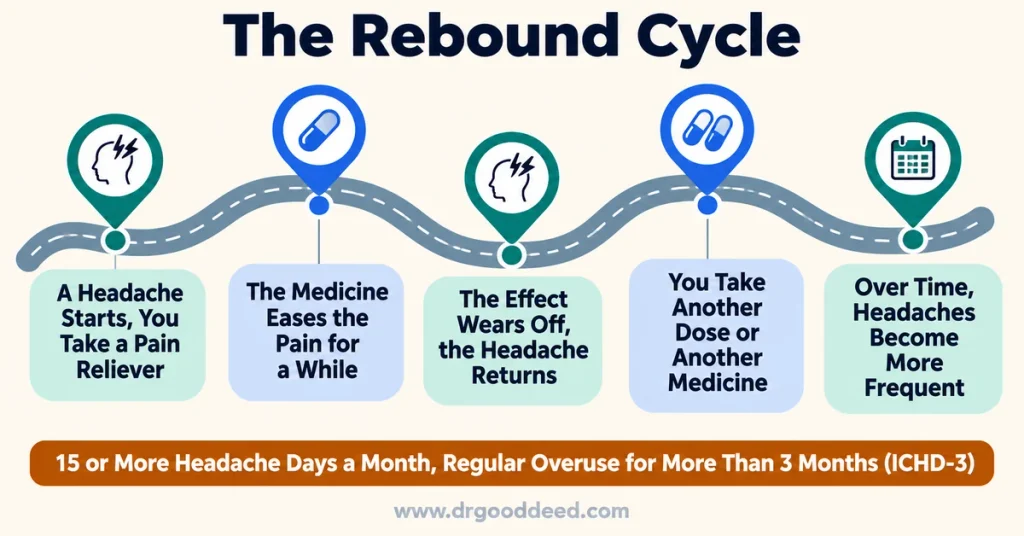
The pattern often looks like this:
- You develop a headache and take a pain reliever.
- The medicine eases the pain for a while.
- The effect wears off, and the headache returns.
- You take another dose or reach for another medicine.
- Over time, headaches become more frequent and harder to manage.
Experts do not fully understand why this cycle develops. Changes in the brain’s pain-processing systems may play a role, especially in people who already have migraine or another headache disorder.
Medication overuse headache often occurs alongside migraine. The National Institute of Neurological Disorders and Stroke explains that regular overuse of headache medicines can worsen headaches or contribute to new symptoms.
This condition usually affects people who already experience headaches. It does not generally develop in someone who has never had a headache disorder and takes an occasional pain reliever for a separate problem.
If you are unsure whether your symptoms are migraine or another headache type, learn more about migraine vs headache.
Medication Overuse Headache Symptoms to Recognize
Medication overuse headache symptoms often include headaches on most days, temporary relief after taking medicine, and pain that returns as the medicine wears off.
The headache may feel different from your usual migraine or tension-type headache. It may also become harder to predict when the pain will start.
Common symptoms
- Headaches on most days of the month
- Pain that returns after temporary relief from medicine
- A headache that feels present when you wake up
- Increased sensitivity to light or sound
- Nausea or discomfort during headaches
- Difficulty concentrating because of frequent pain
- A growing need to take headache medicine
- Headaches that interfere with work, sleep, or daily activities
The exact symptoms depend on your underlying headache condition. Some people experience migraine-like symptoms, while others have a more constant, pressure-like headache.
How do you know if your headache is from medication overuse?
Your headache pattern and medicine use can offer clues, but a clinician needs to assess both before making a diagnosis.
Table: What you notice, what it may mean, and your next step
| What you notice | What it may mean | Your next step |
| Headaches are becoming more frequent | Your headache condition may be changing | Track headache days and discuss the pattern with a clinician |
| Pain returns after medicine wears off | Possible rebound headache pattern | Record when you take medicine and when pain returns |
| You use pain relievers several days each week | Your medicine use may be approaching an overuse threshold | Review your medicine days with your doctor |
| You have headaches on 15 or more days a month | Possible chronic headache disorder or medication overuse headache | Arrange a medical assessment |
| Your headache suddenly becomes severe or feels completely different | A serious cause may need to be ruled out | Call 911 or go to the ER |
Your symptoms alone cannot confirm medication overuse headache. A clinician will also consider other causes, including changes in your underlying headache disorder.
Your existing headache type matters. The main types of headaches can have different patterns and treatment needs.
How Many Days of Pain Relievers Is Too Many?
The medication overuse threshold depends on the type of medicine you take. The ICHD-3 criteria use different monthly limits for different medicine groups, and regular overuse must continue for more than 3 months to meet the diagnosis criteria.
The table below summarizes the commonly used thresholds described by the Cleveland Clinic (2023) and the Migraine Trust.
| Type of medicine | Overuse threshold |
| Simple pain relievers | 15 or more days per month |
| Combination pain relievers | 10 or more days per month |
| Migraine-specific acute medicines | 10 or more days per month |
| Opioid pain medicines | 10 or more days per month |
| Sedative-containing medicines used for headache relief | 10 or more days per month |
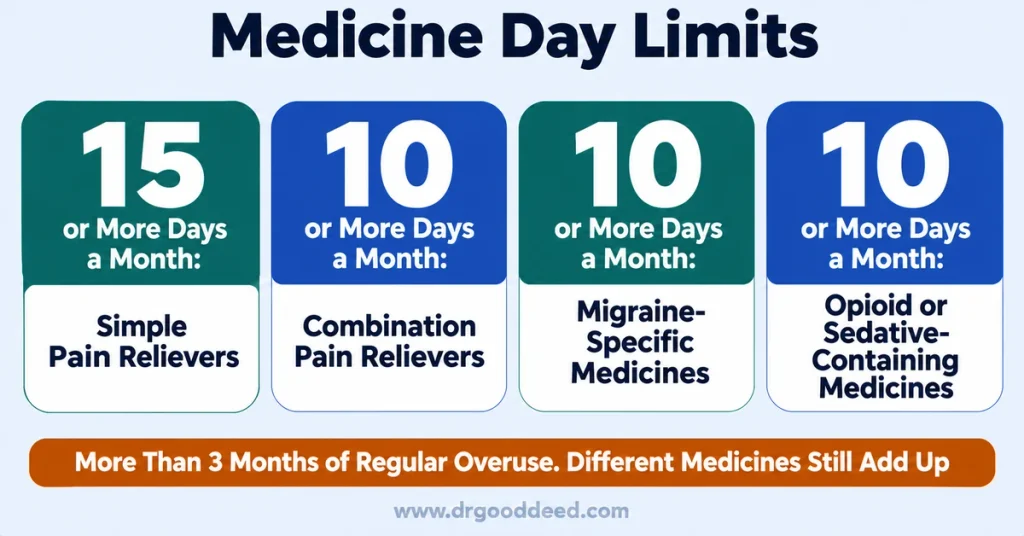
These thresholds are based on expert opinion in the ICHD-3 classification. They are diagnostic guidelines, not a guarantee that using a medicine below the limit is risk-free.
Why counting medicine days matters
A medicine day means a day when you use an acute headache medicine, even if you take it only once that day.
Using different types of pain relievers does not automatically reset the count. If you alternate between medicines, the total number of days you use acute headache treatment still matters.
For example, taking one type of medicine on Monday and a different type on Tuesday means you used headache medicine on two separate days.
Doctor’s Tip: Count every day you use a pain reliever for a headache, including store-bought medicines. Keep track of combination products and medicines taken for more than one reason.
When should you speak to a doctor?
The Mayo Clinic (2025) advises contacting a clinician if you need headache medicine more than twice a week. Advice varies: the Migraine Trust suggests no more than two days a week, while the American Migraine Foundation treats more than two or three days a week as the first red flag.
This is a warning sign, not a diagnosis. Your risk depends on the medicine type, your headache pattern, and how long you have been using it.
Who may be more likely to develop it?
Medication overuse headache is more likely in people who:
- Have frequent migraine or another primary headache disorder
- Already experience headaches on several days each month
- Regularly use acute headache medicines
- Have difficulty controlling their underlying headache condition
- Have sleep problems, anxiety, or depression
- Have a history of repeated headache-related disability
A 2024 review in Life reports that adults aged 30 to 50 are most affected and that women are affected three to four times more often than men. The condition is less common in teens and adults over 65.
The condition is not a sign that you have done something wrong. Frequent headaches can make it difficult to avoid reaching for relief. The goal is to recognize the pattern early and find a treatment approach that works better for you.
How Doctors Diagnose Medication Overuse Headache
A clinician usually diagnoses medication overuse headache by reviewing your headache history, how often headaches occur, and how frequently you use acute headache medicines.
Most people do not need extensive testing when their symptoms and medicine-use pattern clearly fit the condition. However, your doctor may recommend tests if your symptoms suggest another cause.
What your doctor may ask
Your clinician may ask:
- When did your headaches become more frequent?
- How many days each month do you have a headache?
- What does the pain feel like?
- How often do you take headache medicine?
- How long have you used the medicine regularly?
- Does the medicine help, and how long does relief last?
- Do you experience nausea, light sensitivity, or other symptoms?
- Have you noticed changes in sleep, stress, or daily activities?
What are the medication overuse headache criteria?
The ICHD-3 criteria generally include:
- A pre-existing headache disorder.
- Headaches on 15 or more days per month.
- Regular overuse of acute headache medicine for more than 3 months.
- A pattern that is not better explained by another headache diagnosis.
Your clinician will determine whether your symptoms meet these criteria.
How to prepare for your appointment
A headache diary can make the assessment easier.
Record:
- The date and duration of each headache
- How severe the pain feels
- Any symptoms that occur with it
- The type of medicine you use
- The days you take medicine
- Whether the medicine helps
- Possible triggers, such as poor sleep or stress
You can use a notebook, calendar, or migraine tracker apps to record your symptoms.
Bring a list of all medicines you use, including store-bought products and those taken for other conditions. This helps your clinician understand your total medicine use.
Medication Overuse Headache Treatment and Stopping Safely
Medication overuse headache treatment usually involves reducing or stopping the overused medicine under a clinician’s plan while managing the underlying headache condition.
The right approach depends on the type of medicine, your medical history, and how often you experience headaches.
What treatment may involve
- Review your medicine use: Your clinician checks which medicines you take, how often you use them, and whether they may be contributing to the headache cycle.
- Create a stopping or reduction plan: Some medicines can be stopped, while others need a gradual reduction. Your clinician will explain which approach is appropriate.
- Manage withdrawal symptoms: Headaches may temporarily worsen when you reduce or stop an overused medicine. Your clinician can help you plan for this period.
- Treat the underlying headache condition: Preventive treatment may help reduce how often headaches occur and lower your need for acute medicines.
- Arrange follow-up: Your clinician checks your progress, reviews your headache diary, and adjusts the plan if needed.
Is it safe to stop pain relievers on your own?
Not always. The safest approach depends on the medicine you use.
Some acute headache medicines may be stopped under a clinician’s guidance, while opioid pain medicines and sedative-containing medicines may need a gradual reduction.
Do not stop these medicines abruptly on your own. Sudden withdrawal can cause serious problems in some people.
What is bridge therapy?
Bridge therapy is short-term support that a clinician may use to help manage symptoms during the withdrawal period.
It is not the same for everyone. Your clinician will decide whether it is appropriate based on your symptoms and health history.
Will preventive treatment help?
Preventive treatment aims to reduce how often headaches occur and how much they affect your daily life.
Your clinician may consider it if you have frequent migraine or another ongoing headache disorder. The goal is to reduce your need for acute headache medicine over time. In a trial of 120 people summarized by the American Headache Society, withdrawal combined with preventive treatment cut headache days the most, by 12.3 days a month, compared with 9.9 and 8.5 days for the other two approaches.
A treatment plan may combine medicine-use changes with preventive care and follow-up. The best approach depends on your individual needs.
If migraine is part of your headache pattern, ask your clinician about ways to relieve migraine pain while keeping medicine use within a safe plan.
How Long Rebound Headaches Last and Stopping Relapse
Rebound headaches may temporarily become worse when you reduce or stop an overused medicine. The withdrawal period varies, and recovery depends on your underlying headache condition and treatment plan.
A 2024 review in Life reports that withdrawal headaches commonly last 2 to 10 days, although individual experiences vary.
The Cleveland Clinic (2023) notes that many people improve within about two months after addressing medication overuse, while some may need longer support.
What can you expect during recovery?
You may experience:
- A temporary increase in headache intensity
- Nausea or discomfort
- Sleep disturbances
- Irritability or difficulty concentrating
- A gradual reduction in headache frequency as recovery progresses
Your clinician can help you understand what to expect and when to seek additional care.
Can medication overuse headache become permanent?
Medication overuse headache is not considered inevitably permanent. The ICHD-3 notes that it usually, but not always, resolves after the overuse stops.
Some people continue to experience headaches because their original migraine or other headache disorder remains active. This does not necessarily mean the withdrawal plan has failed.
How can you reduce the chance of relapse?
- Follow the medicine-use plan you developed with your clinician.
- Track headache days and medicine days.
- Attend follow-up appointments.
- Discuss preventive treatment if headaches remain frequent.
- Address sleep problems and other factors that may worsen headaches.
- Contact your clinician if you begin using acute headache medicine more often again.
Relapse can happen, especially when the underlying headache condition remains difficult to control. If headaches start increasing again, seek help early rather than waiting until the pattern becomes difficult to manage. The American Headache Society reports that at least half of people do well after treatment, while a 2023 StatPearls review puts relapse at 40 to 50% within 6 years. Smoking, poor sleep, anxiety, and depression can raise the risk.
When to See a Doctor About Rebound Headaches
Speak to your primary care doctor if your headaches keep getting worse, occur frequently, or require pain relievers several days each week.
You should also seek medical attention if your headache pattern changes suddenly or interferes with your ability to work, sleep, or carry out daily activities. Position can change headaches, so note any headache when lying down as well.
When to seek emergency care
Call 911 or go to the emergency department if you experience:
- A sudden, extremely severe headache that reaches its peak quickly
- A headache with facial drooping, weakness, numbness, or difficulty speaking
- A headache with sudden vision changes or loss of balance
- A headache with confusion, fainting, or reduced alertness
- A severe headache with fever and a stiff neck
- A severe headache after a significant head injury
These symptoms may point to a condition that needs immediate assessment rather than medication overuse headache.
Where should you seek care?
| Situation | Where to go |
| Sudden severe headache or stroke-like symptoms | Call 911 or go to the ER |
| Possible overdose or taking more medicine than directed | Call Poison Control at 1-800-222-1222 in the US; call 911 for severe symptoms |
| Frequent headaches or increasing medicine use | Contact your primary care doctor |
| Headaches that continue despite a treatment plan | Ask your doctor about a neurologist or headache specialist |
| A new headache pattern without emergency symptoms | Get same-day care at urgent care or from your primary care doctor |
A primary care doctor is often the first point of contact. They may refer you to a neurologist or headache specialist if your symptoms are complex or difficult to manage.
If your headaches keep getting worse and you use pain relievers often, ask your primary care doctor whether a medication overuse headache could be the reason.
Frequently Asked Questions
What Are the Complications of Medication Overuse Headache?
Medication overuse headache can lead to frequent or chronic headaches, reduced quality of life, and difficulty managing daily activities. Some medicines may also cause other health problems when overused. A clinician can help you reduce these risks and manage your underlying headache condition.
Does Caffeine Make Rebound Headaches Worse?
Yes, high caffeine intake may contribute to rebound headaches in some people. Some pain relievers also contain caffeine, so check product labels and include these medicines in your overall medicine-use record. Ask your clinician how caffeine may affect your headache pattern.
Can Pain Relievers for Another Condition Cause Rebound Headaches?
Yes, in people who already have a headache disorder, pain relievers taken regularly for another condition, such as arthritis, can lead to a rebound headache. Tell your clinician about all medicines you take so they can assess your overall use and help you plan safely.
Will I Need a Daily Preventive Treatment Afterward?
Not everyone needs daily preventive treatment. Your clinician may recommend it if you have frequent or ongoing headaches, especially when an underlying migraine disorder remains active. The decision depends on your headache pattern, medical history, and response to the treatment plan.
Which Doctor Treats Medication Overuse Headaches?
Start with your primary care doctor. They can review your symptoms and medication use, recommend a treatment plan, and refer you to a neurologist or headache specialist if needed. A specialist may help when headaches remain frequent or difficult to manage.
Sources
International Headache Society, 8.2 Medication-Overuse Headache (MOH), ICHD-3. link
American Headache Society, Treating Medication Overuse Headache. link
American Headache Society, Research Summary: Treatment Strategies for Medication Overuse Headache. link
Life (Basel), Medication-Overuse Headache: Update on Management (2024). link
National Institute of Neurological Disorders and Stroke, Headache. link
American Migraine Foundation, Medication Overuse Headache. link
StatPearls, Medication Overuse Headache (2023). link
The Migraine Trust, Medication Overuse Headache. link
Medical Disclaimer: This article is for general information only and is not medical advice. It does not replace a diagnosis, treatment plan, or guidance from a qualified healthcare professional. Always talk to your doctor about your own symptoms and before starting, stopping, or changing any treatment. If you think you may be having a medical emergency, call 911 or go to your nearest emergency room.