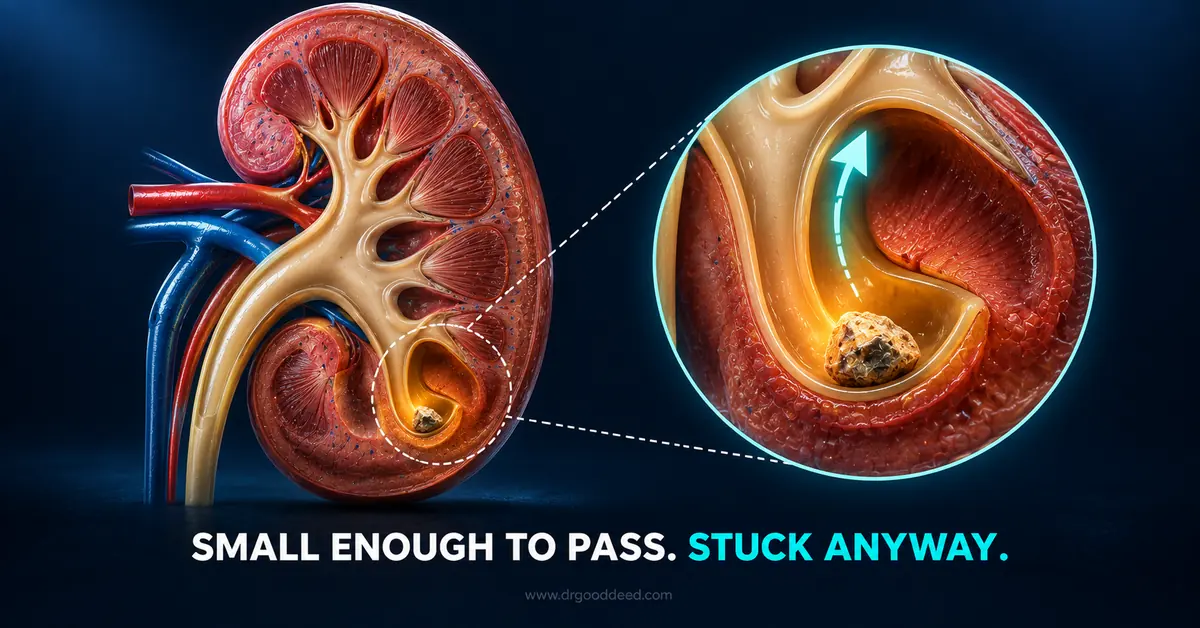

Can kidney stones go away naturally? Yes, small kidney stones can sometimes pass naturally through the urinary tract, especially when they are small and located near the bladder, while larger stones or stones the same size stuck in the lower pole of your kidney are less likely to pass without treatment.
Drinking adequate fluids, staying active, and using pain relief as advised may help, but severe pain, fever, vomiting, difficulty urinating, or blood in the urine warrants prompt medical attention because a blocked or infected urinary tract can be serious.
This guide breaks down both factors, gives you realistic timelines, and tells you exactly when waiting stops being safe.
Key Takeaways
- Stones under 4mm pass on their own about 80 percent of the time, usually within 31 days.
- Location inside the kidney, not just size, changes your odds. A lower pole kidney stone clears less easily than one sitting in the upper or mid-kidney, even at the same size.
- Hydration, movement, and appropriate pain control support passage, but they cannot shrink a stone or guarantee it moves.
- Straining your urine catches the stone so a lab can identify its mineral type, which shapes prevention.
Which Kidney Stones Can Pass Naturally: Size Matters
Stone size is measured in millimeters on a CT scan and it’s the single strongest predictor of natural passage. Your ureter, the tube carrying urine from kidney to bladder, narrows to roughly 3 to 4mm at its tightest points, so anything wider than that has to work harder to get through.
| Stone size | Chance of passing naturally | Typical time to pass |
| Under 4mm | About 80 percent | Around 31 days |
| 4mm to 6mm | About 60 percent | Around 45 days |
| Over 6mm | Roughly 20 percent or less | Often needs a procedure |
This kidney stone size chart for passing reflects data cited by Healthline, Harvard Health, and hospital urology programs tracking real patient outcomes. If you’re wondering will my kidney stone pass on its own, your CT report’s millimeter measurement is the first number to check, right after location.
Location Matters Too: Why Some Small Stones Still Get Stuck
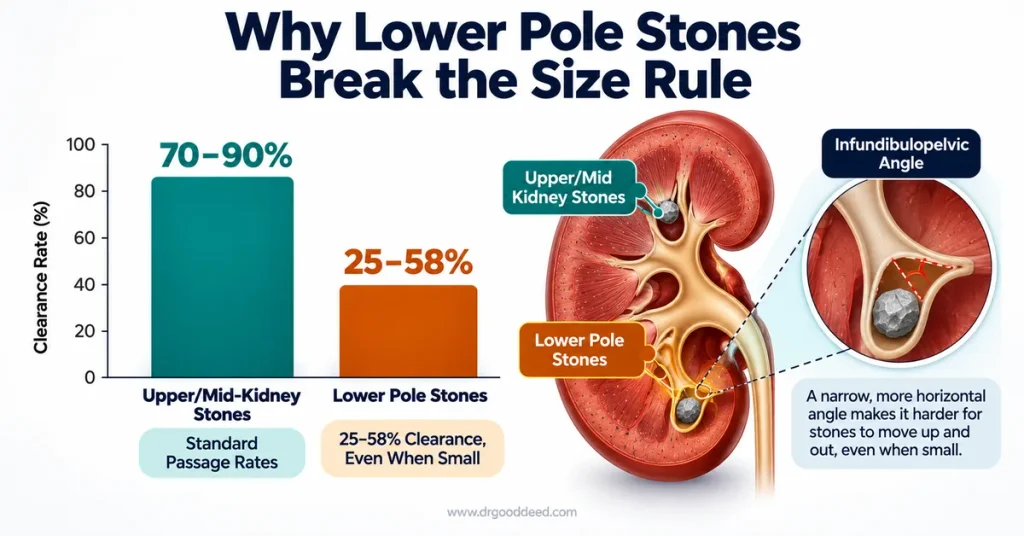
A lower pole kidney stone can be smaller than 4mm and still refuse to move, purely because of anatomy. The lower pole calyx, the cup-shaped chamber at the bottom of your kidney, drains upward against gravity before urine can carry a stone down into the ureter.
- A steep angle between the lower pole and the main collecting system, called the infundibulopelvic angle, makes this worse.
- Research on lower pole stones treated with shockwave lithotripsy has found clearance rates as low as 25 to 58 percent, well below stones in other parts of the kidney, even when the stones themselves aren’t large.
- If your radiology report says “lower pole calculus,” ask your provider directly how that location affects your specific odds, since it changes the calculation beyond what a size chart alone predicts.
How Long Does It Take for a Kidney Stone to Pass Naturally?
If you’re asking how long it takes for a kidney stone to pass naturally, it depends on size, location, and your individual anatomy, but there are useful averages.
- Stones under 4mm: typically pass within about 31 days, sometimes in days to two weeks for the smallest ones.
- Stones 4mm to 6mm: average around 45 days, and often need a follow-up scan around the four to six week mark.
- Stones over 6mm: rarely pass without help, and most urologists won’t ask you to wait longer than about six weeks before recommending a procedure.
- Lower pole stones: may take longer than the size chart suggests, regardless of category, because of the anatomical drainage issue above.
If four to six weeks pass with no progress and no worsening symptoms, that’s the normal point to schedule a follow-up scan rather than an emergency visit.
How to Support Natural Kidney Stone Passage
- Hydration: Aim for enough water that your urine runs pale yellow, generally 2 to 3 liters a day unless a provider has told you to restrict fluids for another condition.
- Movement: Light activity, like walking, is generally encouraged over bed rest, though it won’t force a stone to move on a fixed schedule.
- Kidney stone pain management at home: Over-the-counter NSAIDs such as ibuprofen are often the first line for renal colic, alongside a heating pad on the flank or lower back.
- Medical expulsive therapy: An alpha-blocker kidney stone protocol, most often tamsulosin, relaxes ureteral muscle and is recommended by current AUA guidelines for stones up to 10mm in the distal ureter, though one large 2015 trial found no clear benefit, so evidence quality varies by study and your provider will weigh this with you.
Expert Insight: A stone’s mineral composition, not just its size, predicts how it will respond to hydration and medical expulsive therapy. Calcium oxalate stones behave differently under an alpha-blocker kidney stone protocol than uric acid stones, which is one reason two patients with identically sized stones can have very different passage timelines.
When a Kidney Stone Won’t Pass on Its Own
Stones over 6mm, stones causing high-grade hydronephrosis (swelling of the kidney from blocked urine flow), and many lower pole stones eventually need intervention rather than continued observation. The two most common procedures are shockwave lithotripsy, which uses sound waves to break the stone into smaller pieces, and ureteroscopy, where a thin scope removes or fragments the stone directly.
If you’re dealing with flank pain and aren’t sure whether it’s a stone or something else, our guide to upper left abdominal pain under ribs covers the broader list of causes and the size thresholds doctors use to sort them.
Why Straining Your Urine Matters
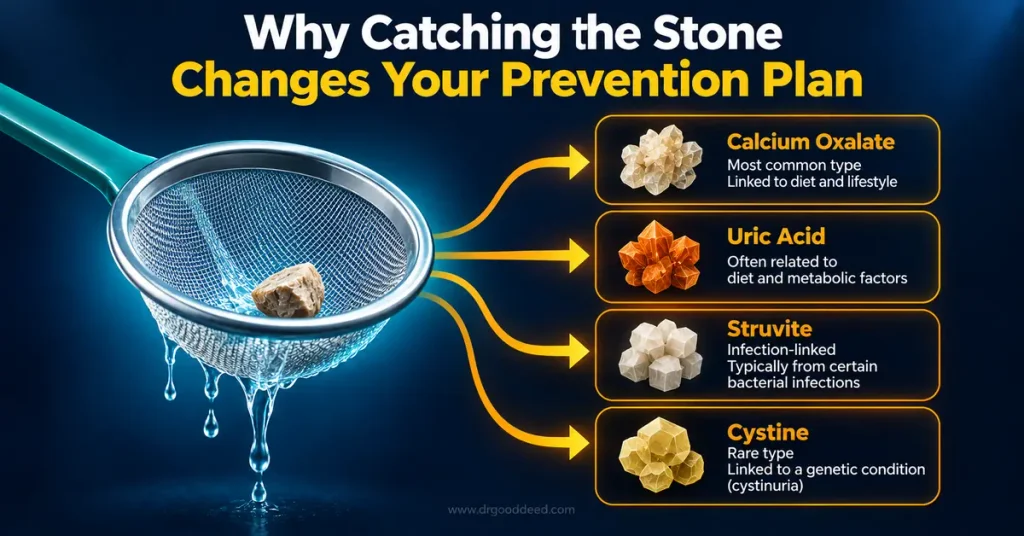
Your provider will likely ask you to strain every trip to the bathroom while you’re waiting for a stone to pass. A simple kidney stone strainer, a fine mesh cup or gauze, catches the stone the moment it exits your body.
- Catching the stone lets a lab identify its exact mineral type (calcium oxalate, uric acid, struvite, or cystine).
- Struvite stones point toward a urinary tract infection as the root cause, while uric acid stones often point toward diet and metabolic factors.
- Even a stone fragment, not just a whole stone, is enough for lab analysis.
- Skipping this step means starting your prevention plan with guesswork instead of data.
When to See a Doctor While Waiting for a Stone to Pass
Waiting for natural passage is reasonable for many small stones, but specific symptoms mean you need same-day or emergency care, not a wait-and-see approach.
Seek emergency care immediately if you have:
- A fever above 100.4°F or shaking chills, which can signal an infected, obstructed kidney, a condition that can turn dangerous within hours.
- Complete inability to urinate, suggesting the stone may be fully blocking urine flow.
- Pain that isn’t controlled by prescribed or over-the-counter medication.
- Persistent vomiting that prevents you from keeping fluids down.
- Visible blood in your urine that’s heavy or accompanied by any of the signs above.
Pro Tip: Set a specific follow-up date with your provider before you leave the office or ER, ideally four to six weeks out. An unscheduled wait is how lower pole and larger stones quietly progress to hydronephrosis before anyone rechecks the scan.
FAQs
Can drinking water alone pass a kidney stone faster?
No. Water supports urine flow and prevents new stones, but it cannot shrink an existing stone or force it through a narrow ureter. Hydration works alongside time and anatomy, not as a standalone fix, especially for a lower pole kidney stone.
Is it safe to wait at home for a kidney stone to pass?
Yes, for most stones under 6mm without fever, uncontrolled pain, or inability to urinate. Confirm the size and location with your provider first. Whether kidney stones can pass safely at home depends entirely on those two numbers.
Do alpha blockers really help pass kidney stones?
It’s mixed. AUA guidelines recommend a 30-day alpha blocker kidney stone trial for stones up to 10mm in the distal ureter based on meta-analyses showing faster expulsion, but one 2015 Lancet trial of 1,167 patients found no benefit over placebo.
Can a kidney stone get stuck permanently?
Rarely, but untreated obstruction can silently damage kidney function over months. Stones over 6mm and many lower pole stones don’t pass without a procedure. A stone that hasn’t moved after six weeks needs re-evaluation.
Will passing a kidney stone hurt the whole time?
No. Pain typically comes in waves as the stone moves and tends to peak when it crosses the ureter’s narrowest points. Many people have pain-free stretches between episodes, though the final passage through the bladder opening is often noticeably sharp.
Sources
- NIDDK: Kidney Stones link
- Cleveland Clinic: Kidney Stones Causes, Symptoms, Diagnosis and Treatment link
- American Urological Association: Surgical Management of Kidney and Ureteral Stones Guideline link
- American Urological Association News: Upper vs Lower Pole Percutaneous Renal Access link
- PMC: Role of Pelvicalyceal Anatomy in Outcomes of RIRS for Lower Pole Stones link
- The Lancet: Alpha-blockers for Ureteric Colic (2015) link
- Renal and Urology News: Using Drugs to Expel Stones link
- Harvard Health Publishing: Kidney Stones link
- Healthline: How Long Does It Take to Pass a Kidney Stone? link
- WebMD: Kidney Stones link
Medical Disclaimer: This article is for general information only and is not medical advice. It does not replace a diagnosis, treatment plan, or guidance from a qualified healthcare professional. Always talk to your doctor about your own symptoms and before starting, stopping, or changing any treatment. If you think you may be having a medical emergency, call 911 or go to your nearest emergency room.