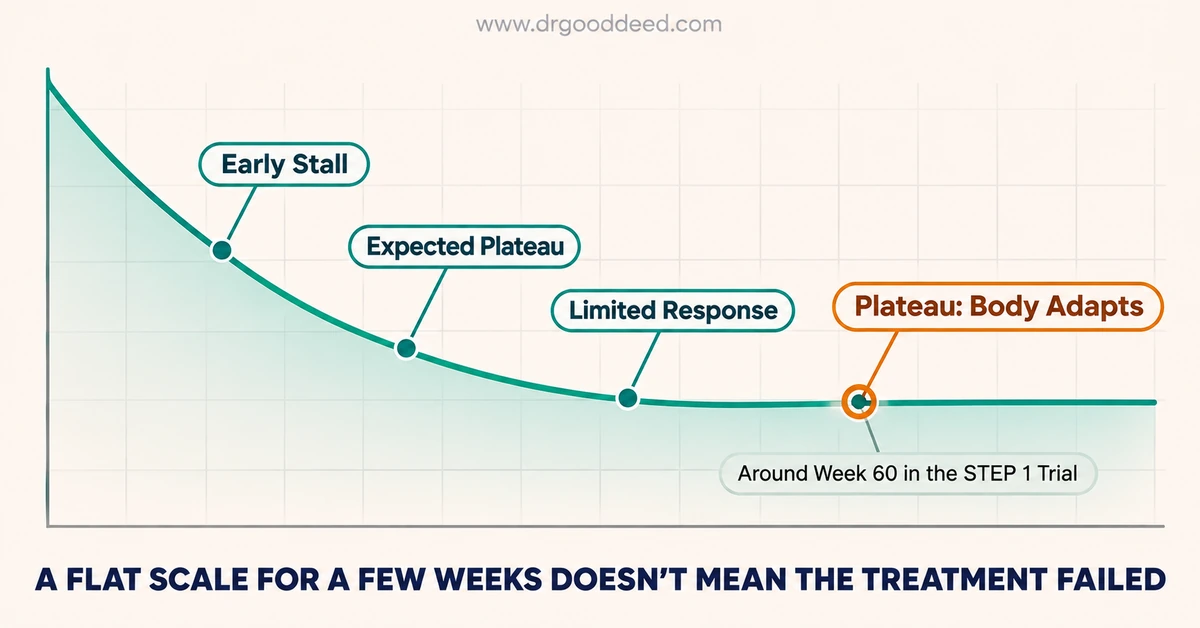

Semaglutide can help people lose a meaningful amount of weight, but the scale rarely moves at a steady pace. A few weeks without change does not automatically mean the treatment has failed. A weight loss plateau on semaglutide can happen because a smaller body needs less energy, because appetite signals shift, or because treatment is still being adjusted.
Other medicines, medical conditions, sleep and stress can also affect results. Knowing whether you are in an early stall, an expected plateau or a limited response helps you and your prescriber decide on the right next step.
Key Takeaways
- Weight loss plateau on semaglutide is common: trial weight loss levels off around week 60 as the body adapts, though some stalls have fixable causes.
- Three situations can look alike on the scale: an early stall, an expected plateau, and a limited response. Each needs a different conversation with your prescriber.
- Missed doses, other medicines, short sleep, stress, and some medical conditions can slow progress and are worth checking first.
- Do not raise, lower, or stop your dose on your own. Severe belly pain or repeated vomiting needs urgent care: call 911 in the US or 999 in the UK.
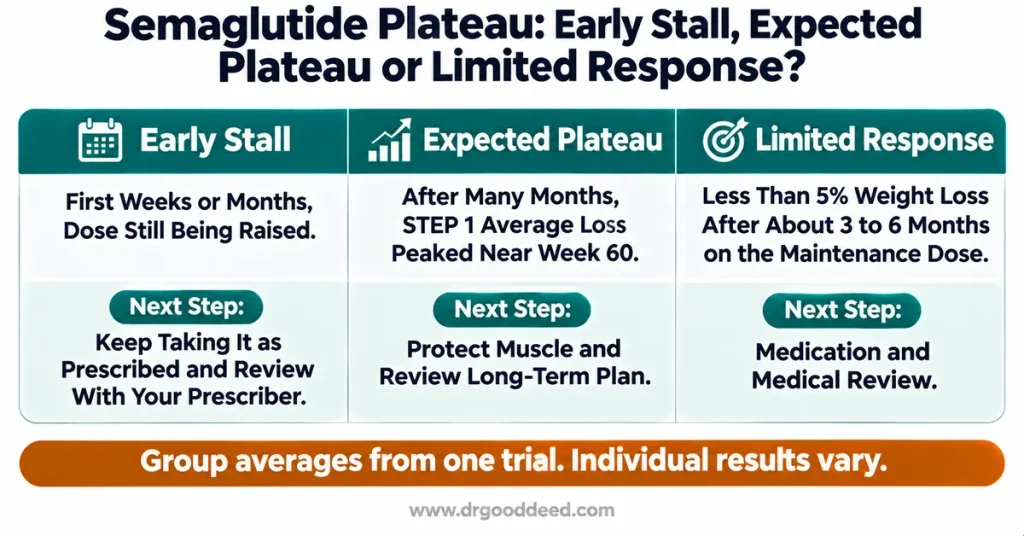
| Situation | Typical timing | What it may mean | Next step |
| Early stall | First weeks or months, while the dose is still being raised | Not yet at the prescribed maintenance dose; early response varies | Keep taking it as prescribed and review progress with your prescriber |
| Expected plateau | After many months; in STEP 1, average loss peaked near week 60 | Your body has adapted to a lower weight | Protect muscle and review your long-term plan with your doctor |
| Limited response | Less than 5% weight loss after about 3 to 6 months on the maintenance dose | Fixable factors, or the medicine may not suit you | Ask for a medication and medical review, then a prescriber decision |
| Weight regain | At any stage | Missed doses, new medicines or stopping treatment | Contact your prescriber; do not restart or double up on your own |
How Can You Tell If You Have a Weight Loss Plateau on Semaglutide?
A semaglutide plateau is a period when weight loss slows down or stops even though you are still taking the medicine as prescribed. In the STEP 1 trial, average weight loss reached its maximum at about week 60 and then leveled off.
STEP 1 enrolled 1,961 adults with overweight or obesity who did not have diabetes and followed them for 68 weeks. People taking weekly semaglutide plus lifestyle counseling lost an average of 14.9% of their body weight, compared with 2.4% on placebo. About 84.6% of the semaglutide group lost at least 5% of their weight, versus 31.5% on placebo, and more than half lost 15% or more. That also means about 15% of people on semaglutide lost less than 5%.
These are group averages, and individual results vary. The trial was funded by Novo Nordisk, and participants were about 74% female and 75% white.
Three situations can look similar on the scale but call for different responses:
- Early stall: a flat stretch in the first weeks or months, often while the dose is still being raised or before you reach the prescribed maintenance dose. It helps to know how long semaglutide takes to work at each stage.
- Expected plateau: weight loss slows and flattens after many months of steady progress, as the STEP 1 curve showed. This is what most people mean by a Wegovy plateau.
- Limited response: less than 5% weight loss after several months on the maintenance dose.
Your prescriber can tell these apart by looking at your weight trend, how long you have been on treatment, and your dose history, rather than a single weigh-in.
In the UK, NICE guidance (TA875) limits NHS semaglutide for weight management to a specialist weight management service for a maximum of 2 years, and says to stop it if less than 5% of starting weight has been lost after 6 months. US readers have no equivalent rule, and insurance coverage varies by plan.
Why Does Weight Loss Stop While Taking Semaglutide?
A weight loss plateau on semaglutide is largely metabolic adaptation: as you lose weight, your body burns fewer calories and your appetite hormones shift in ways that push back against further loss.
Metabolic adaptation is expected after substantial weight loss. A smaller body needs less energy, so the eating pattern that once created a deficit may now simply maintain your new weight. At the same time, research on weight loss physiology shows that leptin, a hormone that signals fullness, tends to fall, while ghrelin, a hormone that drives hunger, tends to rise. The size of these changes varies from person to person.
Body composition also plays a part. In a DXA substudy of STEP 1, which measured body composition in 140 participants (95 of them on semaglutide), fat mass fell by 19.3% and lean mass by 9.7%. Roughly 65% of the weight lost was fat and about 35% was lean mass.
Important note: Lean mass is not the same as muscle. It also includes water, organs and other non-fat tissue, so the 35% figure is not all muscle. This was a small substudy, and losing some lean mass is common with any substantial weight loss, not only with semaglutide.
What Other Factors Can Slow Weight Loss on Semaglutide?
If you are not losing weight on semaglutide, a few everyday factors are worth checking with your clinician before anyone changes your treatment.
Factors to bring up at your next visit:
- Missed or delayed doses, which can reduce the medicine’s effect.
- Not yet being on the prescribed maintenance dose.
- Other medicines, such as sulfonylureas, some antidepressants, antipsychotics and corticosteroids.
- Liquid calories and alcohol, which add energy without much fullness. Regular drinking while taking a GLP-1 can slow progress.
- Short sleep or ongoing stress, which can increase hunger.
- Nausea or other side effects that lead to eating patterns that work against your progress.
- Constipation or water shifts, which can hide fat loss on the scale for a while.
Keep taking semaglutide as prescribed. Never stop or change any prescribed medicine without talking to your prescriber, who can decide whether any of these factors applies to you.
Can Medical Conditions Affect Weight Loss on Semaglutide?
Some medical conditions can make weight loss harder even on semaglutide, including an underactive thyroid (hypothyroidism), polycystic ovary syndrome (PCOS) and, rarely, Cushing syndrome. Diabetes and some diabetes treatments can affect weight too.
Hormonal changes around menopause and after pregnancy can also make weight loss more difficult.
A plateau does not mean you have any of these conditions. Your clinician can look at your symptoms, medical history and medicines to decide whether testing makes sense. Useful questions to ask include whether a thyroid check is worthwhile and whether any of your other medicines could be affecting your weight.
Difficulty losing weight can be one of the signs of thyroid problems. If PCOS is a concern, it may help to read how PCOS is diagnosed.
How Can You Manage a Weight Loss Plateau on Semaglutide?
If you are wondering what to do when you plateau on semaglutide, or how to break a plateau on semaglutide, the safest approach is a medical review plus steady habits that protect muscle, rather than pushing for fast results.
- Review your treatment: Ask your prescriber to look at your dose, timing, how long you have been on treatment and any other medicines before anything changes.
- Stay active: The CDC recommends at least 150 minutes of moderate-intensity aerobic activity a week, plus muscle-strengthening activity on at least 2 days a week, if your health allows.
- Protect lean mass: Strength training helps preserve muscle while you lose weight.
- Get a personal nutrition plan: Ask a registered dietitian for a protein and calorie plan that suits your health, rather than following generic targets.
- Track the trend: Note your weight, doses, appetite and sleep for a few weeks before your next visit, so your clinician sees the full picture.
- Notice non-scale progress: Body composition, how your clothes fit, blood pressure and blood sugar can improve even when the scale is slow.
Practical tip: Compare weight trends over several weeks instead of reacting to daily fluctuations. Consistent tracking helps your clinician tell a temporary stall from a longer-term change.
What Should You Avoid When Weight Loss Stalls on Semaglutide?
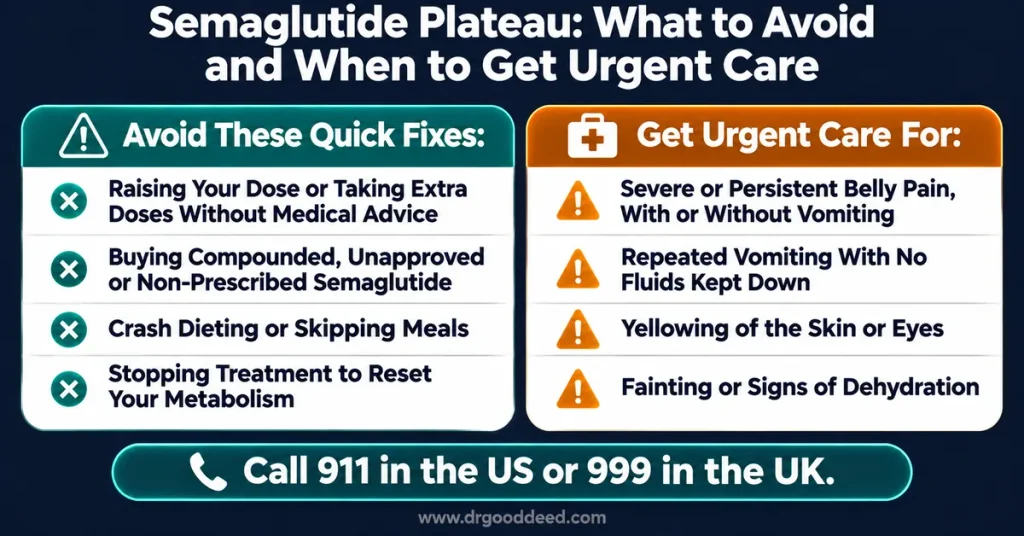
When you hit a weight loss plateau on semaglutide, avoid quick fixes that can cause harm or undo your progress.
- Do not increase your dose or take extra doses without medical advice.
- Do not buy compounded, unapproved, or non-prescribed semaglutide.
- Do not crash diet or skip meals to restart weight loss.
- Do not stop treatment to reset your metabolism.
If you think semaglutide stopped working for you, talk to your prescriber rather than changing treatment yourself. Stopping semaglutide is linked to regaining much of the lost weight, and obesity is a chronic condition that often needs long-term management. The decision to continue or stop belongs with your prescriber.
When Should You See a Doctor About Not Losing Weight on Semaglutide?
Talk to your prescriber if you are not losing weight on semaglutide despite taking it regularly, or if your weight starts rising for no clear reason. In the US, that may be your primary care doctor or the prescribing clinic. In the UK, it may be your GP or your specialist weight management service.
Even when weight loss is modest, some people still see improvements in cholesterol, blood sugar or blood pressure, so a plateau is worth discussing rather than giving up on.
Get urgent medical care for:
- Severe or persistent belly pain, with or without vomiting.
- Repeated vomiting that stops you from keeping fluids down.
- Yellowing of the skin or eyes.
- Fainting, or signs of dehydration such as passing very little urine.
These can be signs of serious problems such as pancreatitis or gallbladder disease, which are listed warnings for semaglutide. In STEP 1, gallbladder disorders occurred in 2.6% of people on semaglutide versus 1.2% on placebo. In the US, call 911 or go to the emergency department. In the UK, call 999 or go to A&E. The long-term side effects of GLP-1 medicines are covered in more detail separately.
Tell your clinician if you are eating very little, feel afraid of eating, or have episodes of binge eating. You deserve support without judgment.
Frequently Asked Questions
How long does a semaglutide plateau last?
There is no good trial data on how long a plateau lasts, and sources describe anything from a few weeks to several months. If your weight has not changed for several weeks while your doses and habits are consistent, review the trend with your prescriber.
Does semaglutide stop working over time?
Many people worry that semaglutide stopped working when the scale stalls. In STEP 1, weight loss leveled off because the body reached a new balance at a lower weight, not because the medicine was shown to wear off. A semaglutide plateau usually reflects that adaptation, and your prescriber can confirm whether treatment still suits you.
Should I switch to tirzepatide if I plateau on semaglutide?
Not automatically. Switching is a prescriber decision, not a self-treatment step. Some doctors consider other treatments after several months without enough response, once dosing, other medicines, and medical causes have been checked. Do not stop or swap medicines on your own.
Will I regain the weight if I stop semaglutide?
Many people do. In the STEP 1 extension, participants who stopped semaglutide regained about two-thirds of the weight they had lost within a year. Talk to your prescriber about a long-term plan before stopping.
Sources
- FDA – Wegovy (semaglutide) injection prescribing information link
- Wilding JPH et al. Once-Weekly Semaglutide in Adults with Overweight or Obesity (STEP 1, including the DXA body composition substudy). N Engl J Med 2021 link
- STEP 1 trial summary, PubMed Central (PMC9130404) link
- Wilding JPH et al. Weight regain and cardiometabolic effects after withdrawal of semaglutide: the STEP 1 trial extension. Diabetes Obes Metab 2022 link
- NICE TA875 – Semaglutide for managing overweight and obesity link
- Sumithran P et al. Long-term persistence of hormonal adaptations to weight loss. N Engl J Med 2011 link
- CDC – Adult Activity: An Overview link
- GoodRx – Why Am I Not Losing Weight on Wegovy? link
- Houston Methodist – Not Losing Weight on a GLP-1? Here’s What Could Be Happening link
Medical Disclaimer: This article is for general information only and is not medical advice. It does not replace a diagnosis, treatment plan, or guidance from a qualified healthcare professional. Always talk to your doctor about your own symptoms and before starting, stopping, or changing any treatment. If you think you may be having a medical emergency, call 911 or go to your nearest emergency room.