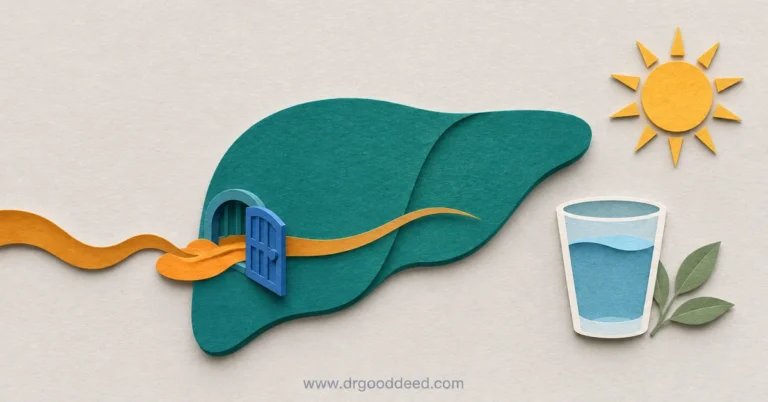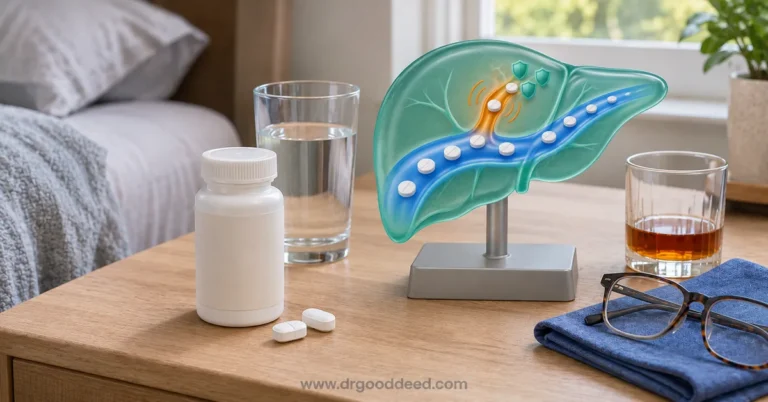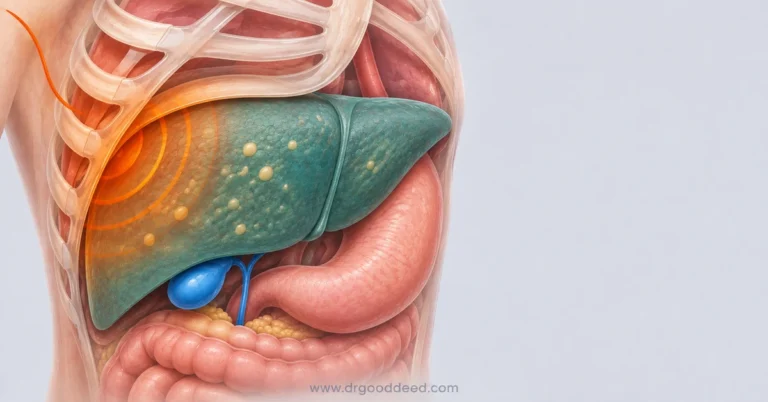

Grade 1 fatty liver on ultrasound means the scan found a mild buildup of fat in your liver, often during a test done for another reason. It is the mildest grade and often causes no symptoms, but the scan cannot show whether the liver is inflamed or scarred. It can often improve with gradual weight loss, regular exercise, and limiting sugary drinks and alcohol.
Key Takeaways
- Grade 1 fatty liver on ultrasound means a mild fat buildup; the scan cannot show whether your liver is inflamed or scarred.
- A routine ultrasound picks up fat. It can’t see inflammation or scarring.
- Blood tests and a FIB-4 score usually come next, to estimate scarring risk (AASLD, 2023).
- Dropping 3% to 5% of your weight improves liver fat. Scarring generally takes more than 10% (AASLD, 2023).
- Consult your doctor for liver function tests and evaluation of possible causes such as diabetes, high cholesterol, or obesity.
What Grade 1 Fatty Liver on Ultrasound Means
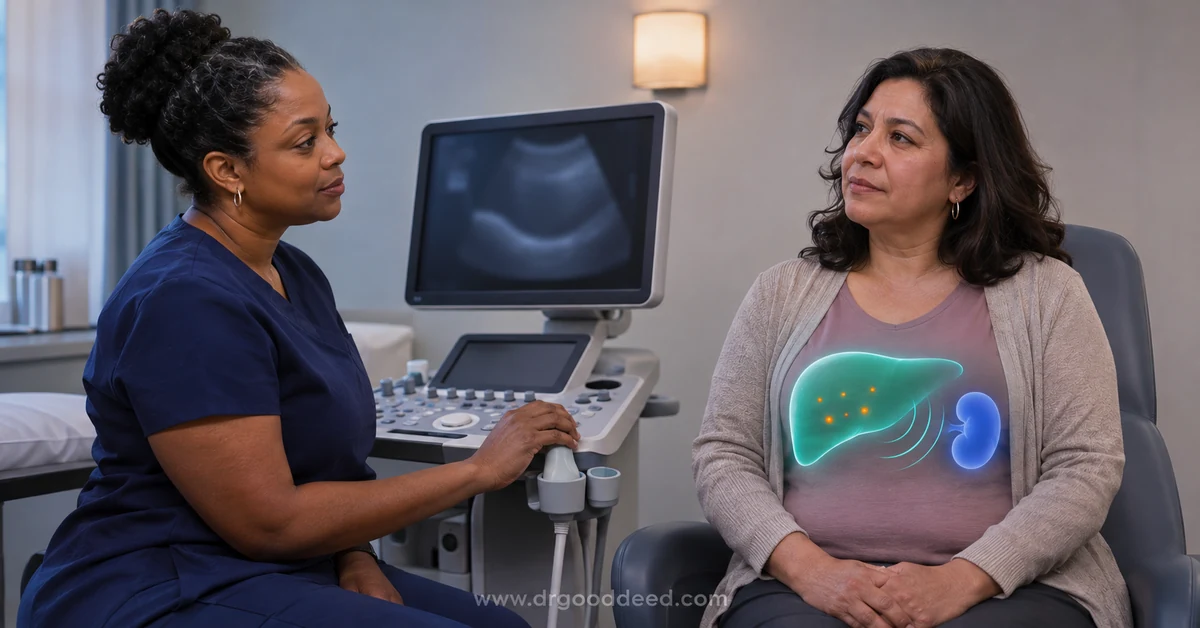
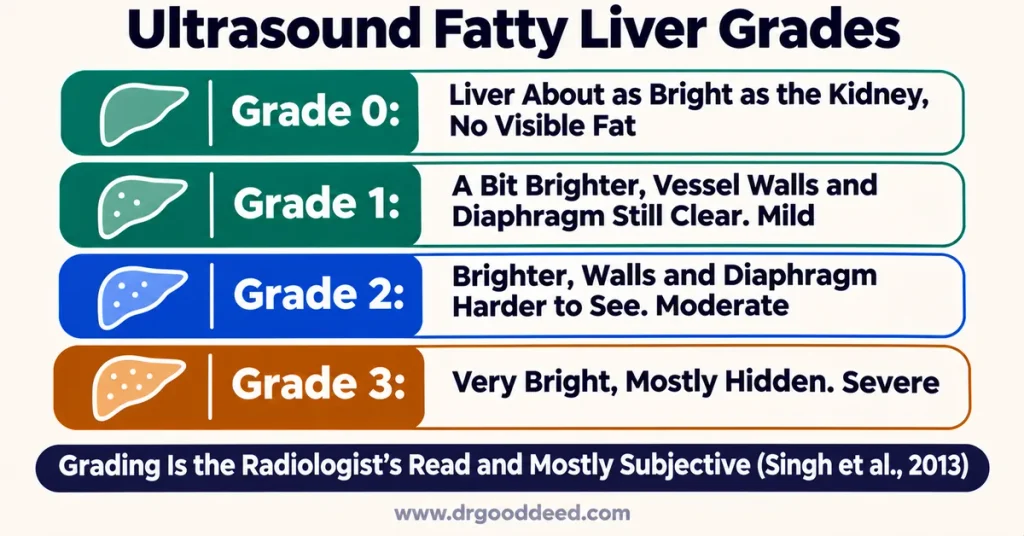
Grade 1 fatty liver on ultrasound means your liver looks slightly brighter than your kidney, while its blood vessels and the diaphragm are still easy to see. Fat sends more of the scan’s sound waves back, so fatty tissue looks bright. Radiologists call that increased echogenicity. The fat itself, inside liver cells, is hepatic steatosis.
The table below compares fatty liver grades on ultrasound (Singh et al., 2013).
| Grade | What the scan shows | In plain words |
| 0 | Liver about as bright as the kidney | No visible fat |
| 1 | A bit brighter than the kidney; vessel walls and diaphragm still clear | Mild fatty liver |
| 2 | Brighter still; vessel walls and diaphragm harder to see | Moderate |
| 3 | Very bright; vessels and diaphragm mostly hidden | Severe |
The grade is the radiologist’s read of the picture, and that assessment is mostly subjective (Radiopaedia, 2026). Some reports mention “mild fatty liver” instead of “grade 1.” It’s the same finding.
Is Grade 1 Fatty Liver Dangerous?
Grade 1 fatty liver is usually not an emergency, but don’t shrug it off either. Fat alone typically doesn’t lead to liver complications (NIDDK, 2021).
- How many people have it? About 24% of US adults, says NIDDK (2021). The American College of Gastroenterology says up to 30 in 100, over 100 million adults (ACG, 2024).
- A smaller group goes on to MASH, the version with inflammation and liver cell damage. ACG (2024) puts that at about 20% of people with MASLD. Inflammation and scarring are the real concern.
- Heart disease is the leading cause of death in people with MASLD (ACG, 2024), so ask about blood pressure and cholesterol too.
Alone, grade 1 fatty liver is usually not dangerous. Alongside inflammation or fibrosis, it can be.
What the Ultrasound Cannot Show
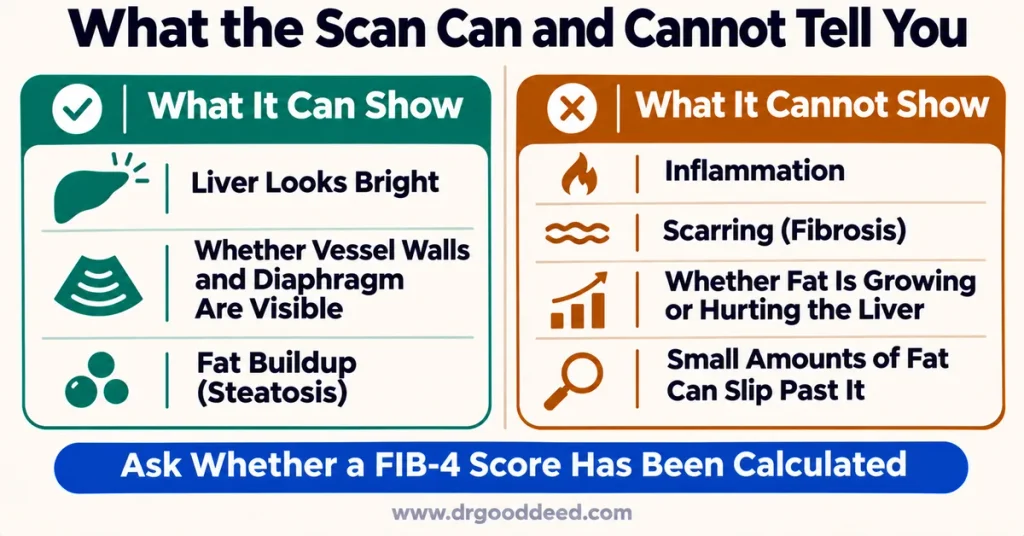
A fatty liver ultrasound shows fat. It doesn’t show inflammation or fibrosis, the medical word for scarring.
- The scan can tell you the liver looks bright and whether the vessels and diaphragm are visible.
- It can’t say if the fat is growing, holding steady, or hurting the liver.
- Small amounts of fat can slip past it. Sensitivity means how often a test catches a problem that’s really there. Radiopaedia (2026) lists ultrasound at 85% sensitive and 94% specific for moderate to severe fat, and less sensitive for lower grades. Singh and colleagues (2013) report a wider range, 60% to 94% sensitivity.
Doctors describe scarring using the stages of liver fibrosis, which an ordinary ultrasound grade does not report.
Doctor’s Tip: A mild grade does not settle the scarring question. Ask whether a FIB-4 score has been calculated.
What Causes Fat to Build Up in the Liver
Fatty liver most often traces back to extra weight, type 2 diabetes or high blood fats.
- Newer material, including Mayo Clinic (2026), says MASLD, short for metabolic dysfunction-associated steatotic liver disease. It replaced the older name NAFLD, and MASH replaced NASH.
- Fat in the liver is often a nudge to look at your overall metabolic health, including blood sugar and blood pressure.
- Alcohol, rapid weight loss and some medicines can also do it. Tell your doctor everything you take, and don’t stop anything on your own.
- MASH becomes likelier after 50 (Mayo Clinic, 2026).
Tests After a Grade 1 Fatty Liver Finding
Follow-up tests after a grade 1 fatty liver finding have two jobs: find the cause, and check for scarring.
The table below lists each follow-up test and the question it answers.
| Test | What it tells you | When it comes up |
| ALT and AST (liver enzymes) | Whether liver cells are irritated | Usually first. A normal result doesn’t rule out disease (AASLD, 2023) |
| Blood count, iron, hepatitis B and C, celiac test | Whether something else is hurting the liver | When the cause isn’t clear (Mayo Clinic, 2026) |
| Blood sugar, A1C, blood fats | Whether the usual metabolic causes are present | Alongside liver tests (Mayo Clinic, 2026) |
| FIB-4 score | How likely advanced scarring is | Often in primary care, from blood results you already have |
| Liver stiffness test (elastography) | Whether the liver is stiff, a sign of scarring | When scarring is still an open question (Mayo Clinic, 2026) |
| Liver biopsy | Inflammation or scarring that scans can’t show | When other tests leave doubt (NIDDK, 2021) |
FIB-4 is a score worked out from your age and routine blood results. AASLD (2023) treats a score under 1.3 as low risk, and those patients can be followed in primary care. With type 2 diabetes, prediabetes, or two or more metabolic risk factors, it’s repeated every 1 to 2 years. Age shifts the cutoffs. Above 65, the line moves up to 2.0, and under 35 the score is less reliable.
A lab’s printed “normal” ALT range often sits higher than true normal, so a result inside it doesn’t clear the liver. That’s why doctors pair enzymes with a scarring score like FIB-4 instead of trusting one number.
Can Grade 1 Fatty Liver Be Reversed?
Grade 1 fatty liver can often improve, mostly through weight loss, but how much varies from person to person. Fatty liver grade 1 treatment comes down to habits, since medicine is reserved for MASH with moderate to severe scarring (Mayo Clinic, 2026).
- Weight: AASLD (2023) says losing 3% to 5% improves liver fat, and more than 10% is generally needed for NASH and fibrosis. Mayo Clinic (2026) calls 10% or more typical and agrees 3% to 5% still helps. Those are the targets if you want to reduce fatty liver grade 1.
- Pace: skip crash diets. NIDDK (2021) lists rapid weight loss among the causes of fatty liver.
- Movement: Mayo Clinic (2026) says at least 150 minutes a week, while Cleveland Clinic (2026) says at least 30 minutes a day. If you’re inactive now, check with your doctor first.
- Drinks: skip sugary drinks like soda and juice (Mayo Clinic, 2026).
Your doctor can explain which signs your liver is healing can be measured on follow-up tests.
When to See a Doctor for Grade 1 Fatty Liver
See your primary care doctor about grade 1 fatty liver even if you feel fine. Fatty liver symptoms are often missing altogether.
The table below matches each symptom with where to go.
| Symptom | Where to go |
| None, but you have the report | Primary care doctor |
| Tiredness, or pain in the upper right belly | Primary care doctor (Mayo Clinic, 2026) |
| Itching, swelling in the belly or legs, yellow skin or eyes | A doctor promptly (Mayo Clinic, 2026) |
| New or worsening symptoms and your doctor can’t see you soon | Urgent care |
| Vomiting blood, confusion or severe sleepiness | ER or 911 |
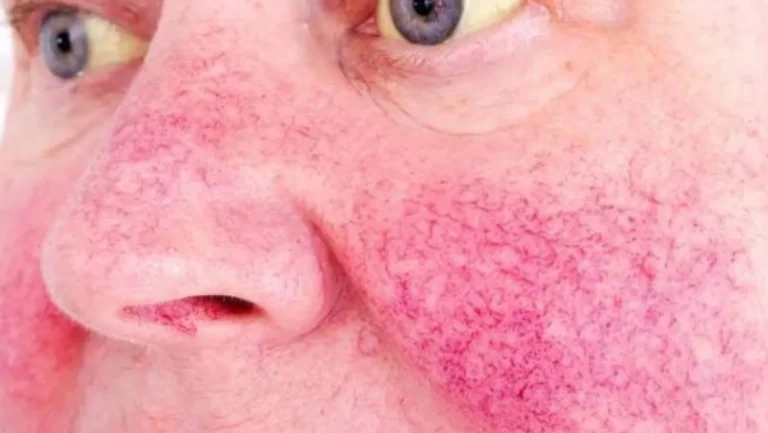
Skin changes are a separate question, covered in this guide to fatty liver symptoms on the face. For pain under the right ribs, see this guide to fatty liver pain on the right side.
If your report mentions grade 1 fatty liver on ultrasound, bring a copy to your primary care doctor and ask which blood tests and scarring checks you need.
Frequently Asked Questions
What Is the Danger Zone for Fatty Liver?
There’s no single number on an ultrasound that marks a danger zone. Scarring matters most, because the amount of fibrosis has been strongly linked to bad outcomes. That’s why doctors check a FIB-4 score or a stiffness test and don’t rely on the grade alone.
What Is the No. 1 Food That Causes Fatty Liver?
No single food has been named the cause. NIDDK (2021) says researchers are studying diets high in fructose and Mayo Clinic (2026) advises skipping sugary drinks like soda and juice. Talk with your doctor about your overall eating pattern instead of hunting for one culprit.
What Is the Difference Between Grade 1 and Grade 2 Fatty Liver?
Grade 1 fatty liver is the mildest ultrasound grade. By grade 2, the vessel walls and diaphragm get harder to see. Neither grade measures scarring, so grade 2 doesn’t prove it and grade 1 doesn’t rule it out. Your doctor uses blood tests and a FIB-4 score to check for scarring.
Do I Need a Liver Specialist for Grade 1 Fatty Liver?
Often not at first. Start with your primary care doctor, who may refer you to a hepatologist, a liver specialist, depending on test results. Low-risk patients can be managed in primary care (AASLD, 2023). Your doctor will usually check a FIB-4 score first.
Will I Need Another Ultrasound?
Not on a fixed schedule. No US guideline sets one for repeat scans. Follow-up usually leans on blood tests and the FIB-4 score, repeated every 1 to 2 years for people with type 2 diabetes, prediabetes or two or more metabolic risk factors. Ask your doctor what makes sense for you.
Sources
National Institute of Diabetes and Digestive and Kidney Diseases, Diagnosis of NAFLD & NASH. link
National Institute of Diabetes and Digestive and Kidney Diseases, Definition & Facts of NAFLD & NASH. link
National Institute of Diabetes and Digestive and Kidney Diseases, Symptoms & Causes of NAFLD & NASH. link
Mayo Clinic, Fatty liver disease (MASLD): Symptoms and causes. link
Mayo Clinic, Fatty liver disease (MASLD): Diagnosis and treatment. link
Hepatology, AASLD Practice Guidance on the clinical assessment and management of NAFLD (2023). link
American College of Gastroenterology, MASLD. link
Cleveland Clinic, Steatotic (Fatty) Liver Disease. link
Radiopaedia, Diffuse hepatic steatosis. link
Journal of Clinical and Experimental Hepatology, Imaging of non alcoholic fatty liver disease: A road less travelled (Singh et al., 2013). link
Medical Disclaimer: This article is for general information only and is not medical advice. It does not replace a diagnosis, treatment plan, or guidance from a qualified healthcare professional. Always talk to your doctor about your own symptoms and before starting, stopping, or changing any treatment. If you think you may be having a medical emergency, call 911 or go to your nearest emergency room.