

The best probiotic for sensitive stomach is the formulation whose exact strain and dose match your dominant symptom, whether that is bloating, urgency, or irregular stools.
If you’re looking for the best probiotic for sensitive stomach relief, you should know which strain, dose, and formulation actually target your symptom. This guide covers the types of probiotics proven for specific digestive symptoms, CFU accuracy, formulation red flags, and how long a fair trial should run.
Key Takeaways
- The best probiotic for sensitive stomachs use depends on your exact symptom, not a single top-ranked product.
- Strain-level evidence matters more than CFU count or the number of strains in a bottle.
- Added prebiotics, sugar alcohols, and fillers often trigger symptoms more than the bacteria itself.
- Clinical guidelines disagree on probiotics for IBS, so trial one product at a time for several weeks.
- Rectal bleeding, unexplained weight loss, or anemia need medical evaluation, not a supplement.
Why the Best Probiotic for a Sensitive Stomach Depends on What Your Stomach Is Sensitive To
A sensitive stomach may have bloating after meals, urgent diarrhea, hard stools, or general discomfort with no clear pattern. Each symptom points to a different probiotic strategy. Matching a product to your actual complaint is the single biggest factor in whether a probiotic helps or backfires.
Is Your Problem Bloating, Loose Stools, Constipation, Pain, or General Discomfort?
| Main problem | What to investigate when comparing probiotics |
| Bloating or gas | Strain evidence plus any added fermentable ingredients |
| IBS symptoms | Exact strain and dose used in clinical trials |
| Diarrhea | Evidence for that specific strain and use case |
| Constipation | Strain-specific evidence and whether fiber is also added |
| Easily irritated digestion | Minimal ingredient list and a slow, one-product trial |
Which Probiotic Details Matter More Than the CFU Number?
A high colony-forming unit (CFU) count alone does not predict whether a probiotic helps a sensitive stomach. Strain identity, digestive survival, and expiration-date potency matter more.

Why the Full Strain Name Matters More Than Seeing “Lactobacillus” on the Label
Probiotics are identified by genus, species, and strain, such as Lactobacillus rhamnosus GG. Probiotics should be identified down to strain level, since evidence for one strain cannot be assumed for another strain with the same species name.
Does 50 Billion CFU Mean a Probiotic Is Too Strong for a Sensitive Stomach?
A higher CFU count has not been shown to work better than a lower, well-studied dose in clinical trials.
- Most trials showing measurable benefit use doses in the billions, not tens of billions, of CFU per day.
- Temporary gas or bloating can occur with any probiotic dose, high or low, during the first week or two.
- CFU is only one label detail; strain identity and full formulation matter just as much as the number.
Why You Should Check CFU Through the Expiration Date
Live bacteria die off during storage. Labels state CFU guaranteed through the expiration date, not only at the time of manufacture. A bottle promising 50 billion CFU at manufacture may deliver far fewer live organisms by the time you actually take it.
Pro Tip: Check whether a probiotic needs refrigeration only after opening or from the moment it is purchased, since many shelf-stable strains use freeze-drying that keeps bacteria dormant until body temperature activates them. A refrigerated product left unrefrigerated during shipping can lose live bacteria well below the labeled CFU, even before its printed expiration date.
Which Probiotic Formulation Is Least Likely to Add Digestive Triggers?
A sensitive stomach may react to what surrounds the probiotic strain, not the bacteria itself. Inulin, chicory root, FOS, and sugar alcohols are common additions that ferment in the gut and cause gas. Reading the full ingredient list matters most when shopping for probiotics for bloating and gas.
Which Probiotic Types Have Real Evidence for Digestive Symptoms?
Among the many types of probiotics sold for digestive complaints, only a handful have been tested in controlled trials for IBS, bloating, or altered bowel habits.
What Does the Evidence Say About Probiotics for IBS?
- The American College of Gastroenterology’s 2021 guideline recommends against routine probiotic use for global IBS symptoms, citing very low-quality evidence overall.
- ACG’s own patient education resource notes that initial bloating or discomfort can occur when starting a probiotic, and this is usually short-lived.
- The British Society of Gastroenterology’s 2021 guideline takes a more permissive stance, suggesting patients who want to try a probiotic take it for up to twelve weeks and stop if symptoms do not improve.
A study on one strain, dose, and symptom does not validate a different product listing the same genus. Meaningful evidence must match the strain, dose, formulation, symptom, and population studied. “Contains Bifidobacterium” on a label is not proof of benefit for your specific complaint.
Expert Insight: Clinicians often see patients discontinue a probiotic after three or four days because of temporary gas, mistaking a normal adjustment period for treatment failure. The more clinically useful question is not whether mild bloating appears in week one, but whether the target symptom, such as stool consistency or pain frequency, has genuinely shifted by week four on one unchanged product.
How Should Someone With a Sensitive Stomach Test a Probiotic?
Testing several supplements at once makes it impossible to know what helped or hurt. A single, defined trial, taken at the best time to take probiotics for your routine, gives a clearer signal than switching brands every week. Structure and patience matter more than brand-hopping.
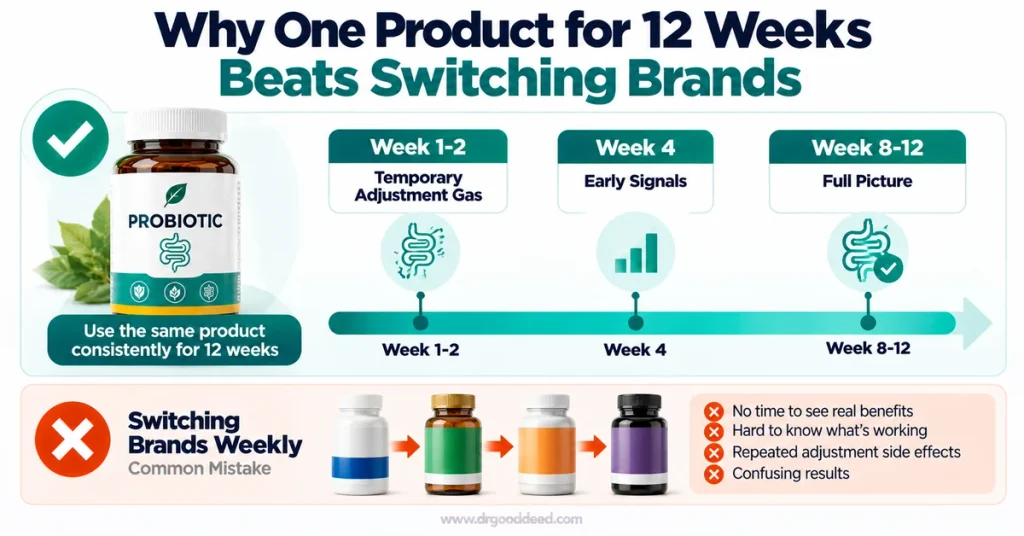
Use a Defined Trial Instead of Stacking Multiple Gut Supplements
Choose one probiotic, take the manufacturer’s recommended dose, and commit to one defined trial period before judging results. Example: a twelve-week trial for an IBS-focused probiotic while tracking symptoms consistently throughout that window.
What Should You Track During the Trial?
- Bloating severity and its timing relative to meals
- Abdominal discomfort, including whether it is constant or tied to bowel movements
- Stool frequency and whether it becomes more or less regular over time
- Stool consistency, using a simple loose, normal, or hard scale
- Urgency, or the sudden need to reach a bathroom
- Gas frequency and whether it changes noticeably week to week
What Does It Mean If Symptoms Worsen After Starting a Probiotic?
Temporary gas or discomfort can occur with any new probiotic as gut flora adjusts. If discomfort persists beyond one to two weeks or worsens significantly, stop the product and consider a different strain instead of pushing through it.
The duration for probiotics to work is early signals near four weeks, with a fuller picture forming by eight to twelve weeks of consistent use.
How Should You Compare the Best Probiotics for a Sensitive Stomach Side by Side?
The table below highlights details most roundups skip, the ones that actually predict whether a best probiotic for sensitive stomach choice will work for your body.
| Product detail | Why it matters |
| Exact strain | Determines whether outside evidence even applies |
| CFU at expiry | Reflects real potency, not manufacture-date marketing |
| Added prebiotic or fiber | Can trigger bloating in reactive guts |
| Sweeteners or polyols | Common cause of gas and loose stools |
| Storage requirement | Affects whether bacteria survive to the expiration date |
| Evidence for your target symptom | Confirms relevance beyond generic “gut health” claims |
When Should You Skip a Probiotic and Investigate the Symptoms Instead?
Before searching for the best probiotic for sensitive stomach options online, rule out red-flag symptoms first. Some digestive complaints should never be self-treated with a supplement, since a probiotic will not address their underlying cause.
Which Symptoms Should Not Be Assumed to Be a Sensitive Stomach?
- Rectal bleeding or black, tarry stools
- Unexplained or unintentional weight loss
- Anemia, which can cause fatigue or shortness of breath
- Persistent fever or severe, constant abdominal pain
- Symptoms that started suddenly after age 45 with no prior history
Who Should Ask a Clinician Before Taking Probiotics?
People with a weakened immune system, serious underlying illness, or recent major surgery should ask a doctor before starting a probiotic. Live organisms carry a small infection risk in these situations, even though probiotics are generally well tolerated by healthy adults.
So, What Is the Best Probiotic for a Sensitive Stomach?
There is no single best probiotic for sensitive stomach relief that works for everyone. The right choice is the product whose exact strain, dose, and formulation match your dominant symptom, and that you personally tolerate over a full trial.
- Sensitive stomach plus probiotics for bloating and gas concerns: scrutinize added fermentable ingredients first.
- Sensitive stomach plus IBS: prioritize strain-specific evidence over CFU size.
- Sensitive stomach plus diarrhea or constipation: check evidence for that exact symptom.
- Very reactive digestion: start with the simplest formulation you can find.
FAQs
How many weeks does it take a gentle probiotic to help?
Most evidence shows measurable change around four weeks, with clearer results by eight to twelve weeks. The typical duration for probiotics to work depends on strain and symptom severity.
Are refrigerated probiotics better than shelf-stable ones?
No, refrigeration alone does not determine quality. Some freeze-dried strains stay stable at room temperature for their full shelf life, while others degrade quickly without cold storage. What matters is whether the label guarantees CFU through the expiration date under its stated storage conditions.
Do you need a different probiotic strain for IBS specifically?
Yes. IBS-focused strains studied in guideline-reviewed trials differ from strains marketed for general immunity or yogurt cultures. A product without IBS-specific strain evidence may not affect abdominal pain or bowel habit changes, even if it supports digestion in other ways.
Can a probiotic cause permanent bloating?
No. Bloating from a new probiotic is typically temporary, resolving within one to two weeks as gut flora adjusts. Bloating that persists for many weeks usually means the formulation or added ingredients do not suit you.
Can children with a sensitive stomach take probiotics?
Sometimes, but pediatric dosing and strain selection differ from adult products. Children should only take probiotics under a pediatrician’s guidance, since strain safety data in children is more limited than in adults. Never give a child an adult-dosed product without medical advice.
Sources
- NIDDK: Irritable Bowel Syndrome, Definition & Facts link
- NIDDK: IBS Symptoms & Causes link
- NIH Office of Dietary Supplements: Probiotics Fact Sheet for Health Professionals link
- ISAPP: Probiotic Labelling Infographic link
- ISAPP: Are All Probiotics the Same? link
- American College of Gastroenterology: IBS Treatment Resource on Probiotics link
- ACG Clinical Guideline: Management of Irritable Bowel Syndrome (2021) link
- British Society of Gastroenterology Guidelines on the Management of IBS, Gut (2021) link
- FDA: Information for Consumers on Using Dietary Supplements link
- NCCIH: Irritable Bowel Syndrome and Complementary Health Approaches link
Medical Disclaimer: This article is for general information only and is not medical advice. It does not replace a diagnosis, treatment plan, or guidance from a qualified healthcare professional. Always talk to your doctor about your own symptoms and before starting, stopping, or changing any treatment. If you think you may be having a medical emergency, call 911 or go to your nearest emergency room.