

A thunderclap headache is a sudden, severe headache that hits its peak in seconds, and it is a medical emergency: call 911 right away. The pain may signal bleeding around the brain or another serious condition, even if it starts to ease. Learn what to do while waiting for help, what can cause this headache, and what tests doctors may use to find the cause.
Key Takeaways
- Thunderclap headaches occur in seconds and indicate brain hemorrhage; therefore, dial 911 immediately, even if the symptoms disappear later.
- It starts suddenly, peaks within a minute and can come with nausea, vomiting, a stiff neck or light sensitivity.
- Bleeding around the brain is found in 11% to 25% of people with a thunderclap headache (StatPearls, 2023).
- Doctors usually start with a head CT scan and may add other tests.
- Call 911 for every new or repeat episode, and attend follow-up appointments even if your initial tests are normal.
Thunderclap Headache: Call 911 Right Away
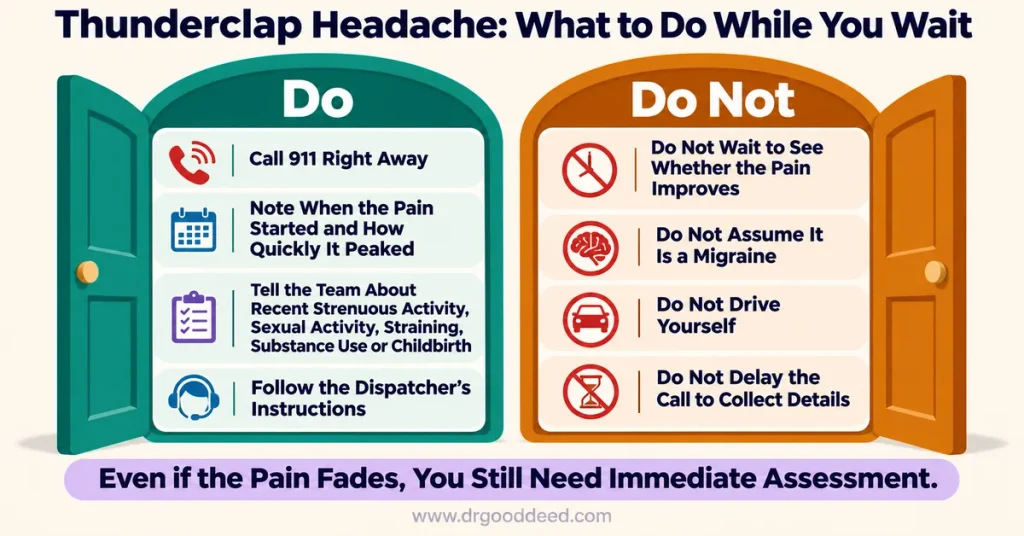
A thunderclap headache needs a 911 call because it can be a sign of bleeding around the brain, which needs hospital treatment fast. Do not wait to see whether the pain improves or assume it is a migraine.
While waiting for emergency help:
- Note when the pain started. Tell the emergency team when the headache began and how quickly it reached its peak.
- Do not drive yourself. Call 911 and follow the dispatcher’s instructions. Emergency responders can assess you and begin appropriate care.
- Share relevant details. Tell the team about recent strenuous activity, sexual activity, straining, substance use, recent childbirth, and any other symptoms. Do not delay the call to collect this information.
A sudden, explosive headache can be the first sign of a life-threatening condition. Even if the pain fades or you feel better, you still need immediate medical assessment.
What a Thunderclap Headache Feels Like
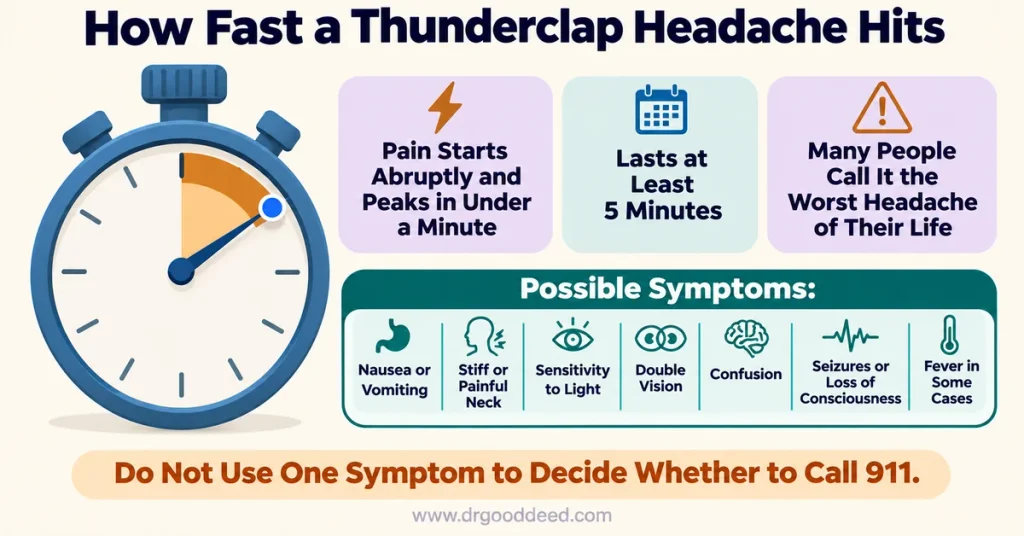
The pain is severe, starts abruptly, peaks in under a minute and lasts at least 5 minutes, and many people call it the worst headache of their life (StatPearls, 2023; NINDS, 2026).
Unlike a headache that gradually builds, this pain can reach full intensity almost immediately. The location and associated symptoms vary, so you should not rely on one specific symptom to judge how serious it is.
Possible thunderclap headache symptoms include:
- Sudden, intense pain that reaches its peak within seconds.
- Nausea or vomiting.
- A stiff or painful neck.
- Sensitivity to light.
- Double vision or other visual changes.
- Confusion or altered awareness.
- Seizures or loss of consciousness.
- Fever in some cases.
You may also experience symptoms associated with a stroke. Learn what a stroke feels like so you can recognize other warning signs, but do not use a symptom checklist to decide whether to call 911. A sudden, severe headache requires emergency assessment even if you have no other symptoms.
Causes of a Thunderclap Headache
Bleeding around the brain is found in 11% to 25% of people with a thunderclap headache, and other brain bleeds in 5% to 10% (StatPearls, 2023). Several conditions can cause this pain, and doctors need to investigate promptly to identify the cause.
| Possible cause | What happens | Additional clues |
| Subarachnoid hemorrhage | Blood enters the space around the brain, often after an aneurysm ruptures. | Sudden, severe headache; possible neck stiffness, vomiting, or loss of consciousness. |
| Reversible cerebral vasoconstriction syndrome (RCVS) | Blood vessels in the brain temporarily narrow. | Several sudden headaches may occur over days or weeks. |
| Cerebral venous thrombosis | A blood clot blocks a vein that drains blood from the brain. | Symptoms can vary and may include headache, seizures, or neurological changes. |
| Cervical artery dissection | A tear develops in the wall of an artery in the neck. | Head or neck pain may occur with stroke-like symptoms. |
| Pituitary apoplexy | Bleeding or reduced blood supply affects the pituitary gland. | Headache may occur with visual changes or other neurological symptoms. |
| Spinal fluid leak | A leak of cerebrospinal fluid can change pressure around the brain. | Headache may be related to body position. |
| Ischemic stroke | A blocked blood vessel reduces blood flow to part of the brain. | Weakness, speech difficulty, vision changes, or other neurological symptoms may occur. |
| Hypertensive crisis | Blood pressure rises to a dangerously high level and may damage organs. | Severe headache may occur with other symptoms of organ injury. |
| Meningitis or encephalitis | Infection or inflammation affects the tissues around the brain or the brain itself. | Fever, neck stiffness, confusion, or other neurological symptoms may occur. |
These conditions cannot be reliably distinguished by how the pain feels alone. Bleeding and blocked-vessel strokes can both start this way, so learn the other stroke warning signs too.
A brain aneurysm is one possible source of bleeding around the brain, but not every thunderclap headache is caused by an aneurysm. Doctors use your symptoms, examination, and test results to determine what is happening.
Common Triggers of a Thunderclap Headache
It can strike during exertion, sex or straining, after binge drinking or some drugs or in the weeks after childbirth, though bleeding can also start at rest or in sleep (StatPearls, 2023). A trigger does not tell you whether the headache is harmless or dangerous.
Circumstances associated with thunderclap headaches include:
- Physical exertion: The pain may begin during strenuous activity.
- Sexual activity: A sudden headache can occur during or around sexual activity.
- Straining: The headache may start during activities that involve bearing down.
- Substance exposure: Binge alcohol use and certain substances, including cannabis, cocaine, and amphetamines, have been associated with these headaches.
- Medication-related factors: Some medication groups, including certain antidepressants and nasal decongestants, have been linked to this pattern. Do not stop or change a prescribed medicine without discussing it with your clinician.
- Recent childbirth: Some serious causes of sudden headaches can occur in the weeks after delivery.
A headache can also begin without an obvious trigger, while you are resting or asleep. Never assume that the absence of a trigger means you are safe.
Thunderclap Headache vs Migraine
The difference is speed, not strength: a thunderclap headache reaches full force in under a minute (StatPearls, 2023), so a first one should never be treated as a migraine at home.
Migraines can cause severe pain, nausea, and sensitivity to light. However, the sudden onset of a thunderclap headache is a key warning sign that requires emergency assessment.
Here is how the patterns differ:
| Feature | Thunderclap headache | Migraine |
| Onset | Sudden, with pain reaching its peak in under a minute. | Often develops more gradually, although patterns vary. |
| Pain intensity | Usually severe from the start. | Can range from moderate to severe. |
| Associated symptoms | May include neck stiffness, vomiting, visual changes, confusion, seizures, or loss of consciousness, depending on the cause. | May include nausea, light sensitivity, sound sensitivity, and sometimes visual or sensory symptoms. |
| First episode | Requires emergency assessment because serious causes must be ruled out. | A familiar, previously assessed pattern may be managed according to an established care plan. |
| Diagnosis | Requires prompt evaluation for bleeding and other dangerous causes. | Based on the headache pattern, symptoms, medical history, and clinical assessment. |
Some migraine types, including basilar migraine, can cause symptoms that resemble a stroke. However, you should not assume that a sudden, explosive headache is a migraine, even if you have a migraine history. Call 911 first.
What Happens at the Hospital
Doctors usually start with a CT scan of the head, which finds bleeding best in the first hours, then add a spinal tap or blood vessel scans if needed (StatPearls, 2023). Prompt testing matters because the ability of a CT scan to detect bleeding can decrease as time passes.
Your evaluation may involve these steps:
- Emergency assessment: The team asks when the headache started, how quickly it peaked, what symptoms accompanied it, and whether you have relevant medical history or recent triggers. They also assess your neurological status.
- Noncontrast head CT: This scan looks for bleeding and other abnormalities. StatPearls (2023) reports that CT sensitivity for detecting subarachnoid hemorrhage can reach up to 100% within 6 to 12 hours, decline to 85% to 95% on day 2, reach 75% on day 3, and fall to 50% to 60% after 5 days. These figures illustrate why you should not delay seeking help.
- Lumbar puncture: If the CT scan does not explain the headache but concern remains, doctors may recommend a spinal tap to examine cerebrospinal fluid for evidence of bleeding, including xanthochromia.
- Blood vessel imaging: CT angiography, MRI, or a catheter-based angiogram may help identify an aneurysm, narrowed blood vessels, a dissection, or another vascular problem.
- Cause-specific treatment: Treatment depends on the diagnosis. For a ruptured brain aneurysm, doctors may use procedures such as clipping or coiling to prevent further bleeding.
A normal neurological examination or an initially reassuring test does not always rule out a serious cause. Your team will decide whether you need additional tests based on your symptoms, timing, and initial findings.
When to Call 911 and When to See a Doctor
Call 911 for any thunderclap headache and for every repeat one; see your doctor for follow-up after the hospital visit. Do not wait for additional symptoms or drive yourself to the emergency department.
Call 911 immediately if you experience:
- A sudden, severe headache that reaches maximum intensity within seconds.
- A severe headache with confusion, fainting, seizures, or difficulty staying awake.
- A headache with new weakness, difficulty speaking, or sudden vision changes.
- A severe headache with a stiff neck, fever, or repeated vomiting.
- A sudden headache that returns after an earlier episode.
After emergency assessment, follow the discharge instructions and attend recommended appointments. Tell your doctor if headaches recur, new symptoms appear, or you have questions about your test results.
A slowly developing positional problem, such as a headache when lying down, may need a different evaluation, but a headache that peaks suddenly is an emergency first.
Never wait out a thunderclap headache at home; call 911 every time, and keep your follow-up visits even if the first scans were normal.
Frequently Asked Questions
Is a Sudden Severe Headache Always an Emergency?
Yes. Treat any sudden severe headache that peaks within seconds as an emergency until doctors have checked you, even if it later turns out to have no serious cause. Call 911 rather than waiting for the pain to ease. A prompt assessment helps doctors identify or rule out dangerous conditions.
Should You Drive Yourself to the ER?
No. Call 911 and follow the dispatcher’s instructions instead of driving yourself. A sudden, severe headache may worsen or occur with confusion, weakness, or loss of consciousness. Emergency responders can assess you and begin appropriate care during transport. Do not delay the call to arrange your own transportation.
Can a Thunderclap Headache Have No Serious Cause?
Sometimes, but only a medical evaluation can determine whether a serious cause is present. A primary thunderclap headache is diagnosed only after doctors investigate and rule out other causes. Because symptoms alone cannot reliably distinguish a harmless headache from bleeding or another emergency, you should always call 911 when this pattern occurs.
Can Thunderclap Headaches Come Back?
Yes. StatPearls (2023) describes reversible cerebral vasoconstriction syndrome as a condition that can cause multiple sudden headaches over days to weeks. The blood vessels usually return to normal within 3 months, and more than 90% of patients have an excellent outcome. However, every new thunderclap headache needs emergency assessment.
Who Is More Likely to Have a Brain Aneurysm?
Risk factors include smoking, high blood pressure, a close family history of a brain aneurysm, and certain inherited conditions. NINDS (2026) also identifies women and adults ages 30 to 60 as groups affected by brain aneurysms. Cocaine or amphetamine use is another risk factor. However, a person without known risk factors can still develop an aneurysm.
Sources
- StatPearls (NCBI Bookshelf), Thunderclap Headache. link
- National Institute of Neurological Disorders and Stroke, Cerebral Aneurysms. link
- National Institute of Neurological Disorders and Stroke, Stroke Signs and Symptoms. link
- Mayo Clinic, Thunderclap Headaches: Symptoms and Causes. link
Medical Disclaimer: This article is for general information only and is not medical advice. It does not replace a diagnosis, treatment plan, or guidance from a qualified healthcare professional. Always talk to your doctor about your own symptoms and before starting, stopping, or changing any treatment. If you think you may be having a medical emergency, call 911 or go to your nearest emergency room.