
Medically reviewed by Dr Anshu Alok, Endocrinology.
A blood sugar of 180 after eating without diabetes is higher than the usual range, but one reading does not mean you have diabetes. If levels repeatedly reach 180 mg/dL, consult a doctor and consider HbA1c and fasting blood sugar tests.
Key Takeaways
- A blood sugar of 180 after eating without diabetes is above normal, so recheck it and ask your doctor about an A1C or glucose test.
- Target: Under 180 mg/dL two hours after a meal is a goal for people with diabetes, not a normal value (CDC, 2024).
- Benchmark: In healthy adults wearing a CGM, the median time above 140 mg/dL was about 30 minutes a day (Shah et al., 2019).
- Next step: If high readings keep showing up after meals, book a visit with your primary care doctor.
Is Blood Sugar 180 After Eating Normal Without Diabetes?
No, a blood sugar of 180 after eating without diabetes is higher than the normal range, though a single high reading is not a diagnosis. Post-meal blood sugar just means glucose measured after you’ve eaten.
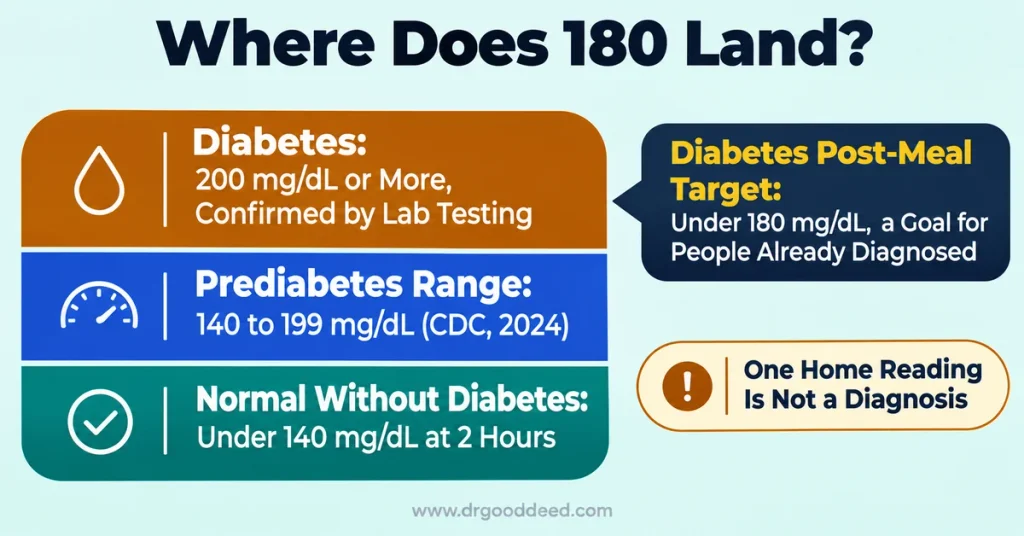
| Range | 2-hour value | What it means |
| Normal without diabetes | Under 140 mg/dL | Expected after a typical meal |
| Prediabetes | 140 to 199 mg/dL | Higher than normal, below the diabetes cut point |
| Diabetes | 200 mg/dL or more | Diagnosed with lab testing that a doctor reads |
| Diabetes post-meal target | Under 180 mg/dL | A management goal for people already diagnosed |
Those ranges come from the CDC (2024). A reading of 180 mg/dL would land in the 140 to 199 mg/dL band if it came from a glucose tolerance test.
A home reading after a regular meal isn’t that test, though. The tolerance test uses a measured sugar drink (CDC, 2024). So 180 blood sugar is too high after eating for someone without diabetes, but it doesn’t cross the diabetes line on its own.
What Is Normal Blood Sugar After Eating for Non-Diabetics?
Without diabetes, blood sugar climbs after a meal and usually drifts back under about 140 mg/dL by the 2-hour mark (CDC, 2024). When you check matters nearly as much as the number itself.
- Timing: Normal blood sugar 2 hours after eating is under 140 mg/dL if you don’t have diabetes. Those cut points were built for the 2-hour mark, so normal blood sugar 1 hour after eating can’t be held up against them. At 1 hour, a number may simply run higher.
- Where the clock starts: In its diabetes target, the CDC (2024) counts two hours from the start of a meal. Counting from your last bite changes what you’re comparing.
- What healthy sensors show: Shah and colleagues (2019) had 153 healthy, non-obese people aged 7 to 80 wear a blinded CGM for up to 10 days. Average glucose sat around 98 to 99 mg/dL, and the median time between 70 and 140 mg/dL was 96%.
- The spike itself: The same study found a median of 2.1% of the time above 140 mg/dL, about 30 minutes a day. Short rises after eating are normal. Long ones are a different story.
- Age: Targets shift with age and health, and a blood sugar chart by age shows fasting and after-meal ranges for each group.
Could Your Meter or CGM Be Reading High?
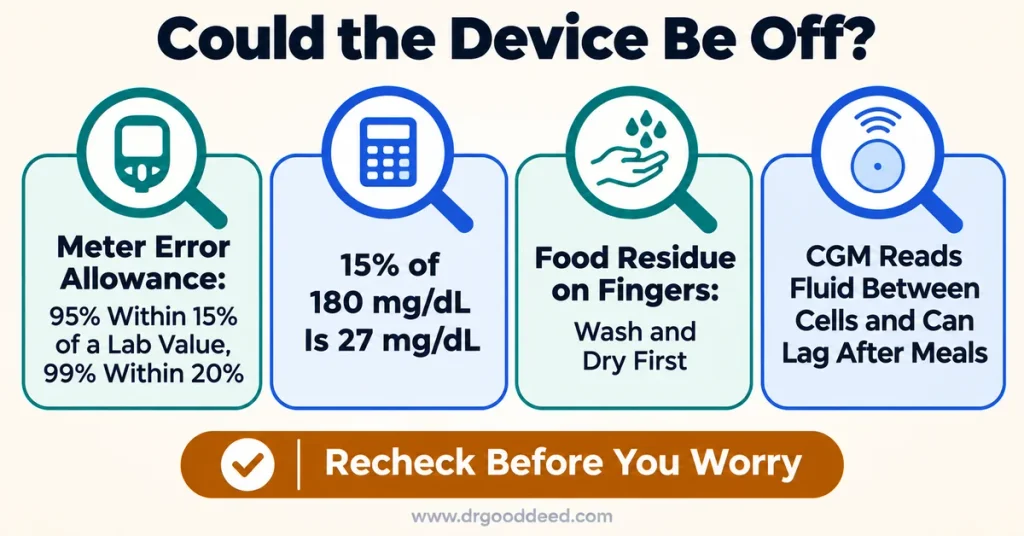
Yes, home meters are allowed some error and CGMs measure a different fluid, so one reading of 180 mg/dL should be rechecked. For a healthy person, a lone odd number more often points at the device than the body.
- The FDA rule: Guidance from 2016, reported by diaTribe, says new home meters need 95% of results within 15% of a lab value and 99% within 20%. Meters already on the market aren’t covered.
- Doing the math: Fifteen percent of 180 mg/dL is 27 mg/dL, so a meter at the edge of its allowance could be that far off.
- Fingers: A little food residue can inflate a finger-stick result. Wash with soap and water and dry your hands first.
- Sensor lag: A continuous glucose monitor (CGM) reads the fluid between cells, not blood. When glucose is moving fast after a meal, it can trail a finger-stick.
- Over-the-counter sensors: Our review of CGMs for non-diabetics explains what these devices can and cannot tell you.
Why Blood Sugar Spikes After Eating Without Diabetes
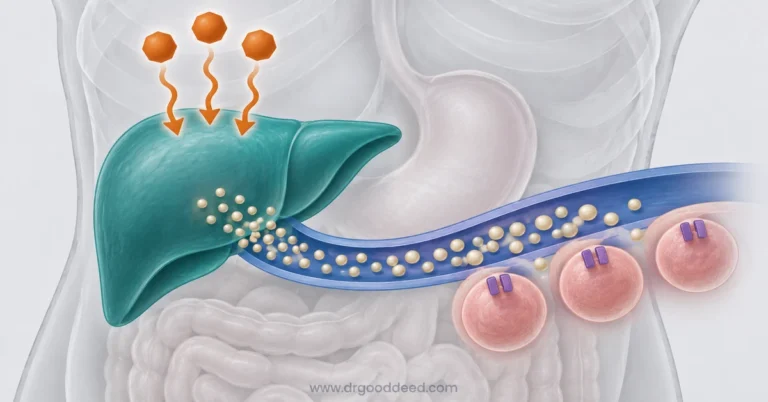
A large or carb-heavy meal, stress, illness, some medicines, and early insulin resistance can all push blood sugar higher after eating. Why does a non-diabetic have high blood sugar after eating? Usually one of these, and usually only for a while.
- The meal: A big plate of fast-digesting carbohydrate can lift glucose past 140 mg/dL for a stretch, even in healthy people.
- Stress and illness: Stress hormones and infections both raise glucose for a time.
- Medicines: A few can raise blood sugar. Don’t stop one on your own. Ask whoever prescribed it.
- Early insulin resistance: Cells respond less to insulin, so glucose clears more slowly after eating. It often shows up before prediabetes.
- Rarer causes: Hormone and organ problems are less common, and our guide to high blood sugar without diabetes covers each one in detail.
Does 180 After Eating Mean Prediabetes?
Not on its own. Prediabetes and diabetes are diagnosed with lab tests, not one home reading (CDC, 2024).
| Test | Normal | Prediabetes | Diabetes |
| A1C test | Under 5.7% | 5.7 to 6.4% | 6.5% or more |
| Fasting blood sugar | 99 mg/dL or below | 100 to 125 mg/dL | 126 mg/dL or more |
| Oral glucose tolerance test (2 hours) | Under 140 mg/dL | 140 to 199 mg/dL | 200 mg/dL or more |
| Random test | No normal band | No band | 200 mg/dL or more |
The CDC (2024) says prediabetes and type 2 diabetes often come with no symptoms at all, so feeling fine proves nothing either way. If a pharmacy or health fair hands you a high number, take it to a doctor, who may retest.
What to Do If Your Blood Sugar Is 180 After a Meal
What should I do if my blood sugar is 180? Recheck it carefully, write down when you ate, and look for a pattern before you worry.
- Wash and retest: Soap, water, dry hands, a fresh strip.
- Check the clock: Note how long it’s been since you started eating.
- Retest at 2 hours: Measure again 2 hours after the meal began and compare it with the 140 mg/dL benchmark.
- Log a few meals: Over several days, jot down the food, the time, the number and any symptoms.
- Book tests if it repeats: If high readings keep coming back, ask your primary care doctor for an A1C test, a fasting blood sugar or a glucose tolerance test.
Pro Tip: Count minutes from your first bite, not your last. The CDC’s diabetes target counts two hours from the start of a meal, so a slow 40-minute dinner changes what your 2-hour number means.
A short stretch of walking after eating is one habit studied for lowering the rise after meals.
When to See a Doctor About High Blood Sugar After Eating
See your primary care doctor if readings after meals stay high, and get urgent care if a very high reading comes with vomiting, confusion or fast breathing.
- Primary care: Repeated readings above 140 mg/dL two hours after meals call for lab testing, not more home checks.
- Urgent care or ER: A very high reading with vomiting, confusion, fast breathing or fruity-smelling breath needs same-day emergency care.
- 911: Call if confusion is severe, the person can’t stay awake, or breathing is labored.
If you see a blood sugar of 180 after eating without diabetes more than once, book a visit with your primary care doctor for proper testing.
Frequently Asked Questions
Can You Have Ketones With High Blood Sugar?
Yes, mainly when the body lacks insulin, as in type 1 diabetes. After an ordinary meal, ketones are rare in someone without diabetes. The CDC (2024) tells people with diabetes who are sick and at 240 mg/dL or above to check them, so a lone 180 mg/dL usually isn’t a reason to test.
What Are the Symptoms of High Blood Sugar?
Thirst, frequent urination, tiredness and blurred vision are the usual ones. The catch, per the CDC (2024), is that prediabetes and type 2 diabetes often cause no symptoms at all. Feeling fine rules nothing out, so lab tests carry more weight than how you feel.
How Long Does Blood Sugar Stay Up After Eating?
Without diabetes, blood sugar generally settles back within a couple of hours, and the CDC (2024) benchmark at the 2-hour mark is under 140 mg/dL. Write down the 2-hour number each time. Guessing at the exact peak isn’t worth the trouble.
What Is a Normal Blood Sugar Spike After Eating for Non-Diabetics?
A normal blood sugar spike after eating for non-diabetics is small and short, and it usually settles back to the pre-meal range within a few hours. In the 153 healthy people Shah et al. (2019) tracked with a CGM, the median time above 140 mg/dL was about 30 minutes a day.
Should a Non-Diabetic Check Blood Sugar After Eating?
No, routine post-meal checks aren’t needed for most people. If you have risk factors for diabetes, ask your doctor about an A1C or fasting blood sugar test instead. The CDC (2024) says home or pharmacy readings should be followed up with a doctor, who may retest.
Sources
- Centers for Disease Control and Prevention, Diabetes Testing (2024). link
- Centers for Disease Control and Prevention, Manage Blood Sugar (2024). link
- Journal of Clinical Endocrinology and Metabolism, Continuous Glucose Monitoring Profiles in Healthy Non-Diabetic Participants (2019). link
- diaTribe, FDA Publishes Final Recommendations on Blood Glucose Meter Accuracy (2016). link
Medical Disclaimer: This article is for general information only and is not medical advice. It does not replace a diagnosis, treatment plan, or guidance from a qualified healthcare professional. Always talk to your doctor about your own symptoms and before starting, stopping, or changing any treatment. If you think you may be having a medical emergency, call 911 or go to your nearest emergency room.