


Prednisone and high blood sugar often go together because prednisone makes the liver release more sugar and makes insulin work less well. This can happen even if you have never had diabetes. If you have noticed higher readings after starting prednisone, knowing when they happen and what to do next can help you manage them safely.
Key Takeaways
- Prednisone and high blood sugar are linked because the medicine pushes out more liver sugar and weakens insulin’s effect, even without diabetes.
- Blood sugar often rises in the afternoon or evening, so a normal morning reading may not tell the whole story.
- High blood sugar from prednisone is often temporary, but some people develop lasting diabetes.
- Contact your care team if your readings rise or you develop symptoms. Severe symptoms may require 911 or emergency care.
- Never stop prednisone or change your diabetes treatment without your prescriber’s guidance.
Why Does Prednisone Raise Blood Sugar?
Prednisone raises blood sugar in two main ways: it tells the liver to release more sugar into the bloodstream and makes it harder for insulin to do its job.
Insulin is a hormone that helps move sugar from your blood into your cells, where your body uses it for energy. When your cells respond less effectively to insulin, the condition is called insulin resistance.
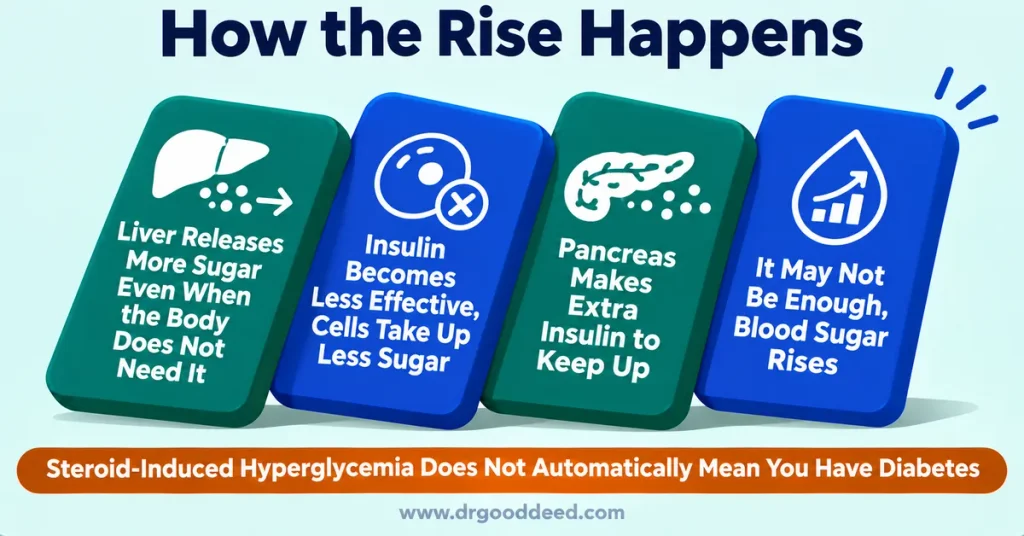
Here’s what happens while you take prednisone:
- Your liver releases more sugar: Prednisone signals the liver to make and release extra glucose, even when your body may not need it.
- Insulin becomes less effective: Your cells have a harder time taking sugar out of the bloodstream.
- Your pancreas tries to keep up: The pancreas may produce extra insulin to balance the rise. However, it may not be enough to keep blood sugar within your usual range.
This rise is called steroid-induced hyperglycemia, which means high blood sugar caused by steroid treatment. It does not automatically mean you have diabetes.
Prednisone can also trigger steroid-induced diabetes in some people, particularly when treatment reveals an underlying problem with blood sugar control.
If your blood sugar was normal before treatment, you may still notice a temporary rise. Prednisone is one of several possible causes of high blood sugar without diabetes.
Prednisone and High Blood Sugar: Daily Timing
Prednisone and high blood sugar follow a daily pattern for many people: readings may look normal on waking, then climb and peak in the afternoon or evening.
The timing depends on when you take prednisone, how your body responds, and whether you take other forms of steroid treatment.
Table: When blood sugar may rise after prednisone
| Time of day | Typical pattern |
| Morning | Blood sugar may be normal or close to your usual level, especially before the rise begins. |
| Late morning or afternoon | Blood sugar may start climbing a few hours after the dose. |
| Afternoon or evening | Readings often reach their highest point, particularly after meals. |
| Overnight | Some people continue to have elevated blood sugar overnight. |
Medical News Today (2025) reports that blood sugar may rise about 4 to 8 hours after prednisone. University Hospitals (2024) describes a rise beginning within 4 hours and lasting up to 12 hours. These estimates differ, and the timing varies from person to person.
Doctor’s Tip: A normal morning reading does not rule out high blood sugar later in the day. Memorial Sloan Kettering (2026) suggests checking 2 hours after lunch or just before dinner when the care team recommends monitoring.
Your clinician can explain how your readings compare with normal blood sugar levels and which times matter most for you.
Who Is Most at Risk of Steroid-Induced Hyperglycemia?
Steroid-induced hyperglycemia can affect anyone taking prednisone, but some people are more likely to experience it.
Your risk may be higher if you:
- Already have diabetes or prediabetes.
- Have a family history of diabetes.
- Are overweight or obese.
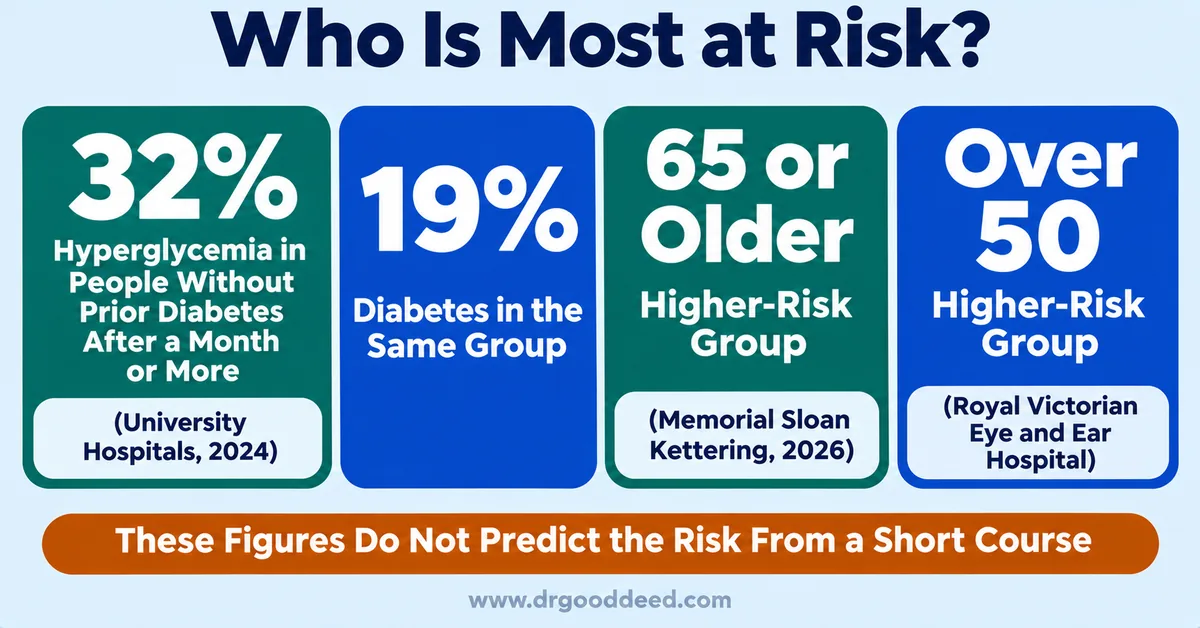
- Are older. Memorial Sloan Kettering (2026) identifies people aged 65 or older as a higher-risk group, while Royal Victorian Eye and Ear Hospital (reviewed 2020) identifies people over 50.
- Take larger amounts of prednisone or use it for a longer period.
- Have other health conditions that affect blood sugar control.
The form of treatment also matters. Mayo Clinic (2026) notes that corticosteroids taken by mouth are more likely to cause whole-body side effects than some other forms.
A University Hospitals (2024) article reports that, among people without prior diabetes who used steroids for a month or longer, a meta-analysis found hyperglycemia in 32% and diabetes in 19%. These figures do not predict the risk from a short prednisone course.
Symptoms of High Blood Sugar on Prednisone
Symptoms of high blood sugar on prednisone can develop gradually. Some people notice changes in how they feel, while others have no obvious symptoms.
Common signs include:
- Feeling unusually thirsty.
- Urinating more often than usual.
- Blurry vision.
- Dry mouth.
- Feeling tired or weak.
- Headaches.
You may notice these symptoms more often later in the day, when blood sugar tends to rise.
However, symptoms alone cannot tell you how high your blood sugar is. Some people have elevated readings without feeling different, so follow your care team’s advice about checking. High blood sugar is not the only side effect to mention; some people also ask about steroids and constipation.
If you develop severe symptoms such as vomiting, stomach pain, confusion, or trouble breathing, call 911 or go to the ER.
How to Check Blood Sugar While Taking Prednisone
The best time and frequency for checking depend on whether you have diabetes, your prednisone treatment, and your recent readings. Your care team can help you decide what to monitor.
If you already have diabetes:
- Follow your existing monitoring plan unless your clinician changes it.
- Ask whether you need extra checks while taking prednisone.
- Share any readings that are higher than your usual levels.
- Ask how your diabetes treatment may need to change during steroid treatment.
If you do not have diabetes:
- Ask whether you need blood sugar checks during treatment.
- If monitoring is recommended, ask whether afternoon or evening readings would be more useful.
- Report repeated high readings, even if you feel well.
Everyday habits that may help:
- Eat regular, balanced meals rather than skipping meals.
- Include vegetables, fiber-rich foods, and protein in your meals.
- Limit sugary drinks and large amounts of added sugar.
- Stay physically active if your health and care team allow it.
- Drink water regularly, unless you have been advised to limit fluids.
If you are considering a CGM for non-diabetics, ask your clinician whether continuous monitoring would provide useful information.
Questions to ask your care team:
- When should I check my blood sugar?
- What readings should prompt a call?
- How long should I monitor after my last dose?
- What should I do if my readings keep rising?
- Will my diabetes treatment need to change?
Does Blood Sugar Go Back to Normal After Prednisone?
Blood sugar often returns to normal after prednisone stops, but it does not happen for everyone.
If prednisone caused a temporary rise, your readings may gradually return to your usual range as the medicine leaves your system. However, some people continue to have high blood sugar or develop diabetes that needs ongoing care.
The length of treatment, your underlying risk factors, and your body’s response all play a role.
As your prednisone dose comes down:
- Your blood sugar may begin to decrease.
- Your diabetes treatment may need to be reduced by your prescriber.
- The risk of low blood sugar can increase if treatment is not adjusted appropriately.
- You may need continued monitoring until your readings stabilize.
A steroid taper means gradually reducing the dose under medical supervision. Never change the dose or stop prednisone on your own.
People with diabetes should also discuss how treatment changes may affect their usual plan. Management can differ between type 1 and type 2 diabetes.
When to Call About High Blood Sugar on Prednisone
Knowing when to seek help matters more than trying to manage a high reading on your own.
The following thresholds come from Memorial Sloan Kettering’s 2026 patient guidance. Your personal targets may differ, so follow the instructions from your own care team.
Table: What to do about high blood sugar readings or symptoms on prednisone
| Reading or symptom | What to do |
| Blood sugar over 400 mg/dL | Seek emergency care or call 911, especially if you have symptoms. |
| Vomiting, stomach pain, confusion, fruity-smelling breath, or trouble breathing | Call 911 or go to the ER. These can be signs of a serious emergency, including diabetic ketoacidosis. |
| Moderate or high ketones | Contact your healthcare provider right away or seek emergency help, depending on symptoms and their instructions. |
| Blood sugar over 200 mg/dL for more than 2 days | Contact your care team promptly for advice, or visit urgent care if you cannot reach them. |
| Repeatedly rising readings or symptoms of high blood sugar | Call your care team, even if your readings are below the thresholds above. |
| New high readings without a diabetes diagnosis | Contact your primary care clinician or care team for evaluation. |
These numbers are not universal safety limits. Memorial Sloan Kettering’s thresholds come from a cancer-care handout and should be confirmed with your clinician for your situation.
Children taking steroids also need close monitoring because high blood sugar can increase infection risk, and their treatment needs may change as the steroid dose decreases. Seattle Children’s (2024) recommends working with the child’s care team throughout treatment.
Important: Do not stop, skip, or change prednisone or your diabetes medicine on your own. MedlinePlus warns that suddenly stopping prednisone can leave your body without enough of its natural steroid hormones.
Call your care team if prednisone and high blood sugar are a new concern, and never stop the medicine on your own.
Frequently Asked Questions
Is steroid-induced diabetes from prednisone reversible?
Steroid-induced diabetes often clears after prednisone stops, but some people go on to have diabetes that needs ongoing treatment. Your clinician may recommend follow-up blood sugar testing, including an A1C test, to check whether your levels have returned to normal.
How long will steroids affect blood sugar?
Prednisone may affect blood sugar for up to 12 hours after a dose, according to University Hospitals (2024). The rise often begins within a few hours and may peak later in the day. The effect can last longer with extended treatment, and some people need monitoring after stopping.
How much does prednisone raise blood sugar in a person without diabetes?
There is no single number that applies to everyone. The rise depends on the prednisone treatment, how long you take it, when you take it, and how your body responds. People without diabetes can still develop noticeable increases, so follow your clinician’s advice about checking.
Does prednisone raise blood sugar if you already have diabetes?
Yes. Prednisone can make blood sugar harder to manage if you already have diabetes. Your readings may rise even when you follow your usual treatment plan. Tell your diabetes care team when you start prednisone so they can advise you about monitoring and possible treatment changes.
Should I stop prednisone if my blood sugar is high?
No. Do not stop prednisone or change your dose without talking to your prescriber. Suddenly stopping prednisone can cause serious problems because your body may not have enough natural steroid hormones. Contact your care team about high readings or symptoms and ask what to do next.
Sources:
Memorial Sloan Kettering Cancer Center, About Steroid-Induced Hyperglycemia (High Blood Sugar) (2026). link
Seattle Children’s, Steroid-Induced Diabetes (2024). link
University Hospitals, Best Practices for Managing Steroid-Induced Hyperglycemia (2024). link
MedlinePlus, Prednisone. link
Mayo Clinic, Prednisone and Other Corticosteroids. link
MedlinePlus, Hyperglycemia. link
Centers for Disease Control and Prevention, Diabetic Ketoacidosis (DKA). link
American Diabetes Association, Hyperglycemia (High Blood Glucose). link
Cleveland Clinic, Prednisone: Uses and Side Effects. link
Medical Disclaimer: This article is for general information only and is not medical advice. It does not replace a diagnosis, treatment plan, or guidance from a qualified healthcare professional. Always talk to your doctor about your own symptoms and before starting, stopping, or changing any treatment. If you think you may be having a medical emergency, call 911 or go to your nearest emergency room.