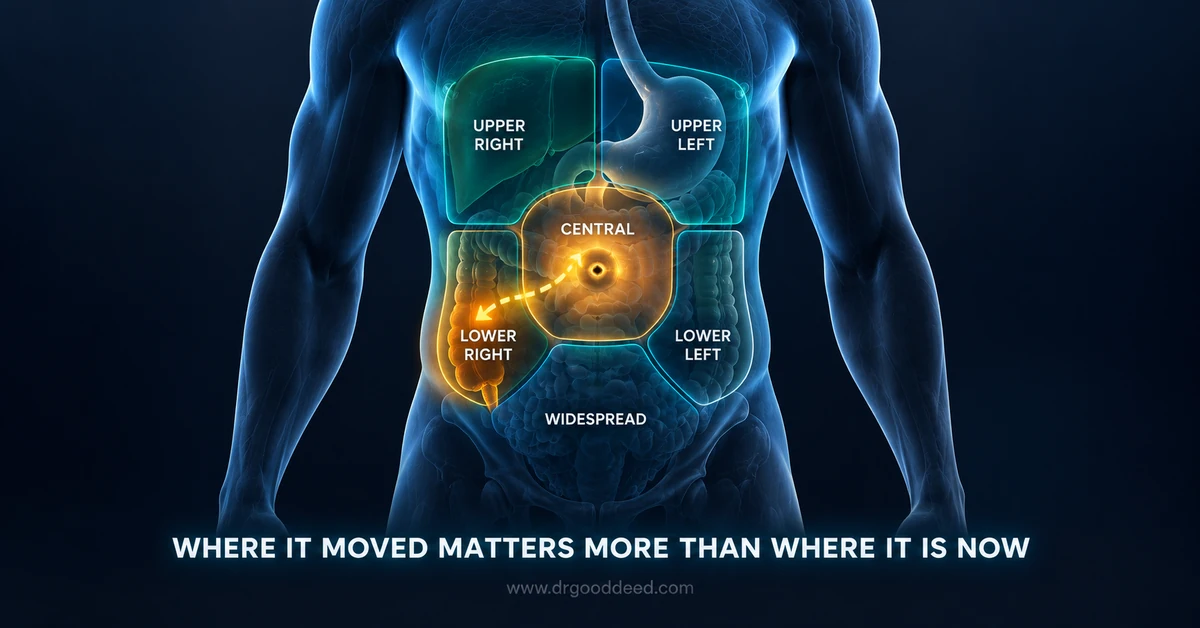

Pain in the upper right abdomen may be associated with the gallbladder or liver, while upper middle pain can involve the stomach or pancreas; upper left pain may relate to the stomach, pancreas, or spleen. Lower right abdominal pain can occur with appendicitis, while lower left pain is sometimes linked to the colon, and pain around the center of the abdomen may involve the intestines or other digestive organs.
An abdominal pain location chart can help organize symptoms by area, but severe, sudden, persistent, or worsening pain, especially with fever, repeated vomiting, fainting, blood in the stool or vomit, or a rigid abdomen, requires prompt medical evaluation.
Key Takeaways
- An abdominal pain location chart narrows the list of likely causes, but a final diagnosis still needs a physical exam and, often, labs or imaging.
- Upper right pain usually points to the liver or gallbladder, especially after a fatty meal. Upper left pain more often involves the stomach, spleen, or pancreas.
- Lower right pain is the classic appendicitis zone, though appendicitis pain typically starts near the navel first and migrates there.
- Lower left pain in adults over 40 raises diverticulitis. In women, it can also signal an ovarian cause.
- Severe pain with fever, a rigid belly, or blood in the stool needs emergency evaluation no matter where it’s felt.
Abdominal Pain Location Chart (Quick Reference)
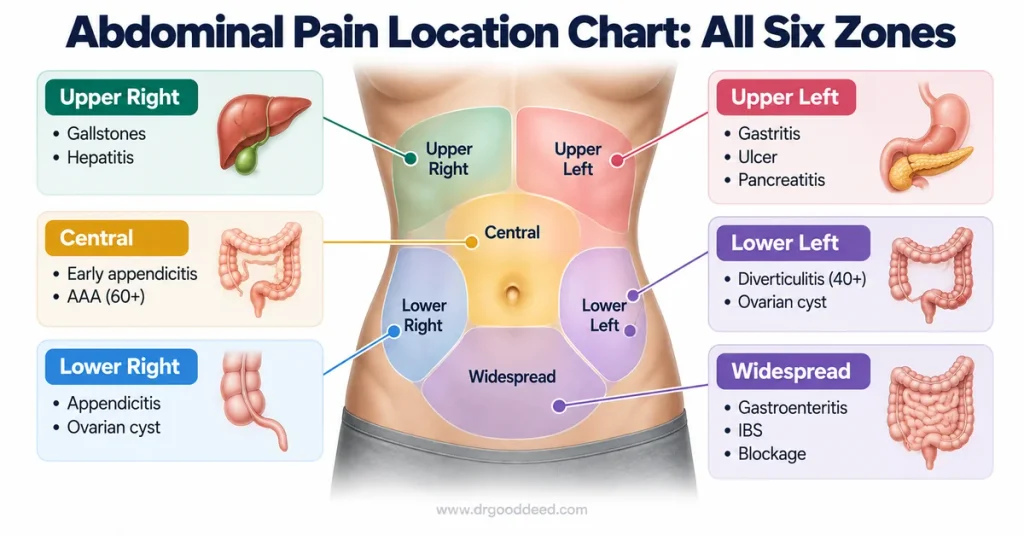
Use this abdominal pain location chart as a first pass, then read the matching region below for detail. Each row lists common causes ranked roughly by how often they occur in US adults, not by how dangerous they are.
A gallstone attack and a peptic ulcer can both cause upper abdominal pain, for instance, so the chart narrows possibilities rather than closing the case. Location combined with how the pain behaves, sudden or gradual, constant or in waves- gives a doctor the clearest starting point for abdominal pain by location.
| Region | Common Causes | Learn More |
| Upper Right | Gallstones, biliary colic, hepatitis, rarely a liver abscess | Upper Abdominal Pain |
| Upper Left | Gastritis, peptic ulcer, pancreatitis, an enlarged spleen | Pain Under Left Rib Cage |
| Lower Right | Appendicitis, ovarian cyst, inguinal hernia, constipation | Appendicitis Symptoms |
| Lower Left | Diverticulitis, constipation, ovarian cyst, a kidney stone in transit | Kidney Pain vs Back Pain |
| Central, Around the Navel | Early appendicitis, gastroenteritis, umbilical hernia, aortic aneurysm in older adults | Stomach Pain in the Morning |
| Widespread | Gastroenteritis, food poisoning, gas, IBS, a bowel blockage if severe | Abdominal Pain and Chills |
What Pain in Each Region Might Mean
Every region of the abdomen sits close to specific organs, which is why pain clusters in predictable spots. This stomach pain location breakdown, the core of any working abdominal pain location chart, covers what’s typically behind pain in each of the six zones and when a pattern needs prompt evaluation instead of a wait-and-see approach.
Upper Right Abdomen
Pain under the right ribs usually traces back to the liver, gallbladder, or bile ducts.
- Gallstones are the most common cause in US adults, especially after a fatty meal, and the ache can radiate to the right shoulder blade.
- Hepatitis causes a duller, steadier pain, often with fatigue and darker urine.
- Biliary colic comes in waves lasting 30 minutes to several hours before it eases.
- For the full differential and self-care steps for this zone, see our upper abdominal pain guide.
Upper Left Abdomen
Pain here usually involves the stomach, spleen, or pancreas.
- Gastritis and peptic ulcers cause a burning ache that often worsens on an empty stomach and eases briefly after eating.
- Pancreatitis produces a steady, boring pain that can bore straight through to the back, frequently tied to alcohol use or a high-fat meal.
- An enlarged spleen, sometimes from infection or a blood disorder, causes fullness and tenderness just under the left ribs.
Because this zone overlaps heavily with upper right abdominal pain’s mirror image, check our dedicated guides on upper left abdominal pain under the ribs and pain under the left rib cage for the full breakdown.
Lower Right Abdomen
Lower right abdomen pain typically begins as vague discomfort around the navel, then migrates to the lower right abdomen over 12 to 24 hours and sharpens as it settles. Other causes include ovarian cysts, inguinal hernias, constipation, and occasionally Crohn’s disease affecting the terminal ileum. Pain that worsens with movement, coughing, or walking, especially with fever or loss of appetite, needs same-day evaluation.
Full symptom breakdown: appendicitis symptoms.
Lower Left Abdomen
In adults over 40, lower left abdominal pain most often points to diverticulitis, inflammation of small pouches that form in the colon wall over time. It typically comes with fever, a change in bowel habits, and tenderness that worsens under pressure. Constipation is a common, milder cause.
In women, an ovarian cyst or, rarely, an ectopic pregnancy can cause pain in this exact spot, which is why a pregnancy test matters whenever pregnancy is possible. A kidney stone moving toward the bladder can also refer pain here.
Central Abdomen, Around the Navel
Pain around the belly button is often the opening stage of appendicitis before it shifts to the lower right.
- Pain around the belly button can also come from early gastroenteritis, a strangulated umbilical hernia, or mesenteric adenitis, an inflamed lymph node in the gut.
- In adults over 60, a steady central ache with a pulsing sensation raises concern for an abdominal aortic aneurysm and needs urgent imaging.
- A hernia bulge that grows tender and won’t push back in is a similar emergency.
Widespread or Hard-to-Pinpoint Pain
Pain spread across more than half the abdomen usually reflects something affecting the whole gut rather than one organ.
- Gastroenteritis, food poisoning, gas, and irritable bowel syndrome cause most of these cases and typically ease within a day or two.
- Generalized pain that turns severe, especially with vomiting and an inability to pass gas or stool, can signal a bowel blockage and needs emergency evaluation rather than home treatment.
- Widespread pain is the one pattern where abdominal pain by location genuinely breaks down, since discomfort covering the whole abdomen doesn’t point to a single organ the way a localized ache does.
Expert Insight: Pain that has moved matters more than pain that’s static. A dull ache that started near the navel and settled into the lower right over several hours is a stronger appendicitis signal than the current location alone, because a single snapshot misses how the pain actually developed.
When Pain Radiates to Your Back or Chest
A basic abdominal pain location chart starts to fall short once pain spreads beyond the belly, and radiation patterns carry their own diagnostic weight.
- Pain that spreads to the back often points to the pancreas, kidneys, or, in older adults, a leaking aortic aneurysm.
- Pain that shoots to the right shoulder blade suggests gallbladder involvement, since the diaphragm shares nerve pathways with that area.
- Pain crossing into the chest is the pattern that always deserves caution, since it can signal a heart attack rather than a digestive problem, particularly in adults over 50 or anyone with diabetes, high blood pressure, or a smoking history.
Compare cardiac and digestive causes in our chest and abdominal pain guide, and see how flank pain differs from muscular back pain in kidney pain vs back pain.
Pro Tip: Note the exact time your pain started and whether it followed a meal. Emergency clinicians weigh this timeline as heavily as location when triaging abdominal pain, since pain that hits peak intensity within seconds is treated differently from pain that builds gradually over hours, even at the same spot.
Red Flags: When Any Abdominal Pain Needs Emergency Care
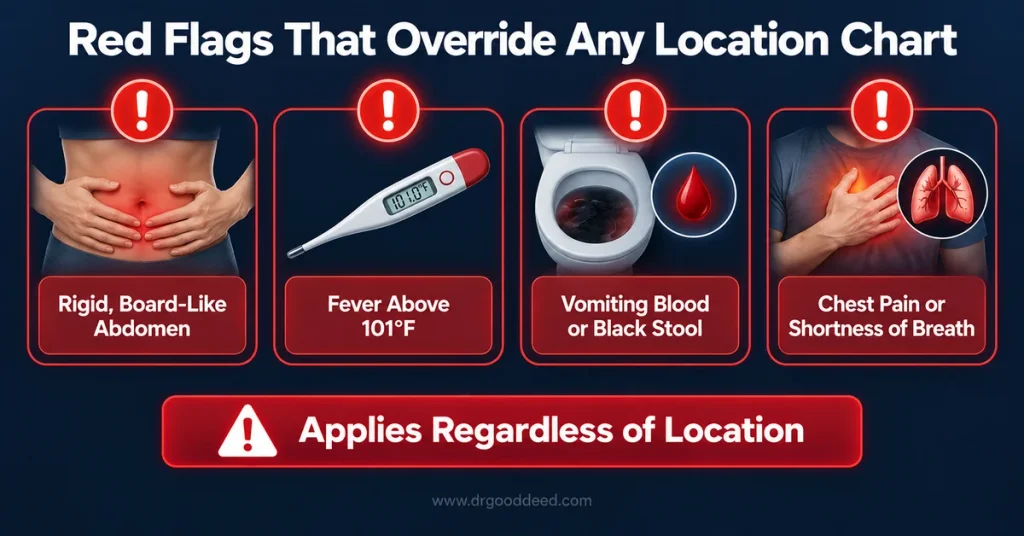
No abdominal pain location chart replaces clinical judgment once any of these signs show up. Seek emergency care or call 911 regardless of where the pain sits if you have:
- Sudden, severe pain that reaches peak intensity within minutes
- A rigid, board-like abdomen that hurts to touch anywhere
- A fever above 101°F combined with abdominal pain
- Vomiting blood or passing black, tarry, or visibly bloody stool
- Abdominal pain during pregnancy, especially with vaginal bleeding
- Inability to pass gas or stool with a swollen, tender belly
- Chest pain, shortness of breath, or fainting alongside stomach pain
Pain with chills and fever together can also signal a spreading infection. See abdominal pain and chills for what that specific combination usually points to.
How to Use This Chart With Your Doctor
Bring three details to your appointment: exactly where the pain started, whether it has moved, and what makes it better or worse.
Doctors often use a framework called OPQRST, onset, provocation, quality, radiation, severity, timing, and this abdominal pain location chart is organized around the same logic. Rate your pain on a 0 to 10 scale and note any pattern tied to meals, movement, or your menstrual cycle.
Keep this abdominal pain location chart bookmarked for the next time pain flares, but treat the stomach pain location meaning behind any single episode as a starting clue, not a final answer.
Sources
- MedlinePlus: Abdominal Pain, National Library of Medicine link
- MedlinePlus: Abdominal Pain Health Topic, National Library of Medicine link
- MedlinePlus: Recognizing Medical Emergencies, National Library of Medicine link
- Cleveland Clinic: Upper Abdominal Pain link
- WebMD: Abdominal Pain Causes and Treatments link
- NewYork-Presbyterian: Abdominal Pain Symptoms & Causes link
- Mayo Clinic: Abdominal Pain, When to See a Doctor link
- Mass General Brigham: Abdominal Pain, ER or Urgent Care link
- UF Health: Abdominal Pain link
- NCBI MedGen: Abdominal Colic link