
Restless legs and low ferritin are closely linked: when your body’s iron stores run low, the urge to move your legs at night can start or get worse. You may notice crawling, pulling, or uncomfortable sensations when you lie down, making it difficult to fall asleep or stay asleep. Understanding the connection can help you know which blood tests to discuss with your doctor and what treatment options may help.
Key Takeaways
- Restless legs and low ferritin are linked, so ask your doctor to check your iron stores with a simple blood test.
- Low brain iron may contribute to restless legs syndrome, even when your routine blood count appears normal.
- For RLS, AASM (2025) suggests iron treatment when ferritin is 75 ng/mL or lower or transferrin saturation is under 20%.
- A doctor should guide iron treatment because too much iron can harm your health.
- Persistent symptoms that disrupt sleep deserve medical assessment. Call 911 for chest pain, difficulty breathing, or fainting (StayWell, 2024).
Restless Legs and Low Ferritin: The Link
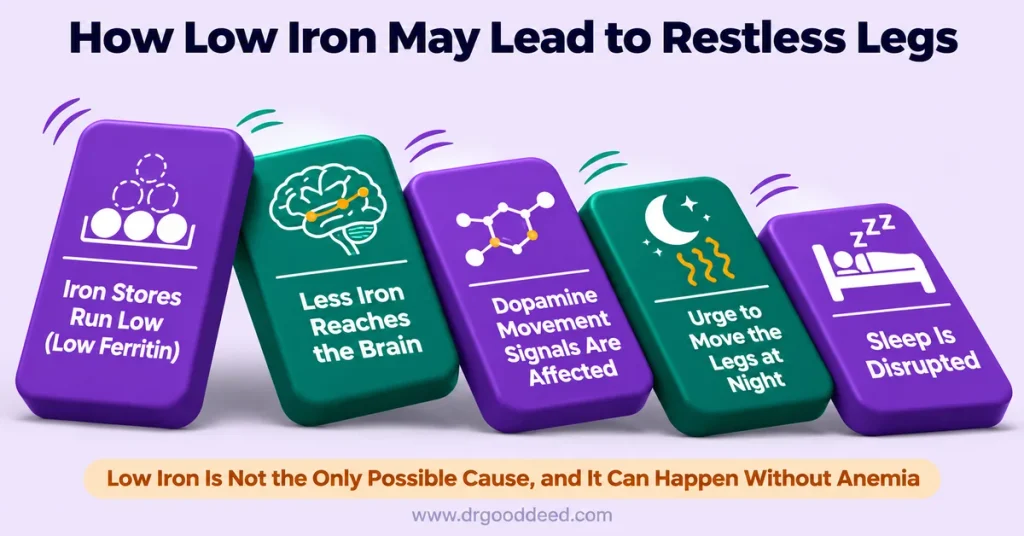
Restless legs and low ferritin are linked because low iron stores can leave too little iron in the brain, where iron helps control the signals that move your legs (NINDS, 2026).
Restless legs syndrome (RLS), also called Willis-Ekbom disease, creates an uncomfortable urge to move your legs, especially when you rest. Iron plays a role in brain function, including the systems that use dopamine to help coordinate movement. Researchers believe changes in brain iron may contribute to RLS, although low iron is not the only possible cause.
Here is what the connection means for you:
- Low ferritin means your body’s iron stores are low, and restless legs from iron deficiency can develop even without anemia.
- Blood tests may not show the full picture. Only 25% to 44% of people with RLS have low serum iron (Alzaabi et al., Cureus, 2025), and brain iron can be low even when blood levels look normal.
- Iron deficiency can also contribute to fatigue. Low iron stores may help explain why some people with restless legs also feel tired all the time.
Low ferritin does not automatically mean that iron deficiency explains every symptom. Your doctor needs to consider your symptoms, test results, and other possible causes before recommending treatment.
What Restless Legs at Night Feel Like
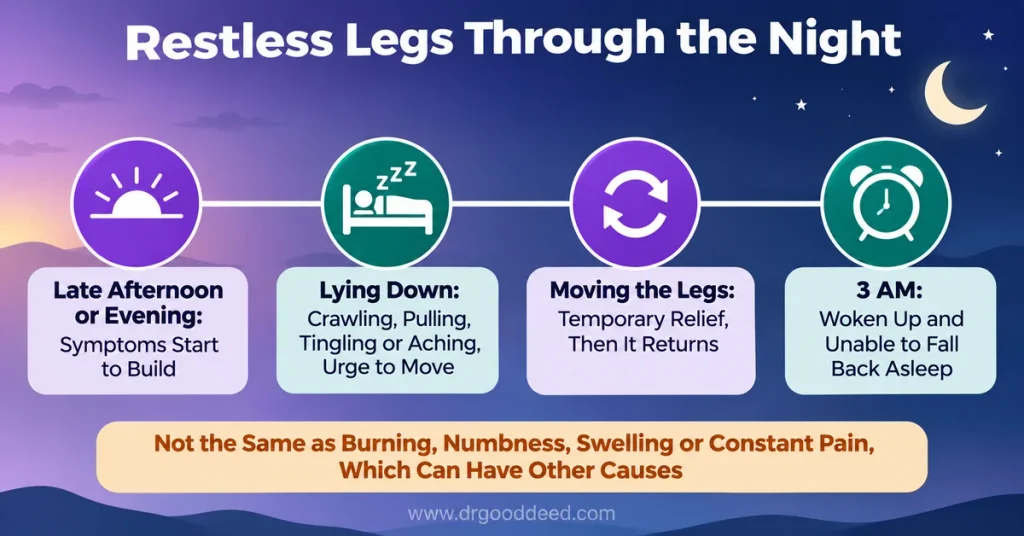
Restless legs are often worse at night because symptoms tend to intensify during periods of rest, particularly in the evening and at bedtime (NINDS, 2026).
Restless legs result in an urge to move one’s legs, together with creeping, pulling, tingling, or aching sensations that occur during rest and are relieved by movement (NINDS, 2026).
One may notice the sensation while resting in a prolonged sitting position, when lying down at night, or while relaxing in the evening. Moving one’s legs temporarily helps relieve the symptom; however, the sensation reappears once one stops moving.
The characteristics are:
- An uncomfortable urge to move one’s legs along with unusual sensations.
- Symptoms that develop or intensify during rest.
- Temporary relief achieved by walking, stretching, and moving legs.
- Symptoms that become more troublesome in the late afternoon or evening.
- Difficulty falling asleep or repeated interruptions to sleep.
Some people also experience periodic limb movements of sleep, which involve repeated, involuntary leg movements during sleep. These movements can occur alongside RLS, but they are not the same condition.
The occurrence of your symptoms is a useful indicator. Restless legs could interfere with your sleep, making you irritated since you cannot get some rest. You might wake up at 3 AM and be unable to fall back asleep due to the same feeling that wakes you up.
Nevertheless, not all leg sensations are related to RLS. The continuous sensation of burning, numbness, swelling, or pain in your legs might indicate something else. Numbness or pins and needles when you sit still can also have other causes, such as when your leg falls asleep easily.
How Doctors Check Your Iron Levels
Doctors check ferritin and transferrin saturation to assess iron stores and availability, ideally using morning blood tests when evaluating clinically significant RLS (AASM, 2025).
A normal blood count does not always rule out low iron stores. Your doctor may recommend specific iron studies to understand whether iron deficiency could be contributing to your symptoms.
Blood Tests That May Help
- Ferritin blood test: Ferritin is a protein that stores iron. Measuring ferritin helps your doctor assess how much iron your body has stored.
- Serum iron: This test measures the amount of iron circulating in your blood.
- Total iron-binding capacity: Often shortened to TIBC, this test helps assess how much capacity your blood has to bind iron.
- Transferrin saturation: This measurement shows the percentage of transferrin, a protein that carries iron in the blood, that is bound to iron. Doctors use it alongside ferritin to assess iron availability.
Iron study tests are recommended by the American Academy of Sleep Medicine (AASM, 2025) for those who have clinical RLS. This recommendation takes into account ferritin and transferrin levels as part of its criteria for determining whether the patient needs to undergo iron therapy.
How to Prepare for Testing
- You should ask your physician or lab for the guidelines on how to prepare yourself for a blood sample. The AASM (2025) recommends avoiding iron supplements and iron-containing food 24 hours before the test.
- Some labs may need a 12-hour fasting period for a ferritin blood test (MedlinePlus, 2025).
- Tell your doctor about recent infections, inflammation, or surgery. These can raise ferritin levels and make the result harder to interpret (MedlinePlus, 2025).
Do not interpret a single result in isolation. Your symptoms, medical history, blood count, ferritin, and transferrin saturation help your doctor decide whether low iron could be contributing to your restless legs.
What Your Ferritin Level Means for RLS
For restless legs, sleep specialists use specific iron thresholds that differ from the ranges commonly used to assess iron deficiency in the general population (AASM, 2025).
A laboratory may label your ferritin result as normal, yet your doctor may still consider it low for RLS treatment decisions. The AASM guidance uses the following thresholds for adults and children.
| Test result | What the AASM (2025) guidance suggests |
| Adult ferritin at or below 75 ng/mL | The doctor may consider iron treatment by mouth or through an IV, depending on the full iron assessment and clinical situation. |
| Adult transferrin saturation below 20% | The doctor may consider iron treatment by mouth or through an IV, based on the overall findings. |
| Adult ferritin above 75 and up to 100 ng/mL | The guidance suggests IV iron rather than oral iron when iron treatment is indicated. |
| Child ferritin below 50 ng/mL | The guideline uses a lower ferritin threshold for considering iron treatment in children. |
These thresholds come from the AASM’s clinical guidance for RLS, not from a universal definition of iron deficiency. The recommendations are consensus-based and should not be treated as instructions to begin treatment on your own.
Some earlier studies have used a cutoff for ferritin of 50 ng/mL in adults with RLS. However, since the AASM’s 2025 guidelines employ different criteria, make sure to ask your doctor to explain your test results based on new recommendations rather than old ones.
Ferritin should be interpreted with caution too. Inflammation, infections, or a recent surgical procedure might affect the results, causing them to appear better than the patient’s iron stores actually are. Other tests such as transferrin saturation might also be considered by the clinician to determine your condition.
How Low Iron Is Treated in Restless Legs
If your iron is low, your doctor may suggest iron by mouth or through an IV, and will recheck your levels because too much iron can be harmful. This approach to iron for restless legs helps address low iron stores while reducing the risk of iron overload.
The proper choice of treatment methods will depend on the results of your tests, symptoms, medical history, and ability to absorb iron.
Treatment may involve:
- Iron by mouth: Your doctor may consider this option when your iron results and medical history support it.
- Iron through an IV: Your clinician may consider this approach in certain situations, including when the guideline’s ferritin thresholds support IV treatment.
- Follow-up blood tests: Repeat iron studies help your doctor assess your response and determine whether further treatment is appropriate.
- Reviewing the cause: Your doctor may investigate heavy menstrual bleeding, gastrointestinal blood loss, poor iron absorption, pregnancy, or another reason for low iron.
Improving iron stores may reduce symptoms when iron deficiency contributes to RLS. However, not everyone responds in the same way, and restless legs can have other causes.
Iron Safety: What You Should Know
Do not start iron supplements on your own or increase your intake because you suspect low ferritin. Too much iron can damage organs and cause serious poisoning (NIH Office of Dietary Supplements, 2023).
People with hereditary hemochromatosis, a condition that causes the body to absorb and store too much iron, should avoid iron supplements unless their specialist specifically advises otherwise (NIH Office of Dietary Supplements, 2023).
Keep iron products out of children’s reach. Iron poisoning can be fatal, particularly in young children. If a child swallows an iron product, contact Poison Control at 1-800-222-1222 for immediate guidance. Seek emergency help if the child has severe symptoms.
Your doctor should guide treatment and follow-up testing. Avoid using iron without appropriate assessment, even if your symptoms seem to match iron deficiency.
Other Steps That Can Ease Restless Legs
Reducing alcohol, nicotine, and caffeine, keeping a regular sleep schedule, and doing moderate exercise may help ease RLS symptoms (NINDS, 2026).
These steps may improve symptom management, but they do not replace an assessment for low iron or another underlying condition.
Consider discussing the following with your healthcare professional:
- Caffeine, nicotine, and alcohol: Review your use of these substances, as they may worsen symptoms for some people.
- Sleep habits: Maintain regular times for sleep and wakefulness, and consult with your physician if you have trouble sleeping.
- Regular physical activity: Physical activity on a regular basis might help to manage symptoms. Consult with your health care professional for an appropriate exercise regimen.
- Other diseases: Sometimes sleep apnea and peripheral neuropathy may occur with restless legs syndrome. The doctor will be able to determine if you need treatment for other medical problems.
- Medications and changing symptoms: List all medications that you use and when your symptoms occur, and your health care provider will determine whether any medications may affect your symptoms.
- Restless legs syndrome often occurs in women and is linked with sleep problems. It will be helpful for you to know about sleep apnea symptoms in women and tell your physician if you have these symptoms.
Keep track of when your symptoms begin, what they feel like, and how they affect your sleep. These details can help your doctor decide what to investigate next.
When to See a Doctor About Restless Legs
See your primary care doctor if restless legs disturb your sleep or interfere with daily life. Call 911 for the emergency warning signs described below.
Low iron levels may occasionally be present with excessive blood loss or other health issues. Emergency services are needed if you have any of the following symptoms:
- Chest pain or trouble breathing.
- Fainting spells or extreme dizziness.
- Vomiting up blood.
- Bleeding in the digestive system causing red or black stools.
These warning signs are included in the adult iron deficiency anemia information from StayWell (2024). Don’t think that these are just symptoms of RLS.
If a single leg becomes swollen, tender, warm, and red, it may indicate a blood clot rather than restless legs and requires immediate medical attention (CDC, 2025). If chest pain or difficulty breathing occurs, call 911, as these may indicate a blood clot in the lungs.
Make an appointment with a healthcare professional if your symptoms interfere with your sleep and do not go away even after you change your schedule. This way, a doctor can determine if there is a need for iron tests or diagnosis of other diseases.
It is advisable to talk about your tiredness, heavy periods, or blood in the digestive tract to the doctor. These details may help in determining the cause of the low iron. Burning or numbness that stays day and night may be nerve damage, so compare it with neuropathy in feet symptoms.
If restless legs at night keep breaking up your sleep, ask your primary care doctor whether restless legs and low ferritin could be the cause.
Frequently Asked Questions
Can Low Iron Cause Restless Legs Even Without Anemia?
Yes. Low iron can cause restless legs or make them worse even without anemia, which is why doctors check ferritin and transferrin saturation, not just your blood count. The AASM (2025) uses higher iron cutoffs for RLS than for the general public.
Who Is More Likely to Have Low Iron and Restless Legs?
It is possible that RLS or low iron might be more common in pregnant women and dialysis patients (NINDS, 2026; StayWell, 2024). Heavy menstruation, gastrointestinal blood loss, and low iron absorption are other causes of low iron levels. These possibilities can be looked into by your physician after reviewing your medical history.
Do Restless Legs Go Away When Iron Improves?
Sometimes, but not always. When low iron contributes to restless legs, treating the deficiency may improve symptoms. However, RLS has no known cure, and symptoms may return even after iron improves, so your doctor may recheck your iron levels regularly (NINDS, 2026; AASM, 2025).
Sources:
- American Academy of Sleep Medicine, RLS and PLMD Guideline at a Glance (2025). link
- National Institute of Neurological Disorders and Stroke, Restless Legs Syndrome. link
- MedlinePlus, Ferritin Blood Test. link
- NIH Office of Dietary Supplements, Iron: Fact Sheet for Consumers. link
- Centers for Disease Control and Prevention, About Venous Thromboembolism (Blood Clots). link
- Cureus, Restless Legs and Iron Deficiency: Unraveling the Hidden Link and Unlocking Relief (Alzaabi et al., 2025). link
Medical Disclaimer: This article is for general information only and is not medical advice. It does not replace a diagnosis, treatment plan, or guidance from a qualified healthcare professional. Always talk to your doctor about your own symptoms and before starting, stopping, or changing any treatment. If you think you may be having a medical emergency, call 911 or go to your nearest emergency room.