
Medically reviewed by Dr Chandril Chugh, Neurology
A phantom smell of smoke is when you smell something burning that no one else can smell and no fire or other source can be found. This experience, called phantosmia, can follow a cold or sinus problem, but it can sometimes be linked to migraine or a neurological condition. First, rule out a real source of smoke before considering medical causes.
Key Takeaways
- A phantom smell of smoke, called phantosmia, often starts in the nose after a cold or sinus problem; rarely, it signals a brain condition.
- Check for real smoke and listen for smoke or carbon monoxide alarms before assuming the smell is phantom.
- Common causes include sinus problems, recent viral infections, migraine, and head injuries.
- Seizures, Parkinson’s disease, and brain tumors are less common neurological causes.
- See a doctor if the smell persists or keeps returning. Call 911 if it occurs with a seizure, confusion, sudden weakness, or trouble speaking.
First, Rule Out Real Smoke
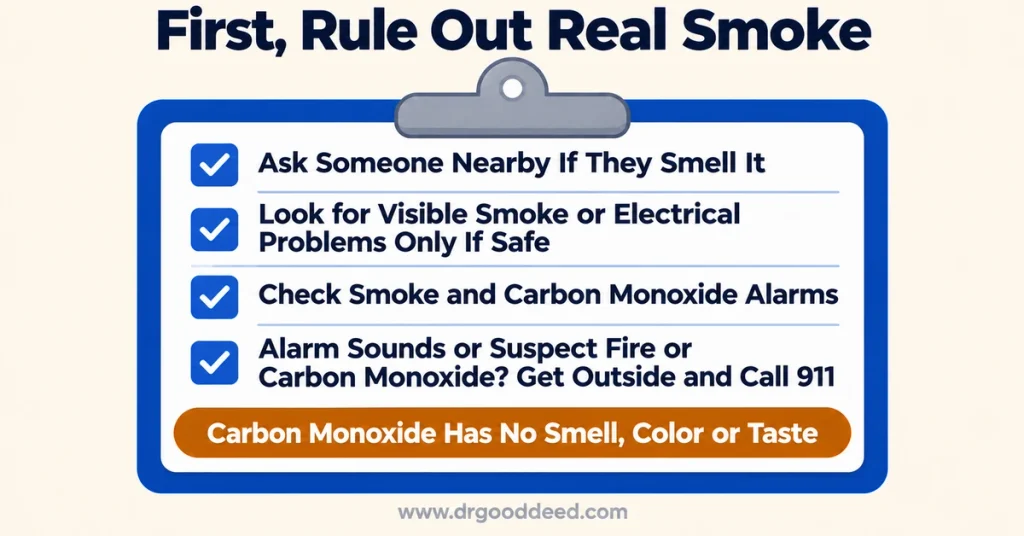
Before considering phantosmia, make sure there is no actual fire, burning electrical equipment, or other source of smoke. Ask someone nearby whether they notice the smell, and check your smoke and carbon monoxide alarms.
Take these safety steps:
- Look for visible smoke or signs of an electrical problem only if it is safe to do so.
- Check your smoke and carbon monoxide alarms.
- If an alarm sounds or you suspect a fire or carbon monoxide exposure, get outside immediately and call 911.
- Do not rely on your sense of smell to detect carbon monoxide. The American College of Emergency Physicians explains that carbon monoxide has no smell, color, or taste.
Once immediate environmental dangers have been ruled out, consider whether the smell could have a medical cause.
What a Phantom Smell of Smoke Means
Phantosmia is the perception of a smell when there is no identifiable odor source. People commonly describe it as smoke, something burning, or a chemical-like odor.
The experience can occur briefly or return repeatedly. In some cases, the smell is noticeable in one nostril; in others, it seems to come from the surrounding environment.
Research provides some context:
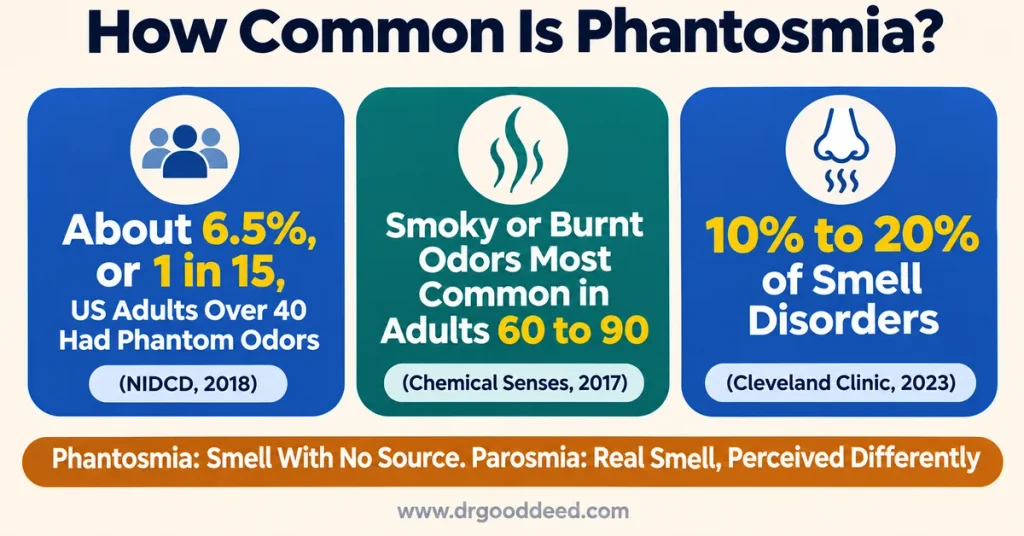
- Prevalence in US adults: The National Institute on Deafness and Other Communication Disorders reported that about 6.5%, or 1 in 15, US adults over 40 experienced phantom odors in a study summarized in 2018.
- Common odor types: In a 2017 Chemical Senses study of 2,569 adults aged 60 to 90, smoky or burnt odors were the most commonly reported phantom smells.
- Share of smell disorders: Cleveland Clinic reported in 2023 that phantosmia accounts for an estimated 10% to 20% of smell disorders. Medical News Today reported a similar range in 2023, although estimates vary by study and population.
Phantosmia differs from parosmia. With phantosmia, you smell something that has no identifiable source. With parosmia, an actual smell is present, but your brain perceives it differently, such as making familiar food smell burnt or unpleasant.
Smelling something burning is not automatically a sign of a serious illness. The cause depends on your medical history, other symptoms, and how long the smell persists.
Common Causes of a Phantom Smell of Smoke
A phantom smell of smoke is often linked to the nose and sinuses, a recent cold or COVID-19, migraine, or a past head injury. These conditions can affect the pathways responsible for detecting and interpreting odors.
Nose and Sinus Problems
Inflammation in the nose or sinuses can interfere with normal smell perception. Conditions such as sinus infections, allergies, and nasal inflammation may change how your brain receives and interprets odor signals.
You may also notice congestion, facial pressure, a blocked nose, or reduced ability to smell other things. If you have recurring sinus symptoms, discuss them with a healthcare professional. The same sinus swelling that explains why allergies cause headaches can also affect your sense of smell.
After a Cold or COVID
A viral infection can affect the cells and pathways involved in smell. After a cold or COVID-19, you may notice a burnt or smoky odor even when nothing is burning.
These changes can occur alongside a reduced sense of smell or other unusual odors. Some people improve as the infection resolves, while others experience longer-lasting changes that need medical assessment.
If the smell persists after other symptoms improve, a healthcare professional can help determine whether the cause is related to post-viral smell changes or another condition.
Migraine
Migraine can sometimes involve unusual sensory symptoms, including phantom smells. In some people, an odor such as smoke may occur before or during a headache, although this is less common than typical migraine symptoms.
Notice whether the smell occurs with headache, nausea, light sensitivity, or other recurring symptoms. Tracking these patterns can help a clinician assess whether migraine may be involved.
Learn more about the types of migraine and how their symptoms can differ.
Head Injury
An injury to the head can damage the olfactory nerves or other structures involved in smell. Phantom odors may begin after a fall, accident, or other head trauma.
Tell your healthcare professional when the injury occurred and whether the smell began immediately or later. New smell changes after a significant head injury deserve medical assessment, particularly when accompanied by headache, confusion, or other neurological symptoms.
Brain Causes Doctors Rule Out
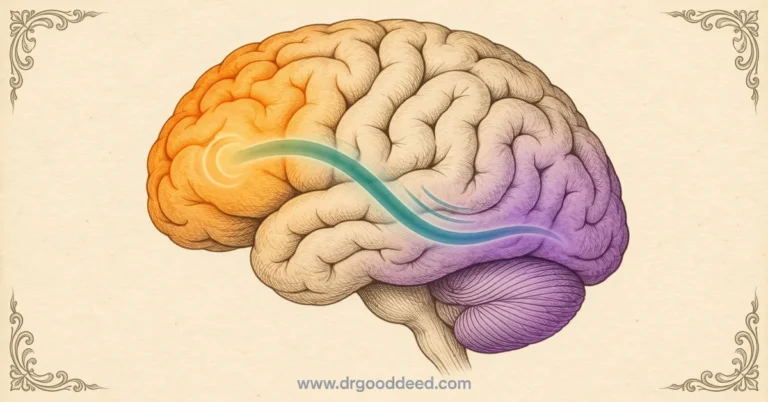
Seizures, Parkinson’s disease, and, rarely, brain tumors can cause phantosmia. Neurological causes are more concerning when the smell occurs alongside other changes in movement, awareness, memory, or speech.
Possible causes include:
- Temporal lobe seizures: A sudden, unusual smell can occur as a sensory warning or aura before or during a focal seizure (ILAE, 2024).
- Parkinson’s disease: Changes in smell can occur in people with this neurological condition, although a phantom smoke smell alone does not establish the diagnosis.
- Brain tumors: A tumor affecting areas involved in smell can occasionally cause phantosmia, but brain tumors are a rare cause, according to MD Anderson Cancer Center in 2026.
- Stroke or other neurological problems: An unusual smell alone is not a typical way to identify a stroke. Sudden weakness, numbness, vision changes, or speech difficulty are more urgent warning signs.
If you experience repeated episodes of a sudden smell along with confusion, unusual movements, or altered awareness, seek medical evaluation. Understanding the difference between stroke and seizure can help explain why associated symptoms matter, but it cannot replace an examination.
Nose or Brain? Clues That Help
The pattern of a phantom smell can offer clues about its cause, but symptoms alone cannot reliably distinguish a nasal problem from a neurological condition.
| Clue | Points toward the nose | Points toward the brain |
| When it started | After a cold, COVID-19 or a sinus infection (Mayo Clinic, 2024) | After a head injury, or with no recent cold or sinus problem to explain it (Mayo Clinic, 2024; MD Anderson, 2026) |
| Other symptoms | A stuffy nose, sinus or allergy symptoms (Cleveland Clinic, 2023) | The smell comes first, then changes in awareness or unusual movements, as in a seizure (ILAE, 2024) |
| How long it lasts | Usually stops once the cold, allergy or infection clears (Cleveland Clinic, 2023) | Can linger much longer, sometimes for years (Cleveland Clinic, 2023) |
| Who checks it | Primary care doctor or ENT specialist; nasal endoscopy (Cleveland Clinic, 2023) | Neurologist; MRI or EEG (Cleveland Clinic, 2023; MD Anderson, 2026) |
These patterns are clues, not diagnostic rules. A nasal condition can sometimes occur without obvious congestion, and a neurological condition may not cause other symptoms at first.
How Doctors Find the Cause
Doctors assess phantosmia by reviewing your symptoms, examining your nose, and deciding whether further tests are necessary. The evaluation depends on how long the smell has lasted, your medical history, and any accompanying symptoms.
The process may include:
- Symptom and medical history: Your doctor may ask when the smell started, how often it occurs, whether it affects one or both nostrils, and whether you recently had an infection or head injury.
- Nose and sinus examination: An ear, nose, and throat (ENT) specialist may examine your nasal passages. Nasal endoscopy may be considered to look for inflammation or structural problems (Cleveland Clinic, 2023).
- Imaging: A CT scan or MRI may be appropriate when the examination suggests a structural or neurological cause.
- Neurological assessment: If seizures or another neurological condition are suspected, a neurologist may recommend an electroencephalogram (EEG) or other testing (MD Anderson Cancer Center, 2026).
Not everyone with phantosmia needs every test. The goal is to identify the likely cause and treat the underlying problem rather than treating the smell in isolation.
When to See a Doctor or Call 911
Arrange a medical appointment if a phantom smell of smoke continues for more than two or three weeks, keeps returning, or affects your daily life, as MD Anderson Cancer Center recommended for persistent phantosmia in its 2026 guidance.
Contact a healthcare professional if:
- The smell persists or repeatedly returns without an obvious cause.
- You develop ongoing changes in your ability to smell.
- The smell begins after a head injury.
- You experience recurring episodes with headaches or other unusual neurological symptoms.
- You have additional symptoms such as confusion, changes in awareness, or unusual movements.
A primary care doctor or ENT specialist can assess common nasal and sinus causes. A neurologist may be appropriate if your symptoms suggest seizures or another neurological problem.
Call 911 if the smell occurs with a seizure, confusion, sudden weakness, numbness, vision changes, or trouble speaking. Do not drive yourself if you have sudden or severe neurological symptoms. Learn what a stroke feels like to recognize possible warning signs, but seek emergency care rather than waiting to see whether they pass.
If a phantom smell of smoke comes with confusion, a seizure, sudden weakness or trouble speaking, call 911.
Frequently Asked Questions
Why Do I Smell Cigarette Smoke When There Is None?
If you smell smoke when there is none, it is often a phantom smell from the nose or sinuses, but check for a real source first. It may also come from a recent viral infection or another change in smell perception. Also check for carbon monoxide danger. If the smell persists or returns, arrange a medical assessment.
Can Heart Problems Cause Phantom Smells?
There is no established direct cause-and-effect relationship between heart disease and phantom smells. A 2017 observational study in Chemical Senses found associations between phantom odors and some health factors, but it could not prove that heart problems cause them. Seek medical advice if the smell is persistent or occurs with other symptoms.
Can Anxiety Cause Phantom Smells?
Anxiety may occur alongside unusual sensory experiences, but a phantom smell should not automatically be attributed to stress. Phantosmia can have nasal, post-viral, or neurological causes. If the smell keeps returning, discuss it with a healthcare professional so that possible physical causes can be assessed.
How Long Does a Phantom Smell Last?
The duration varies. Some phantom smells fade after a cold or sinus problem improves, while others recur or persist for longer periods. If the smell continues for more than two or three weeks (MD Anderson Cancer Center, 2026), or occurs with other concerning symptoms, arrange a medical assessment.
Is Smelling Smoke a Sign of a Stroke?
A phantom smell alone does not usually indicate a stroke. However, sudden weakness, numbness, vision changes, confusion, or difficulty speaking may signal a medical emergency. Call 911 if these symptoms appear suddenly, even if they improve. Do not wait for the smell to disappear before seeking help.
Sources
- National Institute on Deafness and Other Communication Disorders, 1 American in 15 smells odors that are not there (2018). link
- Chemical Senses, Phantom smells: prevalence and correlates in a population-based sample of older adults (2017). link
- Cleveland Clinic, Phantosmia (2023). link
- Mayo Clinic, Phantosmia: What causes olfactory hallucinations? (2024). link
- Medical News Today, Phantosmia: what causes phantom smells? (2023). link
- International League Against Epilepsy, Focal sensory seizure (2024). link
- MD Anderson Cancer Center, Phantosmia: 8 things to know about olfactory hallucinations (2026). link
- American College of Emergency Physicians, Carbon monoxide: the hidden killer. link
- Centers for Disease Control and Prevention, Signs and symptoms of stroke (2026). link
Medical Disclaimer: This article is for general information only and is not medical advice. It does not replace a diagnosis, treatment plan, or guidance from a qualified healthcare professional. Always talk to your doctor about your own symptoms and before starting, stopping, or changing any treatment. If you think you may be having a medical emergency, call 911 or go to your nearest emergency room.