
Delayed concussion symptoms are signs of a brain injury that show up hours or days after you hit your head, rather than right away. You may not feel any issues but then begin to experience a headache, dizziness, brain fog, or changes to your sleep.
These late symptoms can be confusing when you felt fine at first. This article explains how to recognize delayed concussion symptoms, when to call 911 or go to the ER, and what to do in the first few days.
Key Takeaways
- Delayed concussion symptoms can appear hours or days after a head injury; most ease within weeks, but worsening symptoms need emergency care.
- Common late symptoms: Headache, dizziness, trouble concentrating, irritability and sleep changes can start hours or days later (Mayo Clinic, 2026).
- Danger signs: Call 911 or go to the ER for repeated vomiting, seizures, weakness or trouble waking up (CDC, 2025).
- Slow bleeds: Older adults and people on blood thinners can develop a slow brain bleed weeks after a minor bump (MedlinePlus, 2026).
- See a doctor: Get checked within 1 to 2 days of any head injury, even if symptoms are mild (Mayo Clinic, 2026).
Can Concussion Symptoms Show Up Days Later?
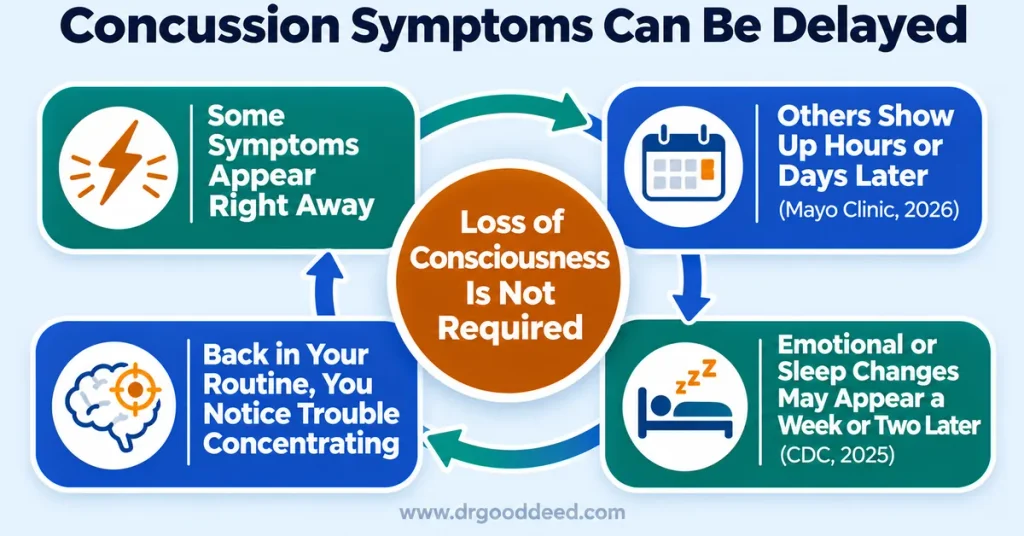
Yes. Some concussion symptoms appear right away and others show up hours or days after you hit your head (Mayo Clinic, 2026). Emotional changes and sleep trouble may not appear until a week or two later (CDC, 2025).
A concussion is a mild traumatic brain injury (mild TBI) that can occur after falling, a sports injury, a car accident, or hitting your head. You don’t have to lose consciousness to have a concussion.
Sometimes symptoms may not be noticed until you get back into your daily routine. If you are struggling to concentrate at work, sensitive to light, or experiencing new headaches, this could be a sign of concussion.
Delayed Concussion Symptoms to Watch For
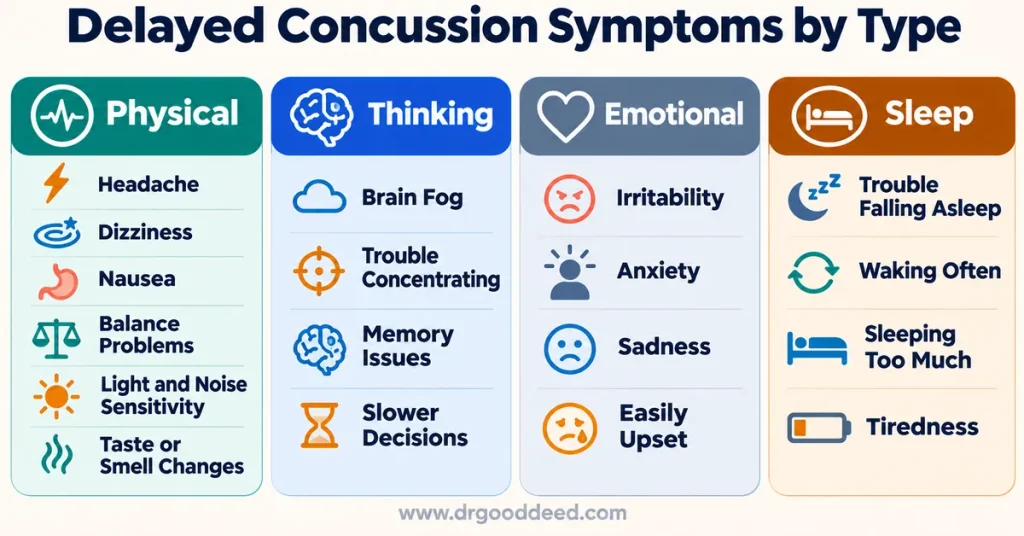
Delayed concussion symptoms often affect thinking, mood and sleep, such as trouble concentrating, irritability, light sensitivity and poor sleep. Mayo Clinic (2026) lists symptoms that can start hours or days after a head injury, grouped here by type.
Symptoms may include:
- Physical symptoms: Headache after hitting your head, dizziness, nausea, balance problems, sensitivity to light and noise, and changes in taste or smell.
- Cognitive symptoms: Brain fog, difficulty concentrating, memory issues, feeling like you’re going slower or struggling to make decisions.
- Emotional symptoms: Irritability, anxiety, sadness, unusual emotions, or feeling more easily upset.
- Sleep symptoms: Struggling to fall asleep, waking frequently, sleeping too much, or feeling tired.
Post-traumatic headache is one of several types of headaches that can start after a blow to the head. These symptoms can also have other causes, so see your doctor to find out whether they are linked to your concussion or another injury.
How Long After Hitting Your Head Can Symptoms Start?
Concussion symptoms can start within minutes or take hours or days to appear, and emotional or sleep changes may start a week or two later (CDC, 2025). A slow brain bleed can cause symptoms weeks after the injury (MedlinePlus, 2026).
| Time after injury | What may occur |
| Minutes to hours after | Headache, dizziness, nausea or confusion can start soon after the injury (Mayo Clinic, 2026). |
| Hours to days after | Sensitivity to light and noise, memory problems or brain fog can appear later (Mayo Clinic, 2026). |
| A week or two after | Emotional changes or sleep trouble may appear (CDC, 2025). |
A chronic subdural hematoma, a slow bleed on the surface of the brain, can cause symptoms weeks after a minor injury. It is more common in older adults and people taking blood thinners (MedlinePlus, 2026).
Most people feel better within a couple of weeks (CDC, 2025), but sources differ on when to get checked again. AANS (2024) advises medical care if symptoms last beyond 10 to 14 days, while MedlinePlus (2026) says to talk to your provider if symptoms are not improving after 2 to 3 weeks.
Danger Signs That Need 911
Call 911 or go to the ER right away if you have any of these danger signs after hitting your head, even if the injury was days ago (CDC, 2025). They can be signs of a serious brain injury.
- Worsening headaches.
- Repeated vomiting or nausea.
- Weakness, numbness or lack of coordination.
- Seizures or convulsions.
- Slurred speech.
- Unequal pupils.
- Confusion, unusual restlessness or abnormal behavior.
- Excessive sleepiness or inability to wake.
- Loss of consciousness for more than 30 seconds, fluid from the nose or ears, or ringing in the ears that will not stop (Mayo Clinic, 2026).
Do not wait for a danger sign to pass, and do not drive yourself to the ER. Call 911.
Slow Brain Bleeds in Older Adults
In older adults and people on blood thinners, a slow bleed can cause confusion or weakness weeks later, even after a minor bump (MedlinePlus, 2026).
A chronic subdural hematoma is a collection of blood on the surface of the brain, under its outer covering. It is also more likely with long-term alcohol use, and the injury may be so minor that you do not remember it (MedlinePlus, 2026). Look out for:
- New or worsening confusion.
- Memory or behavior changes.
- Weakness, particularly on one side.
- Persistent worsening headaches.
- Trouble with walking or balance.
If an older adult has new confusion or weakness after hitting their head, contact their healthcare provider right away. If they have a seizure or cannot stay alert, call 911 (MedlinePlus, 2026). A headache when lying down that keeps getting worse after a fall also needs urgent imaging.
What to Do in the First Days After a Head Injury
Rest lightly, have an adult with you for the first 12 to 24 hours, and avoid alcohol and risky activity (MedlinePlus, 2026). Healthline (2025) suggests watching closely for changes for at least 72 hours.
- Have someone with you: Ask a trusted adult to stay with you for the first 12 to 24 hours after your injury (MedlinePlus, 2026). This can help you notice any changes.
- Rest: It is okay to sleep after hitting your head. Ask your healthcare provider whether someone should wake you to check on you, and how often.
- Avoid alcohol: Do not drink alcohol while recovering, as it can make changes harder to notice.
- Avoid risky activities: Avoid driving, playing sports or doing heavy work until your healthcare provider says it is safe.
- Ask before taking pain relievers: Check with your healthcare provider before taking any pain reliever.
- Return to activity slowly: Follow your provider’s advice on getting back to your usual activities, and do not return to sports the same day. A second hit before you recover can cause second impact syndrome, which is rare but can be fatal (Mayo Clinic, 2026).
When to See a Doctor After Hitting Your Head
See a doctor within 1 to 2 days of any head injury, even if your symptoms are mild (Mayo Clinic, 2026), and again if symptoms are not improving after 2 to 3 weeks (MedlinePlus, 2026). Your doctor can check your symptoms and decide whether you need further tests, such as a CT scan.
Contact your doctor if:
- New symptoms appear hours or days after the injury.
- Headache, dizziness, or brain fog not improving.
- Changes to memory, emotions, or sleep.
- Symptoms affect work or school.
- Symptoms are not improving after 2 to 3 weeks (MedlinePlus, 2026).
Some people have symptoms that last longer. Symptoms lasting more than three months are called persistent post-concussion symptoms, also known as post-concussion syndrome (Mayo Clinic, 2026). If a headache lingers for weeks, your doctor will look at other causes of headaches too.
If delayed concussion symptoms get worse instead of better, or any danger sign appears, call 911 or go to the ER.
Frequently Asked Questions
Does It Take a Few Days After Hitting Your Head to Feel Normal?
Often yes. Mild symptoms days after hitting your head are common and usually ease within a couple of weeks, but they should get better, not worse (CDC, 2025). See a doctor if new symptoms appear or your symptoms stop improving, and call 911 or go to the ER for any danger sign.
Can Concussion Symptoms Get Worse After 5 Days?
They should slowly improve, though some symptoms can become more noticeable in the days after a head injury (Mayo Clinic, 2026). If your symptoms are getting worse, see a doctor the same day. Call 911 or go to the ER for any danger sign, such as repeated vomiting or a worsening headache (CDC, 2025).
Is It Safe to Sleep After Hitting Your Head?
Yes, sleep is allowed after a head injury. Have an adult stay with you for the first 12 to 24 hours, and ask your provider whether someone should wake you to check on you, and how often (MedlinePlus, 2026). If you are hard to wake or cannot stay awake, call 911.
What Are Delayed Concussion Signs in a Child?
Delayed concussion symptoms in a child can include headaches, dizziness, irritability, sleep changes or trouble concentrating (Mayo Clinic, 2026). In babies and young children, watch for crying that will not stop or refusing to nurse or eat. Call 911 for these signs or any adult danger sign (CDC, 2025).
Can You Have a Concussion Without Passing Out?
Yes. Loss of consciousness does not always happen with a concussion (Mayo Clinic, 2026). Symptoms can include headache, dizziness, confusion, memory problems or sensitivity to light and noise. If you hit your head and notice new symptoms, see a doctor, and call 911 or go to the ER for any danger sign.
Sources
- CDC, Symptoms of Mild TBI and Concussion (2025). link
- Mayo Clinic, Concussion: Symptoms and Causes (2026). link
- MedlinePlus, Chronic Subdural Hematoma (2026). link
- MedlinePlus, Concussion in Adults: Discharge (2026). link
- AANS, Concussion (2024). link
- Healthline, How Long After Hitting Your Head Until Concussion Symptoms Start? (2025). link
Medically reviewed by Dr Chandril Chugh, Neurology.
Medical Disclaimer: This article is for general information only and is not medical advice. It does not replace a diagnosis, treatment plan, or guidance from a qualified healthcare professional. Always talk to your doctor about your own symptoms and before starting, stopping, or changing any treatment. If you think you may be having a medical emergency, call 911 or go to your nearest emergency room.